Irreechaa 2026: A Sacred Call to Gratitude and Unity
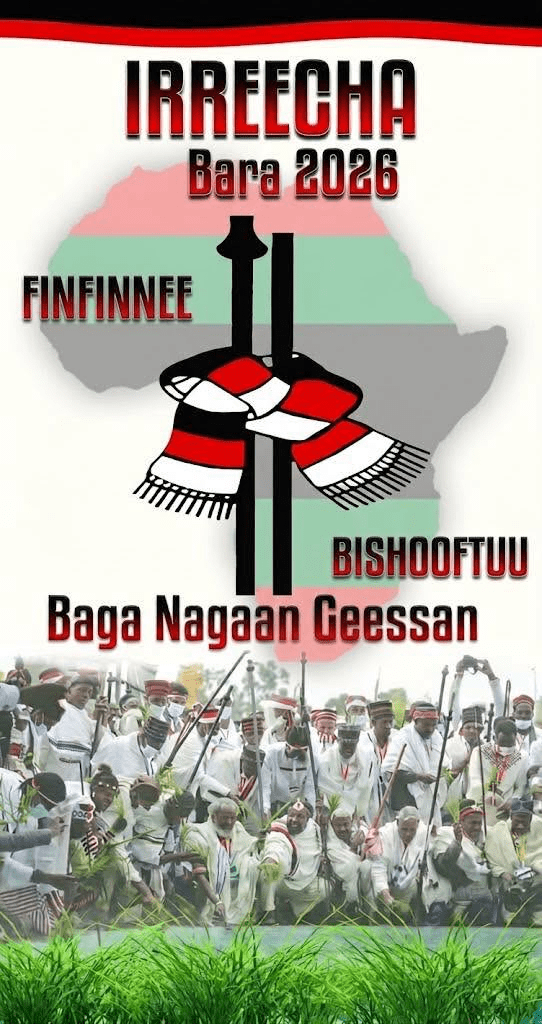
Millions Prepare to Celebrate Africa’s Largest Thanksgiving Festival in Finfinne and Bishoftu
By Maatii Sabaa
In the heart of Oromia, a profound spiritual awakening is stirring. Millions of people are preparing to gather at sacred lakes and rivers to lift their hands in gratitude, to sing songs passed down through millennia, and to affirm a cultural identity that has survived centuries of challenge. Irreechaa 2026—the Oromo Thanksgiving—is approaching, and the call to commemorate this sacred occasion resonates across the globe.
As Girma Tokuma has expressed, there is a deep sense of obligation—a calling from Waaqa (God)—to join this celebration in Finfinne and Bishoftu from October 3 to October 4, 2026 . This is not merely a personal invitation; it is an invitation to all who share a sense of responsibility to honour the Creator, to celebrate life, and to stand in solidarity with one of the world’s most ancient thanksgiving traditions.
What Is Irreechaa?
Irreechaa, also known as Irreessa or Dhibaayyuu, is the annual thanksgiving festival of the Oromo people . Rooted in over 6,000 years of Cushitic civilization, it marks the end of the dark and rainy winter season and the joyous arrival of Birraa (spring) . It is a time when the Oromo people gather at sacred water bodies—lakes, rivers, and springs—to thank Waaqa for the blessings, mercies, and bountiful harvests received over the previous twelve months .
The festival is intimately connected to the Gadaa system, the traditional Oromo governance structure recognised by UNESCO as an Intangible Cultural Heritage of Humanity . As the elders teach, Irreechaa is simply “giving thanks to the one God”—the pinnacle of Oromo religious and cultural expression . It is a day of peace, reconciliation, love, and unity .
The Two Sacred Sites
This year’s celebration will unfold over two days across two of the Oromo people’s most sacred locations :
October 3: Hora Finfinne
The celebration begins at Hora Finfinne, in the heart of the capital city . This location carries profound historical weight. For decades, under oppressive regimes, public celebrations of Irreechaa were banned, and the Oromo people were denied the right to give thanks at their own sacred sites . Celebrating Irreechaa here is not just a cultural act; it is a powerful reclamation of space, identity, and dignity.
October 4: Hora Arsadi in Bishoftu
The grand celebration moves to Hora Arsadi in the city of Bishoftu, approximately 45 kilometres south of Finfinne . This is the site of the main event—a gathering so vast that it is recognised as one of the largest annual human gatherings on the African continent . Millions of participants, dressed in a vibrant sea of traditional white and green, move with purpose and joy towards the water .
The Rituals of Renewal
The Irreechaa ceremony is rich with symbolism :
- Fresh grass and flowers: Participants carry freshly cut green grass and flowers—symbols of fertility, life, and renewal .
- Water immersion: They dip these offerings in the sacred water and sprinkle themselves, a symbolic act of cleansing, purification, and the washing away of hardship .
- Traditional songs: The air echoes with sirba (traditional songs), their melodies passed down from elders to the youth, ensuring the continuity of a living heritage .
- Blessings: Kormoomsaa (youth) move through the crowd, sprinkling people with fresh water as a gesture of cleansing and blessing .
More Than a Festival: A Symbol of Unity and Resilience
Irreechaa is often described as the “most celebrated cultural festival in Africa” . Its core principles are peace, unity, love, and reconciliation. As the festival teaches, holding onto resentment or grievance is not permitted at Irreechaa . A person cannot attend unless they have resolved their disputes with others—a profound reminder that one cannot give thanks while holding a grudge.
The Prime Minister of Ethiopia, Abiy Ahmed, has extended well wishes to the nation on the occasion of Irreechaa, highlighting the Oromo philosophy of water as the source of purity and the foundation of creation and life . He has also noted the added significance of this year’s celebration, as it follows Ethiopia’s inauguration of the Great Ethiopian Renaissance Dam (GERD) .
A Call to All Who Share This Responsibility
As Girma Tokuma has declared, there is a deep sense of obligation to commemorate Irreechaa alongside millions in Oromia. This invitation extends to all who feel the call—to join in giving thanks, to witness the beauty of Oromo culture, and to stand in solidarity with a people who have preserved their traditions against all odds.
Irreechaa 2026 is not just a date on the calendar. It is a celebration of life, a declaration of identity, and a prayer for peace. It is a testament to the resilience of a people who have carried their culture across millennia, and it is an invitation to the world to witness the beauty of gratitude in its most vibrant form.

Posted on August 25, 2026, in Aadaa, Afaan, Events, Finfinne, freedom, gadaa, health, Information, Kindness, Language, Media, News, Oromia, Press Release, Promotion. Bookmark the permalink. Leave a comment.





 Advocacy for Oromia
Leave a comment
Comments 0