Daily Archives: August 30, 2026

The Borana Gadaa System Loses a Distinguished Leader: Former Abbaa Gadaa Liban Jaldesa Passes
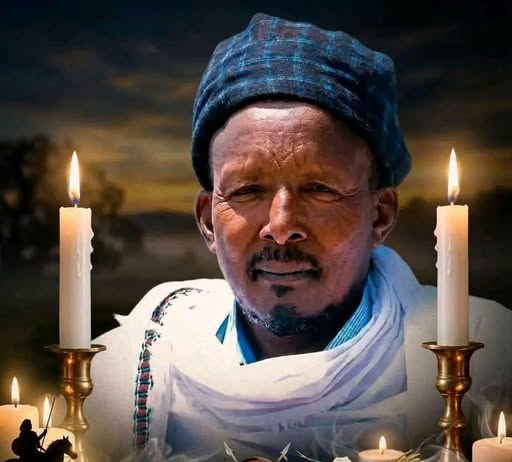
A Legacy of Cultural Stewardship and Resilience Leaves a Lasting Mark
By Daandii Ragabaa
(ONA, Finfinne, 29 August 2026) – The Oromo nation and the Borana community are mourning the loss of a respected cultural leader. Liban Jaldesa, who served as the 69th Abbaa Gadaa of the Borana from 2002 to 2009, has passed away, leaving behind a profound legacy of service to his community.
His tenure marked a significant period in the history of the Borana Oromo, where he played a pivotal role in strengthening the Gadaa institution and promoting the laws, culture, and traditions of his people . The Gadaa system, which he represented, is a sophisticated and indigenous framework of governance recognized by UNESCO as an intangible cultural heritage of humanity. It is a system that embeds a deeply egalitarian social fabric, where democratic power is transferred from one class to another every eight years .
The Weight of the Bullukoo: Leadership in a Time of Challenge
The role of an Abbaa Gadaa is one of profound responsibility. An Abbaa Gadaa is not merely a political figure but the custodian of the community’s soul, tradition, and future. The Gadaa system regulates social, political, economic, and religious life, and the leader is expected to be a competent orator, deeply skilled in the laws and customs of his people .
During his tenure, Liban Jaldesa was a steady hand during a period of immense challenge. The Borana, a predominantly pastoralist community inhabiting southern Ethiopia and northern Kenya, faced acute pressures including changing weather patterns and rising resource scarcity .
As an elder and oral historian once noted about the Gadaa leadership: “The system strictly interrogates a candidate’s lineage and ancestral record. It examines whether the past Gadaa terms of your family brought prosperity, timely rains, abundance, sovereignty, and peace.” Liban Jaldesa carried this weight of expectation, navigating his community through the complexities of a changing world while striving to uphold the sacred principles of Gadaa.
A Living Democracy: The Gadaa Tradition
The Gadaa system he served is a testament to the Oromo people’s ancient commitment to democratic governance. It organizes society into age grades, with each grade moving through a life cycle—from Dabballee (childhood) to Gammee (youth), and ultimately to leadership roles like Kuusa and Gadaa .
To select the Abbaa Gadaa, an extensive evaluation and vetting process called the “Baannattoo” system is conducted, functioning as a traditional electoral campaign for public servants . The son of a previous Abbaa Gadaa would convene his peers for the Wal-argii (Grand Gathering) to build peer acquaintance and deliberate on traditional matters before a new leader could be invested .
As a leader during such a time, Liban Jaldesa’s role was central to this process of cultural transmission and societal continuity.
A Nation Mourns, a Legacy Endures
The passing of Liban Jaldesa is a profound loss. His leadership is described as an enduring part of Borana history and cultural heritage . His wisdom and service are expected to continue inspiring future generations.
His death marks the end of an era, but the principles of the Gadaa system—democracy, community, and resilience—that he represented continue to guide the struggle and shape the future of the Oromo people.
The Oromian News Agency joins the Borana Oromo community in expressing our deepest condolences. We honour his memory and the immense contribution he made to preserving the cultural identity of his people.
Waaqni Ekeraa isaa nagaan haa qubachiisu! May God rest his soul in eternal peace.

A Cry for Justice: The Unfolding Crisis in Oromia
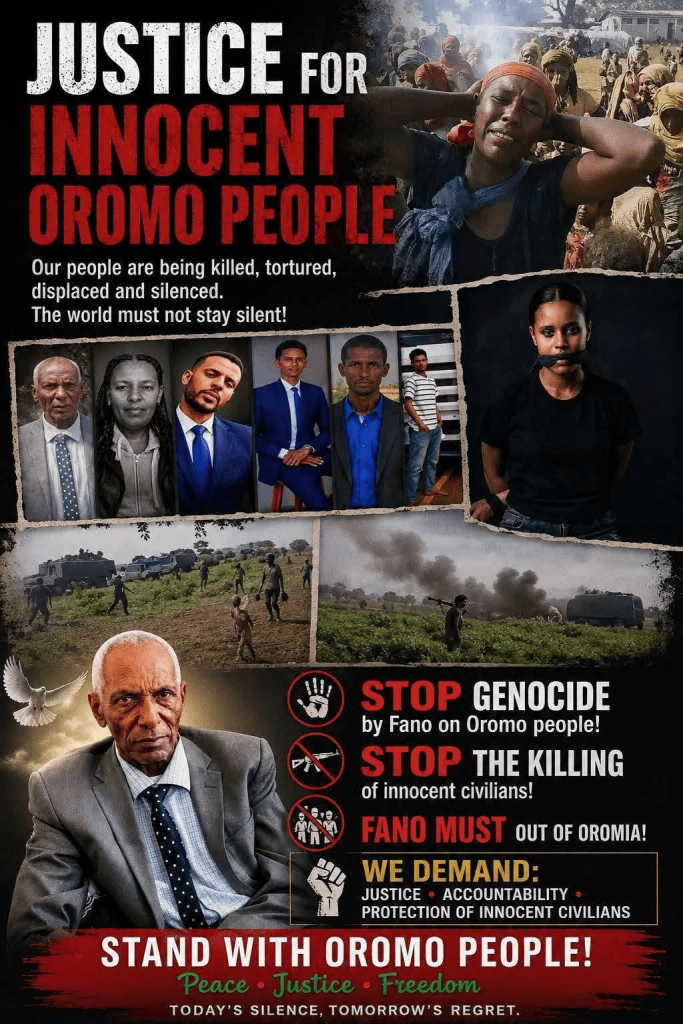
As violence escalates in Ethiopia’s most populous region, a growing chorus of voices is demanding accountability, protection, and peace for the Oromo people.
The plea is urgent and uncompromising: “Stop the killing of Oromo civilians! Stop violence against the Oromo people! Fano must leave Oromia!” These calls reflect a deep-seated crisis that has gripped the Oromia region, where civilians find themselves caught in the crossfire of multiple armed conflicts.
The Human Toll of Conflict
Recent reports paint a harrowing picture of the violence unfolding across Oromia. The Ethiopian Human Rights Commission (EHRC) has documented atrocities including killings, bodily injuries, abductions, displacement, and destruction of property in the Arsi Zone of Oromia . The violence is not isolated—it reflects a broader pattern of human rights abuses across multiple regions, including Amhara and Tigray .
In one particularly devastating incident, armed men killed more than 20 civilians in Oromia. Local civil servants reported that Fano militants attacked civilians “with swords and guns” in the Nono district, approximately 110 kilometers southwest of Addis Ababa, resulting in 25 deaths including women and children, with four more later dying in hospital . A regional security official confirmed that Fano militants had been active in the region for four years, “taking advantage of opportunist moments to launch attacks against civilians and loot property”.
The Humanitarian Crisis
The violence has created a severe humanitarian crisis. The United Nations reports that 3.2 million children are out of school due to the conflict . Hospitals and clinics have been attacked—in 2023, the International Committee of the Red Cross reported that “almost all” of 42 health posts in Oromia’s Beji area had been looted or destroyed . Aid organizations have struggled to distribute supplies, leading to severe malnutrition .
Civilians describe a terrifying reality. One woman from Oromia’s Shewa region told of her family facing constant harassment and extortion from armed groups, with her uncle detained until a 100,000 Ethiopian birr ransom was paid . A coffee farmer from Wollega has been unable to return home for three years due to the security situation, with his harvest stolen by armed fighters .
A Call for Justice and Peace
The demands for justice and protection are clear. As one civil servant noted, the situation “has worsened in recent years” . The Red Cross has warned that the current clashes have “devastating consequences” for civilians, particularly in remote areas, noting that “Oromia doesn’t make the headlines, yet civilians continue to be deeply affected by violence” .
The call for Fano to leave Oromia reflects the reality that multiple armed groups are active in the region, each contributing to the suffering of civilians. For the Oromo people, the demand is simple but profound: protection, justice, and accountability for those who have committed atrocities.
Without decisive action, the cycle of impunity and violence will continue to erode Ethiopia’s stability and legitimacy . The international community, regional bodies, and Ethiopian authorities face a critical choice: allow the violence to continue, or take meaningful steps to protect civilians and bring perpetrators to justice.

OLF Leadership Engages in High-Stakes Consultations Amid Oromo Unity Push
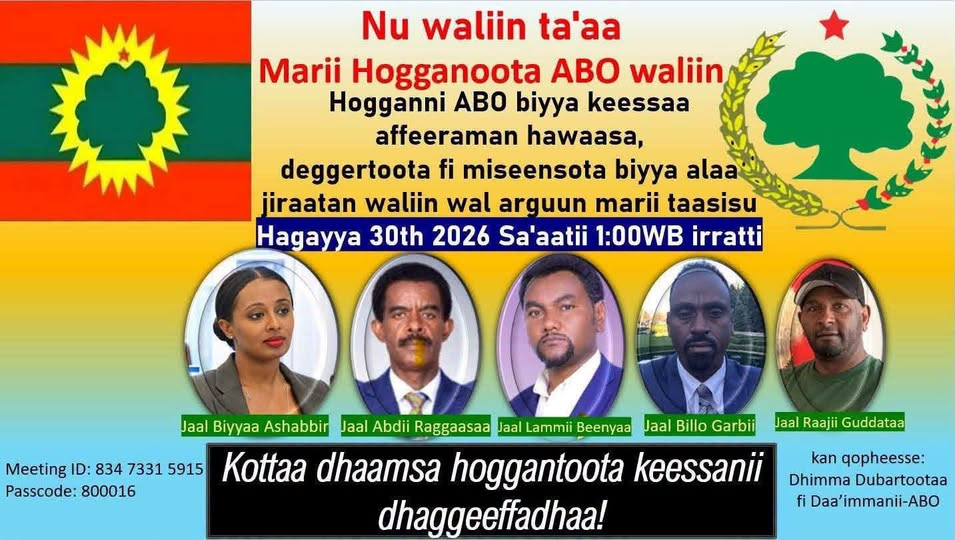
(Finfinne, Oromia)– As Ethiopia’s political landscape grows increasingly volatile, the Oromo Liberation Front (OLF) has convened a series of high-level meetings with its leadership cadres, grassroots members, and traditional institutions—a strategic push to consolidate Oromo unity in the face of mounting security threats and political uncertainty.
A Call for Unity and Vigilance
The most recent consultations, held at the party’s headquarters in Gullalle, brought together Qondaaltota (junior leaders), Dabballoota (cadres), and the general membership for extensive deliberations. Senior OLF leader Jaal Abdii Raggaasaa—who also serves as Member Secretary-General—addressed members with a stark message on the nature of the struggle: that commitment, not temporary strength, determines victory .
“Some individuals enter the organization (Irbuu) but then exploit it—seeking personal benefit rather than serving the people’s cause. When such people exist, it is they themselves who suffer the consequences, not ABO and not others.”
— Jaal Abdii Raggaasaa, OLF Senior Leader
Abdii emphasized that the work of building the Oromo nation extends beyond Ethiopia’s borders—stretching into the diaspora wherever Oromos reside . He stressed that grassroots organizing, beginning “from the village level,” remains essential to lasting political change .
Leadership’s Resolve: “We Must Speak as ABO”
Reflecting on the inevitable challenges facing liberation movements, Abdii offered a sobering reflection:
“In the struggle ABO is waging, even if we face extinction—if we are reduced to just one person—we must speak as ABO. We must not hide ourselves. We may face extinction, but we must not retreat into silence.”
Jaal Yaasoo Kabbabaa Hordofa, another OLF official, reinforced this determination, declaring that “OLF is the center of Oromo peace.” He noted that if OLF participates in elections this year, it will mark the first and largest chapter in Oromo electoral history—an opportunity that must be seized, not as a preference but as an obligation for all members .
Political Prisoners and the Demand for Justice
The OLF has consistently demanded the immediate release of political prisoners who continue to suffer in detention without due process, calling upon both Abbaa Gadaas and religious authorities to actively work toward restoring security in Oromia .
Following the announcement of the 7th General Election results—which saw the ruling Prosperity Party secure a parliamentary majority and OLF fail to win any seats despite fielding 163 candidates—the party issued a pointed critique .
“The OLF once again firmly reiterates that the situation in Oromia and across Ethiopia cannot be resolved merely by declaring an election victory; rather, to prevent worse outcomes, an inclusive, genuine, and transparent dialogue must be conducted without wasting further time.”
The front noted that while it had filed formal grievances with the National Election Board regarding electoral infractions, it does not believe the board investigated these appeals “with the necessary depth, fairness, and justice” .
A Call for Oromo Political Unity
The OLF’s leadership has also renewed its call for all Oromo political organizations to work together to shorten the path to liberation, stating that this is “the most important time” for coordinated action . The executive committee has emphasized that while some previously allied groups have disrupted cooperation due to shifting political dynamics, they must realize that their moves should serve the broader Oromo interest .
The OLF also reiterated its support for the People’s Alliance for Freedom and Democracy (PAFD) and the transitional roadmap presented at the February 2018 London conference. The party calls on all stakeholders—including political elites, academics, and the international community—to contribute to an all-inclusive transitional process that offers a long-term political solution .
The Broader Context: Conflict and Fragility
The leadership’s renewed unity push comes as violence escalates in western Oromia. ACLED data shows that Fano militias—linked to the Amhara Fano National Movement—have increased their activities in Oromia’s Horo Guduru, Kellem, East, and West Wollega zones by 80% since January 2026 . This follows the establishment of the Wollega Fano Bizamo Command in December 2024, which has since fallen under the broader Tsimdo movement—a coalition reportedly aligned with the Tigray People’s Liberation Front (TPLF) and Eritrea, aiming to remove the Ethiopian government.
Amnesty International released a report in August 2026 titled “Because I am Oromo,” alleging that Ethiopia’s government has “ruthlessly targeted” its largest ethnic group—subjecting thousands of Oromos to unlawful killings, torture, and enforced disappearance . The government has denied the allegations.
Looking Forward
The OLF’s consultations reflect a movement at a crossroads—seeking to navigate electoral rejection, internal cohesion, and external threats while maintaining its decades-long commitment to self-determination. As one participant at the February meeting put it: “An awakened nation is built, and the built is united.”
Whether that unity can withstand the mounting pressures—from state security forces, inter-ethnic violence, and international geopolitical maneuvering—remains the central question facing the Oromo struggle today.






