Category Archives: mental health

Candlelight vigil for Nepal flood victims
VICTORIA UNITES FOR NEPAL
Candlelight vigil for Nepal flood victims
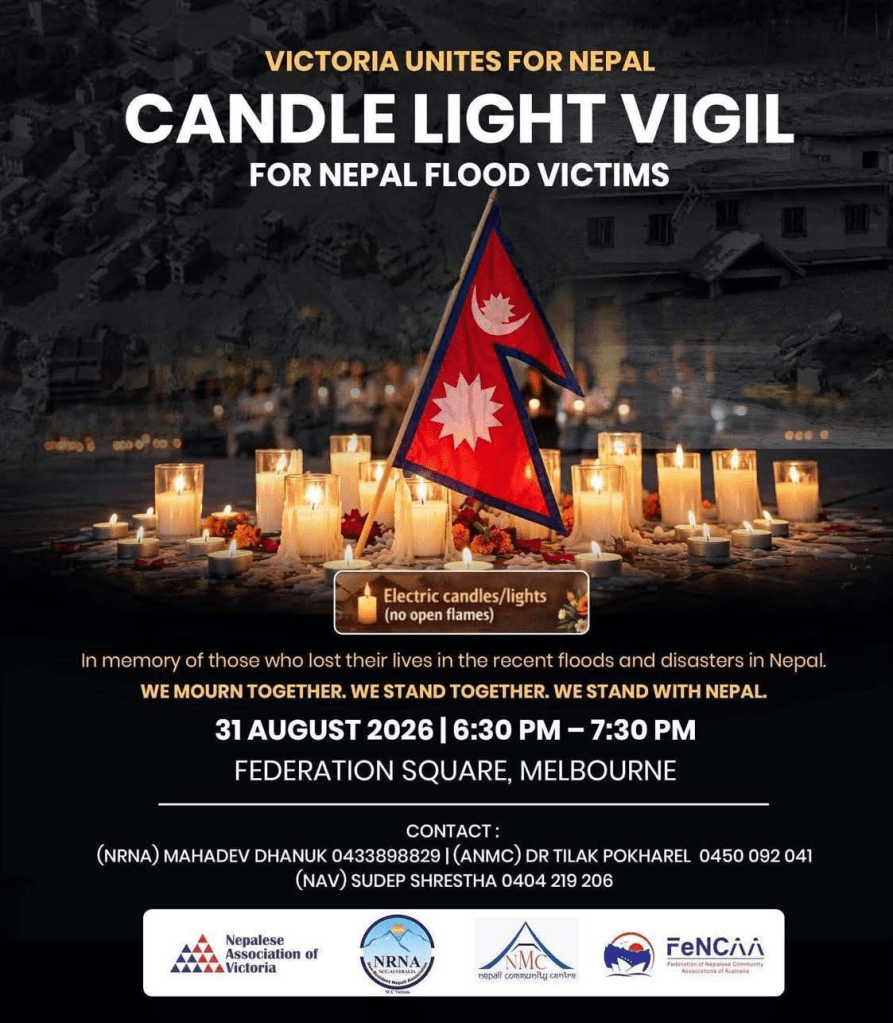
(ONA, 31 August 2026)-Melbourne will tonight open its heart to the people of Nepal as the city hosts a candlelight vigil at Federation Square, honouring the hundreds of lives lost in the catastrophic floods that have devastated the Himalayan nation.
The vigil, organised with the support of the Victorian Multicultural Commission, will see Victorians of all backgrounds gather to remember those who have perished, pray for the missing, and stand in solidarity with the grieving Nepali community.
“WE MOURN TOGETHER. WE STAND TOGETHER.”
The recent flooding in Nepal and surrounding regions has unleashed an unimaginable tragedy. Flash floods and landslides tore through the Bhotekoshi and Trishuli river basins, sweeping away entire communities along the Nepal-China border . The death toll continues to mount—now exceeding 547 confirmed fatalities—with more than 1,473 injured and over 900 still unaccounted for .
For Victoria’s growing Nepali community, this is not a distant disaster. It is personal. It is family. It is home.
A COMMUNITY IN MOURNING
The Victorian Multicultural Commission, standing in solidarity with Victoria’s Nepali community and the people of Nepal, has encouraged all Victorians to join tonight’s vigil.
“Let’s work together, let’s pray together, and let’s go through this pain together,” said Dr Tilak Pokhrel, president of the Australian Nepalese Multicultural Centre, in a heartfelt appeal to the community .
For many in the diaspora, the anguish is compounded by the agonising wait for news. Community members are checking the news every hour, desperately hoping for word from missing relatives and friends . The Australian government has confirmed that 39 Australians remain unaccounted for, including trekkers and tourists caught in remote valleys .
THE TRAGEDY UNFOLDS
The scale of the disaster is staggering. Many of the missing were on a pilgrimage to Mount Kailash in Tibet—a sacred site for Hindus, Buddhists, and followers of other faiths—when the flash floods struck without warning . Survivors have described walls of black water, 60 to 70 feet high, rushing toward them like a tsunami .
One Indian-American couple who narrowly escaped described watching the water approach their tour bus—”It was not water, it looked like a forest fire,” they recalled. They jumped from the bus moments before it was swept away, spending the night in a goat shed before being rescued by helicopter the next day .
Rescue operations continue, with emergency services working tirelessly in extremely difficult conditions. The Caritas Nepal relief organisation has reported that many main bridges and roads have been destroyed, making access to survivors extraordinarily challenging . Even relief teams have been ordered to retreat to safety as the threat of further flash floods persists .
GLOBAL OUTPOURING OF SOLIDARITY
The tragedy has touched hearts around the world. From candlelight vigils in Boston to prayer gatherings in India’s border towns, communities everywhere are standing with Nepal .
Here in Melbourne, tonight’s vigil at Federation Square will be a powerful testament to that global solidarity. Members of the public are invited to gather from 6:30pm to 7:30pm, bringing candles and open hearts to remember those lost and pray for those affected .
“TOGETHER WE ARE STRONGER”
The emotional toll on the diaspora is immeasurable. “We can’t go through this alone,” said Aloonee Adhikari, a Nepali community member in the United States. “When we get to get together like this, it gives us a sense of empowerment that at least we can sit there and pray for them, even if we’re not there” .
Her words resonate across oceans. Tonight, they will echo in Melbourne.
As the Victorian Multicultural Commission reminds us: We mourn together. We stand together.
EVENT DETAILS
Date: Monday 31 August 2026
Time: 6:30pm–7:30pm
Venue: Federation Square, Melbourne
The vigil is a chance for all Victorians—regardless of background or faith—to show the Nepali community they are not alone. It is a moment to transform grief into action, compassion into solidarity.
In the words of one community leader: “One candle, one community, one Nepal. For those we lost, for those who are suffering, for those who are still hoping—together we are stronger, for Nepal and for humanity” .
Come. Light a candle. Stand with Nepal.

A Cry for Justice: The Unfolding Crisis in Oromia
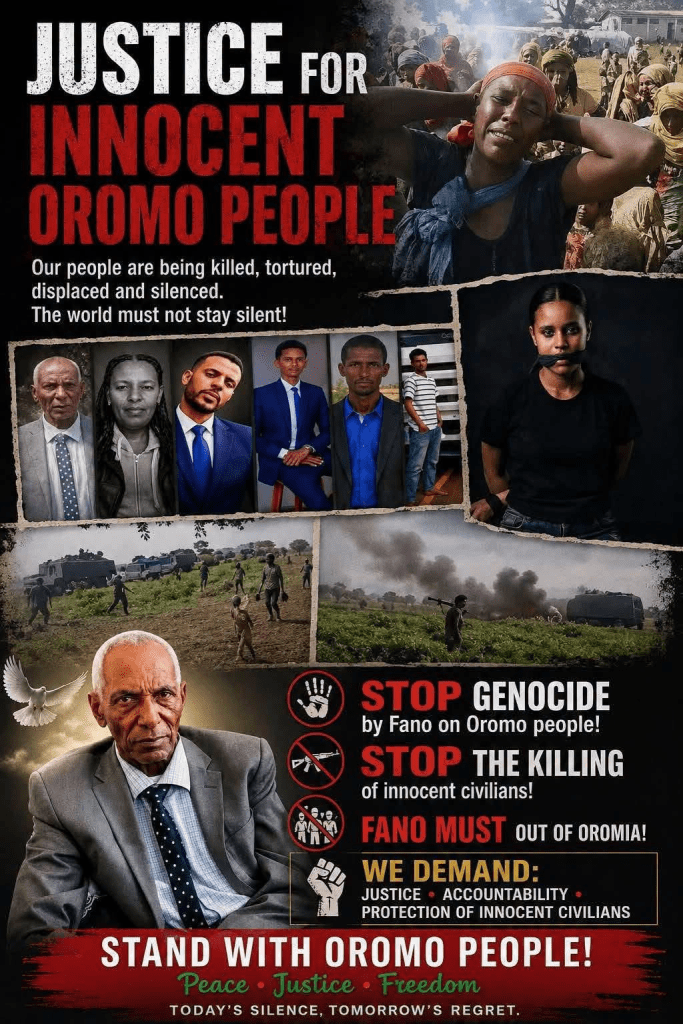
As violence escalates in Ethiopia’s most populous region, a growing chorus of voices is demanding accountability, protection, and peace for the Oromo people.
The plea is urgent and uncompromising: “Stop the killing of Oromo civilians! Stop violence against the Oromo people! Fano must leave Oromia!” These calls reflect a deep-seated crisis that has gripped the Oromia region, where civilians find themselves caught in the crossfire of multiple armed conflicts.
The Human Toll of Conflict
Recent reports paint a harrowing picture of the violence unfolding across Oromia. The Ethiopian Human Rights Commission (EHRC) has documented atrocities including killings, bodily injuries, abductions, displacement, and destruction of property in the Arsi Zone of Oromia . The violence is not isolated—it reflects a broader pattern of human rights abuses across multiple regions, including Amhara and Tigray .
In one particularly devastating incident, armed men killed more than 20 civilians in Oromia. Local civil servants reported that Fano militants attacked civilians “with swords and guns” in the Nono district, approximately 110 kilometers southwest of Addis Ababa, resulting in 25 deaths including women and children, with four more later dying in hospital . A regional security official confirmed that Fano militants had been active in the region for four years, “taking advantage of opportunist moments to launch attacks against civilians and loot property”.
The Humanitarian Crisis
The violence has created a severe humanitarian crisis. The United Nations reports that 3.2 million children are out of school due to the conflict . Hospitals and clinics have been attacked—in 2023, the International Committee of the Red Cross reported that “almost all” of 42 health posts in Oromia’s Beji area had been looted or destroyed . Aid organizations have struggled to distribute supplies, leading to severe malnutrition .
Civilians describe a terrifying reality. One woman from Oromia’s Shewa region told of her family facing constant harassment and extortion from armed groups, with her uncle detained until a 100,000 Ethiopian birr ransom was paid . A coffee farmer from Wollega has been unable to return home for three years due to the security situation, with his harvest stolen by armed fighters .
A Call for Justice and Peace
The demands for justice and protection are clear. As one civil servant noted, the situation “has worsened in recent years” . The Red Cross has warned that the current clashes have “devastating consequences” for civilians, particularly in remote areas, noting that “Oromia doesn’t make the headlines, yet civilians continue to be deeply affected by violence” .
The call for Fano to leave Oromia reflects the reality that multiple armed groups are active in the region, each contributing to the suffering of civilians. For the Oromo people, the demand is simple but profound: protection, justice, and accountability for those who have committed atrocities.
Without decisive action, the cycle of impunity and violence will continue to erode Ethiopia’s stability and legitimacy . The international community, regional bodies, and Ethiopian authorities face a critical choice: allow the violence to continue, or take meaningful steps to protect civilians and bring perpetrators to justice.

OLF Leadership Engages in High-Stakes Consultations Amid Oromo Unity Push
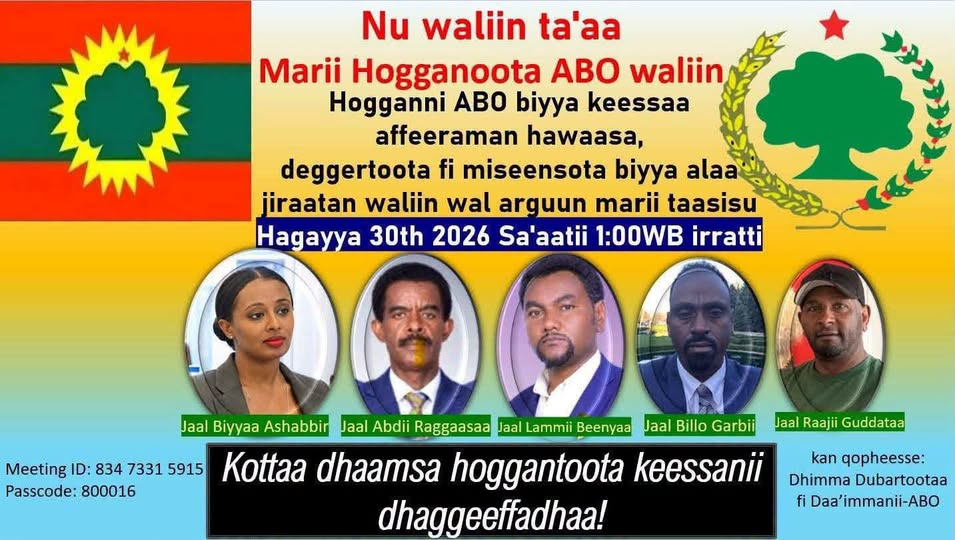
(Finfinne, Oromia)– As Ethiopia’s political landscape grows increasingly volatile, the Oromo Liberation Front (OLF) has convened a series of high-level meetings with its leadership cadres, grassroots members, and traditional institutions—a strategic push to consolidate Oromo unity in the face of mounting security threats and political uncertainty.
A Call for Unity and Vigilance
The most recent consultations, held at the party’s headquarters in Gullalle, brought together Qondaaltota (junior leaders), Dabballoota (cadres), and the general membership for extensive deliberations. Senior OLF leader Jaal Abdii Raggaasaa—who also serves as Member Secretary-General—addressed members with a stark message on the nature of the struggle: that commitment, not temporary strength, determines victory .
“Some individuals enter the organization (Irbuu) but then exploit it—seeking personal benefit rather than serving the people’s cause. When such people exist, it is they themselves who suffer the consequences, not ABO and not others.”
— Jaal Abdii Raggaasaa, OLF Senior Leader
Abdii emphasized that the work of building the Oromo nation extends beyond Ethiopia’s borders—stretching into the diaspora wherever Oromos reside . He stressed that grassroots organizing, beginning “from the village level,” remains essential to lasting political change .
Leadership’s Resolve: “We Must Speak as ABO”
Reflecting on the inevitable challenges facing liberation movements, Abdii offered a sobering reflection:
“In the struggle ABO is waging, even if we face extinction—if we are reduced to just one person—we must speak as ABO. We must not hide ourselves. We may face extinction, but we must not retreat into silence.”
Jaal Yaasoo Kabbabaa Hordofa, another OLF official, reinforced this determination, declaring that “OLF is the center of Oromo peace.” He noted that if OLF participates in elections this year, it will mark the first and largest chapter in Oromo electoral history—an opportunity that must be seized, not as a preference but as an obligation for all members .
Political Prisoners and the Demand for Justice
The OLF has consistently demanded the immediate release of political prisoners who continue to suffer in detention without due process, calling upon both Abbaa Gadaas and religious authorities to actively work toward restoring security in Oromia .
Following the announcement of the 7th General Election results—which saw the ruling Prosperity Party secure a parliamentary majority and OLF fail to win any seats despite fielding 163 candidates—the party issued a pointed critique .
“The OLF once again firmly reiterates that the situation in Oromia and across Ethiopia cannot be resolved merely by declaring an election victory; rather, to prevent worse outcomes, an inclusive, genuine, and transparent dialogue must be conducted without wasting further time.”
The front noted that while it had filed formal grievances with the National Election Board regarding electoral infractions, it does not believe the board investigated these appeals “with the necessary depth, fairness, and justice” .
A Call for Oromo Political Unity
The OLF’s leadership has also renewed its call for all Oromo political organizations to work together to shorten the path to liberation, stating that this is “the most important time” for coordinated action . The executive committee has emphasized that while some previously allied groups have disrupted cooperation due to shifting political dynamics, they must realize that their moves should serve the broader Oromo interest .
The OLF also reiterated its support for the People’s Alliance for Freedom and Democracy (PAFD) and the transitional roadmap presented at the February 2018 London conference. The party calls on all stakeholders—including political elites, academics, and the international community—to contribute to an all-inclusive transitional process that offers a long-term political solution .
The Broader Context: Conflict and Fragility
The leadership’s renewed unity push comes as violence escalates in western Oromia. ACLED data shows that Fano militias—linked to the Amhara Fano National Movement—have increased their activities in Oromia’s Horo Guduru, Kellem, East, and West Wollega zones by 80% since January 2026 . This follows the establishment of the Wollega Fano Bizamo Command in December 2024, which has since fallen under the broader Tsimdo movement—a coalition reportedly aligned with the Tigray People’s Liberation Front (TPLF) and Eritrea, aiming to remove the Ethiopian government.
Amnesty International released a report in August 2026 titled “Because I am Oromo,” alleging that Ethiopia’s government has “ruthlessly targeted” its largest ethnic group—subjecting thousands of Oromos to unlawful killings, torture, and enforced disappearance . The government has denied the allegations.
Looking Forward
The OLF’s consultations reflect a movement at a crossroads—seeking to navigate electoral rejection, internal cohesion, and external threats while maintaining its decades-long commitment to self-determination. As one participant at the February meeting put it: “An awakened nation is built, and the built is united.”
Whether that unity can withstand the mounting pressures—from state security forces, inter-ethnic violence, and international geopolitical maneuvering—remains the central question facing the Oromo struggle today.

The Unrelenting Struggle: Oromo Resistance and the Brutal Reality of Fano Atrocities
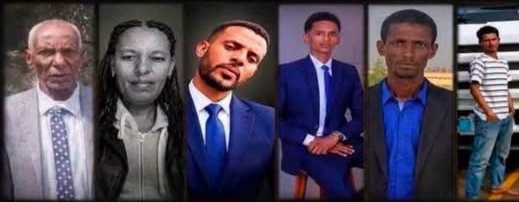
A Reflection on the Ongoing Crisis in East Wallagga and Horro Guduru
By Maatii Sabaa
To this day, the Oromo people have been subjected to the brutal force of the Fano militia. According to a report compiled by the United Oromo Evangelical Church and the Oromia Support Group, the atrocities are widespread—executions, torture, arbitrary detentions, destruction of property, and other acts of violence allegedly committed against Oromo civilians by both Ethiopian government forces and the Fano Amhara militia .
The deaths of fathers, mothers, and children—Oromo lives lost—are met with a chilling refrain: “It is nothing, be patient.” Behind every statistic is a family destroyed, a child orphaned, or a community traumatized. Silence in the face of such suffering only deepens the crisis .
But patience has its limits. When Oromo people are killed and their oppressors dance, those who call themselves “Fano heroes” celebrate. Yet when the Oromo rise to defend themselves, the same voices cry out: “The civilians are finished!” But the truth is simple: self-defense is a natural right. It is not a crime; it is an instinct for survival.
The Conspiracy Against Oromo Self-Defense
There is a deliberate campaign to deny the Oromo people their fundamental right to self-defense. The situation in the East Wallagga and Horro Guduru zones is particularly alarming.
In the Gida Ayana district of East Wallagga, a brutal attack on August 19, 2026, targeted innocent civilians. A bank manager traveling with cash from Gida Ayana to Nekemte was killed in an ambush at Tulu Lencha . Kaffaloo Nagasaa Dayyaas, a farmer beloved in his community, was also among the victims . According to residents, Fano forces attacked ambulances, killing patients and a midwife, in addition to the bank managers and passengers . More than 60 people were killed in the attack, over 70 were wounded, homes were looted, and the violence displaced 20,000 people .
This is not a spontaneous development; it is a calculated plan that has been in motion since at least 2019. A UN document recorded that since 2018, Fano militia has been responsible for a substantial number of killings in East Wollega and Horo Guduru zones . The campaign includes the burning of 200 homes in Homa Galesa village, the killing of 21 villagers in Tullu Moti village, and the brutal beheading of a teenager in Darra district .
As the Oromo people face relentless attacks, their attempts to organize and defend themselves are sabotaged from within. The message is clear: while Oromo fighters are disarmed and disbanded, their enemies are being armed and empowered.
The Cost of Betrayal
The Oromo people have been subjected to a decades-long campaign of marginalization, dispossession, and violence. The current wave of attacks in East Wallagga and Horro Guduru is not an isolated tragedy—it is the latest chapter in a long history of brutality.
But what makes this moment particularly devastating is the silence—and complicity—of those who should be protecting the Oromo people. When Oromo civilians are killed, the world is told to look away. When Oromo resistance is met with disproportionate force, the narrative is twisted to blame the victims.
This is not just a failure of governance; it is a betrayal of the most basic principles of justice and humanity. The Oromo Global Forum has called upon the United Nations Human Rights Council to initiate an independent international investigation into the documented allegations .
A Call to Action
The Oromo people have waited too long for justice. They have been told to be patient while their children are killed, their villages burned, and their land stolen. But patience is not a virtue when it is used as a tool of oppression.
Self-defense is not aggression. It is the right of every people to protect their lives, their families, and their communities. To deny the Oromo this right is to condemn them to perpetual victimhood.
The international community must look beyond the carefully constructed narratives and see the truth: the Oromo people are under attack, and they are fighting for their survival.
Conclusion: The Truth Will Prevail
The conspiracy to silence the Oromo people will ultimately fail. The truth of what is happening in East Wallagga and Horro Guduru—and across Oromia—will not be hidden forever. The blood of the innocent cries out for justice, and it will be heard.
As the Oromo people continue to resist, they do so not out of hatred, but out of love for their children, their land, and their future. They fight for the right to live in peace, free from fear and oppression.
Oromoon of-ittisuu qaba. Of-ittisuun seera uumamaa ti. (The Oromo people have the right to self-defense. Self-defense is a natural law.)

PM Albanese Reaffirms Australia’s Humanitarian Commitment Amid Global Crises

By Dhabessa Wakjira
In a decisive move underscoring Australia’s enduring compassion, Prime Minister Anthony Albanese has confirmed the nation will maintain its annual humanitarian intake of 20,000 refugees – a decision widely hailed by settlement leaders as a beacon of hope in a world grappling with unprecedented displacement.
Addressing media this afternoon, the Prime Minister reaffirmed Australia’s pledge to offer safe haven to those fleeing conflict and persecution, pushing back against any notion that generosity must yield to insecurity.
“In maintaining Australia’s humanitarian intake, Prime Minister Albanese has responded with both compassion and confidence in the Australian people,” said Violet Roumeliotis, CEO of national refugee resettlement provider SSI. “He has recognised that Australia can remain both secure and generous, and that our response to the world’s most vulnerable people is a reflection of our national character.”
A Legacy of Welcome
From the shattered aftermath of World War II to the present day, Australia has built one of the globe’s most respected refugee resettlement programs. More than one million refugees and humanitarian entrants have since made Australia their home – enriching communities, strengthening the economy, and becoming integral threads in the nation’s evolving story.
“There is much to be proud of and much to be grateful for,” Ms Roumeliotis added. “Today’s decision builds on that legacy and reaffirms a vision of Australia as a country that welcomes people seeking safety, creates opportunities for them to belong and contribute, and plays its part in responding to global humanitarian need.”
A Tradition That Endures
With conflict zones multiplying and record numbers of people uprooted worldwide, the Prime Minister’s announcement sends a clear signal: Australia’s humanitarian tradition is not a relic of the past, but a living promise.
“The best of Australia has always been found in our willingness to extend a hand to those seeking safety,” Ms Roumeliotis concluded. “Today’s decision ensures that tradition continues.”
For refugee advocates and communities across the nation, the confirmation offers reassurance – and a reminder that in times of global turmoil, Australia chooses humanity.

The Unshakable Pillar: Why One Foundational Aspiration Will Outlast Every Attempt to Destroy It
By Dhabessa Wakjira
—
In the quiet corners of history, in the roar of revolutions, and in the whispered hopes of ordinary homes, one truth has endured: human beings are born with an innate longing for equality, freedom of thought, and dignity.
This is not a modern invention. It is not a Western import, nor an Eastern myth. It is the quiet fire that lit every abolition movement, every suffrage march, every student protest, and every parent’s prayer for a better future. And in our own community—ummata keenya—this aspiration has been planted like a deep-rooted tree.
That tree is OLF—not as a slogan, but as a living, breathing promise: that no person is above another; that no mind should be chained; that every voice carries the weight of sacred worth.
—
The Aspiration That Refuses to Die
The original text reminds us: “ABOn waan bu’uraa tokko ummata keessa kaahee jira.”
There is, among the people, one foundational principle. It is not written in stone alone—it is written in conscience. It says:
· Equality is not a privilege; it is a birthright.
· Freedom of thought is not a concession; it is the soil where truth grows.
· Dignity is not a reward; it is the oxygen of human existence.
This aspiration, the text insists, cannot be stopped or erased in any form. Not by armies. Not by laws. Not by propaganda. Not by time.
Why? Because it is not borrowed from a constitution or a king. It is discovered—in the cry of a child, in the sweat of a labourer, in the silent grief of a mother, in the bold question of a teenager. It is experiential before it is philosophical.
—
The Many Faces of Opposition
History is littered with attempts to suffocate this aspiration.
· Tyrants have banned books.
· Dictators have jailed thinkers.
· Empires have rewritten histories.
· Corporations have commodified attention.
· Algorithms have tried to herd our thoughts into safe, sellable boxes.
Yet every time, the aspiration returns—not in the same shape, but in a stronger one.
Why? Because suppression is reactive; aspiration is generative.
· Suppression says: “You must not think this way.”
· Aspiration replies: “Then I will think deeper.”
· Suppression says: “You are unequal by nature.”
· Aspiration answers: “Then I will build communities that prove you wrong.”
This is why the text declares: “Kun dhugaa bara baraan dhaloota walqixxummaa fi bilisummaa barbaadan kamiyyuu keessa kan jiraatuu dha.”
It is the permanent inheritance of every generation that dares to seek equality and liberty. Not a relic of the past—but a living torch passed from hand to hand, across fire and flood.
—
What Does This Mean for Us Today?
In our own time—fractured by misinformation, polarized by identity, exhausted by performative justice—this foundational aspiration calls us back to simplicity and courage.
It asks us:
· Do we treat the stranger at our gate as our equal, or as a threat?
· Do we listen to an idea we hate with the same patience as one we love?
· Do we defend dignity for the powerless, even when it costs us comfort?
If the aspiration is truly unkillable, then our job is not to protect it—but to practice it. Because an aspiration that lives only in speeches is a ghost. An aspiration that lives in schoolrooms, marketplaces, courtrooms, and dinner tables—that is a revolution.
—
The Final Word: A Promise, Not a Puzzle
Some will try to redefine this aspiration. They will twist it into a weapon, a commodity, or a vague slogan. But the core remains indestructible:
Every person holds the right to be free, to think boldly, and to stand equal before their fellow human.
No empire, no algorithm, no crisis can undo that truth—because it is not built on fragile institutions. It is built on the fragile, fierce, unbreakable human heart.
And as long as one parent teaches a child to question, one writer speaks truth to power, one citizen refuses to kneel—that aspiration lives.
It has survived every storm before us.
It will survive every storm ahead.
Not because we are lucky.
But because we are human.
—
“ABOn waan bu’uraa tokko ummata keessa kaahee jira.”
May we never forget it. May we never betray it. May we live it—until it needs no defense.

Honouring Our Roots: AOCV Launches Elders Voice Program at Flemington Hub
By Dhabessa Wakjira
—
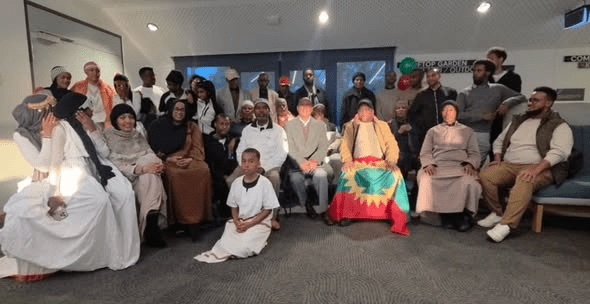
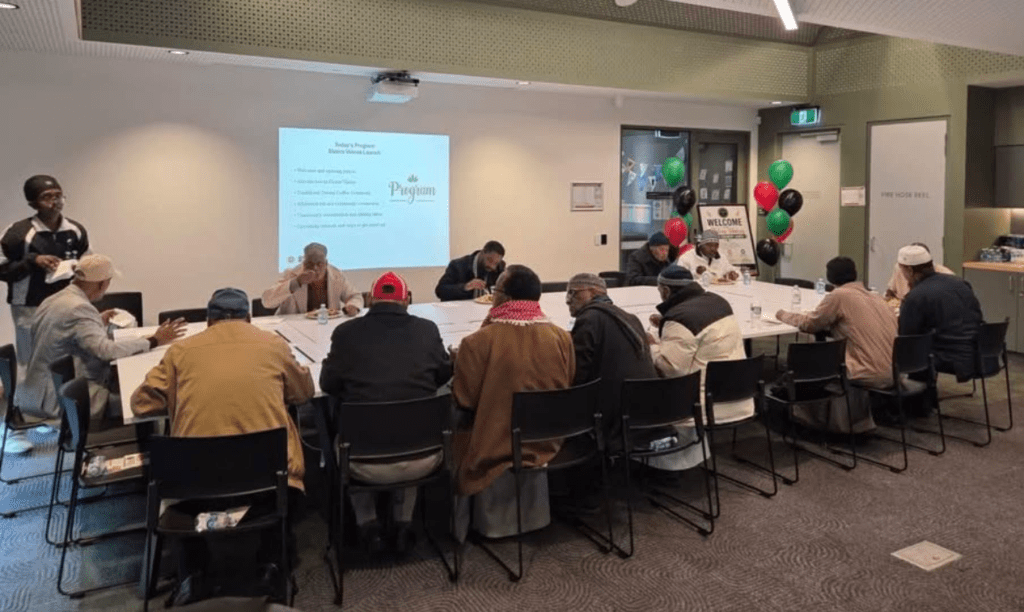
On Sunday, 16th August 2026, the air at Flemington Hub was thick with anticipation, respect, and the warm hum of community. It was a day of celebration, reflection, and a profound commitment to the future—a day when the Australian Oromo Community Victoria (AOCV) officially launched its much-anticipated Elders Voice Program (Sagantaa Sagalee Maanguddootaa) .
The event marked more than just a ceremonial opening; it was a declaration that the voices of our elders matter. That their stories are not merely echoes of the past but living threads that weave the fabric of our identity. As the program unfolds, it promises to become a cornerstone of cultural preservation, intergenerational connection, and community healing.
—
A Program Rooted in Reverence
The Elders Voice Program will be delivered on the first week of every month, offering a regular, dedicated space for elders to share their wisdom, experiences, and cultural knowledge with younger generations. It is a structured yet heartfelt initiative designed to ensure that the rich tapestry of Oromo heritage—its history, traditions, language, and values—is not only remembered but actively lived and passed on.
“Maanguddoonni keenya kuusaa seenaa, aadaa fi duudhaa keenyaati,” the AOCV team reminded attendees during the launch. “Isaan seenaa, barnoota, muuxannoo fi yaadannoo dhaloota walitti hidhu baatanii jiru.”
Translation: “Our elders are the keepers of our history, culture and traditions—carrying stories, lessons and memories that connect us to where we come from and remind us of who we are.”
These words resonated deeply with the crowd, a mix of young and old, Oromo-born and Australian-raised, all united by a shared desire to honour the past while building a resilient future.
—
Why This Program Matters Now
In an age of rapid globalisation and digital distraction, the risk of cultural erosion is real. For diaspora communities, the challenge is even greater. Languages fade, customs evolve, and the intimate oral traditions that once bound generations together can easily slip through the cracks of busy modern lives.
The Elders Voice Program stands as a deliberate counterforce to this trend. By creating a regular forum where elders are not just listened to but celebrated, AOCV is ensuring that:
· History is preserved: Oral histories, migration stories, and ancestral knowledge are documented and shared.
· Wisdom is transferred: Life lessons, problem-solving approaches, and traditional skills are passed to younger hands.
· Identity is strengthened: Young people gain a clearer sense of who they are and where they come from, building pride and resilience.
· Community is unified: Intergenerational dialogue fosters mutual understanding, respect, and deeper social bonds.
—
A Launch to Remember
The Flemington Hub was alive with energy on launch day. Elders were seated in places of honour, their faces beaming with pride and emotion. Young community members performed traditional songs and poetry, weaving the old with the new. There were moments of laughter, tears, and powerful silence—the kind that speaks louder than words.
One elder, reflecting on the initiative, shared: “Yeroo dheeraaf sagaleen keenya hin dhageeffamne ture. Amma garuu, ijoolleen keenya dhaga’uu barbaada. Kun ijoollee keenyaaf, nuufis, eebba guddaadha.”
“For too long, our voices were not heard. But now, our children want to listen. This is a blessing for them and for us.”
The launch concluded with a community feast and the formal announcement of the program’s monthly schedule, with the first official session set to take place in the first week of September 2026.
—
Looking Ahead
The Elders Voice Program is more than a series of meetings—it is a movement. It is a promise that the stories of those who came before us will not be forgotten. It is an invitation for every community member, young and old, to participate in the sacred act of remembering and retelling.
As AOCV continues to build bridges between the Oromo diaspora and broader Australian society, initiatives like this remind us all of a universal truth: every culture is carried forward by its elders, and every community is enriched when it pauses to listen to them.
“Sagalee maanguddootaa keenyaa haa dhageenyu, seenaa isaanii haa galmeessinu, ogummaa isaanii dhalootaaf haa dabarsinu.”
“Let us hear the voices of our elders, document their stories, and pass on their wisdom to the generations to come.”
—
Get Involved
The Elders Voice Program invites all community members to attend, contribute, and learn. For more information on upcoming sessions, volunteer opportunities, or to share an elder’s story, contact AOCV at [insert contact details] .
Together, we honour the past. Together, we build the future.
—
#EldersVoice#AOCV#OromoCommunity#CulturalPreservation#FlemingtonHub#GenerationsUnited

A Life Measured by Service: Remembering Dr. Ephraim Mamo
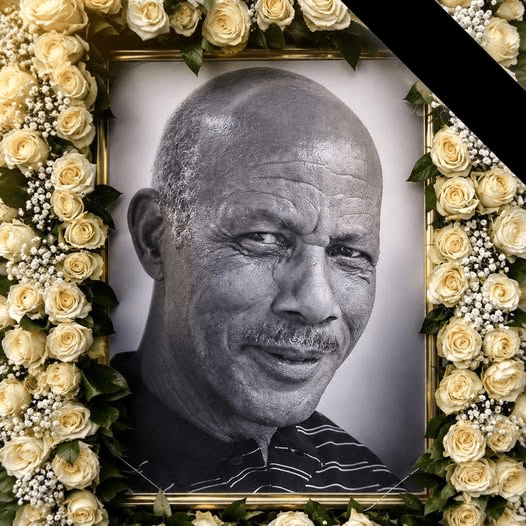
In an age that measures success by wealth and status, one man’s legacy is defined by humility, sacrifice, and the quiet act of giving.
—
The two benches sit unassuming in a modest home in Dambii Dolloo. They are rough-hewn, practical, and utterly unremarkable to the casual observer. But to the family of Dr. Ephraim Mamo, these simple wooden planks—placed together to form a bed in his parents’ home—tell the story of a man who measured his worth not in possessions, but in people.
On August 25, 2026, as the world continues its relentless spin, those who knew Dr. Ephraim gather in memory of a life that touched countless others. His daughter, Metahara Ephraim Mamo, speaking on behalf of the family, offered a reflection that transcends grief, celebrating instead a life of profound purpose and quiet dignity.
A Man of Principle in a World of Pretense
Dr. Ephraim Mamo was many things to many people. To his family, he was a pillar of strength and a wellspring of love. To his students and colleagues at Haramaya University, he was a mentor, a scientist, and a friend. To his community, he was a humble servant whose compassion knew no bounds.
Those who knew him best recall a man who never sought the spotlight. He achieved significant professional success as a scientist and academic, yet he never allowed accolades to inflate his ego. His greatest joy came not from publications or promotions, but from the quiet satisfaction of helping others—even when it required personal sacrifice.
The simplicity of his life serves as a powerful counter-narrative to a world obsessed with accumulation. In a society where status is often measured by material wealth, Dr. Ephraim chose a different path. He valued service over comfort, principles over profit, and relationships over riches.
A Legacy of Generosity
“His greatest joy came from helping others and giving, even when it required personal sacrifice,” Metahara reflects. This generosity was not performative; it was woven into the fabric of his daily existence. Whether mentoring a struggling student, offering counsel to a colleague, or extending kindness to a stranger, Dr. Ephraim embodied the belief that true success lies in what we give away.
His colleagues and friends at Haramaya University remember a man who was always approachable, always willing to listen, and always ready to extend a helping hand. In a world that often rewards ambition at the expense of humanity, Dr. Ephraim remained steadfast in his commitment to compassion.
The Global Embrace of Grief and Gratitude
The outpouring of love following Dr. Ephraim’s passing speaks volumes about the life he lived. Relatives, friends, colleagues, and neighbors—both near and far—rallied around the family with prayers, messages, and condolences. Haramaya University’s staff and colleagues stood in solidarity, honoring a man who had given so much to their institution.
Metahara expressed profound gratitude to Abdi Mekonen and Meti Midekssaa, whose kindness and support during this difficult time exemplified the community spirit that Dr. Ephraim himself cultivated. Special acknowledgment was also extended to those who traveled great distances to be present, and to those who, though physically absent, reached out through social media, phone calls, and messages.
“Though you were not here physically, we felt your love and support,” Metahara writes, capturing the profound truth that grief, when shared, transforms into something bearable—even beautiful.
Faith as Foundation
At the heart of Dr. Ephraim’s life was an unshakeable faith. Metahara begins her reflection with gratitude to her Lord and Savior, Jesus Christ, who she says “was gracious and faithful to our father throughout his life.” This spiritual grounding anchored Dr. Ephraim through life’s triumphs and trials, shaping his character and informing his values.
In times of sorrow, faith offers not easy answers, but a sustaining presence. It reminds mourners that life is more than its final chapter, and that love outlasts the grave.
A Life That Endures
Though the family’s hearts are heavy, they find solace in gratitude. They thank God for the privilege of knowing and loving their father, and they extend their deepest appreciation to everyone who stood with them in their time of grief.
Dr. Ephraim Mamo’s life is a testament to the enduring power of humility, generosity, and service. In a world hungry for heroes, perhaps the most heroic act is to live quietly, love deeply, and leave the world better than you found it.
As the two benches in Dambii Dolloo remain, they are no longer just pieces of furniture. They are sacred relics—reminders that a man once slept there, dreaming not of gold or glory, but of a world made kinder by his presence.
And in that, Dr. Ephraim Mamo found his eternal success.

Slaughter in the Shadows: The Unfolding Horror in East Wollega
As the world looks elsewhere, Ethiopian civilians are being burned alive, and a desperate plea for help rises from the ashes.
In the quiet villages of Ethiopia’s Oromia region, a summer of horror is drawing to a close. While global attention remains fixed on other crises, the International Oromo Women’s Organization (IOWO) has released a desperate appeal documenting an escalating campaign of violence that has turned the East Wollega Zone into a graveyard of professional promise and a testament to human cruelty .
The reports paint a picture of systematic terror allegedly perpetrated by Amhara Fano armed groups. Beginning in July and intensifying throughout August 2026, the violence has centered on the Gida Ayana Woreda—including the communities of Andode Dichoo, Angar Gute, and Tullu Lenca—as well as Kiramu and Horro Guduru. The testimonies describe not merely a conflict, but a targeted attempt to dismantle the very fabric of civilian life.
A Targeting of Hope
What distinguishes these atrocities is the chilling precision of the attacks. Among the dead are not just anonymous civilians, but the very pillars of the community. On August 19, the violence claimed Mr. Lamessa Mangistu, the branch manager of Awash Bank in Gida Ayana, and Mr. Mamush Maru, a banker at the Oromia Cooperative Bank. Their crime? Providing essential financial services to their community .
In Angar Gute, armed men reportedly burned Sister Liktu Amanu, a midwifery and nursing professional, while she was carrying out emergency duties. Just days earlier, 65-year-old Amanu Hirpha Bidu was reportedly burned alive inside an active ambulance during a patient transfer—a blatant violation of the fundamental protections afforded to medical transport under international humanitarian law . The attack on Mr. Olika Sagni, a local teacher, represents another devastating blow, stripping the community of its educators and the promise of future generations.
“We as mothers and sisters, cannot stand the endless brutal actions against civilian human beings,” writes Dinknesh D. Kitila, IOWO’s Board Director, in the appeal . Their plea is directed at the UN Security Council, the Human Rights Council, the U.S. Secretary of State, the EU, and governments worldwide: act before more innocent lives are extinguished.
Scorched Earth and Silence
The destruction is not limited to lives. The IOWO report details widespread arson targeting public offices, private homes, and transport vehicles, displacing families and paralyzing local economies. The group has released harrowing images of vehicles and property consumed by flames, emphasizing that the campaign is as much about erasing community infrastructure as it is about inflicting casualties. The targeted destruction of the Angar Gute area, including a special attack on Tullu Lenca, points to an attempt to force a demographic change or to punish communities for their identity .
This violence is part of a broader pattern of instability in Ethiopia. Travel advisories from various embassies currently designate East Wollega as a “red” or “extremely high-risk” area, warning citizens to avoid the region due to the presence of armed groups and the risk of attacks on civilians . The international community, while aware, has often been slow to act as the crisis deepens.
The World’s Response
The IOWO appeal calls for two immediate actions: emergency civilian protection for vulnerable populations in the affected woredas, and accountability for the perpetrators of these unlawful killings.
As the appeal letter was signed on August 24, the silence from the international community remains deafening. The documented cases of targeted killings of professionals, the use of ambulances as instruments of death, and the burning of entire communities demand more than a passing glance.
The mothers and sisters of East Wollega are not asking for charity; they are demanding the basic right to live. The charred remains of a midwife’s ambulance and the empty desks of murdered teachers are a stain on the conscience of humanity, a stark reminder that the cost of inaction is always counted in lives.

The World Looks Away: Western Oromia’s Cry for Justice

As violence escalates in Western Oromia, a leading advocacy group warns that silence is complicity and calls for urgent international intervention.
—
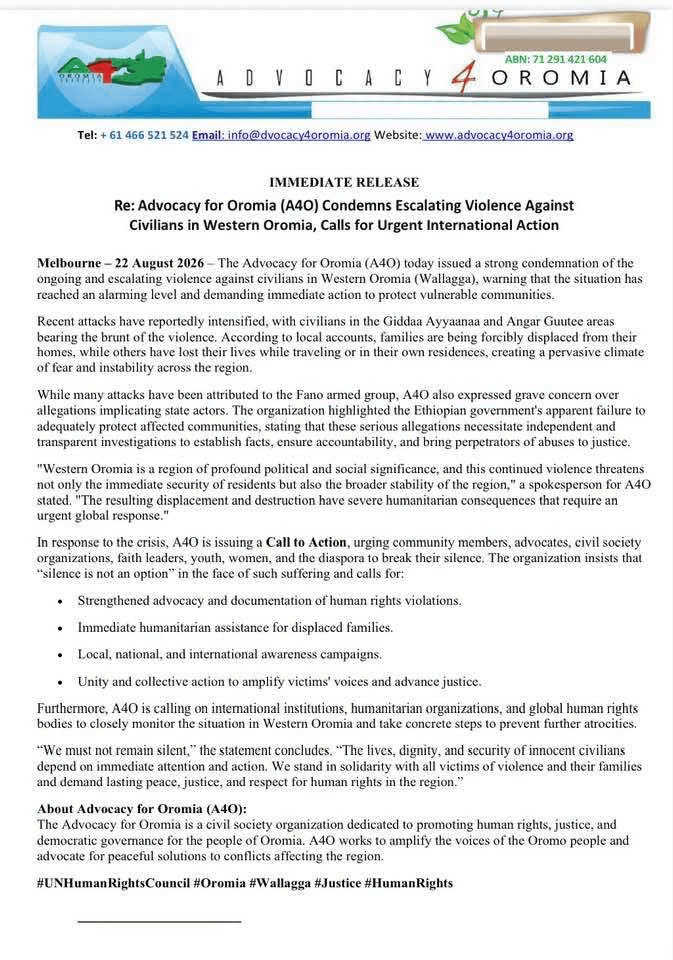
Melbourne – August 22, 2026 – The Advocacy for Oromia (A4O) has issued a stark warning that the escalating violence against civilians in Western Oromia (Wallagga) has reached an alarming level, demanding immediate action to protect vulnerable communities. In a powerful statement released today, the organization condemned the intensifying attacks that have reportedly displaced families, claimed lives, and created a pervasive climate of fear across the region.
The violence, concentrated in the Giddaa Ayyaanaa and Angar Guutee areas, has targeted civilians in their homes and while traveling, according to local accounts. Families are being forcibly displaced, their lives upended by a campaign of terror that shows no sign of abating.
A Crisis of Complicity
While many attacks have been attributed to the Fano armed group, A4O has expressed grave concern over allegations implicating state actors. The organization has accused the Ethiopian government of failing to adequately protect affected communities, a failure that demands independent and transparent investigations.
“Western Oromia is a region of profound political and social significance, and this continued violence threatens not only the immediate security of residents but also the broader stability of the region,” an A4O spokesperson stated. “The resulting displacement and destruction have severe humanitarian consequences that require an urgent global response.”
The government’s apparent inaction raises difficult questions about accountability and the protection of civilians. A4O insists that these serious allegations necessitate thorough investigations to establish facts, ensure accountability, and bring perpetrators of abuses to justice.
A Call to Break the Silence
In response to the unfolding crisis, A4O has issued a Call to Action, urging community members, advocates, civil society organizations, faith leaders, youth, women, and the diaspora to break their silence. The organization insists that “silence is not an option” in the face of such suffering.
The call outlines several key priorities:
· Strengthened advocacy and documentation of human rights violations to ensure that the world bears witness to the atrocities.
· Immediate humanitarian assistance for displaced families, whose basic needs remain unmet.
· Local, national, and international awareness campaigns to shine a spotlight on the crisis.
· Unity and collective action to amplify victims’ voices and advance justice.
A4O is also calling on international institutions, humanitarian organizations, and global human rights bodies to closely monitor the situation in Western Oromia and take concrete steps to prevent further atrocities.
The Cost of Inaction
The human toll of the violence is immeasurable. Families torn apart, communities shattered, and lives cut short—all while the international community remains largely silent. The displacement and destruction have severe humanitarian consequences, yet the global response has been insufficient.
A4O’s statement is a desperate plea to the world: “We must not remain silent. The lives, dignity, and security of innocent civilians depend on immediate attention and action. We stand in solidarity with all victims of violence and their families and demand lasting peace, justice, and respect for human rights in the region.”
A Call to Remember
As the violence continues to escalate, the world faces a choice: to act or to look away. A4O’s message is clear—silence is complicity, and inaction is a choice to abandon innocent lives.
The organization’s commitment to amplifying the voices of the Oromo people and advocating for peaceful solutions is a reminder that even in the darkest times, hope persists. But hope alone is not enough. It requires action, solidarity, and a collective demand for justice.
The people of Western Oromia are not merely statistics; they are mothers, fathers, children, and communities whose lives hang in the balance. Their cries for help must not go unanswered.
—
For more information, contact Advocacy for Oromia (A4O), a civil society organization dedicated to promoting human rights, justice, and democratic governance for the people of Oromia.
#UNHumanRightsCouncil#Oromia#Wallagga#Justice#HumanRights