The Price of Truth: When Telling the Story Costs Everything
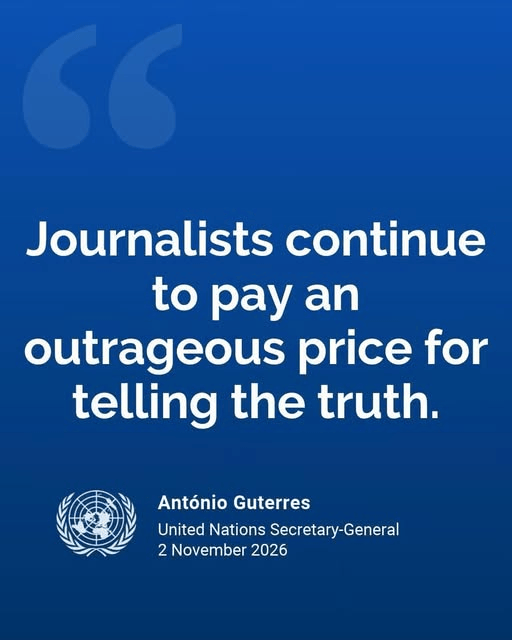
On the International Day to End Impunity, the UN chief sounds an alarm: journalists are being harassed, surveilled, sued, attacked, imprisoned — and sometimes killed — simply for doing their jobs
By Dhabessa Wakjira
—
They gather the news in war zones and city halls, in courtrooms and courthouse squares. They ask the uncomfortable questions, chase the paper trail, and knock on the doors of the powerful. And increasingly, for doing exactly that, they pay a devastating price.
On Monday, as the world marked the International Day to End Impunity for Crimes against Journalists, United Nations Secretary-General António Guterres issued a blunt and urgent appeal: the world must protect media professionals so they can carry out their essential work safely.
“Journalists continue to pay an outrageous price for telling the truth,” Guterres said, noting that reporters are routinely harassed, surveilled, sued, physically attacked or imprisoned — and sometimes even tortured or killed — simply for doing their jobs.
“Nothing should impede journalists’ ability to do their work, which is fundamental to human rights, democracy and the rule of law,” he added.
A Global Pattern of Pressure
The Secretary-General’s warning reflects a reality familiar to press-freedom organizations around the world. From authoritarian capitals to established democracies, journalists face a growing arsenal of tools designed to silence them: surveillance software deployed against reporters’ phones, defamation lawsuits engineered to bankrupt newsrooms, arbitrary detention, and, in the worst cases, physical violence that goes unpunished.
The day itself — established by the UN General Assembly in 2013 — commemorates the 2013 assassination of two French journalists, Ghislaine Dupont and Claude Verlon, killed in Mali. More than a decade later, the core problem it was designed to confront persists: the vast majority of crimes against journalists go unpunished, emboldening those who would harm them.
Impunity, press-freedom advocates argue, is the engine of the crisis. When attacks on journalists go unprosecuted, the message sent is unmistakable: the truth-teller is fair game.
“Fundamental to Human Rights, Democracy and the Rule of Law”
Guterres’ statement places journalists at the center of the democratic project — not as a special-interest group, but as an essential infrastructure of free societies. A free press holds governments accountable, exposes corruption, and gives citizens the information they need to make decisions about their own lives. When journalists are intimidated into silence, it is not only their rights that are violated — it is the public’s right to know.
That principle has particular resonance in a year that has seen journalists detained in record numbers, newsrooms raided, and reporters targeted online with coordinated campaigns of harassment and disinformation. In conflict zones, press insignia have offered little protection; in peacetime, legal harassment has become a favored weapon of the powerful.
A Call to Action
The UN chief’s message on Monday was less a commemoration than a call to action. Protecting journalists, he suggested, requires more than rhetoric — it demands that governments investigate attacks, prosecute perpetrators, and safeguard the legal and physical safety of media workers.
For the journalists still working the beat — the ones filing from conflict lines, sitting through court hearings, and requesting records that someone would prefer stay buried — the stakes are personal. Every story filed is an act of persistence. Every byline, a small assertion that the truth matters.
On this International Day to End Impunity, the message from the UN’s highest office was clear: the price journalists pay for telling the truth is already too high — and the world has a duty to bring it down.
—
This article was produced in recognition of the International Day to End Impunity for Crimes against Journalists, observed annually on November 2.

Posted on November 3, 2026, in Aadaa, Afaan, Bokkkuu, Daaniyaa, Diaspora, Election, Events, Face of Injustice, family violence, Finfinne, freedom, gadaa, gender, Grief Support, Gumaa, health, Information, Kindness, Language, Media, mental health, News, Obituary, Oromia, Press Release, Promotion. Bookmark the permalink. Leave a comment.






Leave a comment
Comments 0