Oromia Consolidates 21 Zonal Administrations into Six Powerful Regional Clusters
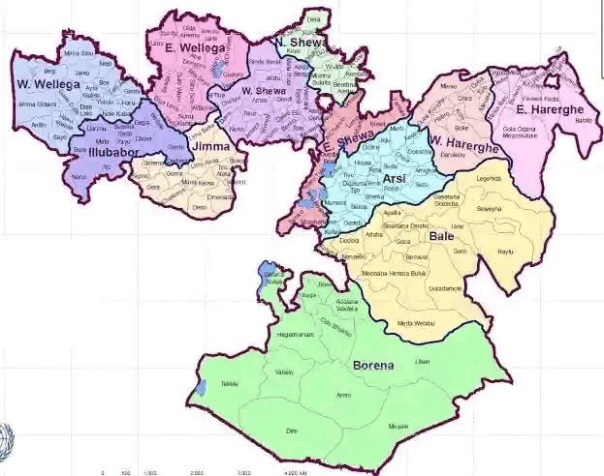
A historic restructuring aims to streamline governance, strengthen service delivery, and bring the state closer to its people
FINFINNE — In a decision described as historic and far-reaching, the Government of Oromia Regional State has approved a major restructuring of its administrative architecture, reducing the region’s 21 zonal administrations to six powerful regional clusters. The reform is designed to build a stronger, more efficient government and to ensure that public services genuinely reach the people they are meant to serve.
The decision, ratified through a draft proclamation by the Oromia Regional State Council during its first-year, seventh-term regular session, consolidates related administrative functions into unified structures. At its core, the reform emphasizes coordination, complementarity, and the effective delivery of services to the public.
With the new structure now in force, the senior leadership of each of the six clusters has been officially assigned.
East Oromia Cluster
Headquarters: Harar
- Abdurrahman Abdalla — Cluster Chief, rank of Deputy President. Office: Harar.
- Miski Muhammad — Deputy Cluster Chief for Development, rank of Bureau Head. Office: Chiro.
- Anas Aliyi — Deputy Cluster Chief for Peace and Justice, rank of Bureau Head. Office: Galamso.
- Jaarso Boru — Senior Advisor to the Cluster Chief, rank of Bureau Head. Office: Gurawa.
- Fiqadu Miliyoon — Advisor to the Cluster Chief, rank of Bureau Head.
- Samia Abdalla — Advisor to the Cluster Chief, rank of Bureau Head.
Central Oromia Cluster
Headquarters: Shaggar and Adama
- Dr. Mengistu Bekele — Cluster Chief, rank of Deputy President. Office: Shaggar and Adama.
- Abbabu Waqo — Deputy Cluster Chief for Development, rank of Bureau Head. Office: Waliso.
- Kifalaw Adare — Deputy Cluster Chief for Peace and Justice, rank of Bureau Head. Office: Fitche.
- Makonnen Bayisa — Senior Advisor to the Cluster Chief, rank of Bureau Head. Office: Ambo.
- Ashannafi Ajjama — Advisor to the Cluster Chief, rank of Bureau Head.
- Taddasa Dirriba — Advisor to the Cluster Chief, rank of Bureau Head.
Southwest Oromia Cluster
Headquarters: Jimma
- Dr. Rashad Kamal — Cluster Chief, rank of Deputy President. Office: Jimma.
- Indalkachaw Tafari — Deputy Cluster Chief for Development, rank of Bureau Head. Office: Bedele.
- Aman Danu — Deputy Cluster Chief for Peace and Justice, rank of Bureau Head. Office: Limu Gannat.
- Didha Guddata — Senior Advisor to the Cluster Chief, rank of Bureau Head. Office: Mattu.
- Muhammadxahaa Abba Fixaa — Advisor to the Cluster Chief, rank of Bureau Head.
- Mosisa Lammessa — Advisor to the Cluster Chief, rank of Bureau Head.
South Oromia Cluster
Headquarters: Yabelo
- Ahmad Haji — Cluster Chief, rank of Deputy President. Office: Yabelo.
- Adula Hirbayye — Deputy Cluster Chief for Development, rank of Bureau Head. Office: Adola.
- Liban Areero — Deputy Cluster Chief for Peace and Justice, rank of Bureau Head. Office: Nageelle Borana.
- Wandimmu Robe — Senior Advisor to the Cluster Chief, rank of Bureau Head. Office: Bule Hora.
- Ibrahim Abdi — Advisor to the Cluster Chief, rank of Bureau Head.
- Isaaq Xaachoo — Advisor to the Cluster Chief, rank of Bureau Head.
West Oromia Cluster
Headquarters: Nekemte
- Masfin Melaku — Cluster Chief, rank of Deputy President. Office: Nekemte.
- Mirressa Fixee — Deputy Cluster Chief for Development, rank of Bureau Head. Office: Gimbi.
- Gammachu Gurmeessa — Deputy Cluster Chief for Peace and Justice, rank of Bureau Head. Office: Shambu.
- Talila Tarrafa — Senior Advisor to the Cluster Chief, rank of Bureau Head. Office: Dambi Dollo.
- Badhasa Dhaba — Advisor to the Cluster Chief, rank of Bureau Head.
- Dassu Lammi — Advisor to the Cluster Chief, rank of Bureau Head.
Southeast Oromia Cluster
Headquarters: Robe
- Ahimad Idris — Cluster Chief, rank of Deputy President. Office: Robe.
- Asaffa Tolasa — Deputy Cluster Chief for Development, rank of Bureau Head. Office: Ginir.
- Abdurrazaq Huseen — Deputy Cluster Chief for Peace and Justice, rank of Bureau Head. Office: Asella.
- Ibrahim Kadir — Senior Advisor to the Cluster Chief, rank of Bureau Head. Office: Shashemene.
- Izzaddin Abuubakar — Advisor to the Cluster Chief, rank of Bureau Head.
- Birhanu Arfasa — Advisor to the Cluster Chief, rank of Bureau Head.
What the Reform Means
The restructuring reduces Oromia’s sprawling 21-zonal system to six consolidated clusters, each led by a chief holding the rank of deputy president. Each cluster also has dedicated deputies for development and for peace and justice, along with senior advisors — a structure that mirrors the executive architecture of the regional government itself.
Officials say the reform is rooted in a simple principle: government should not be distant or fragmented. By grouping similar functions under one coordinated structure, the new system aims to eliminate duplication, improve efficiency, and make public services more accessible to ordinary citizens.
Oromia is Ethiopia’s largest regional state, spanning more than 350,000 square kilometers with a population estimated at over 27 million. For years, analysts and citizens alike have questioned whether a 21-zone structure could effectively serve such a vast and diverse population. The new six-cluster model is presented as the answer.
A Historic Decision With High Stakes
The proclamation was approved during the Council’s first regular session of its seventh term — a detail that underscores the political weight of the decision. The reform is not merely administrative; it is a reimagining of how Oromia governs itself.
Supporters see it as a bold step toward a stronger, more responsive state. Critics, however, have raised questions about political motivations, wondering whether consolidation could weaken the influence of individual zones or shift power in ways that are not immediately visible.
What is certain is that the six clusters are now operational, their leaders appointed, and their headquarters designated. For the people of Oromia, the real test will be felt in the everyday: faster permits, closer services, and a government that listens.
As the region embarks on this new chapter, one thing is clear — Oromia has chosen to reorganize not by dismantling its diversity, but by uniting it under a stronger, more coordinated whole.
#OromiaPresidentOffice2026

Posted on September 30, 2026, in Aadaa, Afaan, Bokkkuu, Diaspora, Events, Face of Injustice, Finfinne, freedom, gadaa, Gumaa, health, Information, Irreechaa, Kindness, Language, Media, News, Oromia, Uncategorized. Bookmark the permalink. Leave a comment.






Leave a comment
Comments 0