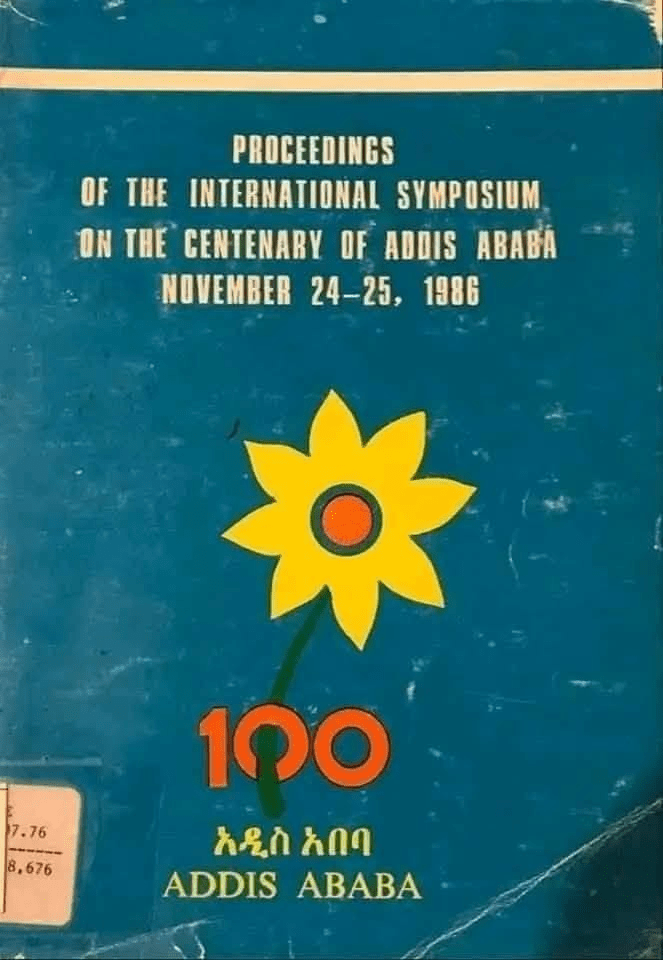
Proceedings of the International Symposium on the Centenary of Addis Ababa (November 24-25, 1986)
By Negash Qemant
In 1986, under the Derg regime, an international symposium was held to mark the centenary of Addis Ababa. The proceedings, published in a historical volume, brought together scholars from various disciplines to examine the history of the city. Among the contributions was a groundbreaking research paper that sheds light on the true origins of Finfinne—the city now known as Addis Ababa.
This paper, presented by scholars of the time, documented the historical reality that the area now occupied by St. George’s Church and the statue of Menelik was once known as Birbirsa. The research paper opens with a striking question:
“Who would imagine that the place where one can see today’s Saint George’s Church and the statue of Menelik was known as Birbirsa?”
The paper continues:
“This paper is about Birbirsa, a place located in Finfinne which later on came to be called Addis Ababa.”
The Name “Finfinne”
The symposium proceedings confirm what Oromo oral tradition has always maintained: the area was originally known as Finfinne—a name derived from the hot mineral springs (finfina) that bubble up from the earth in the area. The proceedings note that the name “Finfinne” was the original designation, and the name “Addis Ababa” was a later imposition.
The research paper documents that the area now known as Piassa, Arat Kilo, and the surroundings of St. George’s Church were once called Birbirsa Goro—an Oromo name. The paper also confirms that the area around the present-day St. George’s Cathedral was known as Birbirsa, an Oromo name that predates the arrival of Menelik and his forces.
The proceedings document that the area was known by Oromo names: Gafarsa, Hurufa Boombii, Tulluu Daalattii, and others. These names were systematically replaced with new names after the establishment of the city under Menelik.
The Dream of Sahle Selassie
The symposium proceedings also address the well-known story of King Sahle Selassie’s “prophecy” about the site where his descendants would build a city. The proceedings treat this story as a genuine prophecy, which was used to legitimise the establishment of the city.
As the proceedings note, the story goes that King Sahle Selassie, while camping in the area, had a vision that his descendants would build a city on that spot. This “prophecy” was used to create an aura of divine legitimacy around Menelik’s decision to establish the capital.
However, as Blatten Geta Hiruy Wolde Selassie notes in his book The History of Ethiopia from the Queen of Sheba to the Victory of Adwa (p. 87):
“This land, which today is called Addis Ababa and is the capital of Ethiopia, was known as Finfinne at that time. King Sahle Selassie, while on a campaign, pitched his tent at the spot where the palace now stands and is said to have prophesied that his descendants would build a city there.”
The Role of Empress Taytu
The symposium proceedings and other historical sources confirm that it was Empress Taytu who gave the city its new name, Addis Ababa (“New Flower”). According to the account of Dr. Dejazmach Zewde Gebre Selassie, Empress Taytu wrote to Emperor Menelik:
“I have found the place we were looking for, and I have named it Addis Ababa.”
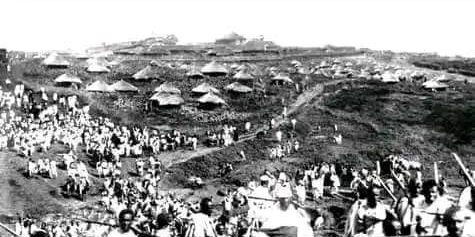
She sent this message to Menelik, who was at a different location at the time. The empress and the emperor, along with their armies, later pitched their tents on the hill known as Tulluu Finfinnee (the hill of Finfinne), where the hot springs (Hora Finfinnee) are located. After this, the emperor ordered that all official correspondence should bear the new name “Addis Ababa.”
However, the symposium proceedings also note that the area was already known as Finfinne and that the local population had long used this name. The renaming was an act of imperial assertion, not a neutral decision.
The Birbirsa Connection: Catholic Missionaries and the Oromo College
The symposium proceedings and Catholic missionary records confirm that Birbirsa Goro was the site of a Catholic mission and an Oromo college established by missionaries. The missionaries had introduced various species of flowers from Europe to the area, planting them in the college compound and surrounding areas. These flowers—not indigenous to the region—impressed Empress Taytu, who saw them when she visited the area.
The Catholic mission records also confirm that after the college was closed, the site was later chosen for the construction of St. George’s Church, which now stands in the heart of the city.
The Erasure of Oromo History
What emerges from these historical documents is a clear pattern: the systematic erasure of Oromo history and identity. The Oromo names—Finfinne, Birbirsa, Gafarsa, Hurufa Boombii, Tulluu Daalattii—were replaced with Amharic names. The story of Sahle Selassie’s “prophecy” was used to create a legitimising narrative that obscured the reality of Oromo dispossession.
The symposium proceedings, while an important historical document, were also a tool of propaganda. The Derg regime, like the imperial regime before it, sought to construct a narrative that legitimised the empire’s expansion. The “prophecy” of Sahle Selassie was treated as a genuine prediction, while the history of the Oromo people in the area was suppressed.
The Oromo Contribution to the City
The historical evidence also confirms that the Oromo people made significant contributions to the establishment and development of the city. The symposium proceedings document the role of Oromo labour in building the city, the supply of food and water by Oromo communities, and the presence of Oromo settlements in the area before the establishment of the capital.
The city’s name—Finfinne—is itself a testament to Oromo presence. The hot springs (finfina) that gave the city its name continue to flow, a reminder of the land’s original identity.
Conclusion: A History That Must Be Reclaimed
The proceedings of the 1986 symposium provide valuable historical evidence that confirms what Oromo oral tradition has always maintained: that Finfinne was originally Oromo land, and that the city was established through dispossession and conquest.
The evidence from the symposium proceedings, combined with the accounts of Blatten Geta Hiruy Wolde Selassie and Dr. Dejazmach Zewde Gebre Selassie, paints a clear picture:
The area was originally known as Finfinne and Birbirsa.
The Oromo people were the original inhabitants of the area.
The city was renamed and its history was systematically rewritten.
The narrative of Sahle Selassie’s “prophecy” was used to legitimise the dispossession.
As the Oromo people continue to demand recognition and justice, this historical evidence serves as a powerful reminder that the truth cannot be erased. The documents exist. The names remain in the landscape. The history is there for those who seek it.
The land remembers. The history endures. Finfinne is Oromo.
This feature article is based on the proceedings of the International Symposium on the Centenary of Addis Ababa (1986) and the historical accounts cited above. It is dedicated to all those who seek the truth about Oromo history and the origins of Finfinne.
A Story of Dispossession, Resilience, and the Unbroken Spirit of Gullallee
By Abdi Milkessa
The history of the Oromo people of Finfinne—the city known internationally as Addis Ababa—is a history of profound sorrow and indomitable resistance. It is a story that moves the heart to tears, sets the teeth on edge, and stirs the soul to action. It is a history that calls upon the Oromo people to reclaim their land, their identity, and their dignity.
As the wise saying goes: “The history of the Oromo Gullallee, like the history of other Oromo communities, grieves you, makes you weep, grinds your teeth in frustration, stirs your heart to action, and makes you proud.”
The Land and Its People
Finfinne was not built on empty land. It was built on the bones and blood of the Oromo people. The area now known as Addis Ababa was once the heartland of the Gullallee Oromo, one of the clans of the greater Tulama Oromo nation. Alongside the Gullallee, other Oromo clans—Eekkaa, Galaan, Meettaa Aabbuu, and Sululta—inhabited the region that surrounded what is now the capital.
The name Finfinne itself is Oromo, derived from the hot mineral springs (finfina) that bubble up from the earth in the area. For centuries, these springs were a source of healing and sustenance for the Oromo people and their cattle.
The land was rich and fertile, a land of pastures, rivers, and hills where the Oromo people lived according to the Gadaa system—a democratic governance structure that regulated every aspect of their lives.
The Arrival of the Colonizers
The arrival of Emperor Menelik II and his armies in the late 19th century marked the beginning of a dark chapter. Menelik, armed with modern European weapons, launched a campaign of conquest against the Oromo, Sidama, Gurage, and other peoples of the south. This was not a peaceful integration—it was colonisation.
The Oromo people of Gullallee were among the first to resist. They stood firm against Menelik’s forces, using their knowledge of the land and guerrilla tactics to defend their homeland. But the disparity in weaponry was overwhelming. The Oromo warriors, armed only with spears and shields, faced muskets and cannons.
One Oromo elder lamented the arrival of the colonisers in a poem:
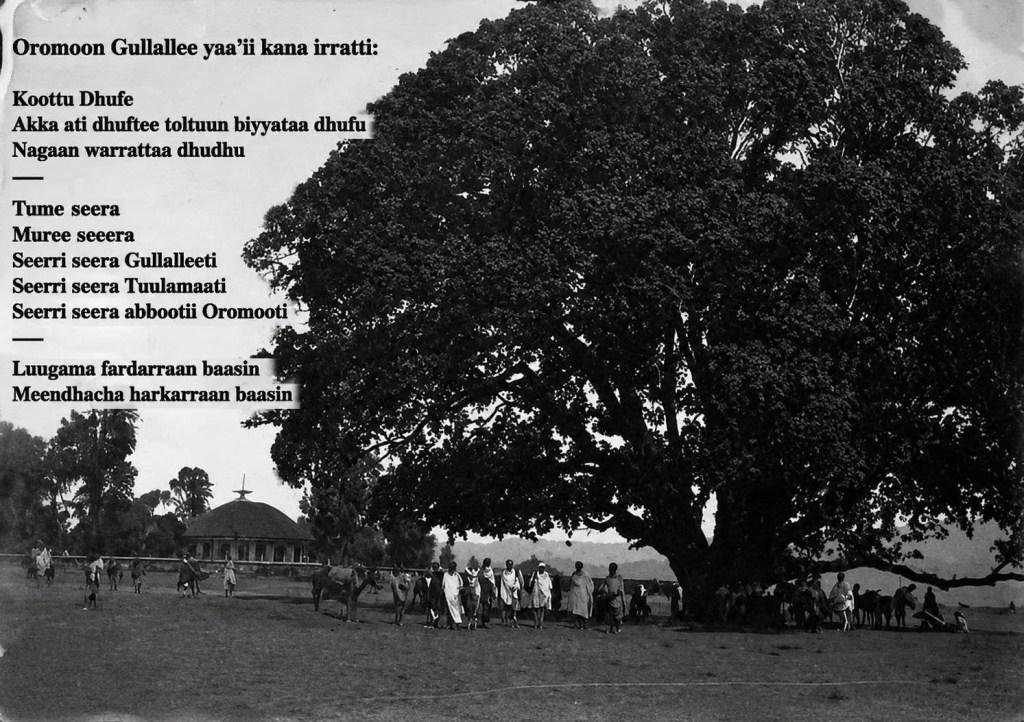
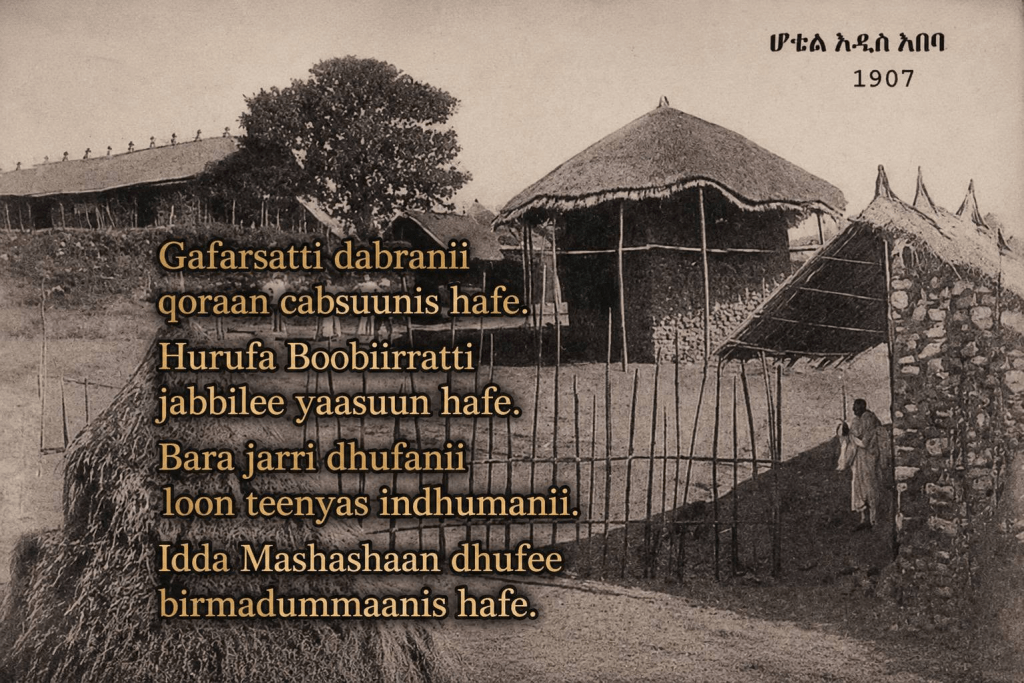
“No more standing on Intotto, to look down at the pasture below, No more taking cattle to Finfinnee, to water at the mineral spring. No more gathering on Tulluu Daalattii, where the Gullallee assembly used to meet. Since Mashasha came, freedom has vanished.”
The Uprising of 1878
The Gullallee Oromo rose in a major uprising in 1878. They had endured years of oppression—land dispossession, cattle raids, and the subjugation of their women. The final straw came when Menelik’s soldiers began taking Oromo women by force.
According to oral tradition, the Oromo women of Gullallee, tired of being violated by the colonisers, gathered together and devised a plan. They told their husbands:
“We are being forced to sleep with the enemy. If you do not act, we will take matters into our own hands.”
The men, shamed into action, organised a rebellion. The Gullallee warriors launched a coordinated attack against the colonisers, using the cover of darkness and their intimate knowledge of the terrain.
But they were outmatched. Menelik sent a massive army under his nephew, Dajjaach Mashashaa Seifu, to crush the rebellion. The Gullallee were defeated. Thousands were killed, and the survivors were scattered.
The Dispossession Continues
The defeat of the Gullallee uprising was followed by a systematic campaign of ethnic cleansing. The Oromo were driven from the heart of Finfinne—from areas now known as Arat Kilo, Siddist Kilo, Piassa, Mercato, and beyond.
The land was given to Menelik’s generals and loyalists. Oromo farms were confiscated. Oromo cattle were taken. Oromo children were forced into servitude.
The Gullallee were scattered to the winds. Some fled to neighbouring Oromo areas—to Meettaa, Sooddo, Bacho, Ada’a Bargaa, Waliso, and Kuttaaye. Others remained in Finfinne, but their numbers dwindled as they were steadily pushed to the margins.
Even today, the dispossession continues. In the areas of Bole, Garji, Bulbula, Laaftoo, Makkannisa, Kaarra Qoree, Buraayyuu, Askoo, Shoogalee, and Qaallittii, Oromo families are being displaced to make way for new developments.
The Resilience of the Oromo Gullallee
Despite the centuries of oppression, the Oromo Gullallee have not been broken. They have preserved their culture, their language, and their identity against all odds.
Their resilience is captured in the songs they still sing:
“Bole was once a field of wheat and barley, Now it is covered with villas. The cattle that once grazed there are gone, The land has been taken by strangers.”
Another song laments the loss of the land while affirming the unbroken spirit of the people:
“Bole, O water of Bole, The villas have covered the field. Tomorrow we will go to Jimma, This evil time will pass. Stand firm, stand firm, do not give up!”
The Struggle Continues
The history of the Oromo Gullallee is not just a story of the past—it is a story of the present. The Oromo people of Finfinne and its surrounding areas continue to face displacement, marginalisation, and the erasure of their identity.
The current government, under the Prosperity Party, has continued the policies of its predecessors. The Oromo Special Zone surrounding Finfinne has been systematically dismantled. Oromo farmers in areas like Buraayyuu, Garjii, Bole, and Laaftoo have been displaced to make way for the expansion of the capital.
But the Oromo people have not given up. They continue to resist, to organise, and to demand justice.
A Call to Action
The history of the Oromo Gullallee is a call to action for all Oromo people. It is a reminder that the struggle for Finfinne is not just about land—it is about identity, dignity, and justice.
As the late Dr. Makuraa Bulchaa wrote:
“We have been lamenting for too long. Let us leave that behind and move forward—both at home and abroad. Let us organise our people, let us build our institutions, let us strengthen our unity, and let us fight for our freedom.”
The path to liberation is clear: unity, organisation, and determination. The Oromo people must overcome their divisions, strengthen their institutions, and build a coordinated struggle that will leave the colonisers with no option but to retreat.
Conclusion
The history of the Oromo people of Finfinne is a history of suffering, but it is also a history of resilience. From the heroes of Gullallee to the Qeerroo of today, the Oromo people have never ceased to resist.
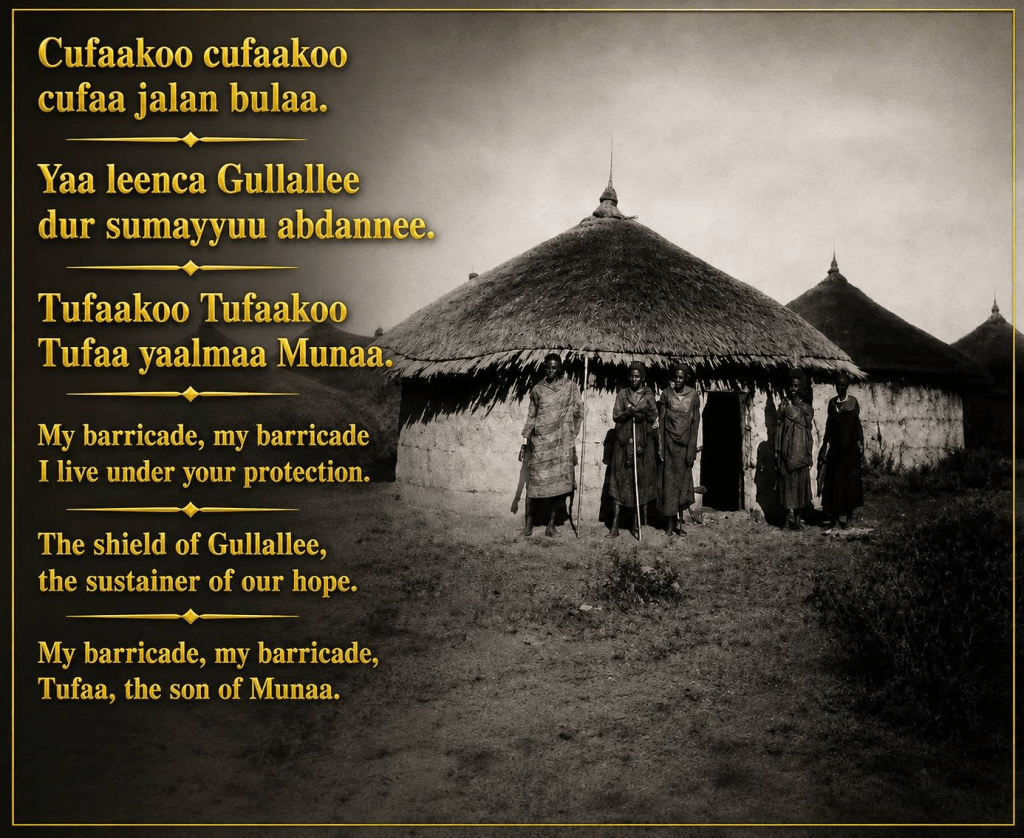
The memory of Tufaa Munaa, Hasanuu Wadaay, and countless other heroes reminds us that the struggle for freedom is a sacred duty. Their sacrifice calls us to action.
Finfinne is not just a city—it is the heart of Oromia. And as long as the Oromo people remember their history, they will never give up the fight to reclaim it.
This feature article is dedicated to the Oromo Gullallee and all the Oromo people who have endured displacement and oppression, and who continue to resist for a free and just Oromia.
When we speak of the great civilisations of antiquity, our minds often turn to Egypt, Greece, or Rome. But long before the Persian Empire rose to dominance, there existed in the heart of Africa a kingdom of extraordinary power, wealth, and sophistication—the Kingdom of Kush.
The Kingdom of Kush, with its three major cities of Meroe, Kerma, and Napata, emerged in the Nubian Desert south of Egypt along the Upper Nile River Valley from the 2nd millennium B.C. to the fourth century A.D. . For over a thousand years, Kush was a major power in the Nile valley, controlling an empire that at its height stretched from Central Sudan to the Mediterranean .
The achievements of this ancient civilisation challenge long-held beliefs that Egypt was the sole centre of advancement in the region. As renowned archaeologist Charles Bonnet’s excavations have revealed, Kush was not a mere vassal state of Egypt but a powerful and independent kingdom with its own distinctively indigenous culture . This sophisticated political state organised trade to the Mediterranean basin and built up a military strong enough to resist Egyptian forces .
The Black Pharaohs: A Legacy of Power
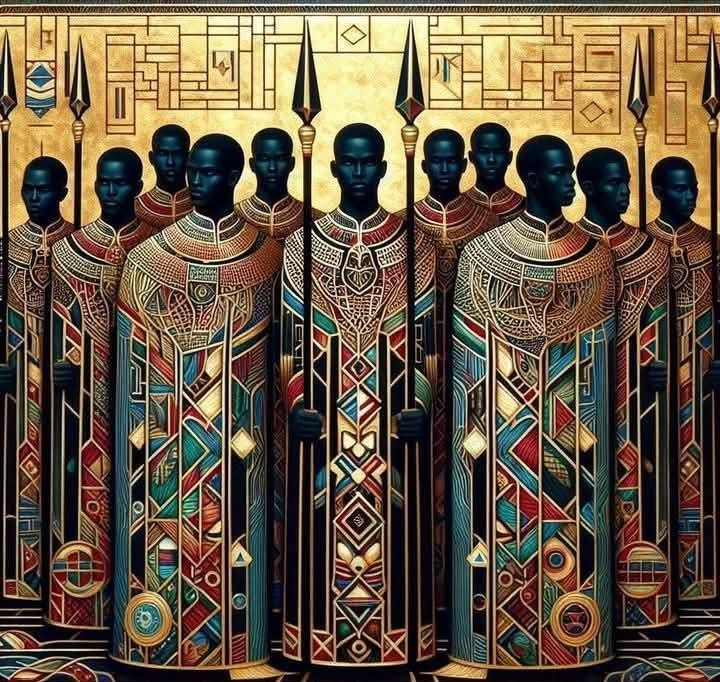
The Kushite rulers of Egypt’s 25th Dynasty, often referred to as the “Black Pharaohs,” represent a pivotal moment in the history of the Nile Valley. Emerging from the Kingdom of Kush at Napata in Nubia, these rulers not only unified Egypt after centuries of fragmentation but also reinvigorated pharaonic traditions .
The first major figure of this dynasty, King Piye, launched a campaign into Egypt during a period of political fragmentation known as the Third Intermediate Period. His Victory Stela records the subjugation of Delta rulers and proclaims his role as restorer of order . By 730 BCE, Piye had conquered Lower Egypt, establishing Kushite authority over both Upper and Lower Egypt .
The dynasty reached its zenith under Taharqa (690–664 BCE), whose reign is remembered for monumental building projects and ambitious foreign policy. Taharqa sponsored extensive temple construction at Karnak, Kawa, and Jebel Barkal, reinforcing his devotion to Amun and his claim to pharaonic legitimacy . He intervened in the Levant, supporting coalitions against Assyrian expansion, and is mentioned in both Biblical and Assyrian sources .
One of the most remarkable features of Meroitic civilisation was its powerful queens. The title “Candace,” meaning “sister,” was given to Kushite queens . Queens such as Amanirenas—who signed a peace treaty with the emperor Augustus—and Amanishakheto, whose treasure was looted in 1834, demonstrate the prominent role of women in Kushite society .
Kush: More Than a Footnote
The Kingdom of Kush was more than a civilisation; it was a power that commanded both land and sea. Kushite armies were formidable, and their military prowess allowed them to conquer and control Egypt itself . Kush also boasted a powerful navy, controlling trade routes along the Nile and beyond .
The economy of the ancient Kushites relied on trade in exotic African goods with Egypt and beyond. As middlemen, Kushite traders passed along ivory, ebony, incense, and other exotic goods from the South to the Egyptians, who then traded with other Mediterranean peoples . The city of Kerma, with its strategic location on the Nile River, controlled this crucial trade route .
Kush produced more gold than anywhere in the world at that time . Archaeologists have uncovered massive gold-processing operations at sites like Hosh el-Guruf, revealing the scale of Kush’s wealth . Minerals and high-quality stone were also mined for trade, and the Kushites introduced and developed iron metallurgy to the region .
A Sophisticated Society
The art and architecture of the Kushites reveal a sophisticated society of innovative craftsmen who constantly assimilated new artistic techniques from other lands . Notable architecture includes stone temple complexes such as the Lion Temple at Naqa and the steep-sided, solid pyramids found at Meroe and Jebel Barkal .
In fact, Sudan has more pyramids than all of Egypt—a testament to the grandeur of the Kushite civilisation . These tall, slender, graceful monuments bear witness to the lasting splendour of Kush .
Kushite art includes narrative tomb wall paintings and unique, eggshell-thin pottery with geometric patterns traded all over the Mediterranean . Stoic granite and bronze statues of gods and kings convey the religious beliefs of this ancient people .
The Question of Cush
The name “Kush” has been connected since at least the time of Josephus with the biblical character Cush, son of Ham (Genesis 10:6). Ham had four sons: Cush, Put, Canaan, and Mizraim (Egypt) . According to the Bible, Nimrod, a son of Cush, was the founder and king of Babylon, Erech, Akkad, and Calneh .
The Cushitic-speaking peoples, who are the ethnolinguistic groups speaking Cushitic languages natively, are today found primarily in the Horn of Africa, with minorities in Egypt, Sudan, Kenya, and Tanzania . Proto-Cushitic was spoken on the Ethiopian Highlands by 5000–4000 BC .
A Civilisation Worthy of Recognition
The Kingdom of Kush is not merely a footnote in the history of Africa—it is a testament to the power, ingenuity, and resilience of the peoples of the Nile Valley. As the American Journal of Archaeology notes in its review of The Nubian Pharaohs of Egypt, the term “Black Pharaohs” has sometimes been used to market exhibits, but the historical significance of Kush extends far beyond its interaction with Egypt . Sudanese colleagues and community members rightly resent the idea that the kings of ancient Sudan are only important because they ruled over Egypt . The Kingdom of Kush deserves to be remembered on its own terms.
Honouring the Voices That Speak for the People’s Will
By Meseret Daba Kene
There are moments in the life of a nation when silence is not an option. There are times when the weight of history, the suffering of generations, and the hope of the future demand that we speak—clearly, boldly, and without fear. And when someone rises to that occasion, we must recognize them, honour them, and stand with them.
A Voice That Cannot Be Silenced
In the ongoing struggle for justice and self-determination, some voices stand out not because they are loud, but because they are true. I am thinking of figures like Aadde Sa’aadaa Abdurahamaan and others in the Caffee Oromiyaa who have spoken with courage and conviction about the question of Finfinne and the will of the Oromo people.
They have stood at the forefront, speaking truth to power, expressing the dreams and aspirations of a people who have been marginalized, dispossessed, and silenced for generations. They have not wavered. They have not been intimidated. They have spoken with the clarity of those who know that the truth is on their side.
And for that, we are grateful.
“Yoo dubbadhu jettan kaa,” —when they chose to speak, they spoke not for themselves, but for the millions who have no voice, for the ancestors who sacrificed, and for the generations yet to come.
The Will of the People
What has been expressed by these brave individuals is not a personal opinion—it is the will of the people. It is the collective desire of a nation that has been denied its rightful place in history. It is the demand for justice, dignity, and recognition.
When they spoke about Finfinne, they spoke about the heart of Oromia—a city that was built on Oromo land, a city that holds the blood and bones of Oromo martyrs, a city that must be recognized as an integral part of Oromo identity.
They expressed the will of the people with such conviction that it left us in awe—not of their words, but of their courage. And we must not let that courage go unrecognized. We must not let that truth be silenced.
The Foundation of Unity
The unity of the Oromo people is not something to be taken for granted. It is built on the foundation of truth, justice, and mutual respect. When we stand together, we are unstoppable. When we speak with one voice, we cannot be ignored.
This is why the work of those who speak for the people is so important. They remind us that we are not alone. They remind us that we have a collective destiny. They remind us that our strength lies in our unity.
“Waan hundi gaarummaaf ta’e!” —everything that happens is for the greater good. Even the challenges we face, the struggles we endure, and the sacrifices we make are all part of a larger purpose: the liberation and prosperity of our people.
A Future of Peace and Prosperity
There is no doubt in my mind that the future of our people is bright. The road may be long and difficult, but the destination is certain. Peace, security, and prosperity will come to our people—not as a gift from others, but as a result of our own efforts, our own unity, and our own determination.
“Nagaan, tasgabbii fi badhaadhinni biyyaafi saba keenyaaf ni ta’a!” —peace, security, and prosperity will be ours.
This is not a naive hope. It is a conviction born of history, experience, and faith. It is a belief that justice will prevail, that truth will triumph, and that the will of the people cannot be defeated.
The Power of Gratitude
In the midst of struggle, it is easy to focus on the difficulties—the losses, the pain, the setbacks. But we must also remember to be grateful. Grateful for those who have stood up for us. Grateful for those who continue to fight. Grateful for the unity that sustains us.
“Hundi keessanu galatoomaa” —thank you all.
Thank you to the leaders who have spoken truth to power. Thank you to the activists who have kept the flame of resistance alive. Thank you to the ordinary citizens who have refused to give up hope. Thank you to the ancestors who paved the way.
A Final Reflection
The struggle for justice is not a sprint—it is a marathon. There will be setbacks. There will be disappointments. There will be moments of doubt. But we must never lose sight of the goal: a free, just, and prosperous Oromia.
Those who have spoken out, who have risked their freedom and their lives for the cause of our people, are our heroes. They are the pillars upon which our future will be built. They are the architects of our liberation.
Let us not forget them. Let us not forget their sacrifice. And let us not forget the truth they have spoken.
Injifannoon Ummata Oromoo!
Nagaan fi tasgabbii haa jabaattu!
Hundi keessanu galatoomaa!
This reflection is dedicated to Aadde Sa’aadaa Abdurahamaan and all those who have dared to speak the truth on behalf of the Oromo people. Your courage inspires us, and your sacrifice will never be forgotten.
As the golden hues of the Ethiopian spring—known as Birraa—begin to blanket the landscape, a profound spiritual and cultural awakening stirs across Oromia. This year, the 2018 Irreecha festival, celebrated on September 24th at Hora Finfinne and September 25th at Hora Arsadee-Bishooftuu, carries a particularly resonant theme: “Irreecha: Olka’iinsa Biyyaatiif” (Irreecha: For the Elevation of the Nation). Following a sacred itinerary, the Council of Oromo Gadaa Elders has announced the events will be observed consecutively, beginning with morning rituals.
This year’s Irreecha stands apart, marking a triumphant return to tradition after a long night of cultural suppression. The proclamation of the Oromo Cultural Renaissance, coinciding with the blessing of the Great Ethiopian Renaissance Dam (GERD), adds a layer of double joy and profound national significance. The very air hums with the promise of renewal.
The Soul of a Nation: Culture as Identity
Culture is the radiant mirror of a people’s soul. It is through their customs, rituals, and traditions that a community reveals its unique character to the world. For the Oromo people, one of the largest nations in the Horn of Africa, culture is not merely a collection of artifacts but the living fabric of daily existence.
The Oromo possess a rich cultural tapestry, interwoven with the rhythms of their environment. Their traditions—from the sacred union of marriage and the art of traditional attire to the intricate wisdom of the Gadaa system—all reflect a deep, symbiotic relationship with the land and the cosmos. Central to this worldview is a profound reverence for Waaqa (God), the Creator.
For centuries, Oromo life was guided by a seamless integration of work, social structure, governance, and spirituality. This harmony was, however, violently disrupted from the era of Emperor Menelik II through the oppressive Derg regime. The Oromo people endured systematic marginalization, their identity and cultural practices suppressed. Their language, customs, and even their names were targets of state-sanctioned denigration.
Yet, like the resilient birbirsaa plant that thrives after the rains, the Oromo spirit endured. The fall of the Derg in 1991 and the subsequent constitutional recognition of the Oromo language and culture heralded a new dawn. A people once forced into the shadows of history could now reclaim their heritage in the full light of day.
Waaqeffanna: The Oromo Spiritual Tradition
At the heart of Oromo identity lies Waaqeffanna, the indigenous belief system. The Oromo have been custodians of a monotheistic faith since time immemorial, believing in a single, omnipotent Waaqa who is the sole Creator of the universe.
Unlike other systems, Waaqeffanna does not worship idols or intermediary deities. It is a direct, personal connection between the worshipper and the Creator. The Oromo believe that Waaqa is the source of all life and power, and that this power manifests through the natural world. The rivers, mountains, trees, and lakes are not gods themselves but sacred creations through which Waaqa’s majesty is revealed.
This philosophy is elegantly expressed through Irreecha, the ultimate act of thanksgiving and spiritual communion. The elders teach that Irreecha is simply “giving thanks to the one God.” It is the pinnacle of Oromo religious and cultural expression, a testament to the enduring faith of a people in the face of adversity.
The Seasons of Life: Why Irreecha is Celebrated
To understand Irreecha, one must understand the Oromo calendar and the life-giving cycle of the seasons. Following the long, harsh rains of the Ganna (winter) season, the landscape transforms. Mighty rivers swell, roads turn to impassable mud, and communities are often separated. Nature, in its raw power, hibernates.
Then comes Birraa, the spring season. The rains recede. The sky clears to a brilliant blue. The mud dries, opening pathways. The once-dormant earth erupts in a spectacular bloom of yellow, white, and purple flowers. The oyiruu (crops) transform from green foliage to golden, life-sustaining grain. This is the season of hope, rebirth, and abundance.
It is in this moment of transition, from the darkness of winter to the light of spring, that the Oromo offer Irreecha. It is a heartfelt “thank you” to Waaqa for guiding them through the difficult months and for bestowing the first fruits of the harvest. It is a powerful acknowledgment of the divine order that governs existence.
“Baga Booqa Birraa geessan!” — “Welcome, the freshness of spring!” is the joyful greeting of the season.
Two Hallowed Places: Irreecha Tulluu and Irreecha Malkaa
The Irreecha rituals are held in two distinct settings, each reflecting a different phase of the spiritual and agricultural cycle.
Irreecha Tulluu (Irreecha of the Mountain)
As the dry season (Bona) takes hold, the land becomes parched, and water sources dwindle. The elderly of the community, acting on ancient knowledge, would gather at a designated highland—a Tulluu—believed to be closer to the divine. Here, they would raise their hands to the sky, beseeching Waaqa for rain. Their prayers, steeped in the wisdom of the Cushitic cosmological tradition, seek to restore the balance of nature and ensure the renewal of life.
Irreecha Malkaa (Irreecha of the River)
This is the main event. Held at the outset of Birraa around mid-September, Irreecha Malkaa is a vibrant, joyous, and public festival. The Oromo gather at the banks of rivers, lakes, or springs—places where the life-giving water is most tangible.
For this occasion, the community dresses in their finest traditional attire. The men wear colorful Wandaboo (shoulder cloths) and carry traditional weapons or staffs, while the women don elegant, flowing gowns and adorn themselves with intricate hairstyles and beaded jewelry, known as Calallee. The youth, particularly the Kormoomsaa (young warriors), move through the crowd, sprinkling people with fresh water, a gesture of cleansing and blessing.
At the appointed time, the Abbaa Gadaa (the Gadaa leader) and elders lead the procession. They carry the sacred Bokkuu (staff of office), Margaa (leaves of peace), and Callacha (ceremonial container). Chanting the sacred mantra “Maareewoo, Maareewoo!”—a powerful invocation of the divine—the throng moves toward the water’s edge.
Water is dipped from the river and touched to the forehead. This act signifies purification and a prayer for longevity and prosperity. The air fills with the sound of devotional songs and prayers.
“Obiin, kunni, malkaa nu gaha, ya Waaqa, nu eebbisi!” (Leader, take us to the river, O God, bless us!)
Irreecha Finfinne and Bishooftuu: The Heartbeat of the Festival
While Irreecha is celebrated across Oromia, the largest and most significant gatherings take place in two locations.
Hora Finfinne (Lake Finfinne), in the heart of the capital, is a site of profound historical significance. For decades, under oppressive regimes, public celebrations were banned. Holding Irreecha in Finfinne is a powerful act of reclaiming space and identity.
Hora Arsadee-Bishooftuu in the city of Bishooftuu is another major center. This location is famed for its beautiful, natural landscape. The specific gathering spot is near a sacred body of water believed to be a site of ancient Oromo worship. The historical figure Harsadi, of the Liiban clan, is associated with this lake.
In recent years, the scale of these gatherings has been staggering. It is estimated that over four million people attend the main Irreecha in Bishooftuu, making it one of the largest annual gatherings of people on the African continent. International media, including the BBC, Al Jazeera, and CNN, have taken note, broadcasting the awe-inspiring images of hundreds of thousands of people dressed in a vibrant sea of colors, moving with purpose and joy.
The day is a total immersion in culture and community. After the prayers and rituals, families and friends return home to share a meal of traditional dishes and freshly brewed Bunaa (coffee). The atmosphere is one of profound peace and unity.
A Culture Reborn
This year’s Irreecha is more than a religious ceremony; it is a powerful statement of cultural resilience. The revival of Irreecha after years of suppression represents a people reconnecting with their spiritual roots, reclaiming their heritage, and looking towards the future with hope.
The Oromo are announcing to the world that their culture, with its deep-rooted values of democracy, community, and spirituality, is not a relic of the past but a vibrant force for the present and future. Irreecha stands as a testament to the enduring spirit of a nation that has overcome immense challenges and continues to celebrate life, faith, and unity with unparalleled passion and dignity.
Deebi’uu: As the sun sets on the banks of Hora Arsadee, the echoes of “Maareewoo” fade into the cool evening air. The Oromo people have once again fulfilled their covenant of thanksgiving, carrying in their hearts the promise of a bright and prosperous future.
We Knew This Was Coming — Yet We Chose to Stay Silent
By Koste Abdiisaa
If we had shown even 1% of the outrage we have expressed over the past two days three, four, or five years ago—when Fano killed hundreds of innocent Oromos in Kiramu, Hagamsa, Amuru, Alibo, Jardega-Jartee, and elsewhere—perhaps these killings would not have happened.
We knew this was coming. The signs were everywhere. The warnings were clear. Yet we chose to remain silent. We chose to look away. We chose to believe that the storm would pass us by.
But storms do not pass by those who refuse to prepare. They break over them.
The Warning Signs We Ignored
For years, the enemies of the Oromo people have been methodically preparing for this moment. While we argued among ourselves, they were opening training camps in our backyard. While we engaged in name-calling and petty divisions, they were building security structures and training hundreds of people to carry out their plans.
We saw it happening. We heard the reports. We knew that innocent farmers—our farmers—were being killed in Kiramu, Hagamsa, Amuru, Alibo, Jardega-Jartee, and countless other places. And what did we do?
We expressed outrage on social media. We posted our anger, shared our grief, and then went back to business as usual.
Our collective inaction allowed this to continue. Our silence gave them permission to proceed. Our failure to act was an invitation for more violence.
The Consequences of Inaction
This is not about hindsight. This is about foresight—and our failure to use it. We cannot pretend that these killings were unexpected. We knew what was coming. We had every warning. But we failed to act.
And now, the consequences are here.
The killing of our innocent farmers is not just a tragedy—it is a judgment on our collective failure to protect our own. It is the result of years of political naivety, misplaced priorities, and a refusal to confront the reality of the threat we faced.
We were good at crying after the fact. We were good at expressing outrage on social media after tragedies happened. But we were very poor at recognizing threats early on, listening to those who recognized them, and preparing ourselves to face them.
The Deeper Outrage
Like many of you, I am outraged by the killing of our innocent farmers. But I am even more outraged by our inaction—our lack of political awareness, our failure to recognize and respond to such cruelty for so long.
What is even more troubling is that some of our so-called political entities—those who claim to speak for us—continue to seek alignment with those responsible. They act as if there is still some humanity left in them to appeal to. They still hope for dialogue with those who have shown, time and again, that they have no interest in peace, only in domination.
This is not leadership. This is delusion.
And we, as a people, have allowed it. We have allowed ourselves to be led by those who refuse to see the enemy for what they are. We have allowed ourselves to be distracted by petty divisions while our people are being slaughtered.
The Beginning, Not the End
Let us not pretend that this is the end. This is the beginning. The attacks will continue. The killings will escalate. And if we do not act now—with unity, determination, and clarity—the tragedies we see today will seem small compared to what is coming.
I fear that we may still fail to act in a timely manner. I fear that we will continue to cry and express outrage for a week, and then return to normal life. I fear that we will continue to do what we seem to be good at: mourning after the fact, but never preparing for what lies ahead.
A Call to Look Within
If this senseless killing of our people does not make us angry enough to question our collective inaction, then perhaps we need to look within ourselves and ask: What kind of society have we become?
Have we become a people who only react after the damage is done? Have we become a people who prioritize social media outrage over real action? Have we become a people who are more concerned with who is right than with what is right?
We must ask ourselves these questions. And we must answer them honestly.
The Path Forward
We cannot change the past. The blood that has been spilled cannot be unspilled. But we can change the future. We can act now—today—to ensure that these tragedies do not continue.
This requires several things:
Unity: We must put aside our petty divisions and unite as a people. Our enemies are united; we must be even more united.
Awareness: We must wake up to the reality of the threat we face. We must recognize the signs and act before it is too late.
Action: We must support those who are willing to sacrifice and risk their lives to defend our people. We must build the structures and institutions necessary to protect ourselves.
Accountability: We must hold our political entities accountable. We must demand that they prioritize the defense of our people over their own political ambitions.
Resilience: We must be prepared for the long fight ahead. This is not a battle that will be won in a day. It requires patience, courage, and an unwavering commitment to our people.
Conclusion: Enough Is Enough
The killing of our innocent farmers is a crime against humanity. But our collective inaction is a crime against ourselves.
We cannot afford to continue down this path. We cannot afford to remain silent while our people are being slaughtered. We cannot afford to wait until the next tragedy to express our outrage.
Enough is enough.
Let us honor the memory of those who have been killed by resolving to act—not just with words, but with deeds. Let us build a future where our people are safe, our land is protected, and our dignity is restored.
Injifannoon Ummata Oromoo!
Nagaan haa jabaatu!
This reflection is dedicated to the innocent Oromo farmers who have lost their lives, and to all those who are determined to build a future of peace, justice, and security for our people.
(Finfinne, 12 August 2026) -Ethiopia’s youth are not just the leaders of tomorrow—they are the architects of today. With the country’s demographic composition showing that young people make up the largest segment of the population, this is not merely a statistic—it is a tremendous opportunity to secure prosperity and lasting development for the nation.
Prime Minister Abiy Ahmed Ali has called on the youth to be the engine of change, the driving force behind transformation, and the solid pillars of Ethiopia’s sovereignty.
The Youth: A Force for Positive Change
In a recent message, the Prime Minister emphasized that Ethiopian youth are guided by noble goals and a clear vision for the future. They are the primary motor of transformation in our society—the unshakable pillars upon which the nation’s sovereignty rests.
Today’s youth are writing a new chapter in the history of Ethiopia. They have turned away from harmful legacies of the past—unproductive traditions, unnecessary rivalries, and destructive conflicts. Instead, they are focusing on development, progress, and the fight against poverty.
A Government Committed to Youth Empowerment
The “Prosperity Party” government is working with dedication and commitment to strengthen the comprehensive participation of youth in all spheres of life. The role of youth in leadership and decision-making is being reinforced, recognizing that the future of Ethiopia depends on the active engagement of its young people.
Key priorities include ensuring equal opportunities for all young people, strengthening youth leadership roles in governance and society, promoting comprehensive participation in economic, social, and political life, and building a nation where young people can thrive and contribute fully.
A Call to Action: Building Our National Vision Together
The Prime Minister has called upon all youth to engage actively in the development of our nation, to work with love and dedication for the prosperity of Ethiopia, to reject division and conflict while embracing unity and progress, and to embrace innovation and creativity to build a brighter future.
Conclusion: The Youth Are Our Hope
Ethiopia’s youth are the heartbeat of the nation, the hope of the future, and the strength of the present. Their energy, creativity, and commitment will shape the destiny of our people for generations to come.
Ethiopia Prevails!
Youth is Power!
Change is Now!
This feature article is dedicated to all the youth of Ethiopia—the architects of a brighter future!
Recognizing the Pillars of Our Community — Jaal Naarobika Baayisaa, Jaal Giiftii Waaqoo, and Jaal Mergitu Argo
By Dhabessa Wakjira
In the heart of the Oromo nation, there exists a force that is as powerful as it is beautiful—the daughters of Oromia. They are the carriers of culture, the guardians of tradition, and the voices of resilience that echo across generations. Today, we pause to honour three remarkable women who embody the spirit of Oromo womanhood: Jaal Naarobika Baayisaa, Jaal Giiftii Waaqoo, and Jaal Mergitu Argo. ❤️
The Daughters of Oromia: A Legacy of Strength
Oromo women have always been the backbone of their communities. From the ancient traditions of the Gadaa system to the modern struggles for justice and recognition, they have stood firm, unyielding, and courageous. They have raised children, preserved culture, and fought for the dignity of their people.
The phrase “Shamarran Oromiyaa” —the daughters of Oromia—carries within it the weight of history and the promise of the future. It is a title of pride, honour, and responsibility. It speaks of women who refuse to be silenced, who refuse to be erased, and who refuse to accept anything less than justice for their people.
Jaal Naarobika Baayisaa: A Beacon of Courage
Jaal Naarobika Baayisaa is a name that resonates with strength and determination. As a daughter of Oromia, she has exemplified the qualities of leadership, resilience, and unwavering commitment to the Oromo cause. Her story is one of courage in the face of adversity—a testament to the power of a woman who refuses to bow to oppression.
Her contributions to the Oromo community, whether through activism, cultural preservation, or community organizing, have left an indelible mark. She stands as a role model for young Oromo women, showing them that their voices matter and that their dreams are valid.
Jaal Giiftii Waaqoo: A Voice for Justice
Jaal Giiftii Waaqoo is a name that has become synonymous with the fight for Oromo rights and dignity. Her unwavering commitment to justice and her fearless advocacy have inspired countless others to join the struggle. She has spoken truth to power, refusing to be intimidated by those who seek to silence the Oromo voice.
Her work has touched the lives of many, from the villages of Oromia to the diaspora communities around the world. She has reminded us that the struggle for justice is not just a political fight—it is a deeply personal one, rooted in the love for one’s people and one’s land.
Jaal Mergitu Argo: A Pillar of Resilience
Jaal Mergitu Argo represents the resilience that defines Oromo women. In the face of challenges that would break others, she has remained steadfast, drawing strength from her culture, her community, and her faith. Her journey is a reminder that resilience is not just about enduring hardship—it is about rising above it and building a better future.
Her contributions to the Oromo community, whether through education, advocacy, or cultural preservation, have been invaluable. She has shown that Oromo women are not just participants in the struggle—they are leaders, innovators, and the architects of a brighter future.
The Power of Oromo Womanhood
The stories of Jaal Naarobika Baayisaa, Jaal Giiftii Waaqoo, and Jaal Mergitu Argo are not just their own—they are the stories of countless Oromo women who have contributed to the resilience and strength of the Oromo nation. They remind us that Oromo women are not just victims of oppression—they are agents of change, builders of community, and the heart of the struggle.
In Oromo culture, women have always held a special place of honour. The Siiqqee institution, for example, has been a powerful symbol of women’s agency and a mechanism for ensuring gender balance and social justice. This tradition is not just a relic of the past—it is a living practice that continues to inspire Oromo women today.
A Call to Celebrate and Honour
As we honour these three remarkable women, let us also honour all the daughters of Oromia—past, present, and future. Let us celebrate their strength, their beauty, and their resilience. Let us recognize their contributions to the Oromo nation and their role in shaping a future of justice, dignity, and self-determination.
To the daughters of Oromia: You are the heartbeat of the nation. You are the carriers of culture, the guardians of tradition, and the voices of hope. Your strength inspires us, your courage emboldens us, and your love sustains us.
Conclusion: A Legacy That Endures
Jaal Naarobika Baayisaa, Jaal Giiftii Waaqoo, and Jaal Mergitu Argo represent the best of what it means to be a daughter of Oromia. Their contributions to the Oromo cause, their commitment to justice, and their unwavering resilience are a testament to the power of Oromo womanhood.
Shamarran Oromiyaa — The daughters of Oromia — will always be the strength of the nation.
Injifannoon Ummata Oromoo!
Jaal Naarobika Baayisaa, Jaal Giiftii Waaqoo, and Jaal Mergitu Argo — you are honoured!
This feature article is dedicated to all the daughters of Oromia who have contributed to the struggle for justice, dignity, and self-determination. Your legacy will endure for generations to come.
In the early 1960s, Ethiopia was a nation of silence. Political parties were banned. Open dissent was crushed. The empire of Haile Selassie I, with its ancient Amharic-speaking elite, governed through a system of centralized control that left little room for the voices of its largest ethnic group—the Oromo.
Yet, in the cramped offices of Addis Ababa, three small self-help groups began to meet. The Jibat and Macha, the Metta Robii, and the Tulama Shawa associations had been formed to provide modest social relief to Oromo communities. But in 1963, these three organizations merged into something far more significant. They became the Macha-Tulama Self-Help Association—Waldaa Wal-gargaarsa Maccaa fi Tuulamaa—and in doing so, they ignited a fire that would reshape Oromo history forever.
A Name That United a People
The association took its name from two of the major Borana Oromo clans: Machaa and Tulema. But its vision was far broader than any single clan. It was designed to embrace all Oromos, irrespective of religion or region, and even welcomed non-Oromo nationalities who accepted its objectives. Its founders were a remarkable group: Hail Mariam Gamada, a lawyer; Alemu Qixxeesa, a retired colonel; Mamo Mezemer; and others who had been educated in the imperial system but had “subsequently rediscovered their culture”.
The most prominent leader was Tadesse Birru, a former general in the Ethiopian police force and territorial army. A Shewa Oromo who had been fully integrated into Amhara culture, his Oromo origins were not apparent to many until he began to champion the cause of his people. His conversion was a powerful symbol: a man who had risen to the highest ranks of the imperial establishment, turning his back on privilege to fight for his own people.
Two Levels of Purpose
The association operated on two distinct levels. The first was practical and visible: it built schools, health clinics, roads, and water supplies across Oromia. It constructed churches and mosques for believers who had none. It provided financial and legal assistance for the disabled and unemployed.
But the second objective was political—and far more dangerous. In an era when political parties were forbidden, the Macha-Tulama Association became a vehicle for Oromo nationalism. It was the first movement to articulate Oromo grievances in a public, organized manner. It championed “the social, educational, cultural and political rights of the Oromo people”. It politicized the masses and, through its dynamic Youth Wing, produced revolutionary literature that circulated underground. Its very existence marked “the public rise of Oromo nationalism”.
The Threat to Empire
The association’s rapid growth was breathtaking. At its height, it claimed as many as 200,000 members. It expanded “very rapidly all over Oromiyaa as a Pan-Oromo movement”. It was most successful in the south, particularly in Arsi, where Oromos had been relegated to the status of tenants on their own land after being conquered by Menelik’s forces.
For the imperial government, this was an existential threat. The Ethiopian state accused the association of committing “acts of terror” in an effort to suppress the developing Oromo National Movement. The repression was swift and brutal.
The Crackdown
In 1966, the Macha-Tulama Association was banned. Its leaders were arrested, imprisoned, and some were executed. Tadesse Birru, Mamo Mezemir, Alemu Kitessa, and others were imprisoned and killed for their humanitarian and political activities. The association was banned during the imperial regime, again under the Derg, and once more in 2011 under the EPRDF regime. It was accused of “threatening Ethiopia’s unity—an unfounded claim,” according to its current president.
Yet the organization refused to die. It survived underground, and its members continued to organize. The suppression of the Macha-Tulama Association became “an immediate reason for the birth of” a more militant organization. In 1974, the Oromo Liberation Front (OLF) was formed, largely from the underground cells of the Macha-Tulama Association.
A Legacy That Endures
Today, the Macha-Tulama Association—now officially known as the Mecha and Tulema Self-Help Association—continues its work. It regained its legal status in 2019. It celebrated its 60th anniversary in 2024, a testament to its resilience.
Its current president, Diribi Damuse, has outlined the association’s ongoing humanitarian efforts: supporting internally displaced people from Western Oromia, assisting those affected by drought in Borena and Guji, and providing aid to university students and Abba Gada leaders. The association, he emphasized, “has united members from diverse backgrounds, including military, students, intellectuals, and grassroots, including non-Oromo members from Wolayita, Sidama, and other ethnic groups”.
The Unfinished Struggle
The Macha-Tulama Association’s place in Oromo history is secure. It was the first organized, mass-based expression of Oromo identity in the modern era. It bridged the gap between the rural peasantry and the urban intelligentsia. It laid the groundwork for every Oromo political movement that followed.
But its story is also a warning. The association was banned not because it committed violence, but because it united a people. Its leaders were killed not for crimes, but for the crime of demanding dignity. The imperial state, and every regime that followed, understood that a united Oromo people was a threat to centralized power.
As the association continues its work—building schools, feeding the hungry, preserving culture—it carries with it the memory of those who gave their lives. Mamo Mezemir, Tadesse Birru, Alemu Kitessa, and so many others are not just names in a history book. They are the foundation upon which modern Oromo consciousness was built.
The Macha-Tulama Association was the spark. The fire it lit continues to burn.
—
Sources: UNHCR Refugee Review Tribunal; Canada Immigration and Refugee Board; Addis Standard; Wikipedia; AfricaBib; Taylor & Francis; Advocacy for Oromia.
The air in Oromia is heavy with a sense of urgency. Across the region and its surrounding areas, a silent tremor of concern is reverberating through the hearts of its people. We are witnessing a pivotal moment in our history, a time fraught with challenges that test the very fabric of our society. The question is no longer if we will act, but when—and how boldly.
As we look at the current state of affairs, it is impossible to ignore the profound anxieties that grip our communities. The safety net that once held our families together is fraying under the weight of economic strain, environmental upheaval, and political instability. We are, to put it plainly, standing on the precipice of a great ordeal. The need for a unified, robust, and relentless response—a determined stand against the tide of adversity—has never been more critical.
This is not merely a time for sorrow; it is a time for strategy. The path forward is not found in despair, but in the deliberate construction of a new paradigm. We must build a fortress of resilience, brick by brick, institution by institution. It is through the creation of resilient systems—in agriculture, education, and governance—that we can effectively combat the crises that threaten to overwhelm us. We need a “fala/ gaachanaa” (shield) that is not just reactive but proactive, designed to protect the most vulnerable and secure the borders of our collective future.
Yet, the ultimate shield for Oromia is not made of steel or stone; it is made of the mind and spirit of its youth. The young men and women of this generation are the architects of tomorrow. To leave them untrained, unmotivated, or disconnected is to invite disaster. Our imperative is clear: we must educate, energize, and organize the Oromo youth.
This is more than a call to action; it is a call to transformation. We must transform our schools into crucibles of critical thinking, our communities into hubs of entrepreneurial energy, and our political spaces into arenas of constructive dialogue. By doing so, we ensure that our youth do not become victims of circumstance, but rather, become the standard-bearers of a proud heritage. They must become the vanguard that carries the torch of Oromia forward, ready to stand as “gaachana” (champions) for their land and their people.
It is a saddening truth that the heritage of the Oromo people—a legacy of resilience, democracy, and cultural richness—is at risk of being eroded. We are custodians of a “Dhaloota qaroo” (a heritage of value), a distinct identity that has survived for millennia. To protect this inheritance is to diversify it; to bring in new voices, new ideas, and new energy. We must ensure that the narrative of our people is written not by our oppressors, but by our own hands, in our own words.
The time for deliberation is over. The foundations of a new era must be laid today. It is not enough to hope for a brighter tomorrow; we must labor for it. Starting today, we must commit to the arduous but noble task of rebuilding. Starting today, we must bridge the divides that separate us. Starting today, we must empower the next generation to take the helm.
The challenges are great, but the spirit of Oromia is greater. Let us meet this moment with the courage it demands. The hour of need is upon us, but it is also an hour of opportunity. Let us rise, unite, and forge a destiny worthy of the sacrifices of our ancestors and the dreams of our children.
Advocacy for Oromia was established in 2010 with the purpose of enabling and empowering Oromo people by providing accurate and timely information that will help to make better choices to create the kind of future in which they wish to live.
It also provides information focus on the major issues facing us in the 21st century and it is going to try and bring a balanced approach with factual information that is positive and solution based.
The website has been in operation for the last nine years with the mission of promoting and advancing causes of Oromo people through advocacy, community education, information service, capacity building, awareness raising and promotion.
The website is also the official site of Advocacy for Oromia Association in Victoria Australia Inc., a non-profit organisation, registered under the Associations Incorporation Reform Act 2012 in Victoria as April 2014.
Our team already had considerable community development experience and expertise. Our various projects helped to develop our confidence and the capacity of our agency. Our team used every gained knowledge, skills and experiences as an opportunity to design and develop new approaches, to documenting progress, supporting positive employment outcomes, liaising with community stakeholders, and conduct evaluation.
Advocacy for Oromia is devoted to establishing Advocacy for Oromia organisation to close the gaps where we can stand for people who are disadvantaged and speaking out on their behalf in a way that represents the best interests of them. We are committed to supporting positive settlement and employment outcomes for Victoria’s Oromo community.
Advocacy for Oromia Office
Addresses:
39 Clow St,
Dandenong VIC 3175
=====================
247-251 Flinders Lane
Melbourne VIC 3000
Activities Address
Springvale Neighbourhood House Inc
Address: 46-50 Queens Ave, Springvale VIC 3171
Postal Address:
P. O. Box 150
Noble Park, Vic 3174
With your support, we can continue to help community build a better future.
Advocacy for Oromia Mental Health Program
The aim of the program is to improving the mental health and well-being of Oromo community in Victoria. It aims to assist those experiencing, mental ill-health, their families and carers of all ages within this community to address the social determinants of mental health for Oromo community. It helps:
Identify and build protective factors,
Reduce stigma and discrimination
Build capacity for self-determination
Better understand mental wellbeing, mental ill-health and the impacts of trauma
The goal of the project is to increase mental health literacy of Oromo community that aims:
To assist people with mental health issues
To increase the capacity of mental health worker
To better understand mental wellbeing
To provide mental health education and information
To address the social and cultural causes of mental health issues
Advocacy for Oromia will organise information session, women performance, radio programs, culturally adopted conversations on Oromo Coffee Drinking ceremony, providing training for mental health guides and forum and producing educational materials on the selected groups and geographical area.
Human Rights Education Program
The Human Rights Education Program is a community based human rights program designed to develop an understanding of everyone’s common responsibility to make human rights a reality in each community.
Human rights can only be achieved through an informed and continued demand by people for their protection. Human rights education promotes values, beliefs and attitudes that encourage all individuals to uphold their own rights and those of others.
The aim of the program is to build an understanding and appreciation for human rights through learning about rights and learning through rights. We aimed at building a universal culture of human rights. Thus, we aimed:
To build an understanding and appreciation for human rights through learning about rights and learning through rights.
To build capacities and sharing good practice in the area of human rights education and training
To develop human rights education and training materials and resources
The goal of the project is to increase human rights literacy of Oromo community that aims:
To better understand human rights
To increase the capacity of human rights worker
To analyse situations in human rights terms
To provide human rights education and information
To develop solidarity
To strategize and implement appropriate responses to injustice.
The ultimate goal of education for human rights is empowerment, giving people the knowledge and skills to take control of their own lives and the decisions that affect them.
Human rights education constitutes an essential contribution to the long-term prevention of human rights abuses and represents an important investment in the endeavour to achieve a just society in which all human rights of all persons are valued and respected.
Advocacy for Oromia will organise information session, performance, radio programs, culturally adopted conversations on Oromo Coffee Drinking ceremony, providing training for Human Rights guides and forum and producing educational materials on the selected groups and geographical area.
Community Safety Program
The program aims to strengthen existing collaborations and identify opportunities for the development of partnerships aimed at community safety and crime prevention activities. This approach seeks to improve the individual and collective quality of life by addressing concerns regarding the wider physical and social environment. Importantly, community safety means addressing fear of crime and perceptions of safety as without this any actions to address the occurrence of crime and anti-social behaviour are of less value.










 Advocacy for Oromia