Daily Archives: November 6, 2026

Eight Black Women Who Rose to the Highest Levels of Political Power in America
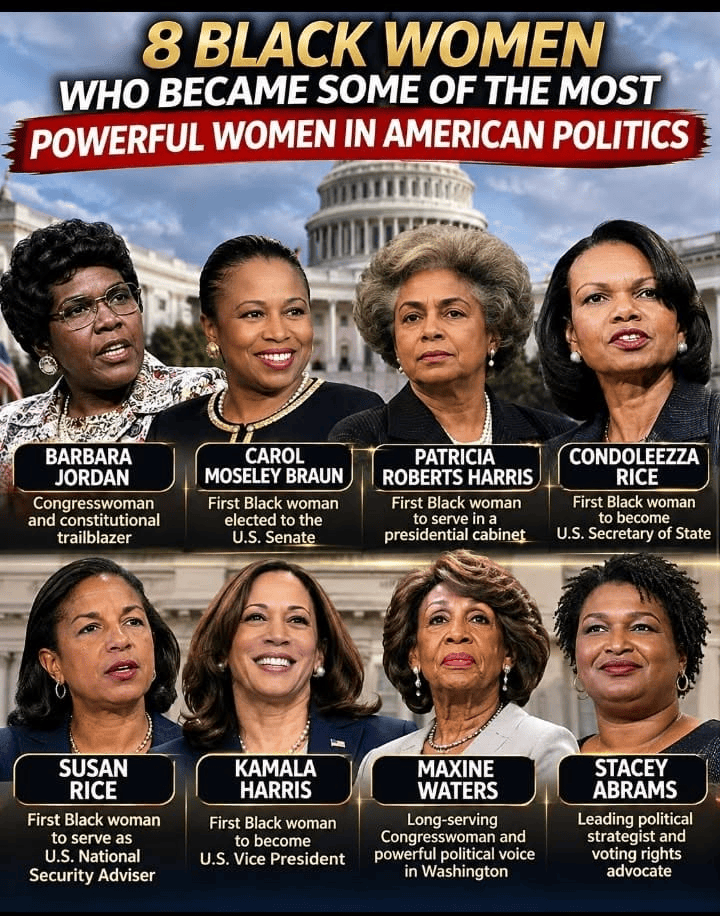
By Dhabessa Wakjira
From the halls of Congress to the White House, the U.S. Senate, and the highest levels of national security, eight Black women have broken barriers, challenged political traditions, and become some of the most influential figures in American political history. Their journeys remind us that Black women have not simply participated in American politics—they have helped shape its direction.
1. Barbara Jordan (1936–1996): The Congresswoman Who Challenged a President
Barbara Jordan was one of the most respected political figures in American history. In 1966, she became the first Black woman elected to the Texas Senate. In 1972, she made history again by becoming the first Black woman elected to Congress from a Southern state since Reconstruction.
Her greatest national moment came during the Watergate scandal in 1974. As a member of the House Judiciary Committee, she delivered a powerful speech during the impeachment proceedings against President Richard Nixon. She defended the U.S. Constitution and argued that no president should stand above the law. Her speech established her as one of America’s most respected political orators.
2. Carol Moseley Braun (1947– ): The First Black Woman Elected to the U.S. Senate
In 1992, Carol Moseley Braun achieved a historic political breakthrough. She defeated Republican incumbent Alan Dixon in Illinois, becoming the first Black woman ever elected to the United States Senate. She served from 1993 to 1999.
During her time in the Senate, she advocated for education, civil rights, and women’s equality. In 1999, President Bill Clinton appointed her U.S. Ambassador to New Zealand and Samoa. She also sought the Democratic presidential nomination in 2004. Her achievement opened another important door for Black women in American political leadership.
3. Patricia Roberts Harris (1924–1985): The First Black Woman in a Presidential Cabinet
Patricia Roberts Harris was a lawyer, diplomat, educator, and government official. In 1965, she became the first Black woman appointed as a U.S. ambassador, serving in Luxembourg.
Her achievements continued under President Jimmy Carter. In 1977, she became Secretary of Housing and Urban Development (HUD), making her the first Black woman to serve as a U.S. cabinet secretary. In 1979, she became Secretary of Health, Education, and Welfare. When that department was reorganised in 1980, she became the first Secretary of the newly established Department of Health and Human Services. She occupied some of the most influential positions in the American federal government.
4. Condoleezza Rice (1954– ): The First Black Woman to Become U.S. Secretary of State
Condoleezza Rice became one of the most influential women in American foreign policy. In 2001, President George W. Bush appointed her National Security Adviser—the first Black woman to hold that position. In January 2005, she made history again when she became the 66th U.S. Secretary of State, the first Black woman ever to occupy the office.
Her responsibilities included international diplomacy, foreign policy negotiations, and America’s relationships with other countries. She served until January 2009. Her decisions, particularly concerning the Iraq War era, remain subjects of political debate. Nevertheless, her appointment represented a historic breakthrough in American government.
5. Susan Rice (1964– ): The First Black Woman to Become U.S. National Security Adviser
Susan Rice became one of the most influential foreign policy officials in President Barack Obama’s administration. Before becoming National Security Adviser, she served as U.S. Ambassador to the United Nations from 2009 to 2013. In 2013, she became the first Black woman appointed National Security Adviser.
The position placed her at the centre of presidential decision-making on international relations, intelligence, defence, and national security. She served until 2017. In 2021, President Joe Biden appointed her Director of the Domestic Policy Council. Her career demonstrates the growing influence of Black women in America’s most sensitive government institutions.
6. Kamala Harris (1964– ): The First Black Woman to Become Vice President
Kamala Harris made American political history. She previously served as District Attorney of San Francisco, California Attorney General, and U.S. Senator. In 2020, Joe Biden selected her as his running mate. After winning the presidential election, Harris was sworn in on January 20, 2021.
She became the first woman to serve as U.S. Vice President, the first Black person to hold the office, and the first South Asian American to become Vice President. In 2024, she became the first Black woman nominated for president by a major American political party. Although she lost the 2024 presidential election, her place in American political history remains significant.
7. Maxine Waters (1938– ): The Long-Serving Congresswoman
Maxine Waters is one of the most prominent Black women in contemporary American politics. Born in St. Louis, Missouri, she moved to Los Angeles, California, where she became involved in community organising and politics. She was elected to the California State Assembly in 1976. In 1990, she was elected to the U.S. House of Representatives.
Waters became nationally recognised for her outspoken positions on racial justice, economic inequality, housing, financial regulation, and government accountability. She chaired the powerful House Financial Services Committee from 2019 to 2023. Her influence has made her one of the most recognisable Black women in American congressional politics.
8. Stacey Abrams (1973– ): The Political Strategist
Stacey Abrams is a lawyer, former Georgia legislator, and voting rights advocate. She served in the Georgia House of Representatives from 2007 to 2017 and became the chamber’s Democratic minority leader.
In 2018, she became the first Black woman nominated for governor by a major political party in the United States. Although she narrowly lost the election to Brian Kemp, her political influence grew nationally. She became widely recognised for her work on voter registration, voting access, and electoral participation. Through organisations including Fair Fight Action, she helped bring national attention to voting rights debates. She ran for governor again in 2022 but lost to Kemp. Although she has never served as governor, her influence on modern American electoral politics is undeniable.
What These Eight Women Have in Common
Their political journeys demonstrate how much American politics has changed. Barbara Jordan became a powerful defender of constitutional accountability. Carol Moseley Braun broke the racial and gender barrier in the U.S. Senate. Patricia Roberts Harris opened the door to Black women’s leadership in presidential cabinets. Condoleezza Rice reached the highest levels of American foreign policy. Susan Rice became the first Black woman National Security Adviser. Kamala Harris became America’s first female and first Black Vice President. Maxine Waters became one of the most recognisable voices in Congress. Stacey Abrams became a major force in modern electoral organising.
They did not all share the same political beliefs, strategies, or backgrounds. But each made a significant contribution to the history of Black political representation in America. Their stories remind us that Black women have not simply participated in American politics. They have helped shape its direction.






