Daily Archives: November 7, 2026

“Land Expansion Wars” in Oromia: OLF Statement Condemns Violence, Displacement, and Mass Killings
By Daandii Ragabaa
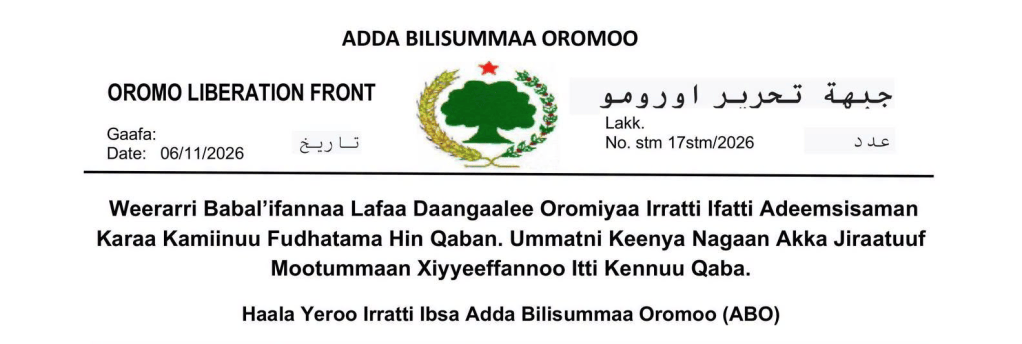
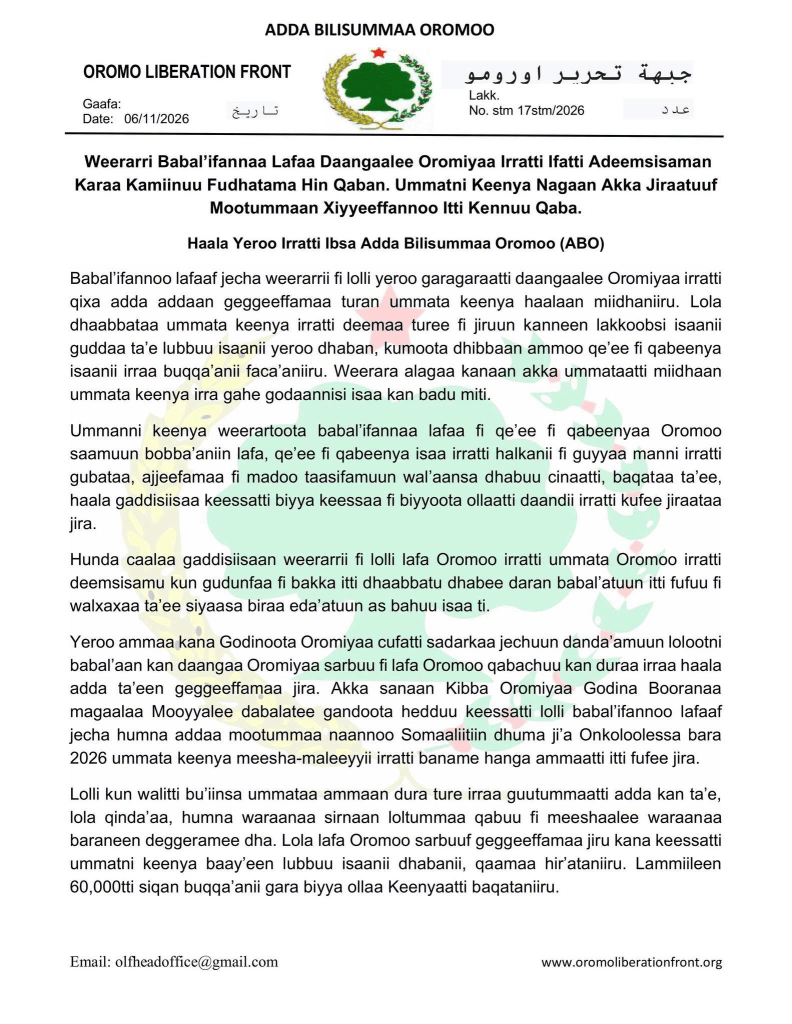
FINFINNEE — In a strongly worded statement released on November 6, 2026, the Oromo Liberation Front (OLF) has condemned what it describes as “land expansion wars” being waged against the Oromo people across multiple regions of Oromia, calling for an immediate end to the violence and accountability for those responsible.
A Pattern of Violence and Displacement
The statement, issued under the title “Land Expansion Wars on Oromia’s Borders Are Unacceptable in Any Form,” documents a series of attacks that it says have caused immense suffering among the Oromo people. According to the OLF, wars and conflicts over land have been waged on Oromia’s borders at various times, with devastating consequences. Many people have lost their lives, and hundreds of thousands have been displaced from their homes and property, scattered across the region.
The OLF describes the situation as particularly tragic: the Oromo people, who have been victims of land expansion and resource plundering, have been forced to abandon their homes, watching their houses burn day and night, being killed and displaced, and—lacking any means of protection—becoming refugees both within Ethiopia and in neighboring countries.
The Current Crisis: An Expanding Conflict
The statement emphasizes that the current situation is not merely a continuation of past conflicts. The attacks on Oromo land have taken on a new and more dangerous character. At present, what the OLF describes as “large-scale military operations” are being conducted in a manner that crosses Oromia’s borders and seizes Oromo land in an unprecedented way.
Specifically, the statement highlights that in Borena Zone, including the town of Moyale and many villages in southern Oromia, a war of land expansion has been waged by the special forces of the Somali regional government since the end of October 2026. This war, the OLF states, is being fought against an unarmed civilian population and continues to this day.
The OLF emphasizes that this war is fundamentally different from previous communal conflicts: it is a well-organized military operation supported by trained soldiers and modern weapons. The statement reports that many Oromo people have lost their lives and been injured in this conflict, and that over 60,000 civilians have been displaced and fled to neighboring Kenya.
A Broader Geographic Scope
The statement identifies a wide range of areas where land expansion attacks are being carried out, including:
- Southeastern Oromia — the lowlands of East Bale and West Bale zones
- Eastern Oromia
- Central Oromia — North Shoa and East Shoa zones
- North Oromia — Walloo
- Northwestern Oromia — Metekkel
- Western Oromia — East Wollega and Horro Guduru Wollega zones
In these areas, the OLF claims, forces supported by “goolessitoota” (a term referring to those who have historically exploited and subjugated the Oromo) are conducting attacks. The statement describes the violence as “heavy and shocking” and says it is difficult to express in words the scale of the suffering being inflicted on the Oromo people.
The “Fannoo” Forces and Mass Killings
The statement specifically names a force called “Fannoo”—described as an armed group mobilized under this name by “goolessitoota” forces—which has been waging war against the Oromo people for years. According to the OLF, these forces continue their attacks with renewed intensity, spilling innocent blood, plundering resources, and burning homes.
The statement provides specific examples of recent atrocities:
- November 4, 2026 — In Kiramuu district, East Wollega Zone, armed forces attacked villages including Guddina Jireenyaa and Caruu (in Abee Dongoroo district). Women, the elderly, and children were injured in the attacks. Homes and property were set on fire, and images of the destruction are circulating.
- In Caruu village, a family of nine people—including a father and mother—were killed by these forces.
Mass Killings in Benishangul-Gumuz
The statement also reports on violence in Benishangul-Gumuz Region, Metekkel Zone, where Oromo civilians have faced repeated attacks, pressure, and harassment.
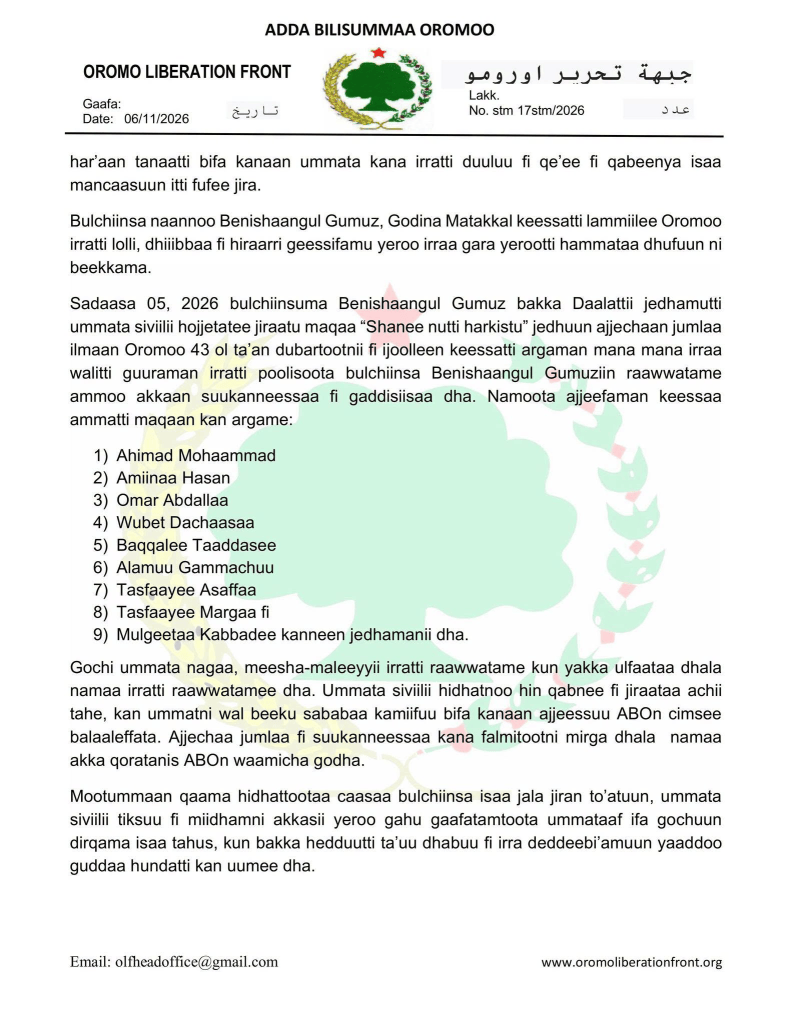
On November 5, 2026, in a place called Daalattii in Benishangul-Gumuz, a mass killing was carried out under the name “Shanee nutti harkistu” (a derogatory term). According to the OLF, more than 43 Oromo civilians, including women and children, were rounded up from their homes and killed by police of the Benishangul-Gumuz regional administration.
The statement lists some of the victims by name:
- Ahimad Mohaammad
- Amiinaa Hasan
- Omar Abdallaa
- Wubet Dachaasaa
- Baqqalee Taaddasee
- Alamuu Gammachuu
- Tasfaayee Asaffaa
- Tasfaayee Margaa
- Mulgeetaa Kabbadee
The OLF describes this as a “grave crime against humanity” and strongly condemns the killing of unarmed civilians. It calls on human rights defenders to investigate the mass killing.
A Call for Accountability
The statement holds the government responsible for failing to protect civilians. It notes that the government has the duty to control its administrative structures, protect civilians, and make those responsible for such violence accountable to the public. The fact that this is not happening—and that such violence is recurring—is a source of grave concern.
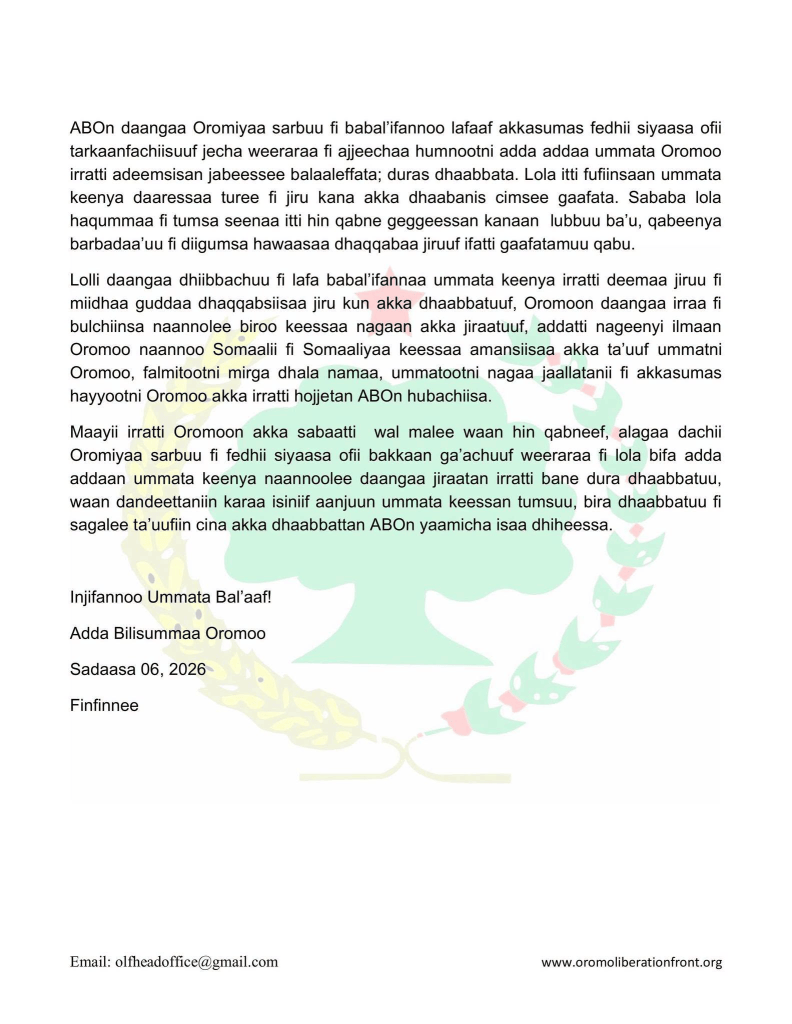
The OLF reiterates its strong condemnation of the wars and killings being carried out against the Oromo people by various forces seeking to cross Oromia’s borders, expand land, and impose their own political interests. It calls for an immediate end to the ongoing war that is devastating the Oromo people.
A Call to Action
The statement concludes with a call to the Oromo people, human rights defenders, peace-loving peoples, and Oromo intellectuals to work toward ending the violence and ensuring that Oromos can live in peace within their borders and in neighboring regions. It specifically calls for ensuring the safety of Oromo people in Somali Region and Somalia.
The OLF calls on all Oromo people to stand against the land expansion and attacks being carried out against the Oromo people in border areas, and to support their communities to the best of their ability—to stand with them and be their voice.
“Victory to the Oromo People!”
Source: Oromo Liberation Front (OLF) Statement, November 6, 2026, Finfinnee.
Note: This article is based on a statement issued by the Oromo Liberation Front.

Good Morning from Gesse Grassland: A Window into Ethiopia’s UNESCO-Recognized Bale Mountains
By Bona Oromia
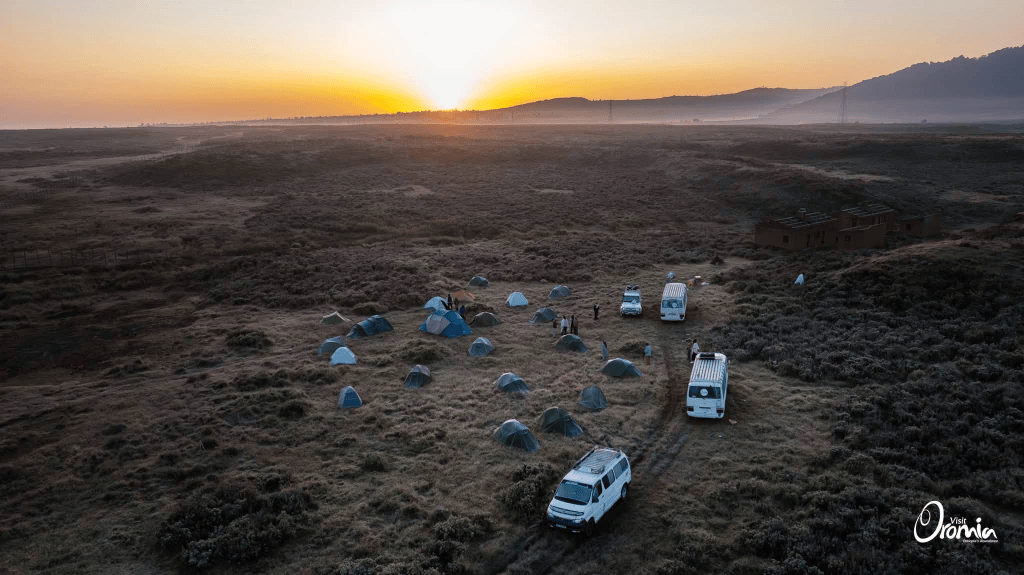
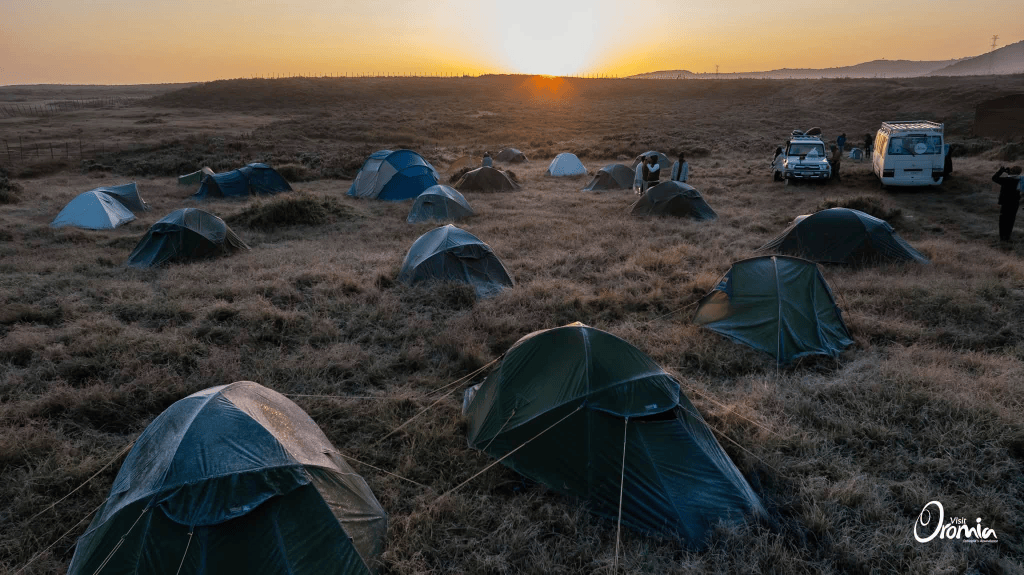
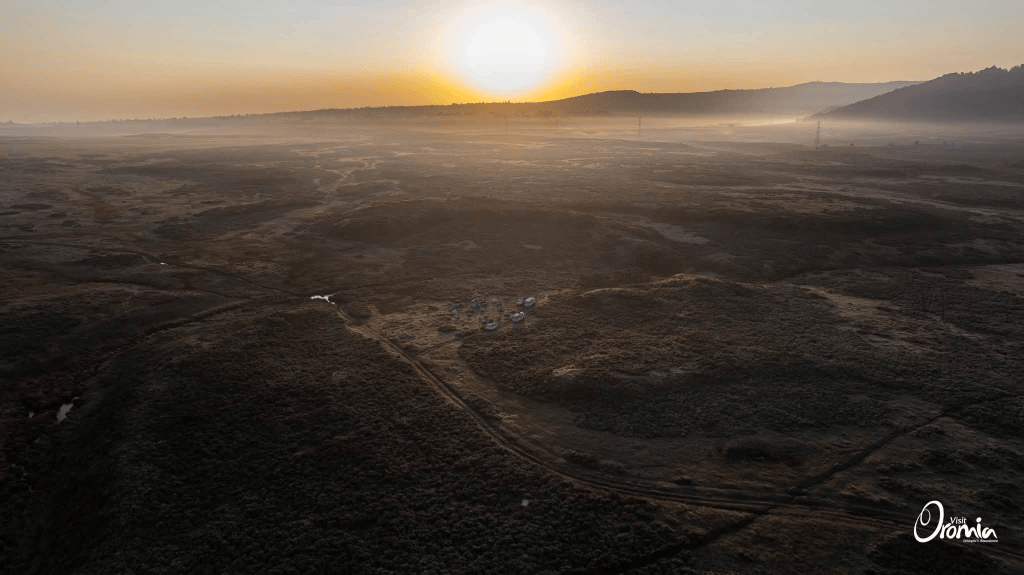
BALE MOUNTAINS NATIONAL PARK, Oromia — Good morning from Gesse Grassland, where the sun rises over one of Ethiopia’s most spectacular and ecologically significant landscapes—the UNESCO-recognized Bale Mountains National Park.
A Land of Origins
The Bale Mountains, located in the Oromia region of southeastern Ethiopia, are part of the Ethiopian Highlands and represent one of the country’s most important natural treasures. The park is home to the largest continuous area of Afro-alpine habitat on the African continent, covering approximately 2,200 square kilometers of stunning landscapes ranging from cloud forests to glacial lakes and vast grasslands like Gesse.
Ethiopia, often called the “Land of Origins,” is the cradle of humankind and a country of extraordinary natural and cultural diversity. The Bale Mountains embody this identity—a place where ancient landscapes meet modern conservation efforts, and where the richness of Oromia’s natural heritage is on full display.
A UNESCO World Heritage Site
In 2023, the Bale Mountains National Park was inscribed as a UNESCO World Heritage Site, recognizing its outstanding universal value. The park is home to an extraordinary array of endemic species found nowhere else on Earth, including:
- The Ethiopian wolf (Canis simensis)—the world’s rarest canid, with more than half of its global population living in the Bale Mountains
- The mountain nyala (Tragelaphus buxtoni)—a large antelope species endemic to Ethiopia
- The Bale monkey (Chlorocebus djamdjamensis)—a rare primate found only in the bamboo forests of the Bale Mountains
- Giant lobelias and other Afro-alpine plant species that create surreal, otherworldly landscapes
The park is also a critical water source, feeding rivers that supply water to millions of people in Ethiopia and neighboring countries.
Gesse Grassland: A Place of Beauty and Biodiversity
Gesse Grassland, where this morning’s greeting originates, is one of the park’s most iconic landscapes. The open grasslands, framed by volcanic peaks and dotted with grazing livestock and wild herbivores, offer visitors a chance to experience the African highlands in their most pristine form. It is a place where the silence of the mountains is broken only by the calls of birds and the rustle of the wind—a reminder of what the world looked like before modernity reshaped so much of the planet.
Ethiopia’s Abundance
Ethiopia is a country of remarkable abundance—not only in its wildlife and landscapes but in its cultural heritage and the diversity of its peoples. The Oromo people, the largest ethnic group in Ethiopia, have inhabited these lands for centuries, developing a deep relationship with the natural world that is reflected in their culture, traditions, and indigenous governance systems like the Gadaa.
The promotion of tourism in Oromia and Ethiopia more broadly is part of a larger effort to share this abundance with the world—to invite visitors to experience the Land of Origins firsthand, while also supporting conservation and community development.
A Call to Visit
For travelers seeking adventure, natural beauty, and cultural richness, Ethiopia offers an unparalleled experience. From the Bale Mountains to the Simien Mountains, from the rock-hewn churches of Lalibela to the ancient obelisks of Axum, from the Great Rift Valley lakes to the Danakil Depression—Ethiopia is a country of endless discovery.
Good morning from Gesse Grassland. Good morning from the Bale Mountains. Good morning from Ethiopia—the Land of Origins.
Visitoromia.org | Visitethiopia.et | Ethiopia: Land of Origins
#VisitOromia #EthiopiasAbundance #VisitEthiopia #LandOfOrigins #Oromia #Ethiopia

“From Words to Deeds”: PMO Ethiopia Releases Ninth Volume of “From Meskerem to Meskerem”
By Bona Oromia
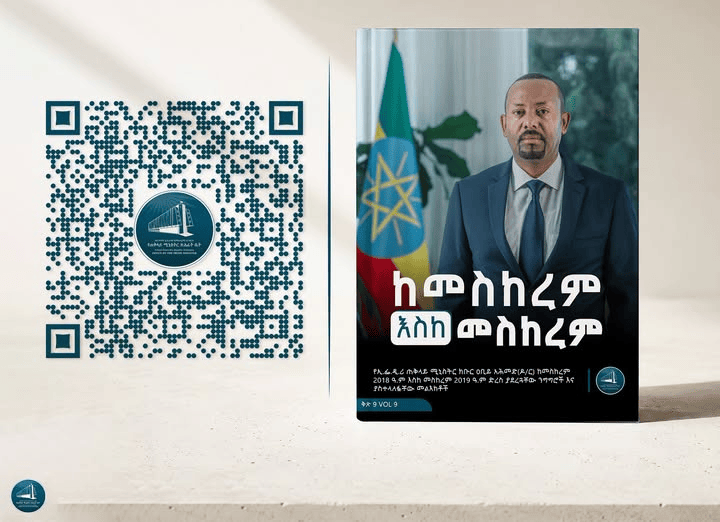
ADDIS ABABA — The Office of the Prime Minister of the Federal Democratic Republic of Ethiopia has released the ninth volume of its annual publication, “From Meskerem to Meskerem” (ከመስከረም እስከ መስከረም), a series that documents the speeches, messages, and historical moments of Prime Minister Abiy Ahmed (PhD).
The publication, now in its ninth edition, continues its mission of preserving the words and actions that have shaped Ethiopia’s journey of change—ensuring that the vision articulated by its leaders is recorded and transmitted to future generations.
Words Express Vision, Actions Transform It
The guiding philosophy of the series is captured in its opening message: “Words express vision; actions transform vision into reality.” Recording and preserving the speeches, messages, and historical events of leaders is described as a crucial way to transmit the nation’s journey of change and its history to future generations.
This ninth volume documents the Prime Minister’s speeches and messages delivered at various events and ceremonies from Meskerem 2018 to Meskerem 2019 in the Ethiopian calendar. It covers a period of significant national transformation—a time when the government’s rhetoric of reform was tested against the demands of implementation.
From Promise to Tangible Asset
The publication is described as telling the story of a journey “from words to deeds, from hope to tangible asset”—a transition from vision to execution and from aspiration to measurable progress. Within its pages are messages that connect national change, development, economic progress, national dignity, and international cooperation with a forward-looking vision for the future.
The volume serves as a concrete testimony to leadership, implementation, and nation-building—a record of the Ethiopian journey of change, from speech to event, from vision to result.
A Record for History
The series is more than a collection of speeches. It is a historical document—a record of the ideas, commitments, and actions that have defined a pivotal period in Ethiopia’s modern history. By compiling and publishing these materials annually, the Prime Minister’s Office ensures that the country’s political discourse and policy direction are preserved in a form that scholars, citizens, and future leaders can study and learn from.
The ninth volume’s release comes at a time when Ethiopia continues to navigate complex economic, political, and social challenges. The publication’s emphasis on “progress verified by action” rather than rhetoric alone reflects a recognition that words must be matched by results.
Read the Full Book
The full publication is available for reading via the following link:
https://pmo.gov.et/…/efb1bd26-fc75-4c5a-96d1…
“Beyond words, progress verified by action. Happy reading!” the announcement concludes.
#PMOEthiopia #FromMeskeremToMeskerem #Ethiopia #Leadership #NationBuilding

SOOLANEE: Award-Winning Oromo Film Now Available on YouTube

By Dhabessa Wakjira
MELBOURNE — SOOLANEE, a landmark Oromo-language film released in 2024, is now available for free viewing on YouTube. The film’s producers are warmly inviting the broader Oromo community and film lovers everywhere to subscribe to Guuboo Entertainment and watch the acclaimed production.
A Film of Many Firsts
SOOLANEE was written by Keeyeroon Darajjee and directed by Rabbirraa Daadhii and Eliyaas Kifilu. Produced by 5 STAR FILM PRODUCTION, the film was released in 2024 and has since become a significant milestone in Oromo cinema.
The film’s title, Soolanee, carries cultural resonance, and its production values have earned it recognition beyond Ethiopia’s borders.
International Acclaim
In 2025, SOOLANEE won the Best International Film award at the Charlotte Black Film Festival in North Carolina, USA. The film has also been selected and screened at numerous international film festivals, earning widespread recognition and critical acclaim. Additionally, SOOLANEE was nominated for a Gumaa Award, further cementing its place as one of the most celebrated Oromo films of recent years.
Now Available to All
The full film is now available on YouTube, and the producers are inviting everyone to watch, subscribe, like, comment, and share.
Watch SOOLANEE here: https://www.youtube.com/watch?v=vAV2vWGKlXU
The film’s release on YouTube marks an important moment for Oromo-language cinema—making an internationally recognized production accessible to audiences around the world, free of charge.
A Call to the Community
The producers extend their warm invitation: “Guutummaa Soolanee YouTube irraa akka daawattan kabajaan afeeramtanii jirtu”—”You are respectfully invited to watch the entirety of Soolanee on YouTube.”
They also encourage viewers to Subscribe, Like, Comment, and Share, helping to amplify the reach of Oromo cinema and support the growing industry of Afaan Oromoo filmmaking.
Watch SOOLANEE now: https://www.youtube.com/watch?v=vAV2vWGKlXU
#SOOLANEE #OromoFilm #AfaanOromoo #GuubooEntertainment #OromoCinema

The Seed and the Rock: Why Life’s Hardest Beginnings Build Life’s Strongest Foundations
By Bona Oromia
In a quiet corner of nature, two seeds begin their journey through life. One finds open space, sunlight, and an easy path to growth. The other encounters a rock. Its path is blocked. Its progress is slow. It must struggle just to reach the surface. If these seeds could speak, the struggling one might ask: “Why is my journey so difficult when the other seed has it so easy?”
This simple fable, animated and shared widely online, carries a profound lesson for anyone who has ever wondered why success seems harder to achieve than it does for others. The struggling seed finds a way forward, develops strong roots, and eventually grows into a magnificent tree. When the storm arrives, its journey takes on a whole new meaning—what once seemed like a disadvantage becomes the very source of its strength.
Your Beginning Does Not Decide Your Ending
Some people start their careers with the best education, supportive managers, and excellent opportunities. Others begin with limited resources, rejection, and difficult circumstances. The fable reminds us that while your starting point may influence your journey, it does not have to determine your destination. The seed that had to fight its way around a rock grew deeper roots than the one that had it easy—and it was the one that survived the storm.
Obstacles Can Teach What Comfort Cannot
The rock forced the struggling seed to find another way to grow. In the same way, a lost sale can teach a salesperson to ask better questions. A failed project can sharpen a manager’s judgment. A business setback can teach an entrepreneur financial discipline. The lesson is counterintuitive but powerful: sometimes the experience we desperately want to avoid becomes the lesson we desperately need.
Build Your Roots Before Chasing Visible Success
A tree’s strength is not just in its height. Much of it lies beneath the ground, where nobody can see it. In professional life, these roots are knowledge, discipline, relationships, integrity, and the ability to learn. The fable warns against becoming so busy chasing promotions, titles, and rewards that we forget to build the capabilities needed to sustain them. Visibility is not the same as strength.
Stop Comparing Your Journey with Someone Else’s
You may see someone moving ahead while you are struggling to take the next step. But you rarely know the full story behind another person’s success or the strengths you are developing through your own challenges. The fable’s message is clear: measure yourself against who you were yesterday, not merely against where someone else stands today.
Leaders, Don’t Remove Every Obstacle—Build Capability
Managers, parents, and mentors often try to make everything easy for the people they care about. Support is essential, but solving every problem for others can prevent them from learning to solve problems themselves. Give people guidance, resources, and encouragement—then give them the opportunity to think, act, make mistakes, and grow. The rock, in other words, may be the most valuable teacher of all.
Remember: The Storm Will Eventually Come
Markets change. Customers say no. Projects fail. Careers take unexpected turns. You cannot control every storm, but you can prepare yourself before it arrives. The real measure of growth is not how tall you stand on a sunny day, but how well you face the difficult days.
The animated fable of the two seeds is a reminder that struggle is not a sign of failure. It is often the precondition for resilience, wisdom, and lasting success. The seed that had to fight for its place in the sun grew strong enough to survive the storm—and when the storm came, its struggle was revealed for what it always was: the beginning of its strength.
#InspiresOromia #PersonalGrowth #Resilience #Leadership #Motivation