The Passing of a Pillar: Professor Abdullahi A. Shongolo and the Enduring Legacy of Oromo Indigenous Knowledge
By Dhabessa Wakjira
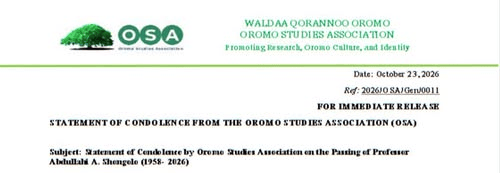
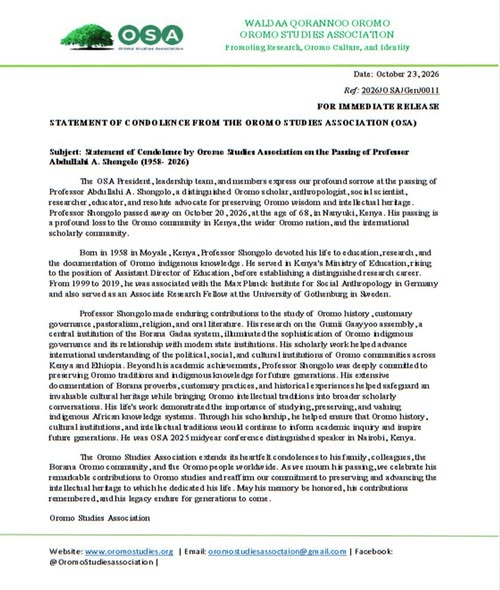
On October 20, 2026, the scholarly and cultural world lost a towering figure. In Nanyuki, Kenya, Professor Abdullahi A. Shongolo—a distinguished anthropologist, social scientist, and resolute advocate for Oromo intellectual heritage—passed away at the age of 68. In a formal statement of condolence released on October 23, the Oromo Studies Association (OSA) announced his passing, describing it as “a profound loss to the Oromo community in Kenya, the wider Oromo nation, and the international scholarly community.”
For those who knew his work, Professor Shongolo was not merely an academic; he was a bridge. Born in 1958 in Moyale—the very border town where the sacred wells of the Borana have faced generations of political siege—he spent his life ensuring that the sophisticated governance, oral literature, and customary laws of his people were not just preserved, but globally recognized as vital contributions to human civilization.
From the Classroom to the Global Stage
Professor Shongolo’s journey began in education. Before establishing a distinguished research career, he served in Kenya’s Ministry of Education, eventually rising to the position of Assistant Director of Education. This foundational experience shaped a career defined by a dual commitment: rigorous academic inquiry and the practical upliftment of his community.
From 1999 to 2019, his intellectual home was the Max Planck Institute for Social Anthropology in Germany. He also served as an Associate Research Fellow at the University of Gothenburg in Sweden. Yet, despite his extensive international footprint, his research gaze never strayed far from the Horn of Africa.
His scholarship was deeply rooted in the lived realities of the Oromo people. He made enduring contributions to the study of Oromo history, pastoralism, religion, and oral literature. His meticulous research on the Gumii Gaayyoo assembly—a central institution of the Borana Gadaa system—illuminated the remarkable sophistication of Oromo indigenous governance. At a time when colonial and post-colonial narratives often dismissed African traditional systems as primitive, Shongolo’s work provided irrefutable evidence of a highly structured, democratic, and consensus-based political order, and he expertly examined how this system interacted with modern state institutions.
Safeguarding the “River of Blessings”
Professor Shongolo understood that a culture survives through its language and its stories. Beyond his formal academic publications, he was deeply committed to the meticulous documentation of Borana proverbs, customary practices, and historical experiences.
In recent years, as the Oromo people have faced systemic marginalization and violence, Shongolo’s work served as a vital anchor. By archiving the intellectual traditions of the Oromo, he ensured that future generations would inherit a robust cultural identity. His life’s work demonstrated the absolute necessity of studying, preserving, and valuing indigenous African knowledge systems.
His dedication to the Oromo nation was recognized just a year prior to his passing. In 2025, he served as the distinguished speaker at the OSA’s midyear conference in Nairobi, where he continued to challenge and inspire a new generation of Oromo scholars and activists.
A Legacy That Endures
The passing of Professor Shongolo comes at a critical juncture for the Oromo people. As the Oromo Studies Association fights to center Oromo voices in global human rights discussions—often countering biased narratives promoted by state-aligned institutions—the loss of a scholar of Shongolo’s stature is deeply felt.
Yet, as the OSA noted in their statement, his work has laid a foundation that cannot be erased. “His extensive documentation of Borana proverbs, customary practices, and historical experiences helped safeguard an invaluable cultural heritage,” the statement reads, “while bringing Oromo intellectual traditions into broader scholarly conversations.”
The Oromo Studies Association extended its heartfelt condolences to his family, colleagues, the Borana Oromo community, and the Oromo people worldwide. In mourning his passing, the organization reaffirmed its commitment to preserving and advancing the intellectual heritage to which Professor Shongolo dedicated his life.
Professor Abdullahi A. Shongolo is gone, but the Gumii Gaayyoo he studied, the proverbs he recorded, and the dignity of the Gadaa system he brought to the world’s attention will continue to echo. He ensured that the intellectual wealth of the Oromo nation is no longer a hidden treasure, but a beacon for generations to come.
May his memory be honored, his contributions remembered, and his legacy endure.
Dhabessa Wakjira is a writer covering Horn of Africa affairs and Oromo cultural heritage.

Posted on October 24, 2026, in Aadaa, Afaan, Events, Face of Injustice, Finfinne, freedom, Grief Support, health, Language, Media, Obituary, Oromia. Bookmark the permalink. Leave a comment.






Leave a comment
Comments 0