Daily Archives: October 24, 2026

The Lion of Borana: Remembering Guyyoo Boruu Galmaa, the Abbaa Gadaa Who Defied Empires
By Dhabessa Wakjira
In the annals of Oromo history, there are leaders who govern, and then there are those who become the embodiment of a people’s resistance. Guyyoo Boruu Galmaa, who served as the Abbaa Gadaa of the Borana Oromo from 1944 to 1952, belongs unequivocally to the latter. He was not merely a custodian of the ancient Gadaa system; he was a shield against the encroaching empires of the 20th century—a man whose defiance of both Italian invaders and the Ethiopian imperial state preserved the soul of the Borana people.
His story, deeply intertwined with the fate of the sacred wells and the contested borders of Moyale, offers a masterclass in indigenous diplomacy and unyielding sovereignty.
A Legacy Born in the Shadow of Partition
The roots of Guyyoo Boruu’s leadership stretch back to a defining tragedy for the Borana nation. In 1907, the British and Ethiopian empires signed the Anglo-Ethiopian Boundary Agreement, a colonial decree that arbitrarily carved the Borana homeland in two, dividing the people of Moyale.
At that time, it was Boruu Galmaa Dooyyoo—the father of Guyyoo—who served as the Abbaa Gadaa. He was among the first to openly reject the treaty, recognizing it not as a legal boundary, but as an existential threat to the unity and sovereignty of the Borana. The son inherited the father’s fire.
In 1944, when Guyyoo Boruu Galmaa took the Baallii (the ritual transfer of power) and assumed the mantle of Abbaa Gadaa, he stepped into a region rife with external pressure. The Borana were not only facing the legacy of the 1907 partition but were also navigating the chaotic fallout of global wars and shifting imperial ambitions in the Horn of Africa.
Defying the Italian War Machine
Historical records reveal that Guyyoo Boruu’s leadership did not begin in 1944; his journey as a freedom fighter started much earlier. Between 1936 and 1945, he was actively leading the Borana Oromo in resistance against the Italian occupation.
When the Italians invaded, they brought not just armies, but a strategy of land seizure. As the historical account notes, the Italian forces attempted to annex vast tracts of Handaraa land, claiming everything except the sacred Arddaa and Tula (water wells). Guyyoo Boruu responded by building the Borana Gadaa structures and waging a relentless war against the Italians.
His struggle was not just about repelling a foreign army; it was about defending the sacred ecology of Borana life. The Tula wells were the lifeblood of the cattle and the people. Guyyoo Boruu understood that to lose the land was to lose the wells, and to lose the wells was to lose the Borana identity itself.
Standing Against the Imperial Crown
Following the defeat of the Italians, the Borana faced a new, more insidious threat: the expanding centralization of Emperor Haile Selassie’s government. Between 1947 and 1950, the imperial regime sought to impose its administrative and cultural dominance on the southern frontiers.
Guyyoo Boruu Galmaa became the primary obstacle to this encroachment. He did not merely resist the political pressures of the imperial state; he actively protected the Gadaa system, ensuring that traditional laws, democratic consensus, and indigenous governance continued to thrive despite the centralizing forces of Addis Ababa.
His defiance culminated in a moment of profound historical significance. In 1950, the Haile Selassie government, seeking to co-opt local leaders, offered Guyyoo Boruu the title of “Giraazmach”—a high-ranking imperial military and administrative honor.
He refused.
In rejecting the title, Guyyoo Boruu Galmaa made a definitive statement of Oromo autonomy. He rejected the legitimacy of an empire that had partitioned his people and threatened their customs. By turning his back on imperial honors, he affirmed that his authority came not from a distant emperor, but from the Gadaa, the Borana people, and the land itself.
The Enduring Wisdom of the Elders
The legacy of Guyyoo Boruu Galmaa is not confined to the history books; it is a living, breathing testament to the resilience of Oromo culture.
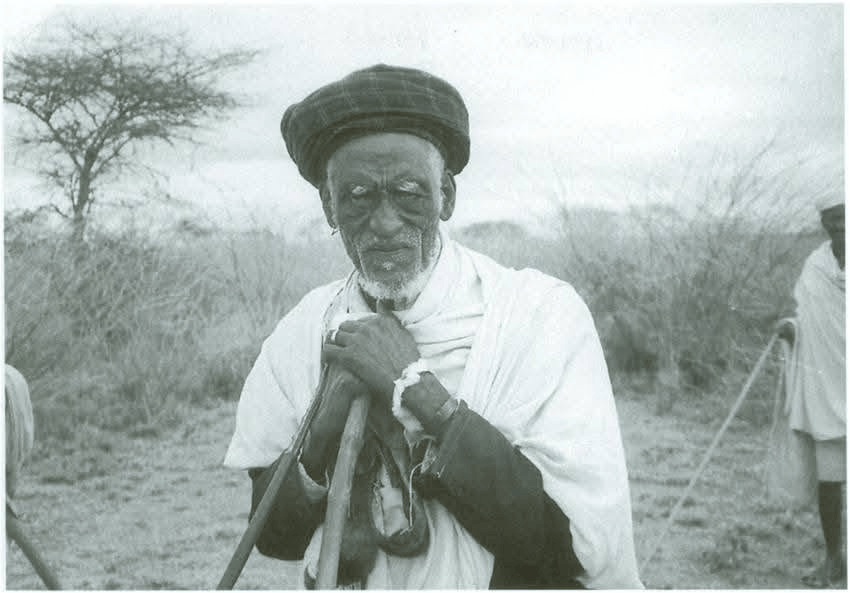
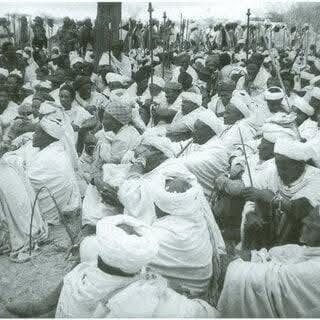
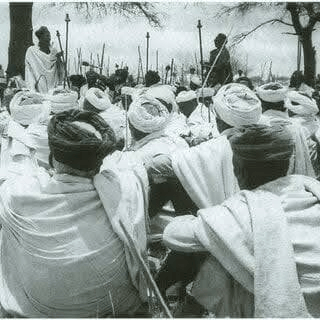
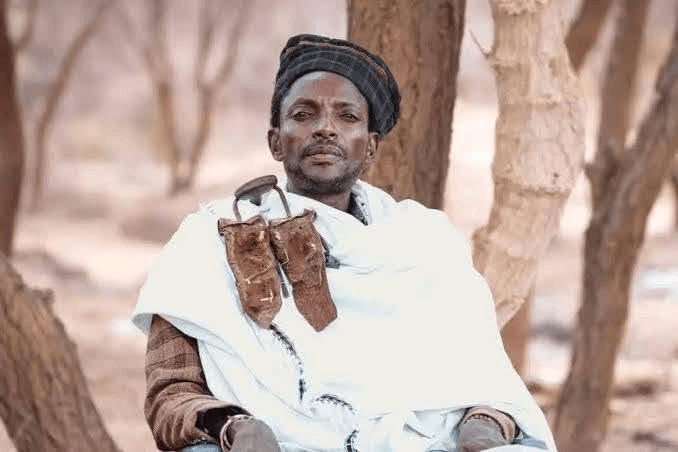
His life was meticulously documented by Western anthropologists who recognized the profound nature of the Borana political system. The renowned scholar Eike Haberland photographed him in 1952—the year he completed his term as Abbaa Gadaa. Decades later, in 1986, anthropologist Günther Schlee captured another historic moment: Guyyoo Boruu, then approximately 95 years old, was photographed at the Gumii Gaayyoo (the great assembly) as his son, Boruu Guyyoo Boruu, took the Baallii and assumed the leadership of the Gadaa.
That photograph, showing the aged father watching his son take the reins of power, is a powerful visual metaphor. It represents the unbroken chain of the Gadaa system—a system that Guyyoo Boruu fought to protect with weapons, diplomacy, and sheer moral courage.
A Beacon for the Present
As the Oromo people today face a renewed crisis of state violence, displacement, and the ongoing political capture of their sacred resources—including the Tuula Saglan Booranaa—the legacy of Guyyoo Boruu Galmaa serves as a vital beacon.
He stands as a reminder that Oromo sovereignty is ancient, sophisticated, and deeply rooted in a democratic culture that predates modern statehood. He proved that true leadership is not measured by the titles bestowed by empires, but by the courage to defend one’s people against them.
Nearly a century after he began his resistance, the spirit of Guyyoo Boruu Galmaa still echoes across the plains of Borana, flowing like the waters of the sacred wells he fought to protect: undivided, unbroken, and eternally free.
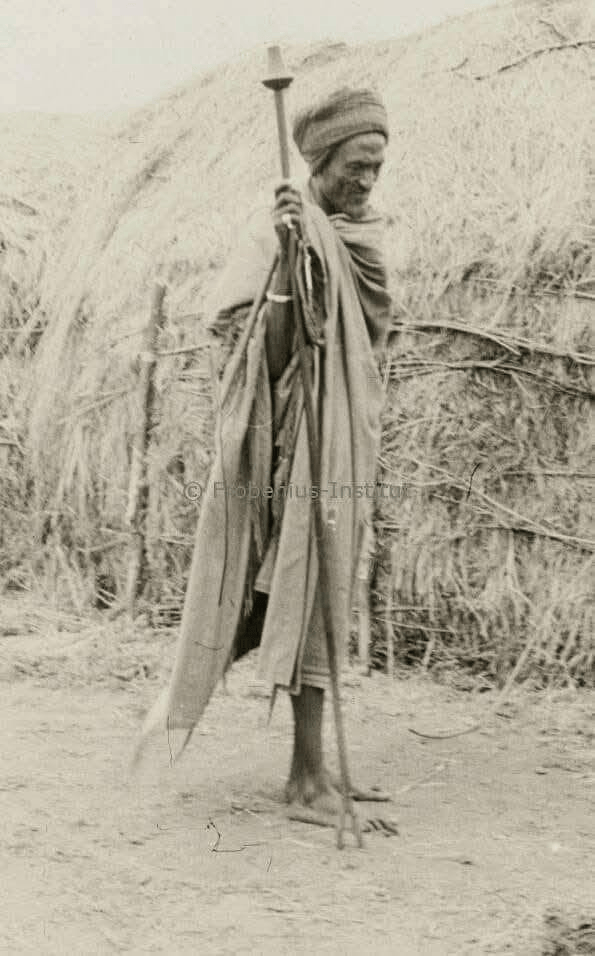
Photos: Guyyoo Boruu Galmaa, photographed by Eike Haberland (1952) and Günther Schlee (1986).

Terror in Mandera: Ethiopian Oromos Seek Refuge After Fatal Stabbing Amid Rising Border Tensions
By Daandii Ragabaa
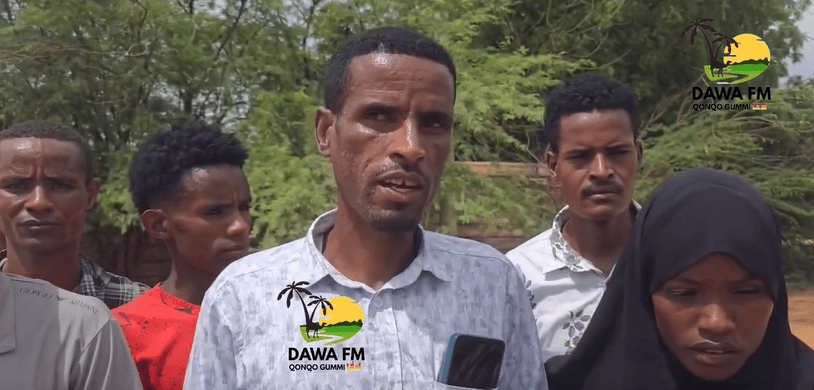
Fear has gripped the Ethiopian Oromo community in Mandera town, Kenya, following the brutal stabbing to death of one of their colleagues. In a desperate bid for survival, several members of the community have reportedly sought refuge at the Mandera Police Station, appealing to the Kenyan government and security agencies for urgent protection.
The killing, which has sent shockwaves through the cross-border community, highlights the precarious reality facing Ethiopian nationals living and working in Kenya, many of whom are fleeing the devastating conflict in their home country.
According to community members, the victim was targeted simply for being an Ethiopian Oromo. The group is insisting they are innocent civilians who should not be forced to pay the price for the ongoing political violence and tensions linked to events across the border.
“We are appealing to the authorities to intervene and guarantee our protection,” a community representative said. “We should not be held responsible for tensions or violence linked to events across the border. We are here to work and live in peace.”
The fatal stabbing has raised serious concerns about the security of Ethiopian nationals in Mandera, a town that sits squarely on the Ethiopia-Kenya border—a region already deeply scarred by arbitrary colonial borders, resource-based conflicts, and the spillover effects of the Ethiopian government’s military campaigns in Oromia.
For many Oromos, crossing into Kenya is a matter of survival. As documented by human rights organizations, Oromo civilians displaced by government forces and state-aligned militias constitute the bulk of Ethiopian refugees fleeing to neighboring countries. Yet, as the tragedy in Mandera demonstrates, the search for safety often leads them into new environments of hostility and xenophobia, where they are scapegoated for broader geopolitical tensions.
The situation in Mandera remains highly volatile. The affected individuals are now calling on community leaders, the Kenyan government, and security agencies to step in immediately to prevent any retaliatory attacks and ensure calm and restraint among residents.
They emphasize a fundamental principle of human dignity: that all residents, regardless of their nationality or ethnic background, must be able to live and work without fear.
As the community mourns the loss of their colleague and huddles in police stations for safety, the incident serves as a stark reminder of the regional fallout of the crisis in the Horn of Africa. It is a humanitarian emergency that ignores national borders, demanding urgent attention and protection for vulnerable civilians caught in the crossfire of a conflict they did not choose.
Video credit: Dawa FM

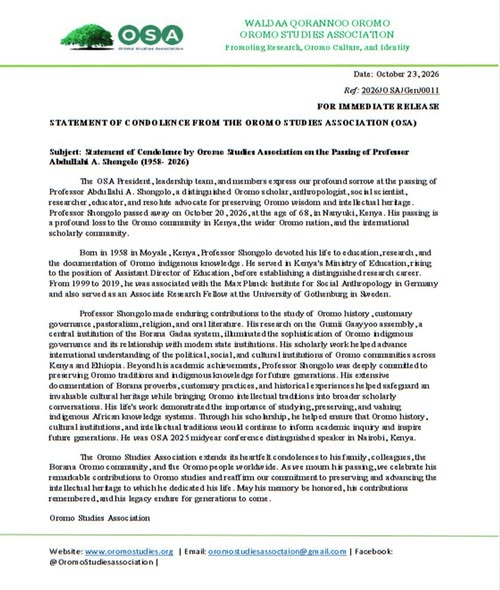
The Passing of a Pillar: Professor Abdullahi A. Shongolo and the Enduring Legacy of Oromo Indigenous Knowledge
By Dhabessa Wakjira
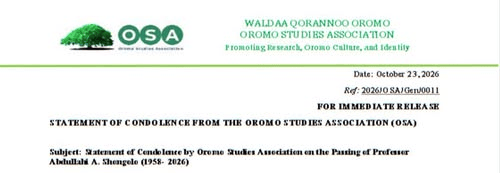
On October 20, 2026, the scholarly and cultural world lost a towering figure. In Nanyuki, Kenya, Professor Abdullahi A. Shongolo—a distinguished anthropologist, social scientist, and resolute advocate for Oromo intellectual heritage—passed away at the age of 68. In a formal statement of condolence released on October 23, the Oromo Studies Association (OSA) announced his passing, describing it as “a profound loss to the Oromo community in Kenya, the wider Oromo nation, and the international scholarly community.”
For those who knew his work, Professor Shongolo was not merely an academic; he was a bridge. Born in 1958 in Moyale—the very border town where the sacred wells of the Borana have faced generations of political siege—he spent his life ensuring that the sophisticated governance, oral literature, and customary laws of his people were not just preserved, but globally recognized as vital contributions to human civilization.
From the Classroom to the Global Stage
Professor Shongolo’s journey began in education. Before establishing a distinguished research career, he served in Kenya’s Ministry of Education, eventually rising to the position of Assistant Director of Education. This foundational experience shaped a career defined by a dual commitment: rigorous academic inquiry and the practical upliftment of his community.
From 1999 to 2019, his intellectual home was the Max Planck Institute for Social Anthropology in Germany. He also served as an Associate Research Fellow at the University of Gothenburg in Sweden. Yet, despite his extensive international footprint, his research gaze never strayed far from the Horn of Africa.
His scholarship was deeply rooted in the lived realities of the Oromo people. He made enduring contributions to the study of Oromo history, pastoralism, religion, and oral literature. His meticulous research on the Gumii Gaayyoo assembly—a central institution of the Borana Gadaa system—illuminated the remarkable sophistication of Oromo indigenous governance. At a time when colonial and post-colonial narratives often dismissed African traditional systems as primitive, Shongolo’s work provided irrefutable evidence of a highly structured, democratic, and consensus-based political order, and he expertly examined how this system interacted with modern state institutions.
Safeguarding the “River of Blessings”
Professor Shongolo understood that a culture survives through its language and its stories. Beyond his formal academic publications, he was deeply committed to the meticulous documentation of Borana proverbs, customary practices, and historical experiences.
In recent years, as the Oromo people have faced systemic marginalization and violence, Shongolo’s work served as a vital anchor. By archiving the intellectual traditions of the Oromo, he ensured that future generations would inherit a robust cultural identity. His life’s work demonstrated the absolute necessity of studying, preserving, and valuing indigenous African knowledge systems.
His dedication to the Oromo nation was recognized just a year prior to his passing. In 2025, he served as the distinguished speaker at the OSA’s midyear conference in Nairobi, where he continued to challenge and inspire a new generation of Oromo scholars and activists.
A Legacy That Endures
The passing of Professor Shongolo comes at a critical juncture for the Oromo people. As the Oromo Studies Association fights to center Oromo voices in global human rights discussions—often countering biased narratives promoted by state-aligned institutions—the loss of a scholar of Shongolo’s stature is deeply felt.
Yet, as the OSA noted in their statement, his work has laid a foundation that cannot be erased. “His extensive documentation of Borana proverbs, customary practices, and historical experiences helped safeguard an invaluable cultural heritage,” the statement reads, “while bringing Oromo intellectual traditions into broader scholarly conversations.”
The Oromo Studies Association extended its heartfelt condolences to his family, colleagues, the Borana Oromo community, and the Oromo people worldwide. In mourning his passing, the organization reaffirmed its commitment to preserving and advancing the intellectual heritage to which Professor Shongolo dedicated his life.
Professor Abdullahi A. Shongolo is gone, but the Gumii Gaayyoo he studied, the proverbs he recorded, and the dignity of the Gadaa system he brought to the world’s attention will continue to echo. He ensured that the intellectual wealth of the Oromo nation is no longer a hidden treasure, but a beacon for generations to come.
May his memory be honored, his contributions remembered, and his legacy endure.
Dhabessa Wakjira is a writer covering Horn of Africa affairs and Oromo cultural heritage.