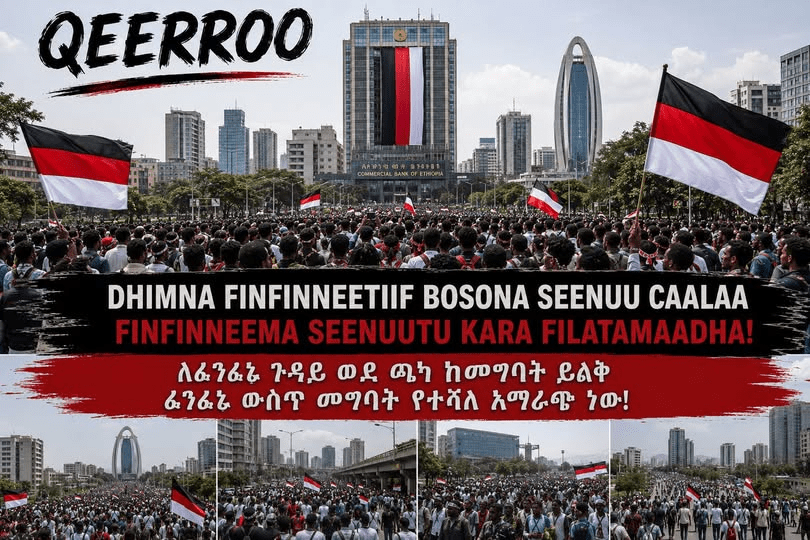
For the Cause of Finfinne: Entering Finfinne Itself Is Better Than Entering the Forest
A Reflection on Strategy, Presence, and the Path Forward for Oromo Liberation
By Dhabessa Wakjira
In the long and arduous struggle for Oromo liberation, the question of strategy has always been central. For decades, the Oromo people have employed various methods of resistance—armed struggle in the forests, political advocacy in the diaspora, and mass protests in the streets. Each has its place and its purpose. But there is a principle that deserves careful consideration:
“Dhimma Finfinneetiif bosona seenuu caalaa Finfinneedhuma seenuutu karaa filatamaadha.”
“For the cause of Finfinne, entering Finfinne itself is better than entering the forest.”
This is not a dismissal of armed struggle or the sacrifices made by those who have fought in the forests. It is a strategic reflection on the nature of the struggle for Finfinne and the most effective means of achieving justice for the Oromo people’s ancestral capital.
The Significance of Finfinne
Finfinne—the city known internationally as Addis Ababa—is not just any city. It is the historical and spiritual heart of the Oromo people. It is the place where the Oromo people lived for generations before the expansion of the Ethiopian Empire. It is the site of their cultural heritage, the cradle of their language, and the symbol of their historical presence in the region.
For the Oromo people, Finfinne is not a bargaining chip. It is not a political football to be kicked around by competing interests. It is their ancestral homeland, and their connection to it is inseparable from their identity.
The struggle for Finfinne is therefore not just a political struggle—it is a struggle for the very soul of the Oromo nation. It is a struggle for recognition, for justice, and for the restoration of a people’s connection to their land.
The Forest and the City: Two Strategies
Historically, the Oromo liberation movement has employed two primary strategies: armed struggle in the forests and political organizing in the cities. Both have their strengths and limitations.
The Forest Strategy
Armed struggle has been a vital part of the Oromo resistance. The Oromo Liberation Army (WBO) has fought bravely against successive Ethiopian regimes, and their sacrifices have inspired generations. The forest has been a sanctuary for those who could not operate openly, a place where resistance could be sustained even in the darkest times.
However, the forest strategy has limitations. It is physically demanding, resource-intensive, and often results in heavy casualties. It can also be geographically remote from the centers of political power, limiting its direct impact on urban populations and decision-makers.
The City Strategy
The city strategy—entering Finfinne itself—offers a different approach. It recognizes that the struggle for Finfinne cannot be won solely in the forests. It must be waged in the city itself, among its residents, in its institutions, and in its political life.
Entering Finfinne means:
- Building a presence in the city’s political and civic institutions
- Organizing communities within the city
- Advocating for Oromo rights in the urban space
- Challenging the narrative that denies Oromo history
- Demanding recognition of Finfinne’s Oromo heritage
- Participating in governance to shape the city’s future
This strategy recognizes that Finfinne is not just a piece of land to be claimed from the outside—it is a living city with millions of residents, a complex political landscape, and a role as Ethiopia’s capital. Engaging with the city directly is essential for achieving justice.
Why Entering Finfinne Matters
1. Presence Is Power
In politics, presence is power. If the Oromo people are absent from Finfinne’s political and civic life, their voice will not be heard. Entering Finfinne means being present where decisions are made, where policies are shaped, and where the future of the city is determined.
2. The City Is the Symbol
Finfinne is not just a city—it is a symbol. It is the symbol of Oromo dispossession and the symbol of Oromo resistance. To enter Finfinne is to reclaim that symbol. It is to assert that the Oromo people have a rightful place in their ancestral capital.
3. The City Is the Center of Power
Finfinne is the seat of the Ethiopian government, the African Union, and numerous diplomatic missions. It is the center of political and economic power in Ethiopia. To influence the future of Finfinne, the Oromo people must be present at the center of that power.
4. The City Is a Space for Organizing
Finfinne is home to millions of people, including a significant Oromo population. It is a space for organizing, for building alliances, and for creating a movement that can effect change from within. By entering Finfinne, the Oromo people can build a movement that is rooted in the city itself.
5. The City Is the Future
The future of Finfinne will be shaped by those who are present in the city. If the Oromo people are absent, others will shape that future. Entering Finfinne ensures that the Oromo people have a say in what that future looks like.
The Path Forward
The principle that “entering Finfinne is better than entering the forest” is not a rejection of armed struggle. It is a call to recognize that the struggle for Finfinne must be waged on multiple fronts. It must include:
- Political organizing in the city
- Advocacy for Oromo rights in national and international forums
- Legal action to challenge unjust policies
- Cultural preservation to maintain Oromo heritage in the city
- Economic empowerment to build Oromo prosperity
- Public awareness to educate residents about Finfinne’s history
- Participation in governance to shape the city’s future
This multi-front approach recognizes that the struggle for Finfinne is not just about the past—it is about the present and the future. It is about ensuring that the Oromo people have a rightful place in their ancestral capital and that the city reflects the diversity and history of the Oromo nation.
A Call to Action
The time has come for the Oromo people to enter Finfinne—not as visitors, but as participants. Not as outsiders, but as rightful inhabitants. Not as supplicants, but as citizens with equal rights.
Entering Finfinne means:
- Registering to vote in the city’s elections
- Participating in civic organizations that shape the city’s life
- Advocating for Oromo rights in the city’s institutions
- Building businesses that create jobs and prosperity
- Educating residents about Finfinne’s Oromo history
- Demanding recognition of Oromo heritage in the city’s public spaces
This is not an easy path. It requires patience, persistence, and courage. But it is a path that offers a real chance for lasting change.
Conclusion: A New Chapter in the Struggle
The Oromo people have fought for Finfinne for generations. They have sacrificed their lives, their freedom, and their dreams. They have entered the forests, faced the guns, and endured the prisons. But the struggle is not over.
“Dhimma Finfinneetiif bosona seenuu caalaa Finfinneedhuma seenuutu karaa filatamaadha.”
“For the cause of Finfinne, entering Finfinne itself is better than entering the forest.”
This is a call to a new chapter in the struggle—a chapter of presence, participation, and engagement. A chapter where the Oromo people enter the city they love and claim their rightful place in it.
Let us enter Finfinne. Let us build a future where the Oromo people are recognized, respected, and empowered in their ancestral capital. Let us create a city that reflects the beauty, diversity, and resilience of the Oromo nation.
Finfinne is Oromo.
Entering Finfinne is the path forward.
The struggle continues.
Injifannoon Ummata Oromoo!
Finfinne haa jabaattu!
Finfinnee haa seennu!
This feature article is dedicated to all those who have fought for Finfinne and to those who will continue the struggle in the city itself—the heart of the Oromo nation.

Posted on August 11, 2026, in Aadaa, Afaan, Biography, Bokkkuu, Daaniyaa, Diaspora, Election, Events, Face of Injustice, Finfinne, freedom, gadaa, Grief Support, Gumaa, health, Information, Kindness, Language, Media, mental health, News, Oromia, Oromo diaspora, Oromo truth telling. Bookmark the permalink. Leave a comment.





 Advocacy for Oromia
Leave a comment
Comments 0