Arming the Party: The Perils of Military Training for Civilian Political Leadership in Ethiopia
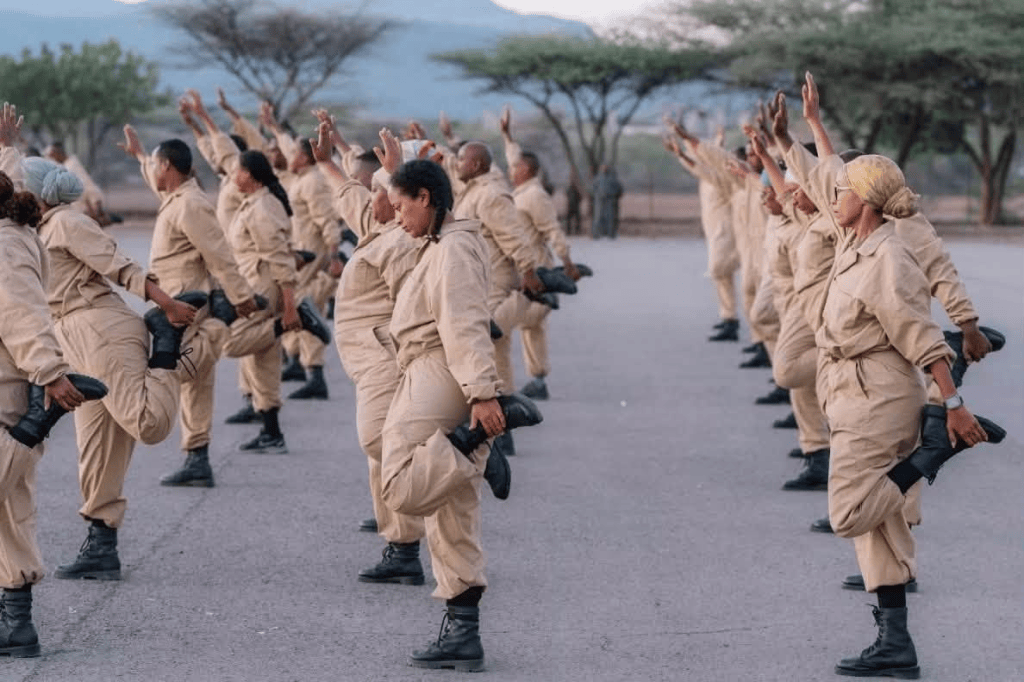
An Analysis of Kader Nour Elmi’s Statement on Prosperity Party Cadre Training
By ONA Staff Reporter
In fragile democracies and transitional states, the line between the ruling party and the state apparatus is often perilously thin. When that line is crossed—particularly concerning the national armed forces—the implications for democratic governance, human rights, and long-term stability are profound.
A recent statement by Kader Nour Elmi, a member of the Freedom and Equality Party (Somali Region), raises critical alarm bells regarding the provision of military and security-related training to the civilian leadership of Ethiopia’s ruling Prosperity Party (PP). Elmi’s analysis touches upon one of the most sensitive fault lines in contemporary Ethiopian politics: the creeping militarization of partisan politics and the potential weaponization of state security institutions.
The Two Faces of Leadership Training
Elmi’s statement offers a nuanced starting point. On the surface, providing security and strategic training to civilian leaders is not inherently sinister. In an increasingly volatile geopolitical environment—characterized by asymmetric warfare, cyber threats, and complex regional conflicts—leaders with a robust understanding of national security can, theoretically, govern more effectively. Capacity building can improve strategic foresight and institutional resilience.
However, the context in which this training occurs is everything. Elmi rightly notes that establishing a “special relationship” between a ruling party and the national armed forces invites legitimate and grave concerns. When the Prosperity Party—a partisan political entity—receives specialized military or security training, it risks blurring the fundamental distinction between the party and the state.
In a true democratic system, the military belongs to the republic, not to the party in power. The Ethiopian National Defense Force (ENDF) and other security apparatuses are constitutionally mandated to protect the sovereignty of the state and the rights of all citizens, irrespective of their political affiliations. When the ruling party co-opts military institutions for its own cadre development, it sends a dangerous message: that the military exists to protect the party’s grip on power, rather than the nation’s constitutional order.
The Threat to Military Neutrality and Political Equality
Elmi’s most potent point is the concern over military neutrality and political equality. Ethiopia is a deeply diverse nation, home to numerous political parties and armed resistance movements, particularly in Oromia and Amhara. If the armed forces are perceived as being ideologically aligned with, or trained to protect, the Prosperity Party, the military loses its legitimacy as a neutral arbiter and national unifier.
This dynamic breeds profound inequality. If PP leaders are trained in security and military strategy while opposition parties are left out, it creates a two-tiered political system. The ruling party becomes a quasi-military entity, while opposition groups are relegated to a position of structural vulnerability. In such an environment, democratic competition ceases to be a battle of ideas and becomes a contest of force. The military and security services, rather than being the shield of the people, become the sword of the incumbent.
The Need for Transparency and Accountability
Elmi’s call for transparency is not just a procedural demand; it is a constitutional necessity. The purpose, content, funding, and legal framework of providing military training to civilian party leaders must be subjected to rigorous public scrutiny.
Who is funding this training? Is it being conducted by the Ministry of Defense, the National Intelligence and Security Service (NISS), or foreign entities? What is the curriculum? Are state resources—which are funded by the taxes of all Ethiopians, including those who oppose the Prosperity Party—being diverted to strengthen a partisan political machine?
Without transparent legal frameworks and accountability mechanisms, these training programs risk becoming shadowy operations that entrench authoritarianism. The use of state security institutions to advance partisan interests is a hallmark of state capture—a phenomenon that undermines the rule of law and erodes public trust in the very institutions meant to protect them.
A Warning from the Opposition
Kader Nour Elmi’s statement, coming from a member of an opposition party in the Somali region—an area that has experienced its own complex dynamics of regional security and political marginalization—serves as a timely warning. It highlights that the concerns over the Prosperity Party’s relationship with the military are not isolated to one region or one ethnic group; they are a national dilemma.
The Prosperity Party came to power promising a new era of unity and prosperity. However, when the ruling party engages in military-style training for its cadres, it signals a reliance on security apparatuses to maintain control, rather than on democratic consensus and the ballot box. This approach mirrors the tactics of previous authoritarian regimes, where the military was used to suppress dissent and ensure the survival of the ruling elite.
Conclusion: Preserving the Democratic Boundary
The integrity of Ethiopia’s democratic transition hinges on the strict separation of party and state. Elmi’s analysis is a vital contribution to the national discourse, reminding us that national security institutions must remain firmly under the control of constitutional law, not the partisan whims of a ruling party.
If the Prosperity Party truly believes in democracy, it must ensure that its leadership training is fully transparent, legally sanctioned, and devoid of any military or security dimensions that violate the principle of civilian oversight and military neutrality.
As Elmi concludes, preserving this distinction is essential. It is the only way to safeguard democracy, strengthen the rule of law, and ensure that the national armed forces serve the people of Ethiopia, rather than the narrow political interests of those in power.

Posted on November 1, 2026, in Aadaa, Afaan, Asylum Seekers, Daaniyaa, Diaspora, Election, family violence, Finfinne, freedom, gadaa, health, Information, Kindness, Language, Media, Obituary, Oromia. Bookmark the permalink. Leave a comment.






Leave a comment
Comments 0