Irreechaa: The Festival That Believes in the Beauty of the Human Soul
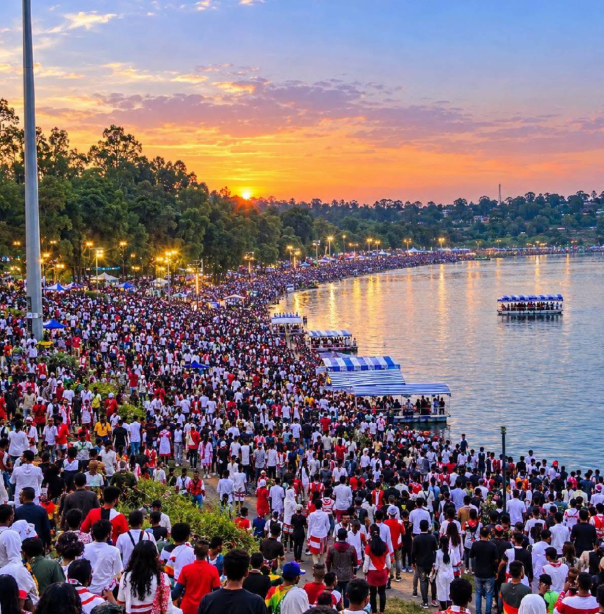
Every year, millions gather at the water’s edge to give thanks, seek forgiveness, and welcome a season of light. But the deeper story of Irreechaa is not only about a harvest or a river — it is about what humanity can become.
A Morning at the River
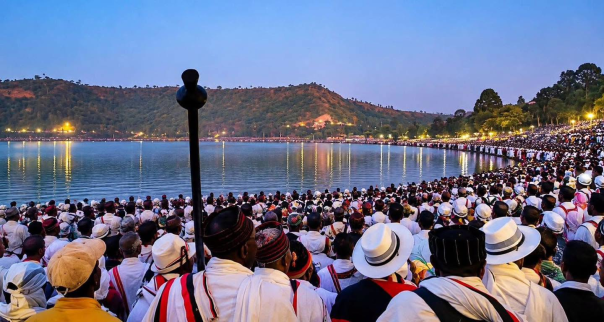
As the first light of Birraa — the Ethiopian spring — spills across the horizon, the banks of the Bishoftu lakes and the Awash River begin to fill. Elders in white näts’äla wraps arrive carrying bundles of fresh grass and yellow adey abeba flowers. Mothers lead daughters by the hand. Young men sing songs their grandfathers sang before them. The air smells of rain, wet earth, and gratitude.
This is Irreechaa, the great Thanksgiving festival of the Oromo people, celebrated at the end of the rainy season and the beginning of the harvest. To outsiders, it can look like a single day of celebration. To those who carry it in their blood, it is a whole philosophy of life — a yearly reminder of what it means to be human.
And at the heart of that philosophy lies a striking conviction: that the human soul is meant to be beautiful, and that beauty is not a luxury — it is a duty.
Thanksgiving as a Way of Seeing
Irreechaa begins with galata — thanksgiving. But this is not the polite gratitude of a hurried prayer. It is gratitude as a lens through which the entire world is viewed.
The Oromo elders say that the person who cannot give thanks cannot truly see. When you thank the earth for its harvest, you begin to notice the earth. When you thank the rain for falling, you begin to honor the rain. Thanksgiving, in this tradition, is the first act of a beautiful soul — the recognition that life is a gift received, not a possession earned.
At Irreechaa, gratitude is offered for the harvest, for health, for children, for peace, for the return of the rains. But it is also offered for things unseen: for forgiveness granted, for conflicts resolved, for another year of life. In a world addicted to complaint, Irreechaa stands as a radical act of remembering the good.
The Work of Restoration and Forgiveness
But Irreechaa is not naive. Its joy is not the joy of those who pretend nothing is broken. It is the joy of those who have done the harder work first.
Before the celebration comes reconciliation. In the weeks leading up to Irreechaa, families settle disputes. Neighbors ask forgiveness. Debts of the heart are repaid. The festival cannot be entered with a grudge in the chest; tradition holds that the one who carries bitterness to the riverbank carries it alone.
This is where Irreechaa’s belief in beautiful souls becomes most demanding. A beautiful soul is not a flawless soul — it is a soul willing to be restored. Forgiveness here flows in two directions: the courage to ask, and the generosity to grant. Restoration is not merely the repair of what was broken; it is the creation of something stronger than what existed before.
In a time when division is profitable and resentment is addictive, Irreechaa whispers another way: you do not have to stay wounded.
Love, Harmony, and the Living World
Standing at the water’s edge, the Oromo faithful do not see nature as a backdrop. They see a relative.
The river is not a resource; it is a mother. The tree is not timber; it is a witness. The land is not property; it is an ancestor. This is why Irreechaa is celebrated near water — because water is the clearest sign of life’s interdependence. What happens to the river happens to the people.
This harmony with nature is not sentimentality. It is a moral claim: you cannot love people while abusing the world they live in. The same soul that forgives a neighbor must also protect the forest. The same heart that gives thanks for the harvest must refuse to poison the soil that produced it.
Irreechaa thus offers a vision of humanity that is ecological at its core — not because it is fashionable, but because it is ancient. To respect nature is to respect the Creator, the ancestors, and the children not yet born. It is to understand that renewal and regeneration are not just human projects; they are the rhythm of the whole living world.
Remembering the Ancestors
No Irreechaa is complete without remembrance.
Elders speak the names of those who have passed. Libations are poured. The generations stand together in one long chain, and the living are reminded that they did not invent themselves. They are the continuation of a story.
Remembering ancestors is not nostalgia. It is accountability. It asks: What did they hand to us, and what will we hand forward? A beautiful soul, in this tradition, is one that knows it is a link, not an island.
This remembrance also gives Irreechaa its famous hope: the bright season over the dark. The rainy months of scarcity and confinement give way to harvest, color, and gathering. Darkness is not denied — it is acknowledged, survived, and then overcome. Every year, the festival reenacts the truth that winter does not have the final word.
Renewal and the Regeneration of Humanity
At its deepest level, Irreechaa is about renewal — not just of the fields, but of the person.
The waters of the lake are a symbol of cleansing. The green grass is a symbol of new life. The yellow flower that blooms at the season’s turn is a symbol of hope that appears precisely when the old season ends. The festival asks each participant: What in you needs to be renewed this year?
And the answer it offers is a whole program for the human family: a kind heart, a good spirit, right relationships with people and with nature, respect for life, love as practice, harmony as goal. These are not abstract virtues. They are the daily disciplines of a soul that has decided to be beautiful.
The regeneration of humanity, Irreechaa insists, does not begin in parliaments or palaces. It begins in the heart that chooses gratitude over greed, forgiveness over revenge, and harmony over domination.
A Festival That Believes in Us
In the end, Irreechaa is not merely a celebration of a harvest. It is a declaration of faith in the human soul.
It believes that people can be kind. It believes that old wounds can heal. It believes that the earth can be honored and the ancestors remembered. It believes that light follows dark, that love is stronger than hatred, and that a good spirit is not a weakness but the highest form of strength.
To stand at the river at Irreechaa is to be told, by a tradition older than any empire: You were made for beauty. Live like it.
And perhaps that is the festival’s greatest gift to a fractured world — not just a day of thanksgiving, but a lifelong invitation to become the beautiful soul that Irreechaa has always believed we could be.
Happy Irreechaa! May your season be bright.

Posted on October 5, 2026, in Aadaa, Afaan, Events, Finfinne, freedom, gadaa, health, Information, Irreechaa, Kindness, Language, Media, News, Oromia, Oromo diaspora, Press Release, Promotion, Sirna Oromo. Bookmark the permalink. Leave a comment.






Leave a comment
Comments 0