The Pen and the Sword: Remembering Jaal Kumsaa Buraayyuu, a Titan of the Oromo Struggle
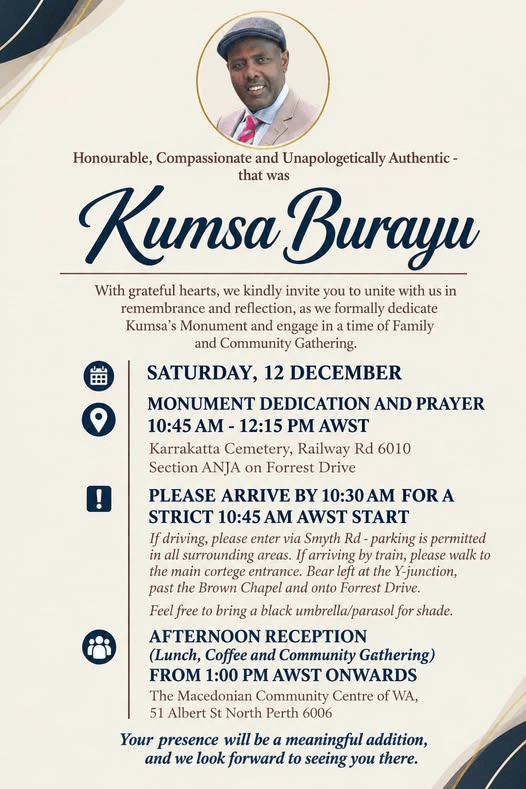
By Dhabessa Wakjira
In the long and arduous history of the Oromo people’s struggle for self-determination, the weapons of resistance have not only been rifles and guerrilla tactics; they have also been the pen, the novel, and the printing press. On July 15, 2025, the Oromo nation lost one of its most formidable intellectual warriors. Jaal Kumsaa Buraayyuu (Kumsa Burayu Balo)—a prominent nationalist, author, journalist, and political activist—passed away, leaving behind a monumental legacy that fundamentally shaped Oromo literature and political consciousness.
His life was a testament to the power of words in the face of state repression. From the rural heartlands of East Wallagga to the global stage of international exile, Kumsaa Buraayyuu dedicated his life to ensuring that the Oromo story was not just preserved, but weaponized for liberation.
Forging a Cultural Renaissance
Born in November 1969 in the Horro Guduru zone of East Wallagga, Oromia, Kumsaa grew up immersed in the rich oral traditions and cultural heritage of his people. This early exposure to indigenous knowledge would become the bedrock of his later work.
The 1990s were a pivotal time for Ethiopia. As the brutal Derg regime collapsed, Kumsaa Buraayyuu emerged as a pioneering voice in the Oromo cultural recovery movement. In 1993, he authored Suuraa Abdii (The Picture of Hope), one of the earliest and most influential novels written in Afaan Oromo. The novel was not just a work of fiction; it was a searing, critical examination of the oppressive realities of the Derg regime. For a people whose language and history had been systematically marginalized, Suuraa Abdii was a radical act of reclaiming identity.
Furthermore, Kumsaa was an early and fierce advocate for the expansion of Afaan Oromo literacy using the Qubee (Latin) script. Recognizing that a language is the lifeblood of a culture, he championed the written word as the primary vehicle for Oromo emancipation.
The Cost of Truth
Kumsaa’s literary brilliance was matched by his journalistic courage. In 1993, he co-founded the Madda Walaabuu publishing and advertisement organization, which became a vital hub for Oromo intellectual thought. He also served as an editor for early Oromo political and cultural magazines, most notably Odolee.
Through these platforms, Kumsaa provided a space for Oromo voices that the state wanted silenced. But speaking truth to power in Ethiopia carries a heavy price. Because of his relentless work and his advocacy for Oromo rights, Kumsaa faced severe political persecution and imprisonment under the incoming EPRDF regime. The state recognized what many already knew: his ideas were a threat to their centralized, hegemonic control.
Exile and the Unyielding Struggle
Faced with the impossibility of continuing his work safely within Ethiopia, Kumsaa was forced to flee in 1996. After a brief period in Djibouti, he resettled in Australia in 1997. Yet, for a true patriot, exile is not a retreat; it is merely a change of battleground.
From his new home in the Global South, Kumsaa Buraayyuu remained highly active in the political struggle. He joined the Oromo Liberation Front (OLF/ABO), dedicating his strategic mind to the cause. From 1998 to 2009, he served as a senior OLF official and led the OLF South Pacific branches, organizing and mobilizing the Oromo diaspora across Australia and New Zealand.
In an era where the Ethiopian government and its allies actively abused their influence in international media and institutions to demonize the Oromo people and their organizations, Kumsaa’s diplomatic and journalistic work in the Pacific region became an essential counter-narrative. He understood that the struggle for Oromia had to be fought simultaneously in the homeland and in the halls of international opinion.
A Legacy that Breathes
Jaal Kumsaa Buraayyuu was a bridge between the traditional oral historians of the past and the modern, globalized digital activists of the future. He understood that the Gadaa system, the ancient democratic governance model of the Oromo, was not just a relic of history, but a guiding philosophy for a better future—one rooted in human security, compromise, and consensus.
His passing on July 15, 2025, is a profound loss to the Oromo nation. He leaves behind a generation of writers, readers, and activists who were inspired by Suuraa Abdii and who learned the Qubee script through his advocacy.
Though Kumsaa Buraayyuu is gone, the “picture of hope” he painted through his life’s work remains. He proved that while the state can imprison the body, it can never imprison the Afaan Oromo language, nor the indomitable spirit of the people who speak it.
May his memory be a blessing, and may his legacy continue to fuel the fight for freedom, justice, and self-determination for generations of Oromos to come.

Posted on October 30, 2026, in Aadaa, Afaan, Biography, Diaspora, Events, Finfinne, freedom, gender, Grief Support, Gumaa, Information, Kindness, Language, Media, mental health, News, Oromia, Oromo diaspora, Press Release, Promotion, Sirna Oromo. Bookmark the permalink. Leave a comment.






Leave a comment
Comments 0