Category Archives: Diaspora

The Man Who Would Redefine Ethiopia
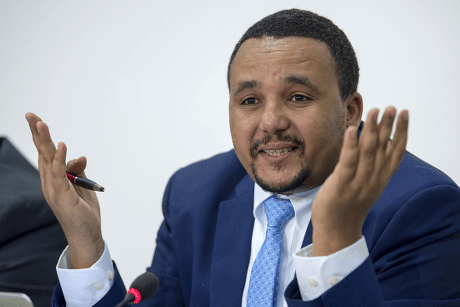
Jawar Mohammed’s “Progressive Patriotism” and the Oromo Question: A New Chapter in Ethiopia’s National Story
By Sultan Abda Neja, Ph.D.
—
For much of modern Ethiopian history, the question of who owns the nation has been answered in blood, in policy, and in silence. It is a question that has haunted the Oromo people—Ethiopia’s largest ethnolinguistic community—for generations. Their relationship with the modern Ethiopian state has been shaped by conquest, land dispossession, political exclusion, and cultural marginalization. Yet something is shifting. The old binary of Oromo resistance versus Ethiopian state nationalism is being challenged—not by a soldier, not by a separatist, but by a media-savvy activist-turned-thinker named Jawar Mohammed.
At the heart of this shift is a deceptively simple concept: Progressive Patriotism. It is Jawar’s attempt to articulate a political framework in which Oromo identity and Ethiopian national belonging are not mutually exclusive. It asks a new question: Can Oromo nationalism help redefine Ethiopian nationalism from within?
—
The Long Road from Resistance
To understand the weight of Jawar’s proposition, one must first understand the weight of history. Oromo nationalism did not emerge in a vacuum. It grew out of the expansion and consolidation of the modern Ethiopian state, the incorporation of Oromo territories, and subsequent struggles over land, language, religion, and political representation.
The Ethiopian state-building project, for much of its history, was associated with centralized authority, cultural homogenization, and the marginalization of groups whose languages and political identities differed from those of the ruling elite. The Oromo Liberation Front (OLF), founded in 1973, became the most prominent expression of Oromo resistance. But even then, Oromo nationalism was never monolithic. Some advocated independence; others supported multinational federalism, stronger regional autonomy, or a democratic Ethiopian state.
The 1995 Constitution, which formally recognized the rights of nations, nationalities, and peoples—including the right to self-determination up to secession—represented a significant shift. Yet constitutional recognition did not automatically produce democratic governance. The political crisis that culminated in the 2014–2018 protests exposed the limits of the existing order. Oromo protesters mobilized against political exclusion, human rights abuses, and the proposed expansion of Addis Ababa into surrounding Oromia.
Then came 2018. Abiy Ahmed, an Oromo politician, became prime minister. It was a moment of symbolic triumph—an Oromo had reached the highest office in the land. But symbolism, as Jawar would later argue, is not transformation.
—
Jawar’s Intervention: From Resistance to Governance
Jawar Mohammed’s political trajectory—from a fiery activist and media owner to a prominent voice in the debate over Ethiopia’s future—mirrors the broader evolution of Oromo political consciousness. His call for a transition from resistance politics to governance politics, and from ethnonationalism to broader nation-building, represents a significant shift.
In his writings and interviews, Jawar argues that Oromo politics must evolve beyond its traditional oppositional orientation. A movement that has historically defined itself through resistance must now demonstrate its capacity to govern, build institutions, deliver public services, and contribute to national stability. Political legitimacy cannot be sustained indefinitely through historical grievances alone.
This is not to suggest that Jawar asks Oromos to abandon their identity or their legitimate demands. Rather, he challenges the assumption that protecting Oromo interests and building a common Ethiopian political future are mutually exclusive. Given the Oromo people’s demographic significance, geographical position, cultural influence, and historical role in Ethiopia, their political participation is essential to any sustainable project of national reconstruction.
In a recent interview on Kallatti Media, Jawar explained that Ethiopian nationalism should not be understood as an identity or political project owned exclusively by historically dominant groups. Oromos, like other peoples of Ethiopia, have an equal right to define, shape, and participate in the national project. An Oromo can embrace Ethiopian citizenship, contribute to national unity, and take pride in a shared political identity without surrendering Oromo cultural identity or constitutional rights.
From this standpoint, Progressive Patriotism challenges the historical tendency to associate Ethiopian nationalism with cultural assimilation, political centralization, or the dominance of one group. It opens the possibility of an inclusive nationalism in which belonging to Ethiopia does not require becoming less Oromo.
—
The Goobana Question: Heroes, Traitors, and the Politics of Memory
Jawar’s concept of Progressive Patriotism extends beyond constitutional arrangements. It also engages with the politics of memory—specifically, the way political movements construct historical narratives that distinguish heroes from traitors.
In his text, Goobana: The Hero-Traitor Narrative in the Oromo Struggle, Jawar examines how the figure of Goobana Daacee—a historical Oromo figure remembered as a collaborator with Emperor Menelik II and, consequently, a traitor—has been used within the Oromo national movement. The narrative of betrayal, Jawar argues, can serve important political purposes: it mobilizes communities, establishes collective memory, and defines political loyalties.
But when a movement moves from resistance to governance, such narratives become liabilities. A movement operating in opposition can organize its political identity around a clear distinction between the oppressed and the oppressor, resistance and collaboration, liberation and betrayal. A political movement that enters government, however, must negotiate competing interests, govern citizens with different identities, and build institutions that extend beyond its original constituency.
Jawar suggests that political movements may need to move from a resistance narrative toward a governing narrative. Figures previously condemned may be reassessed; figures celebrated may be subjected to new scrutiny. The task, he argues, is not to replace every hero with a traitor, but to create a political culture in which historical disagreements can be examined without becoming grounds for denying citizenship, identity, or political legitimacy.
—
The Abiy Paradox: An Oromo Leader, but an Oromo-Empowering Government?
The question of Oromo ownership of Ethiopian nationalism cannot be separated from the political trajectory of Abiy Ahmed. His rise to power in 2018 symbolized the opportunity to translate Oromo political mobilization into democratic transformation at the national level.
His early reform agenda generated expectations of political liberalization, reconciliation, and greater openness. His government’s peace initiative with Eritrea further strengthened the image of a leader seeking to move beyond longstanding regional hostility. But the subsequent political project—associated with the formation of the Prosperity Party in 2019 and the language of Medemer—proved contentious.
Supporters interpreted Medemer as an attempt to overcome political fragmentation and the limitations of ethnic-based party organization. Critics, including Oromo nationalists, argued that it weakened the political and institutional protections established under multinational federalism. The war in Tigray, the subsequent armed conflicts in other regions, political polarization, and serious allegations of abuses by state and non-state actors exposed the limitations of a political transition that did not produce a broadly accepted democratic settlement.
The broader lesson is that an Oromo’s accession to the center of Ethiopian power does not automatically mean that Oromo nationalism has achieved its democratic objectives. An Oromo-led government is not necessarily an Oromo-empowering government, just as an Ethiopian national identity is not necessarily an exclusionary identity. The decisive issue is the character of the institutions and policies through which political power is exercised.
—
The Critics Speak: Progressive Patriotism Under the Microscope
Jawar’s Progressive Patriotism has not gone unchallenged. Critics from across the political spectrum have raised important questions about its conceptual clarity, its practical implications, and its relationship to the status quo.
Moges Zewdu Teshome argues that Jawar conflates multinational federalism, multicultural federalism, and a multicultural unitary state—distinct institutional arrangements that cannot be resolved simply by democratizing an allegedly flawed constitutional structure. He advocates revisiting the constitutional order, strengthening an inclusive civic identity, and building a political community in which citizenship is not subordinated to ethnic affiliation.
Professor Messay Kebede challenges Jawar’s claim that ethnonationalism has become effectively irreversible, reasoning that political identities and institutions are historically constructed and can therefore change. He proposes democratic or civic nationalism as a more coherent alternative, arguing that inclusive democratic institutions can protect cultural diversity without making ethnic political sovereignty the organizing principle of the state.
Benti Geleta Buli, through a sentiment analysis of Jawar’s proposal, notes that the term “progressive” remains inadequately defined and could become a rhetorical framework that preserves the status quo rather than resolving Ethiopia’s political divisions. He presents constitutional patriotism as a more constructive alternative grounded in shared constitutional values, democratic participation, and inclusive citizenship.
And in my own earlier critique, I argued that Jawar’s distinction between “centripetal” and “centrifugal” political forces unfairly portrays ethnonationalist movements while underemphasizing the historical injustices, assimilationist policies, and authoritarian practices that gave rise to them. Appealing to right-wing Ethiopian nationalists by equating their historical responsibilities with those of ethnonationalist movements risks undermining the legitimate struggles and sacrifices of nations and nationalities, including the Oromo people.
These critiques are not dismissive. They are, in fact, a sign of the seriousness with which Jawar’s intervention is being taken. They demand that Progressive Patriotism move beyond slogan and toward institutional specificity.
—
Toward a Constitutional Patriotism: The Roadmap
If Progressive Patriotism is to become more than a rhetorical compromise, it must be grounded in concrete institutional commitments. One possible way to clarify it is to connect it to constitutional patriotism—attachment to a political community based on shared constitutional principles, democratic institutions, equal citizenship, and fundamental rights rather than ethnic or cultural uniformity.
For Ethiopia, such a framework would require at least five commitments:
1. Meaningful regional self-government and the rights of nations, nationalities, and peoples must be constitutionally protected.
2. Federal and regional governments must be accountable through genuinely competitive political processes and an independent judiciary.
3. Minorities within regional states must enjoy equal citizenship, cultural rights, security, and political participation.
4. National institutions must be accessible to citizens regardless of language, ethnicity, religion, or political affiliation.
5. Disputes over federal authority, regional boundaries, resources, and political representation must be resolved through credible constitutional procedures rather than coercion.
Beyond these constitutional commitments, a pragmatic roadmap for Oromo ownership of Ethiopian nationalism requires several practical steps: protecting political pluralism within Oromo society, democratizing multinational federalism, establishing credible national dialogue, creating effective mechanisms for accountability, promoting an inclusive national historical narrative, and defining Progressive Patriotism institutionally.
It also requires a crucial conceptual separation: national unity must be separated from unconditional support for a government. Citizens should be able to oppose a prime minister, criticize the federal government, or demand constitutional change without being branded enemies of Ethiopia. Likewise, support for Oromo rights should not require unconditional loyalty to an Oromo political organization.
—
The Future of Ethiopian Nationalism: A Shared Project
The most important question, ultimately, is not whether Oromo nationalism should disappear into Ethiopian nationalism or remain permanently opposed to it. It is whether both can be transformed through democratic institutions so that neither requires the political subordination of the other.
Jawar Mohammed’s Progressive Patriotism is an attempt to articulate a framework in which ethnic identity and shared national belonging can coexist. Its credibility depends on democratic institutions, constitutional protections, political pluralism, and an explicit rejection of coercive assimilation. Abiy Ahmed’s experience illustrates the dangers of attempting to build national cohesion by weakening the political forces and constitutional guarantees through which historically marginalized communities sought recognition.
The future of Ethiopian nationalism will depend on whether the country can build a political community in which unity is freely sustained rather than coercively imposed, ethnic identities are protected rather than demonized, and national citizenship is shared rather than monopolized.
Oromo nationalism’s most consequential contribution to Ethiopia may ultimately be its capacity to help transform Ethiopian nationalism from an inherited claim of state authority into a genuinely shared project of democratic citizenship. That is the promise of Progressive Patriotism. Whether it becomes a reality depends not on the eloquence of its advocates, but on the institutions through which it is enacted—and on the willingness of all Ethiopians, Oromo and non-Oromo alike, to engage in the difficult, patient work of democratic negotiation.
The question is no longer whether the Oromo belong to Ethiopia. The question is what kind of Ethiopia can belong equally to Oromos and all other citizens. The answer, if it comes, will not be found in slogans or in the shadow of a single leader. It will be found in the constitution, in the ballot box, and in the everyday practice of citizenship.
—
Sultan Abda Neja, Ph.D., is a political analyst and author specializing in Ethiopian politics, federalism, and ethnonationalism. His work has appeared in Borkena and other outlets.
The full article can be accessed:

The Irony of Faisal Roble’s Attack on Oromo Nationalism: A History of Somali Expansionism
By Asfaw Beyene
I was taken aback by recent comments from two prominent political commentators of Somali ethnicity, Farah Maalim and Faisal Roble, both associated with Nairobi’s political circles. My focus here is on the remarks made by Faisal Roble.
In an interview with a media outlet unfamiliar to me, Faisal Roble expressed concern about what he described as the growing number of “ultra-nationalists” among the Oromo. He claimed that these nationalists had become so numerous, indeed, “huge” in number, that the phenomenon posed a danger to Ethiopia.
He then asked why Oromo nationalists had become so radicalized, suggesting that the movement’s supposed extremism might be explained by its being relatively new and youthful. As evidence of what he called the “pervasive” nature of Oromo nationalism, he alleged that Oromo nationalists were making territorial claims extending as far as Mogadishu, Djibouti, Yemen, Kenya, and Eritrea.
By the time I finished listening to the interview, I found myself wondering whether Faisal Roble had confused Somali ultra-nationalists with Oromo nationalists. Nearly every characteristic he attributed to Oromo nationalism seemed far more applicable to the historical record of Somali expansionist nationalism.
His argument deserves careful examination.
The Contradictions in Faisal Roble’s Argument
First, the history of radical nationalism in the Horn of Africa cannot be discussed without examining Somali expansionism. Somali nationalism has a long and complicated history. Its expansionist manifestations, particularly the ideology of Greater Somalia, contributed to regional wars, territorial disputes, and political instability. Somalia’s own experience with authoritarian rule, civil war, and state collapse demonstrates the destructive potential of nationalism when it becomes inseparable from territorial ambition and political exclusion.
It would be simplistic to attribute Somalia’s decades of instability entirely to nationalism. Nevertheless, the historical consequences of expansionist and pervasive Somali nationalism are too significant to ignore.
Second, Faisal Roble describes Oromo nationalism as a danger to Ethiopia. This assertion raises a fundamental question: a danger to which Ethiopia? If Oromo nationalism seeks equality, self-determination, political representation, and the protection of Oromo rights, it can be considered a danger only to a political order that refuses to recognize those rights.
A political movement demanding justice for a historically marginalized people should not automatically be characterized as extremist. The distinction between legitimate national aspirations and exclusionary ultra-nationalism is essential.
Third, Faisal portrays Oromo nationalism as a new and youthful phenomenon.
This reflects a troubling misunderstanding of Oromo history. The historical roots of Oromo collective identity, political institutions, resistance, and struggles over sovereignty extend back centuries. The Oromo played a major role in the political transformations of the Horn of Africa during the sixteenth century, long before the emergence of the modern Ethiopian state.
Modern Oromo nationalism took shape through subsequent historical experiences, particularly the incorporation of Oromo territories into the expanding Ethiopian Empire during the nineteenth century. To describe Oromo nationalism simply as a new movement is to overlook this long historical trajectory.
Fourth, Faisal alleges that Oromo nationalists claim territories extending to Mogadishu, Djibouti, Yemen, Kenya, and Eritrea. This is perhaps the most extraordinary part of his argument. I have yet to encounter a credible statement by a recognized Oromo political party, organization, or prominent nationalist leader asserting territorial claims over Mogadishu, Yemen, Eritrea, or Djibouti.
If Faisal possesses such evidence, he should present it. Which Oromo political organization has made these claims? When were they made? In what official document or public statement? Without such evidence, these allegations amount to a sweeping and potentially inflammatory misrepresentation of Oromo nationalism.
The irony is striking: the territorial ambitions he attributes to Oromo nationalists bear a much closer resemblance to the historically documented ideology of Greater Somalia. This leads to a more important question: Why has Faisal Roble chosen this moment to launch such an attack on Oromo nationalism? To explore that question, we must examine the emerging political connections between Nairobi, Mogadishu, and Jijjiga.
The Nairobi–Mogadishu–Jijjiga Nexus
Recent political developments in the Horn of Africa raise questions about the relationships among Somali nationalist networks, political actors in Somalia, and political movements operating within Ethiopia’s Somali Region. Nairobi has long served as an important center for Somali political, commercial, and diaspora activity. Its significance as a meeting place for politicians, businesspeople, and opposition figures is well established. However, the existence of these networks does not, by itself, establish that they operate under a coordinated political agenda.
What concerns me is the possibility that certain political actors are attempting to exploit regional tensions, territorial disputes, and opposition alliances to advance a renewed expansionist agenda. This concern becomes particularly important when viewed alongside recent political developments in Ethiopia and the changing alliances among armed and opposition movements.
The Minnesota Fraud Cases and the Nairobi Connection
Recent federal fraud prosecutions in Minnesota have also drawn attention to the movement of stolen public funds into overseas investments, including real estate in Kenya. Among the individuals named in connection with these cases, several of them have investments in Nairobi realestate. The diversion of funds intended to feed vulnerable children is deeply disturbing. Such misconduct betrays taxpayers’ trust, harms the communities these programs were designed to serve, and unfairly tarnishes the reputation of the many honest, hardworking Somali Americans who have contributed to their communities and American society. Criminal responsibility rests with the individuals involved and should never be generalized to an entire ethnic or immigrant community. Nevertheless, for Oromos and Kenyans, reports of property acquisitions by individuals indicted in the Minnesota fraud cases, in a city (Nairobi) where allegations of a nonexistent Oromo ultranationalist movement have suddenly surfaced, raise legitimate concerns. This does not imply any connection between those implicated in Minnesota and political figures in Nairobi. Rather, the broader question is whether illicit financial networks, political influence, and regional nationalist agendas intersect in ways that warrant further investigation.
The ONLF and the Changing Political Alliances in Ethiopia
In September 2026, the Ogaden National Liberation Front (ONLF) was reported to have joined a coalition known as the Ethiopian Peoples’ Forces Alliance for Survival, bringing together seven armed and opposition organizations opposed to Prime Minister Abiy Ahmed’s administration.
The ONLF has historically pursued Somali self-determination in Ethiopia’s Somali Region. Its political trajectory must also be understood in the context of the broader history of Somali nationalism and the territorial disputes that have shaped relations between Ethiopia and Somalia. The changing fortunes of opposition alliances, including those associated with the TPLF, may have created opportunities for other political movements to reposition themselves.
I am particularly concerned that some advocates of Somali expansionist nationalism may see these developments as an opportunity to revive older territorial ambitions. Faisal Roble’s political commentary and Farah Maalim’s reported statements about support for the ONLF deserve examination in this context, despite political sympathy for an organization should not be confused with proof of operational involvement in its activities. The critical issue is whether opposition to the Ethiopian government is being used to advance legitimate political demands or to reopen territorial conflicts between neighboring communities.
Moyale, Borana, and the Politics of Territorial Expansion
Recent tensions around Moyale and Borana territory have intensified these concerns. Moyale lies in a historically sensitive borderland where Oromo and Somali communities, including Borana and Garri populations, have longstanding relationships shaped by trade, migration, political competition, and periodic conflict.
Reports of violence, including the alleged killing of a 13-year-old girl and the reported refusal to return her body to her family, are deeply disturbing. These allegations demand an independent investigation, accountability, and justice for the victim’s family. No territorial or political dispute can justify the killing of a child. This is extreme nationalism in action.
Of particular concern are reports that a Somali national flag, rather than the flag of Ethiopia’s Somali Regional State, was raised in contested territory. If verified, such an act would carry political significance extending beyond an ordinary local dispute. It would raise questions about whether the conflict was being framed in terms of Somali national territorial ambitions rather than local administrative boundaries. This is why I do not believe the tensions should be dismissed simply as a dispute between the Garri and Borana communities both of whom are Oromos and both of whom speak Oromo language. There is a larger historical and political context that deserves examination.
The timing of Faisal Roble’s remarks, following heightened tensions and Oromo reactions to events in the area, is striking. His criticism of Oromo nationalism appears to reflect a broader political anxiety about Oromo resistance to territorial encroachment. Whether this interpretation is correct requires further evidence. Nevertheless, it provides a compelling reason to examine the historical record of Somali expansionist nationalism.
Greater Somalia: The Historical Irony
Perhaps the greatest irony in Faisal Roble’s accusations is that the territorial expansionism he attributes to Oromo nationalists closely resembles the ideology of Greater Somalia. The Greater Somalia project was not an imaginary accusation invented by political opponents. It was an explicit political objective promoted by extreme Somali nationalist movements and successive Somali governments. Its central ambition was to unite Somali-inhabited territories across the Horn of Africa under a single political entity. This included the Somali Republic, the Ogaden and other Somali-inhabited territories of Ethiopia, the Northern Frontier District of Kenya, and Djibouti. The five-pointed star on Somalia’s flag historically symbolized these five Somali territories.
Under Siad Barre, this ideology became closely associated with military expansionism and the attempt to alter established international borders by force. Thus, the history of Somali ultra-nationalism is not merely a history of territorial ambition. It is also a warning about the destructive consequences of authoritarianism, militarization, and exclusionary political identity.
Against this historical background, Faisal Roble’s portrayal of Oromo nationalism as uniquely expansionist becomes especially difficult to understand.
The Western Somali Liberation Front and the Ogaden War
The Western Somali Liberation Front (WSLF) provides one of the clearest historical examples of ultra nationalism and the territorial objectives associated with Greater Somalia. Supported by the Somali government, the WSLF operated in eastern Ethiopia and played a significant role in the conflict that culminated in the 1977 – 1978 Ogaden War. The name Western Somali Liberation Front itself reflected a territorial conception in which parts of internationally recognized Ethiopian territory were regarded as belonging to a broader Somali nation.
During the war, Somali forces advanced into substantial portions of eastern Ethiopia before being defeated by Ethiopian forces. The conflict had devastating consequences for the region and its civilian populations, the broader military campaign and associated political movements affected Oromo communities and territories. But the central point is undeniable: territorial revisionism was an explicit component of the Greater Somalia project, manifested as ultra nationalism. These fanatical adventures to alter boarders by force led to the disintegration of the Somali state apparatus and the mushrooming of warlords.
Where, then, is the equivalent documented Oromo nationalist program claiming Mogadishu, Yemen, or Eritrea? If Faisal Roble wishes to make that comparison, the burden of evidence rests with him.
From the WSLF to the ONLF
The decline of the WSLF and the emergence of the ONLF marked an important transformation in Somali nationalist politics in Ethiopia. The ONLF emerged in the 1980s and eventually became a major political and armed organization advocating self-determination for ethnic Somalis in Ethiopia. Although the ONLF and WSLF differed in their organizational structures, political circumstances, and stated objectives, their histories are connected to the broader question of Somali national identity and political sovereignty in the Horn of Africa.
The relationship between Somali nationalist movements and Oromo liberation organizations has also been complex. At different times, their interests have converged around opposition to Ethiopian central governments. At other times, territorial competition, political rivalry, and conflicting national aspirations have generated serious tensions. Historical attacks of Somali extremists on Oromo liberation figures, including the 10 massacred at Shinniga in 1980 have deeply saddened the Oromo people, leaving a historical scar. Faisal shall pour no more fuel to these historic wounds and respect the brotherly sentiment that existed between Oromos and Somalis for centuries.
The Somali Abo Liberation Front and the Struggle Over Oromo Territory
During the 1970s, the Somali government supported extremist Somali movements operating in southern Ethiopia, including areas historically associated with the provinces of Bale, Sidamo, and Arsi. These regions were primarily inhabited by Oromo populations. The SALF mobilized some communities in these areas to suit Somalia’s regional political and military objectives. Unlike the WSLF, which focused primarily on Somali national claims in eastern Ethiopia, the SALF’s activities extended into areas where Oromo identity and political aspirations were central. It was a clear expansionist and extremist move to annex some Oromo territories including the Garri.
Following Somalia’s defeat in the Ogaden War, the Oromo Abo Liberation Front (OALF) emerged reflecting changing political identities and alliances. The precise organizational relationship between the SALF and OALF, including claims about formal renaming and changes in political affiliation, remain beyond the scope of this paper. Nevertheless, the broader history illustrates an important point: Somali state-sponsored political and military movements were active in territories inhabited by Oromo communities, and the growing national aspirations of Somali extremism was already evident decades ago.
This is the historical context in which false accusations of Oromo territorial expansionism must be evaluated. It is important to note that out of such piles of political extremism was born Al-Shabaab, whose emergence was also shaped by a different mix of ideology, state collapse, and extremist politics. There simply are no parallels to such extremism in the Oromo body politics, reason why Faisal’s statement itself comes as extreme.
Who Is Really Promoting Expansionist Nationalism?
Faisal Roble’s comments raise questions that cannot be avoided. Why are political commentators such as Faisal Roble and Farah Maalim devoting so much attention to the alleged dangers of Oromo nationalism while appearing less concerned about the documented history of Somali territorial expansionism? Why portray Oromo demands for political rights and territorial security as extremist while failing to apply the same scrutiny to the ideology of Greater Somalia? And why should Oromo opposition to perceived territorial encroachment be interpreted as radicalization rather than as a legitimate concern about security, identity, and political rights?
These questions are especially important given the continuing challenges facing Somalia itself.
Somalia has struggled for decades with state fragmentation, armed insurgency, political instability, and the difficulty of establishing effective authority across its territory. Regional and international assistance, including sacrifices made by Ethiopian forces, has played a significant role in efforts to restore security. I have no doubt that many of these forces come from Oromia.
Rather than reopening old territorial disputes, political leaders and commentators should devote greater attention to peace, accountable governance, economic development, and cooperation among the peoples of the Horn of Africa.
This is not an argument against Somali nationalism as an expression of cultural identity or legitimate political aspiration. Nor is it a criticism of Somali people, whose communities have suffered enormously from war, displacement, and political instability. It is an argument against expansionist ultra-nationalism, regardless of who promotes it.
Conclusion: The Danger of Historical Amnesia
Faisal Roble’s criticism of Oromo nationalism suffers from a fundamental contradiction. He warns against an alleged Oromo expansionist movement without identifying credible evidence of the extraordinary territorial claims he attributes to it. Yet the historical record contains extensive documentation of Somali nationalist movements that openly pursued territorial revisionism across the Horn of Africa.
The Greater Somalia project, the WSLF, the Ogaden War, and the history of Somali-backed political movements in southern Ethiopia are not matters of speculation. They are part of the region’s political history.
None of this means that Oromo nationalism should be exempt from criticism. Any nationalist movement can become intolerant, exclusionary, or extremist. Oromo nationalism, like every other political movement, should be judged by its principles, conduct, and respect for the rights of others. But criticism must be grounded in evidence, not sweeping accusations or historical distortions.
If Faisal Roble believes that Oromo nationalists are claiming Mogadishu, Yemen, Djibouti, Eritrea, and Kenya, he should identify the organizations, leaders, statements, and documents that substantiate his allegations. Until then, his claims remain unsupported.
The peoples of the Horn of Africa have suffered enough from territorial wars, political manipulation, and competing nationalist ambitions. They deserve a future based on mutual recognition, historical honesty, and respect for one another’s rights. The real danger to Ethiopia and the wider Horn of Africa is not the legitimate expression of Oromo or Somali national identity. It is the revival of expansionist ideologies that treat the territories and rights of neighboring peoples as objects of political conquest. That is the danger Faisal Roble should be addressing rather than projecting onto Oromo nationalism the very expansionist tendencies that have already caused so much suffering in the region.

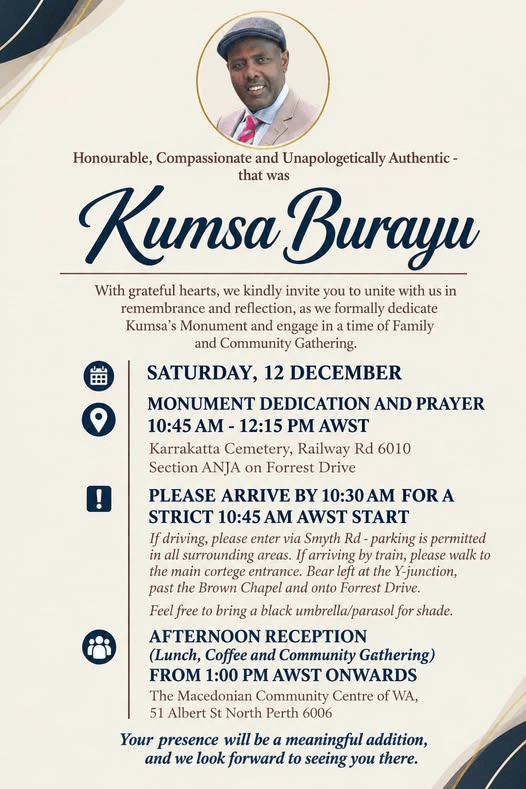
The Pen and the Sword: Remembering Jaal Kumsaa Buraayyuu, a Titan of the Oromo Struggle
By Dhabessa Wakjira
In the long and arduous history of the Oromo people’s struggle for self-determination, the weapons of resistance have not only been rifles and guerrilla tactics; they have also been the pen, the novel, and the printing press. On July 15, 2025, the Oromo nation lost one of its most formidable intellectual warriors. Jaal Kumsaa Buraayyuu (Kumsa Burayu Balo)—a prominent nationalist, author, journalist, and political activist—passed away, leaving behind a monumental legacy that fundamentally shaped Oromo literature and political consciousness.
His life was a testament to the power of words in the face of state repression. From the rural heartlands of East Wallagga to the global stage of international exile, Kumsaa Buraayyuu dedicated his life to ensuring that the Oromo story was not just preserved, but weaponized for liberation.
Forging a Cultural Renaissance
Born in November 1969 in the Horro Guduru zone of East Wallagga, Oromia, Kumsaa grew up immersed in the rich oral traditions and cultural heritage of his people. This early exposure to indigenous knowledge would become the bedrock of his later work.
The 1990s were a pivotal time for Ethiopia. As the brutal Derg regime collapsed, Kumsaa Buraayyuu emerged as a pioneering voice in the Oromo cultural recovery movement. In 1993, he authored Suuraa Abdii (The Picture of Hope), one of the earliest and most influential novels written in Afaan Oromo. The novel was not just a work of fiction; it was a searing, critical examination of the oppressive realities of the Derg regime. For a people whose language and history had been systematically marginalized, Suuraa Abdii was a radical act of reclaiming identity.
Furthermore, Kumsaa was an early and fierce advocate for the expansion of Afaan Oromo literacy using the Qubee (Latin) script. Recognizing that a language is the lifeblood of a culture, he championed the written word as the primary vehicle for Oromo emancipation.
The Cost of Truth
Kumsaa’s literary brilliance was matched by his journalistic courage. In 1993, he co-founded the Madda Walaabuu publishing and advertisement organization, which became a vital hub for Oromo intellectual thought. He also served as an editor for early Oromo political and cultural magazines, most notably Odolee.
Through these platforms, Kumsaa provided a space for Oromo voices that the state wanted silenced. But speaking truth to power in Ethiopia carries a heavy price. Because of his relentless work and his advocacy for Oromo rights, Kumsaa faced severe political persecution and imprisonment under the incoming EPRDF regime. The state recognized what many already knew: his ideas were a threat to their centralized, hegemonic control.
Exile and the Unyielding Struggle
Faced with the impossibility of continuing his work safely within Ethiopia, Kumsaa was forced to flee in 1996. After a brief period in Djibouti, he resettled in Australia in 1997. Yet, for a true patriot, exile is not a retreat; it is merely a change of battleground.
From his new home in the Global South, Kumsaa Buraayyuu remained highly active in the political struggle. He joined the Oromo Liberation Front (OLF/ABO), dedicating his strategic mind to the cause. From 1998 to 2009, he served as a senior OLF official and led the OLF South Pacific branches, organizing and mobilizing the Oromo diaspora across Australia and New Zealand.
In an era where the Ethiopian government and its allies actively abused their influence in international media and institutions to demonize the Oromo people and their organizations, Kumsaa’s diplomatic and journalistic work in the Pacific region became an essential counter-narrative. He understood that the struggle for Oromia had to be fought simultaneously in the homeland and in the halls of international opinion.
A Legacy that Breathes
Jaal Kumsaa Buraayyuu was a bridge between the traditional oral historians of the past and the modern, globalized digital activists of the future. He understood that the Gadaa system, the ancient democratic governance model of the Oromo, was not just a relic of history, but a guiding philosophy for a better future—one rooted in human security, compromise, and consensus.
His passing on July 15, 2025, is a profound loss to the Oromo nation. He leaves behind a generation of writers, readers, and activists who were inspired by Suuraa Abdii and who learned the Qubee script through his advocacy.
Though Kumsaa Buraayyuu is gone, the “picture of hope” he painted through his life’s work remains. He proved that while the state can imprison the body, it can never imprison the Afaan Oromo language, nor the indomitable spirit of the people who speak it.
May his memory be a blessing, and may his legacy continue to fuel the fight for freedom, justice, and self-determination for generations of Oromos to come.

From Refugee Roots to Leadership: Louise Perry to Lead Victoria’s Multicultural Commission
By Dhabessa Wakjira
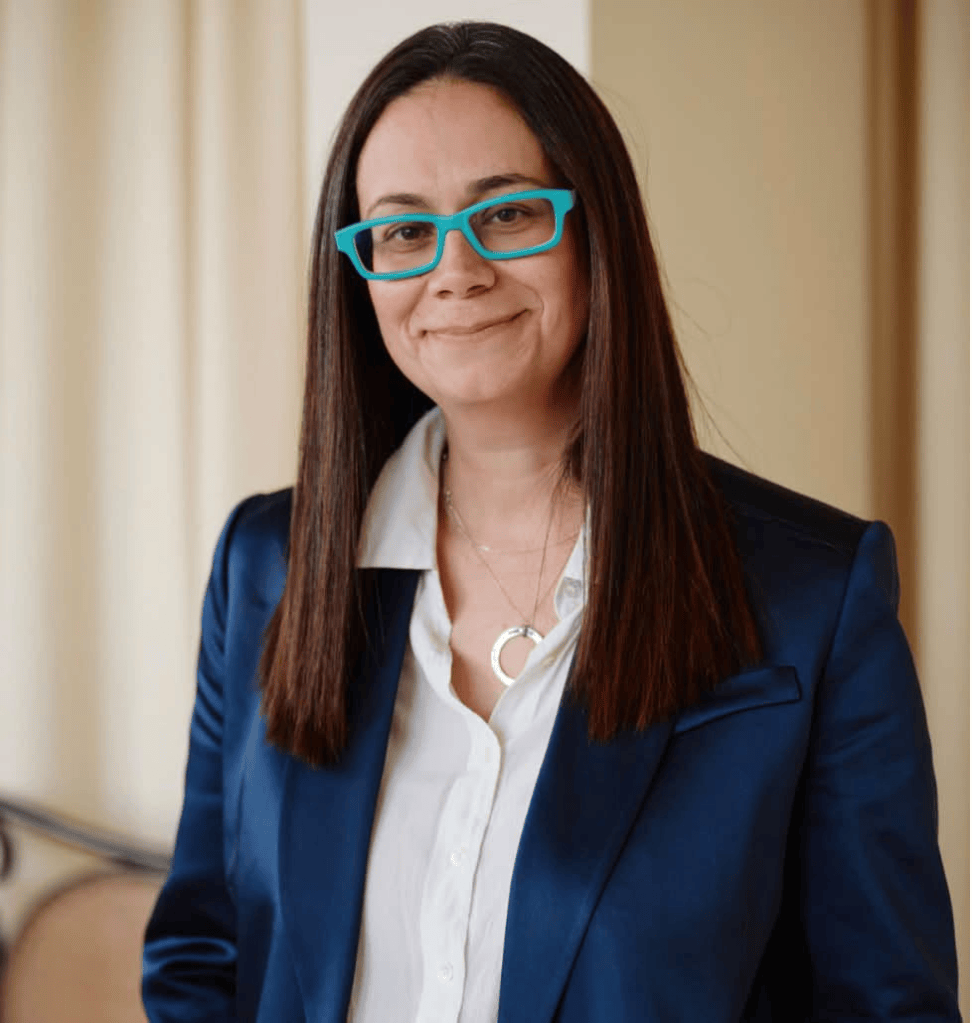
MELBOURNE – Victoria’s commitment to fostering an inclusive and harmonious society has found a steadfast champion. Multicultural and Multifaith Victoria (MMV) has announced that Ms. Louise Perry will continue her tenure as the Interim Multicultural Coordinator General.
While the title is long, the mission is deeply personal. For Perry, the role is not just a bureaucratic appointment, but a culmination of a life shaped by migration, resilience, and a profound dedication to human rights.
As a Burmese woman, a migrant, and the daughter of a refugee, Perry brings a unique duality to the position. She merges her lived experience with significant professional expertise across the public, development, and human rights sectors. It is this combination of personal insight and professional acumen that MMV leadership believes will be instrumental in driving the organization forward.
“Louise brings extensive experience across government, human rights, and international development, along with a lifelong commitment to strengthening inclusion and opportunity for diverse communities,” MMV said in a statement announcing her continued appointment.
Having traversed the complex landscapes of international development and public service, Perry is acutely aware of the challenges and opportunities facing Victoria’s diverse populace. Her career has been defined by a drive to ensure that systemic barriers are dismantled and that opportunity is accessible to all, regardless of background.
In her role as Interim Coordinator General, Perry is tasked with positioning MMV as a trusted, effective, and robust institution. She is passionate about ensuring the organization builds strong, meaningful partnerships across a wide spectrum of stakeholders—from grassroots community groups and government bodies to businesses and the broader Victorian public.
Her vision for MMV is one of active engagement and tangible results. By fostering these cross-sector alliances, Perry aims to deliver meaningful change, ensuring that the voices of multicultural and multifaith communities are not just heard, but are integral to the shaping of policy and public life in Victoria.
As she continues to lead the organization through its establishment phase, Perry stands as a testament to the very values MMV seeks to uphold: that diversity is a strength, and that leadership is often most powerful when informed by the journey of those who have lived it.

The Lion of Borana: Remembering Guyyoo Boruu Galmaa, the Abbaa Gadaa Who Defied Empires
By Dhabessa Wakjira
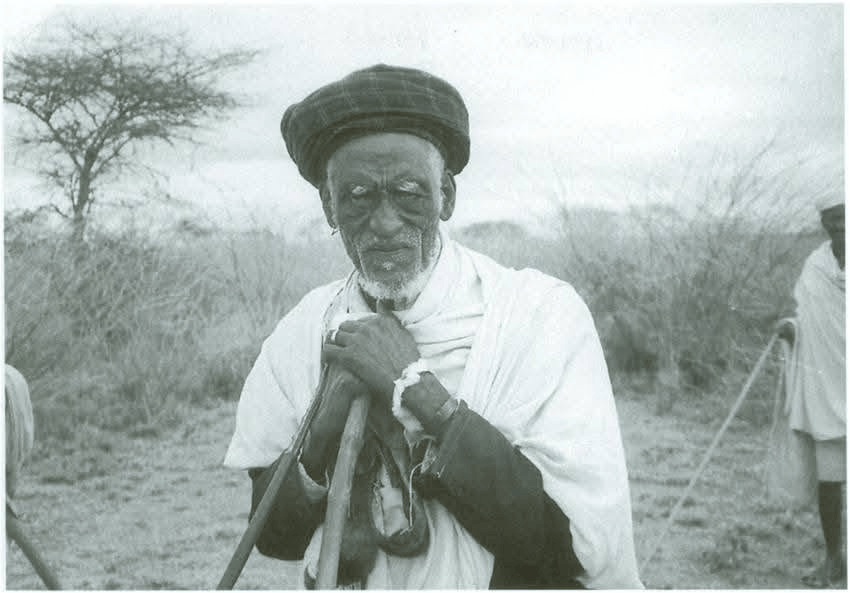
In the annals of Oromo history, there are leaders who govern, and then there are those who become the embodiment of a people’s resistance. Guyyoo Boruu Galmaa, who served as the Abbaa Gadaa of the Borana Oromo from 1944 to 1952, belongs unequivocally to the latter. He was not merely a custodian of the ancient Gadaa system; he was a shield against the encroaching empires of the 20th century—a man whose defiance of both Italian invaders and the Ethiopian imperial state preserved the soul of the Borana people.
His story, deeply intertwined with the fate of the sacred wells and the contested borders of Moyale, offers a masterclass in indigenous diplomacy and unyielding sovereignty.
A Legacy Born in the Shadow of Partition
The roots of Guyyoo Boruu’s leadership stretch back to a defining tragedy for the Borana nation. In 1907, the British and Ethiopian empires signed the Anglo-Ethiopian Boundary Agreement, a colonial decree that arbitrarily carved the Borana homeland in two, dividing the people of Moyale.
At that time, it was Boruu Galmaa Dooyyoo—the father of Guyyoo—who served as the Abbaa Gadaa. He was among the first to openly reject the treaty, recognizing it not as a legal boundary, but as an existential threat to the unity and sovereignty of the Borana. The son inherited the father’s fire.
In 1944, when Guyyoo Boruu Galmaa took the Baallii (the ritual transfer of power) and assumed the mantle of Abbaa Gadaa, he stepped into a region rife with external pressure. The Borana were not only facing the legacy of the 1907 partition but were also navigating the chaotic fallout of global wars and shifting imperial ambitions in the Horn of Africa.
Defying the Italian War Machine
Historical records reveal that Guyyoo Boruu’s leadership did not begin in 1944; his journey as a freedom fighter started much earlier. Between 1936 and 1945, he was actively leading the Borana Oromo in resistance against the Italian occupation.
When the Italians invaded, they brought not just armies, but a strategy of land seizure. As the historical account notes, the Italian forces attempted to annex vast tracts of Handaraa land, claiming everything except the sacred Arddaa and Tula (water wells). Guyyoo Boruu responded by building the Borana Gadaa structures and waging a relentless war against the Italians.
His struggle was not just about repelling a foreign army; it was about defending the sacred ecology of Borana life. The Tula wells were the lifeblood of the cattle and the people. Guyyoo Boruu understood that to lose the land was to lose the wells, and to lose the wells was to lose the Borana identity itself.
Standing Against the Imperial Crown
Following the defeat of the Italians, the Borana faced a new, more insidious threat: the expanding centralization of Emperor Haile Selassie’s government. Between 1947 and 1950, the imperial regime sought to impose its administrative and cultural dominance on the southern frontiers.
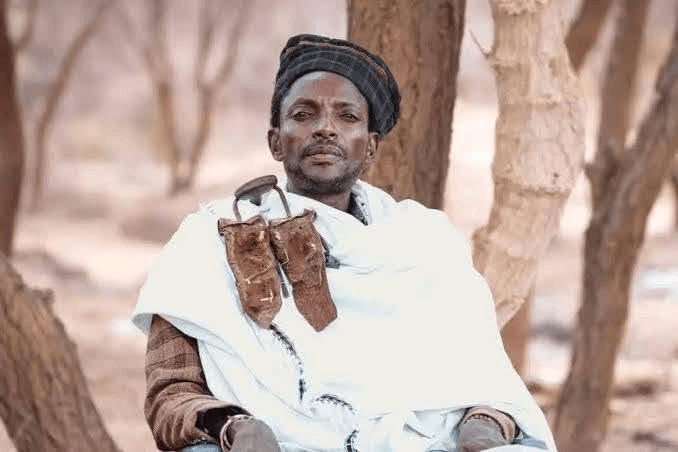
Guyyoo Boruu Galmaa became the primary obstacle to this encroachment. He did not merely resist the political pressures of the imperial state; he actively protected the Gadaa system, ensuring that traditional laws, democratic consensus, and indigenous governance continued to thrive despite the centralizing forces of Addis Ababa.
His defiance culminated in a moment of profound historical significance. In 1950, the Haile Selassie government, seeking to co-opt local leaders, offered Guyyoo Boruu the title of “Giraazmach”—a high-ranking imperial military and administrative honor.
He refused.
In rejecting the title, Guyyoo Boruu Galmaa made a definitive statement of Oromo autonomy. He rejected the legitimacy of an empire that had partitioned his people and threatened their customs. By turning his back on imperial honors, he affirmed that his authority came not from a distant emperor, but from the Gadaa, the Borana people, and the land itself.
The Enduring Wisdom of the Elders
The legacy of Guyyoo Boruu Galmaa is not confined to the history books; it is a living, breathing testament to the resilience of Oromo culture.
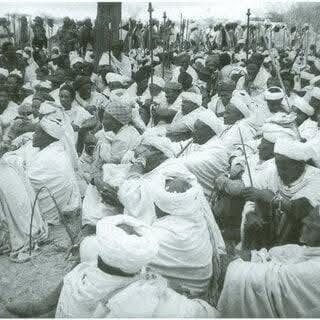
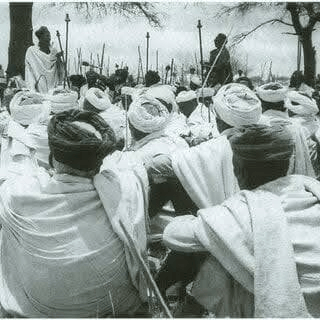
His life was meticulously documented by Western anthropologists who recognized the profound nature of the Borana political system. The renowned scholar Eike Haberland photographed him in 1952—the year he completed his term as Abbaa Gadaa. Decades later, in 1986, anthropologist Günther Schlee captured another historic moment: Guyyoo Boruu, then approximately 95 years old, was photographed at the Gumii Gaayyoo (the great assembly) as his son, Boruu Guyyoo Boruu, took the Baallii and assumed the leadership of the Gadaa.
That photograph, showing the aged father watching his son take the reins of power, is a powerful visual metaphor. It represents the unbroken chain of the Gadaa system—a system that Guyyoo Boruu fought to protect with weapons, diplomacy, and sheer moral courage.
A Beacon for the Present
As the Oromo people today face a renewed crisis of state violence, displacement, and the ongoing political capture of their sacred resources—including the Tuula Saglan Booranaa—the legacy of Guyyoo Boruu Galmaa serves as a vital beacon.
He stands as a reminder that Oromo sovereignty is ancient, sophisticated, and deeply rooted in a democratic culture that predates modern statehood. He proved that true leadership is not measured by the titles bestowed by empires, but by the courage to defend one’s people against them.
Nearly a century after he began his resistance, the spirit of Guyyoo Boruu Galmaa still echoes across the plains of Borana, flowing like the waters of the sacred wells he fought to protect: undivided, unbroken, and eternally free.
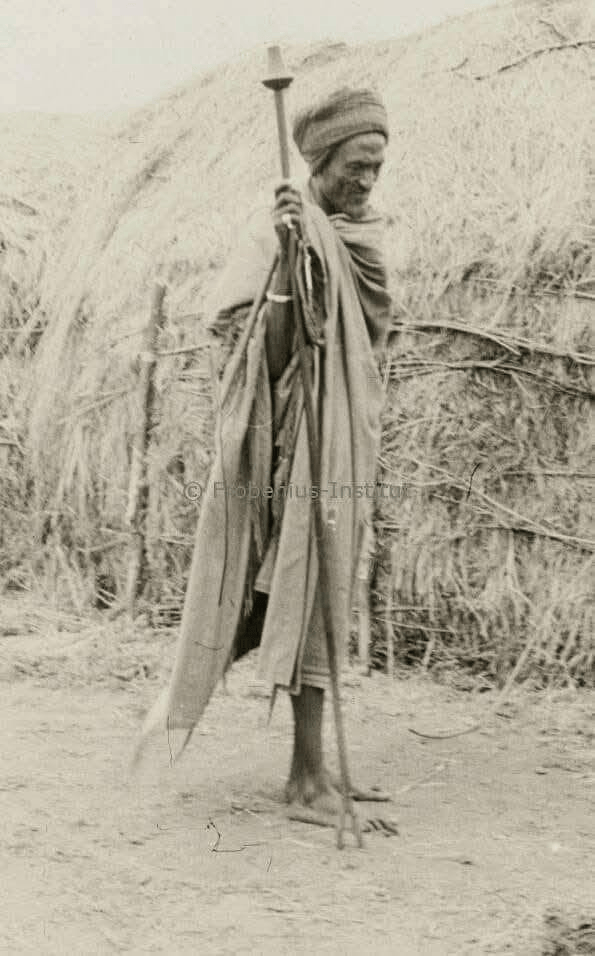
Photos: Guyyoo Boruu Galmaa, photographed by Eike Haberland (1952) and Günther Schlee (1986).

Terror in Mandera: Ethiopian Oromos Seek Refuge After Fatal Stabbing Amid Rising Border Tensions
By Daandii Ragabaa
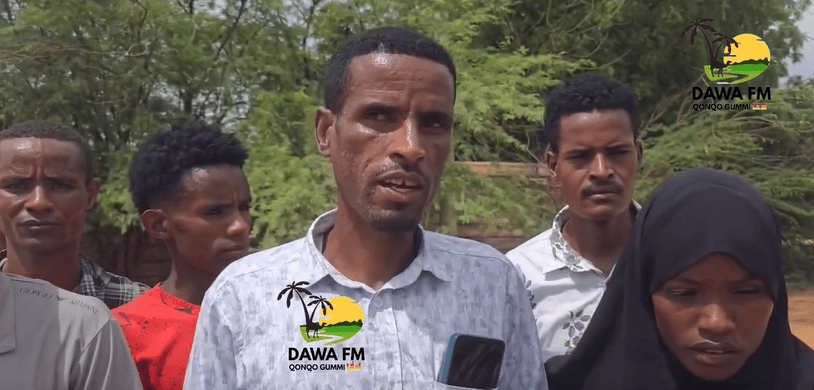
Fear has gripped the Ethiopian Oromo community in Mandera town, Kenya, following the brutal stabbing to death of one of their colleagues. In a desperate bid for survival, several members of the community have reportedly sought refuge at the Mandera Police Station, appealing to the Kenyan government and security agencies for urgent protection.
The killing, which has sent shockwaves through the cross-border community, highlights the precarious reality facing Ethiopian nationals living and working in Kenya, many of whom are fleeing the devastating conflict in their home country.
According to community members, the victim was targeted simply for being an Ethiopian Oromo. The group is insisting they are innocent civilians who should not be forced to pay the price for the ongoing political violence and tensions linked to events across the border.
“We are appealing to the authorities to intervene and guarantee our protection,” a community representative said. “We should not be held responsible for tensions or violence linked to events across the border. We are here to work and live in peace.”
The fatal stabbing has raised serious concerns about the security of Ethiopian nationals in Mandera, a town that sits squarely on the Ethiopia-Kenya border—a region already deeply scarred by arbitrary colonial borders, resource-based conflicts, and the spillover effects of the Ethiopian government’s military campaigns in Oromia.
For many Oromos, crossing into Kenya is a matter of survival. As documented by human rights organizations, Oromo civilians displaced by government forces and state-aligned militias constitute the bulk of Ethiopian refugees fleeing to neighboring countries. Yet, as the tragedy in Mandera demonstrates, the search for safety often leads them into new environments of hostility and xenophobia, where they are scapegoated for broader geopolitical tensions.
The situation in Mandera remains highly volatile. The affected individuals are now calling on community leaders, the Kenyan government, and security agencies to step in immediately to prevent any retaliatory attacks and ensure calm and restraint among residents.
They emphasize a fundamental principle of human dignity: that all residents, regardless of their nationality or ethnic background, must be able to live and work without fear.
As the community mourns the loss of their colleague and huddles in police stations for safety, the incident serves as a stark reminder of the regional fallout of the crisis in the Horn of Africa. It is a humanitarian emergency that ignores national borders, demanding urgent attention and protection for vulnerable civilians caught in the crossfire of a conflict they did not choose.
Video credit: Dawa FM

Celebrating Oromia Media: The Unyielding Voice of a People

By Dhabessa Wakjira
In a country where the state maintains a near-monopoly on the levers of national and international media, the existence of independent Oromia media is nothing short of an act of defiance. To celebrate Oromia media today is to celebrate the resilience of a people who, for over a century, have seen their history distorted, their language suppressed, and their struggles silenced.
While the government in Finfinnee projects a façade of progress to the international community, the reality on the ground—as documented by human rights organizations—is a landscape scarred by violence, displacement, and systemic marginalization. In this environment, Oromia media serves as the vital, beating heart of the Oromo nation’s quest for truth and self-determination.
The Battle Against Erasure
The importance of an independent Oromo press cannot be understood without acknowledging the historical context. As the Oromia Support Group (OSG) notes in its submissions to the UN Human Rights Council, the Oromo people were subjected to the neftenya-gabbar system of subjugation, and while formal slavery was abolished, the culture of supremacy continued. Even today, the OSG warns that the gains in autonomy and the adoption of the Oromo language within the 1995 constitution are in danger of being lost as power is centralized.
For decades, mainstream Ethiopian media has been complicit in this erasure. It has often served as a mouthpiece for the state, demonizing Oromo organizations, masking state-sponsored atrocities, and amplifying biased narratives. When international human rights organizations are sometimes duped into publishing poorly researched reports that wrongly attribute massacres to the Oromo Liberation Army (OLA), independent Oromia media becomes the essential corrective mechanism. It is the platform that documents the drone strikes in East Wallega, the mass displacements in West Showa, and the forced conscription of children.
Oromia media does not just report the news; it archives the truth. It ensures that the 7,862 civilian killings documented since 2018 are not reduced to mere statistics, but are remembered as the mothers, fathers, and children lost to a brutal conflict.
Amplifying the Culture of Gadaa
To view Oromia media solely through the lens of conflict is to miss its profound cultural significance. The Oromo people possess a rich, vibrant heritage rooted in the ancient Gadaa system—a democratic, egalitarian, and consensus-based governance model recognized by UNESCO as a World Heritage treasure.
Oromia media is the guardian of this heritage. Through music, poetry, literature, and broadcasting in Afaan Oromoo, it nourishes a language that was once forbidden in schools and public life. It carries the voices of the Borana elders reciting the blessings of the Tuula Saglan Booranaa (the Nine Sacred Water Wells) across the diaspora. It celebrates the resilience of the Qerroo youth, who have stood at the forefront of demanding justice.
In a world where the government and its allies abuse their influence in global media and institutions to demonize Oromo people, these independent platforms offer a counter-narrative of dignity. They remind the world that the Oromo are not merely victims of a geopolitical crisis, but a proud nation with a sophisticated history of compromise, power-sharing, and democracy.
The Courage of the Diaspora
Much of this vital work is shouldered by the Oromo diaspora. Fleeing the violence that has created a global refugee crisis—with Oromos facing xenophobia in South Africa, detention in Egypt, and extortion in Yemen—the diaspora has weaponized media as a tool for survival.
Organizations like the Oromia Support Group (OSG) and various independent Oromo media outlets operate under immense pressure. They face digital surveillance, smear campaigns, and the constant threat of being discredited by state-aligned actors. Yet, they persist. They bridge the gap between the isolated villages of Oromia and the halls of the United Nations in Geneva.
A Voice for the Future
As the Horn of Africa faces increasing instability, the role of Oromia media will only grow in importance. It is the vehicle through which the Oromo people can demand accountability for the crimes committed against them, and it is the medium through which they articulate their vision for the future—a future built on self-determination, human rights, and the revival of their indigenous democratic values.
The existence of a free Oromia media is a testament to the fact that no amount of state repression, drone strikes, or media manipulation can extinguish the spirit of a people. To celebrate Oromia media is to celebrate the journalists, the poets, the citizen reporters, and the diaspora activists who refuse to let the world look away.
It is the sound of a nation reclaiming its own story. And it is a sound that will not be silenced.
Dhabessa Wakjira is a commentator on Horn of Africa affairs and human rights.

Dr. Taaddasaa Eebbaa (Gadaa Meelbaa): The Visionary Who Breathed Life into Ethiopia’s Biodiversity Legacy
By Dhabessa Wakjira
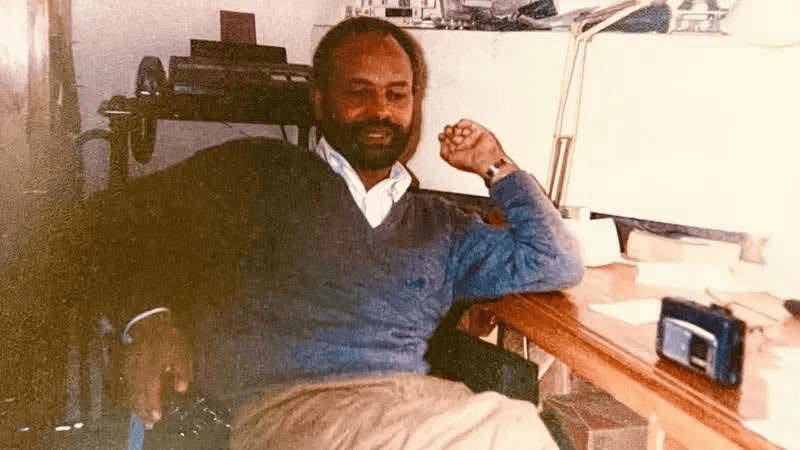
In the annals of Ethiopian and Oromo history, few figures embody the rare combination of scientific brilliance, political conviction, and unwavering sacrifice as profoundly as Dr. Taaddasaa Eebbaa. Known affectionately by many names—Dr. Fidoo, Doktoree, and most famously in literary circles as Gadaa Meelbaa—this remarkable scholar, freedom fighter, and author left an indelible mark on his nation’s scientific and political landscape before his passing on May 1, 2022, in Washington, D.C.
Humble Beginnings, Extraordinary Vision
Born in Najjoo, in the West Wallagga region, Dr. Taaddasaa’s journey from a young student in his hometown to an internationally recognized geneticist reads like a testament to the power of determination. He completed his primary education in Najjoo before pursuing his secondary studies in Jimma—a journey that would set the stage for an extraordinary academic career.
His first degree in agriculture from Alemaya College (now Haramaya University) marked the beginning of a lifelong dedication to understanding and preserving Ethiopia’s natural wealth. Not content with domestic excellence, Dr. Taaddasaa pursued his master’s and doctoral degrees at universities in the United States and the United Kingdom, specializing in genetics—a field that would become central to his life’s work.
The Architect of Ethiopia’s Biodiversity Conservation
The 1970s found Dr. Taaddasaa teaching at Haramaya University before joining the Ministry of Agriculture as a researcher. It was during this period that his visionary leadership would leave an enduring legacy on Ethiopian science.
As the director of a groundbreaking research project dedicated to studying Ethiopia’s plant genetic resources, Dr. Taaddasaa didn’t merely participate in scientific inquiry—he fundamentally shaped it. The institution that would eventually become the Ethiopian Biodiversity Institute (EBI) stands as a monument to his foresight and dedication.
According to historical accounts, Dr. Taaddasaa was not just a founding member but the intellectual force behind the establishment of this crucial institution in 1978, initially named the Plant Genetic Resource Centre of Ethiopia. Professor Endashaw, a former colleague, emphasizes this point with conviction: “Everything was initiated by Taaddasaa. Nothing was added. They removed him from the institution’s history. From all of us, they bought it from there.”
The institution’s original location near present-day Embasi, Kenya, was selected under Dr. Taaddasaa’s guidance—a decision that reflected his deep understanding of Ethiopia’s ecological diversity and its importance for global food security.
When Science Met Politics
Dr. Taaddasaa’s brilliance extended beyond the laboratory. His passion for Oromo culture and identity led him to help organize the first Oromo cultural showcase at the National Theatre in the 1970s—an act of cultural preservation that foreshadowed his later political engagement.
The political repression of the Derg regime did not spare this distinguished scientist. Historical accounts document that he was imprisoned twice in 1979 for his activities. The political pressure became unbearable, forcing Dr. Taaddasaa to make the heart-wrenching decision to leave his work and family behind in Finfinne, escaping through Assosa to Sudan at the end of 1979. From there, he joined the Oromo Liberation Front (OLF), beginning a new chapter in his life of service.
Dr. Shuggux Galataa Qondaalaa, a former OLF leader who knew Dr. Taaddasaa intimately, recalls his political journey: “He was among those who participated in founding the OLF. He took part in the secret meeting held in Finfinne on June 11, 1976. Everyone who participated in that meeting continued as members of the central committee, and Dr. Taaddasaa continued the struggle from then on.”
Sacrifices Beyond Measure
The personal cost of Dr. Taaddasaa’s commitment to freedom was staggering. His wife, Aadde Addisaalem Gannat, was imprisoned for over ten years during the Derg regime, finally released in 1988. His young son, barely two years old, died from neglect—a tragedy that haunts the pages of his life story. His daughter Urjii remains as a testament to a family that paid dearly for their convictions.
“Taaddasaa is not just someone with a good mind, but someone who thinks of others. Someone who thinks of his country,” reflects Professor Endashaw. “If he had stayed in science, he would have been a star researcher. What is past cannot be returned.”
Within the OLF, Dr. Taaddasaa’s contributions were equally significant. He served as a member of the Political Bureau after the 1988 leadership transition and contributed to the Biree Diplomaasii—a foundational document for the organization’s diplomatic strategy. His journey of exile took him through Khartoum, Germany, and finally to the United States, where he lived until his death.
The Pen That Awakened a Nation
Perhaps Dr. Taaddasaa’s most enduring contribution to Oromo consciousness came not through politics or science, but through literature. In 1988, while in Khartoum, he published “Oromia”—a book that would become a cornerstone of Oromo national awakening.
Published under the pseudonym Gadaa Meelbaa, the book’s authorship remained a mystery to many for years. The text, later translated into both Afaan Oromoo and Amharic, comprehensively addressed Oromia’s resources, culture, traditions, historical oppression, and the challenges facing the Oromo people.
Bulii Ejjetaa, who was a university student when the book was published, recalls its transformative impact: “We saw that book as a ‘pill of freedom.’ It asked us clearly: What is Oromia? Where is it located? What does it have? What has it been through? We shared it and discussed it at university. After joining the struggle, we used it to educate our people.”
The book served as a consciousness-raising tool for countless young Oromos, many of whom had been disconnected from their cultural identity. “For students who didn’t know their Oromummaa, we would say, ‘Give this child that pill,'” Bulii remembers. “That book was a pill for strengthening Oromummaa and nationalism.”
Years after its publication, when Dr. Taaddasaa’s authorship became known, he transferred the book’s rights to the Oromo people and the OLF—a final act of generosity from a man who had given everything.
An Unacknowledged Legacy
Despite his monumental contributions, Dr. Taaddasaa’s role in founding the Ethiopian Biodiversity Institute has been systematically erased from official narratives. Five years after he established the institution, records began crediting someone else with its founding.
This erasure of his legacy represents a broader pattern of historical amnesia that has obscured the contributions of Oromo intellectuals to Ethiopian national development. Yet those who knew him and benefited from his work ensure his memory endures.
A Life of Purpose, A Legacy of Inspiration
Dr. Taaddasaa Eebbaa’s life represents the intersection of scientific excellence and political conviction—a rare combination that produced lasting change in multiple spheres. He was a geneticist who understood that preserving Ethiopia’s biodiversity was essential for the nation’s future. He was a freedom fighter who believed that the Oromo people deserved dignity, self-determination, and cultural recognition. And he was an author whose words awakened a generation.
In his final years, Dr. Taaddasaa returned to Ethiopia briefly when the OLF transitioned to peaceful political participation, serving as an advisor to the organization. His journey had come full circle—from a young student in Najjoo to an internationally recognized scientist, from a political prisoner to a freedom fighter, from an exiled author to a respected elder statesman.
He passed away on May 1, 2022, in Washington, D.C., after a long illness, leaving behind his daughter Urjii and a legacy that transcends the boundaries of science, politics, and literature.
Dr. Taaddasaa Eebbaa—Gadaa Meelbaa—reminds us that true greatness lies not in what we accumulate but in what we give. He gave his scientific genius to Ethiopia’s biodiversity, his political passion to Oromo liberation, and his literary gift to a people hungry for self-knowledge. In doing so, he became more than a scholar or a revolutionary—he became a pillar of Oromo memory, a testament to what one person can accomplish when guided by love for people and country.
His story deserves to be told, retold, and never forgotten—not merely as a historical record, but as an inspiration for generations yet to come. For in remembering Dr. Taaddasaa Eebbaa, we remember what it means to live with purpose, to sacrifice with dignity, and to leave the world better than we found it.
—
This feature article honors the life and legacy of Dr. Taaddasaa Eebbaa (Gadaa Meelbaa), whose contributions to Ethiopian science, Oromo liberation, and literature continue to inspire.

Irreechaa Celebrated in Peace and Unity, Advocacy for Oromia Says, Pledging to Nurture the Festival’s Message of Reconciliation
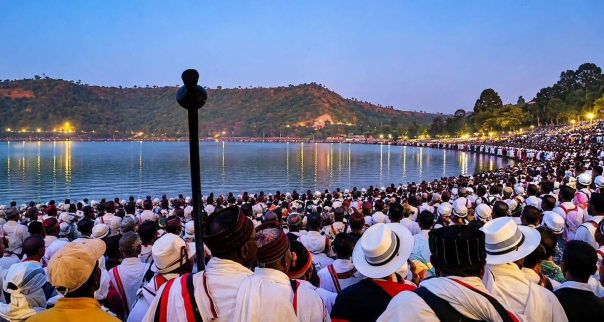
Advocacy group praises security forces, community members, and government structures for ensuring a peaceful celebration of the Oromo thanksgiving festival amid a national climate of conflict and hatred
(October 4, 2026)-Advocacy for Oromia has expressed deep satisfaction with the peaceful and beautiful celebration of Irreechaa, the revered Oromo thanksgiving festival, praising all parties who contributed to its success and vowing to continue nurturing the ancient tradition as a source of peace, reconciliation, and prosperity.
In a statement released on October 4, 2026, the advocacy group said it was “greatly delighted that the Irreechaa festival has been celebrated in a beautiful and peaceful manner,” and extended its gratitude to all those who played a role in ensuring the festival unfolded peacefully.
Irreechaa, one of the most significant cultural and spiritual festivals of the Oromo people, is widely recognized as a celebration of thanksgiving, reconciliation, love, peace, and unity. The statement noted that millions of people gathered in unity in Finfinnee (Addis Ababa), Bishoftu, and across the world, reaffirming the festival’s enduring power to bring communities together.
Gratitude Amid a Challenging National Climate
The statement placed particular emphasis on the significance of the peaceful celebration given the current situation in the country. “Above all, at a time when the situation in our country is filled with conflict and hatred, we wish to express our heartfelt gratitude to the security organs and police who participated, and to our community who provided support and assistance, in ensuring that the Irreechaa festival, which began in peace, was also concluded in peace in Oromia,” the group stated.
Advocacy for Oromia also extended its appreciation to government structures, community organizations, and individual community members who played a major role in facilitating the celebration.
A Festival That Has Endured Through Hardship
The statement highlighted the resilience of Irreechaa, noting that the festival has continued over the years “despite oppression and pressure from systems.” The group expressed hope that Irreechaa will continue to proclaim and sustain reconciliation, peace, love, and unity into the future.
“Advocacy for Oromia wishes to declare that it will work in every possible way to nurture and expand this Irreechaa festival, which is a source of peace and reconciliation, and a means of well-being and prosperity,” the statement read.
The group concluded with a prayer for the nation: “May reconciliation, restitution, and peace be upon our country and our people!”
A Continuing Commitment
The statement underscores Advocacy for Oromia’s ongoing commitment to promoting the cultural heritage of the Oromo people and advocating for peace and reconciliation in the region. As Irreechaa continues to draw millions of celebrants each year, the group’s pledge to protect and expand the festival reflects its broader mission of fostering unity and well-being among Oromo communities at home and abroad.
— Advocacy for Oromia, October 4, 2026

Irreechaa: The Festival That Renews Humanity, Reconciles Creation, and Reclaims Time Itself
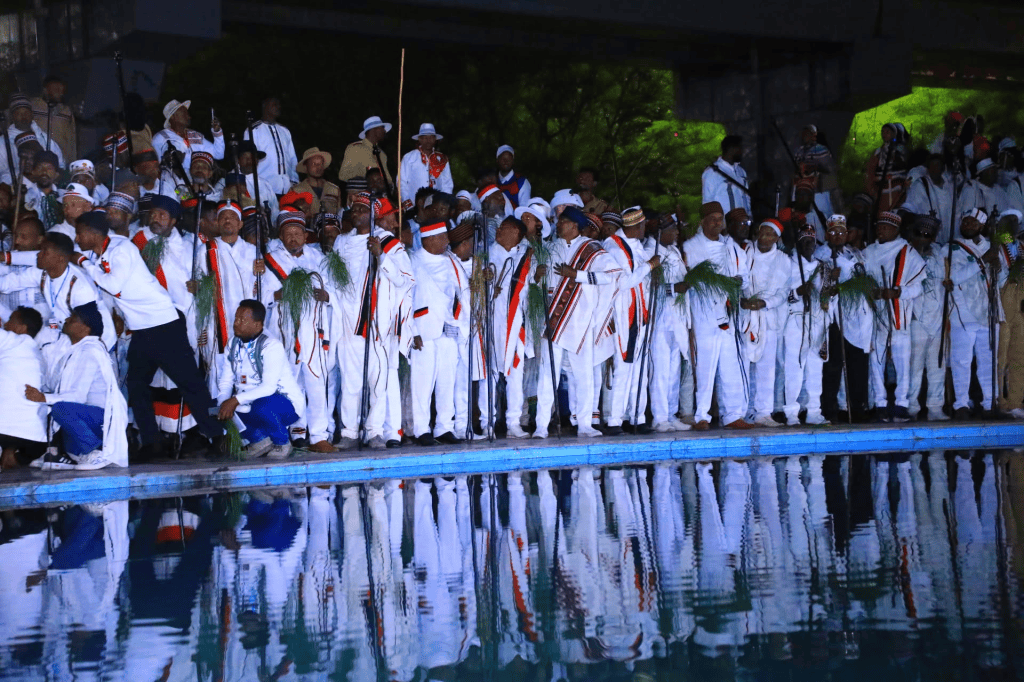
In the Oromo language, nineteen sacred phrases capture the full magnitude of Irreechaa — a celebration that is not merely cultural but cosmic, not merely annual but eternal, not merely human but divine.
Beneath the sycamores, beside the sacred waters, a people gather to become whole — and to remind the universe what wholeness means.
A Litany of Renewal
There are sentences that function as scripture. The Oromo people have such a sentence about Irreechaa:
“Irreechaan humneessaa namummaa, lachiisaa namummaa, marabeessaa namummaa, nageessaa namummaa, araarsaa namummaa, waloomsaa uumaa-uumamaa, sirna galateeffannaa, yaadannoo uumamaa, hulluuqoo hameenyaa, mallattoo ulfoo, yeroo dhiifamaa, ce’umsaa baraa, damboobsaa namummaa, fooyyessaa namummaa, fufsiisaa namummaa, fineessaa namummaa, guutessaa namummaa, kadhannaa gaarummaa, fi haaromsaa namummaa ti.”
This is not a description. It is a declaration. It is the Oromo people’s theological testimony about what Irreechaa is — not what it symbolizes, not what it represents, but what it accomplishes in the world.
Nineteen phrases. Nineteen dimensions of one reality. Nineteen ways of saying: Irreechaa renews humanity, reconciles creation, and reclaims time itself.
Part One: The Renewal of Humanity
The first five phrases focus on the human person — what Irreechaa does to the individual soul.
Humneessaa Namummaa — The Empowerment of Humanity
Irreechaan humneessaa namummaa. Irreechaa is the empowering of humanity.
Before the festival, participants are asked to reconcile. They set aside grudges. They release resentment. This is not weakness — it is the most difficult form of strength. To forgive is to be liberated from the prison of grievance.
The person who has made peace is not just morally superior. They are empowered. They have reclaimed energy that was being spent on resentment. They stand at the water’s edge lighter, freer, more capable of gratitude.
This is the first renewal: the empowerment that comes from letting go.
Lachiisaa Namummaa — The Reconciliation of Humanity
Irreechaan lachiisaa namummaa. Irreechaa is the reconciling of humanity.
This is Irreechaa’s beating heart. Without araara — reconciliation — the festival cannot proceed. The tradition is explicit: you cannot participate while holding a grudge. The water will not receive your thanks if your heart is still at war.
In a world that profits from division, this requirement is revolutionary. Irreechaa says: Before you celebrate, reconcile. Before you give thanks, make peace. Before you approach the sacred, heal the human relationships that have been broken.
The Oromo do not pretend that reconciliation is easy. They simply insist that the work of peace must be done — deliberately, consciously, before the community gathers.
Marabeessaa Namummaa — The Unification of Humanity
Irreechaan marabeessaa namummaa. Irreechaa is the unifying of humanity.
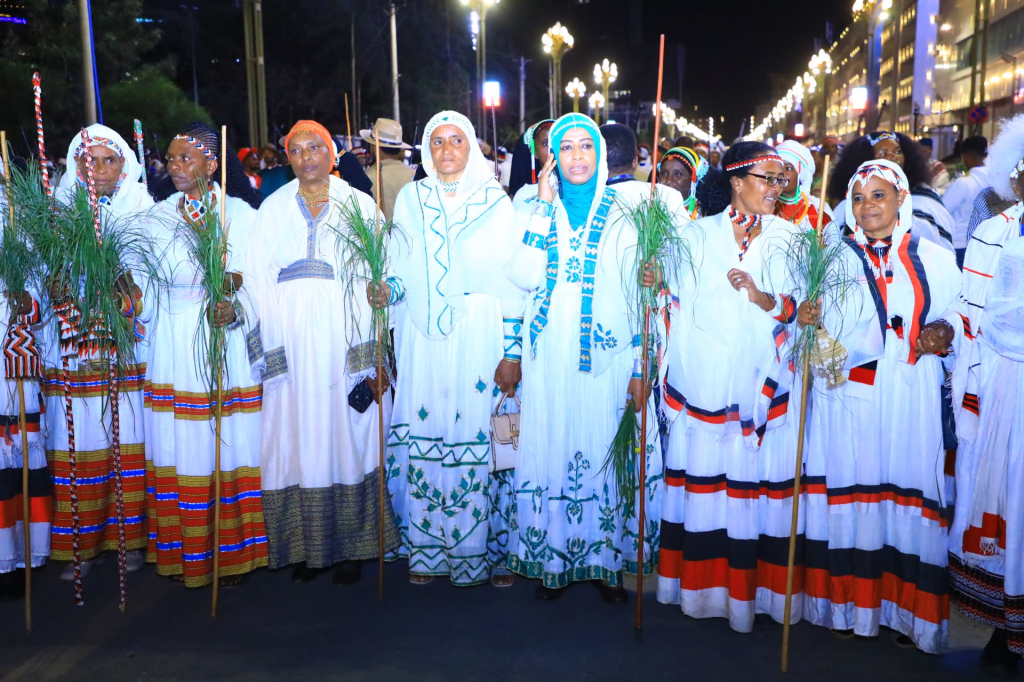
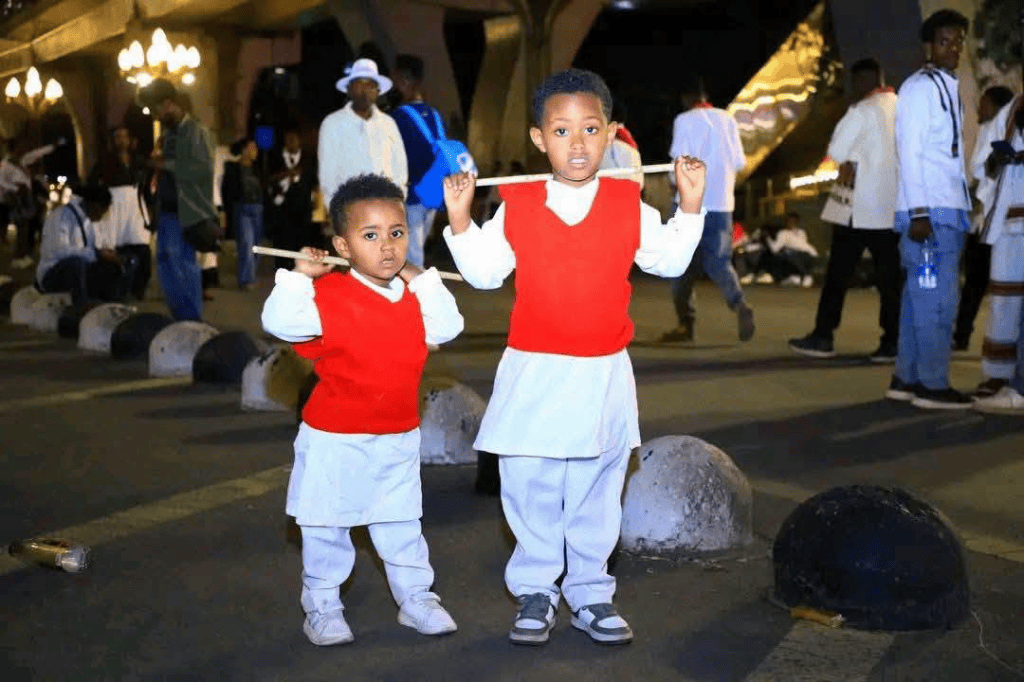
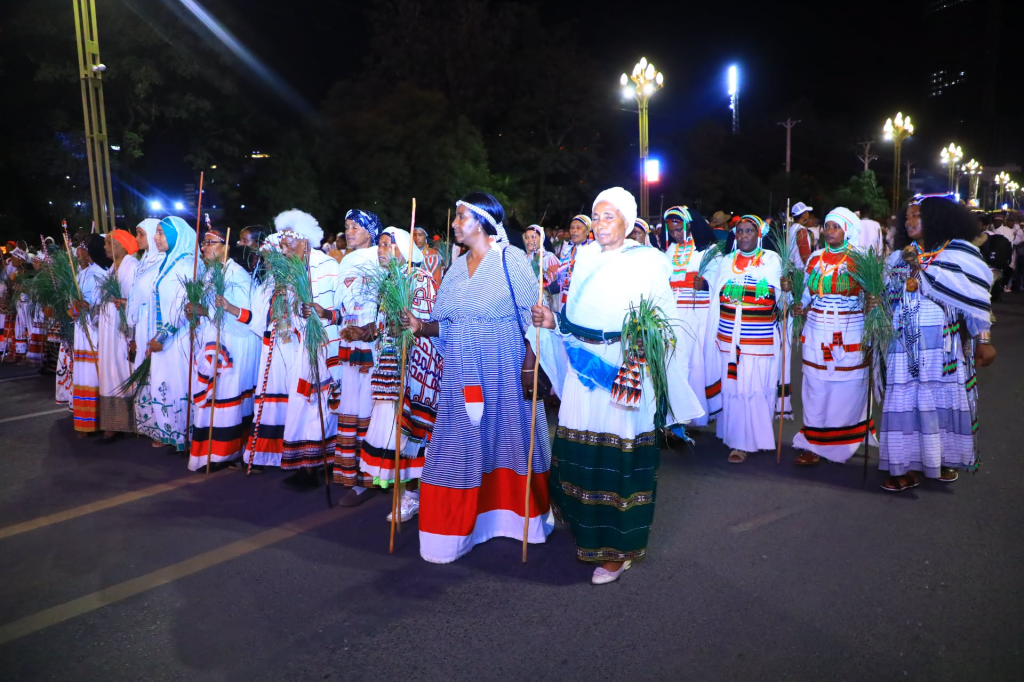
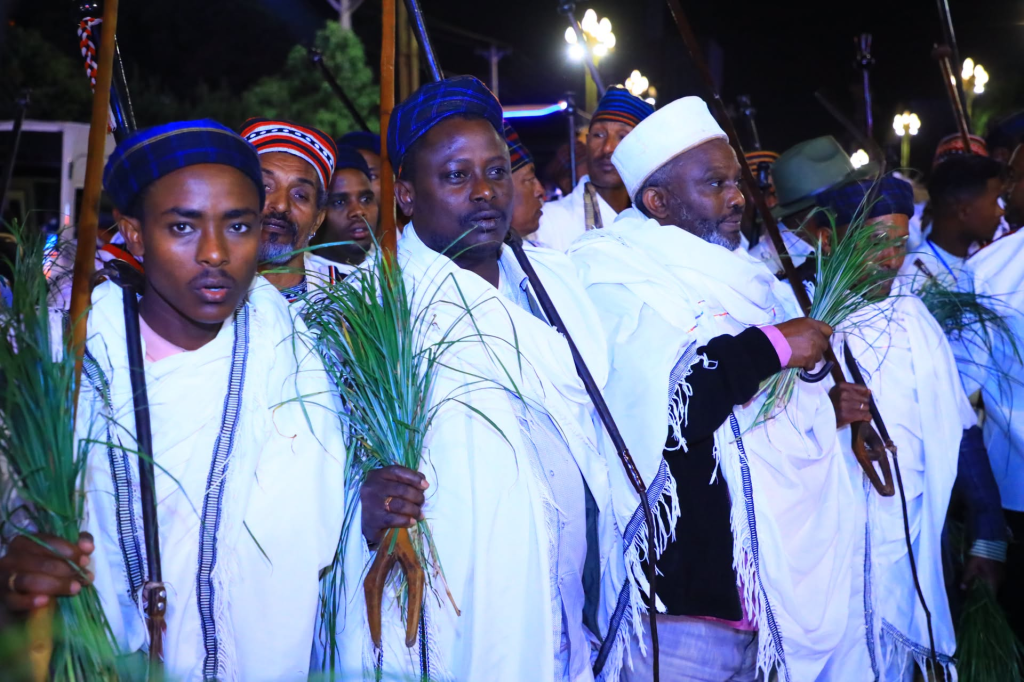
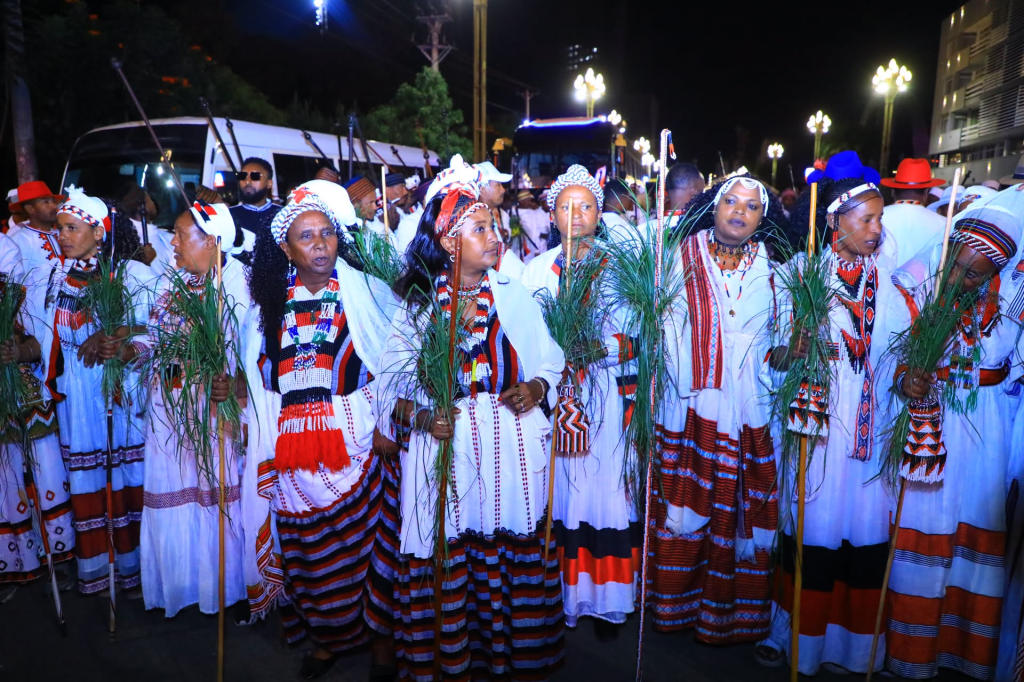
Millions arrive from across Ethiopia, from the diaspora, from every walk of life. Farmers and professors. Mothers and students. Elders and children. Muslims and Christians and practitioners of the old faith. They dress in white — a sea of unity that visually overwhelms the eye.
But the unification is not mere numbers. It is spiritual. It is the experience of dissolving the boundaries that separate human beings from one another. For one day, the Oromo people are not many. They are one.
This is tokkummaa — unity — and it is not an abstract ideal. It is a lived experience at the water’s edge. The person standing beside you is not a stranger. They are your brother. They are your sister. They are yourself.
Nageessaa Namummaa — The Peace-Bringing of Humanity
Irreechaan nageessaa namummaa. Irreechaa is the peace-bringing of humanity.
The Oromo greeting for the festival is “Baga Irreechaa nagaan geessan” — May the Irreechaa arrive in peace. This is not a casual wish. It is a declaration of intent.
Irreechaa does not merely celebrate peace. It produces it. The festival is a peace-making technology, an ancient ritual that creates the conditions for harmony between individuals, communities, and the divine.
Consider what happens when millions of people gather in a single place and commit, together, to reconciliation. Consider what happens when a nation’s largest cultural event is built on the requirement that participants set aside their conflicts. Peace is not the absence of conflict. It is the presence of araara. And Irreechaa makes that presence visible, tangible, and real.
Araarsaa Namummaa — The Forgiveness of Humanity
Irreechaan araarsaa namummaa. Irreechaa is the forgiving of humanity.
Araara is the Oromo word for reconciliation, but it carries a deeper meaning: the restoration of relationship, the healing of rupture, the return to wholeness. At Irreechaa, forgiveness is not a suggestion. It is a prerequisite.
The person who comes to the water carrying resentment is not participating in Irreechaa. They are merely present. True participation requires the internal work of forgiveness — the decision to release the debt, to let go of the grievance, to choose relationship over righteousness.
This is the fifth renewal: the forgiveness that makes all other renewal possible.
Part Two: The Reconciliation of Creation
The next several phrases expand beyond the human person to encompass the entire created order.
Waloomsaa Uumaa-Uumamaa — The Harmony of Creation
Irreechaan waloomsaa uumaa-uumamaa. Irreechaa is the harmonizing of creation.
The Oromo understanding of Irreechaa is not limited to human community. The festival reconciles the entire cosmos — uumaa (the Creator) and uumamaa (creation) — in a single act of thanksgiving.
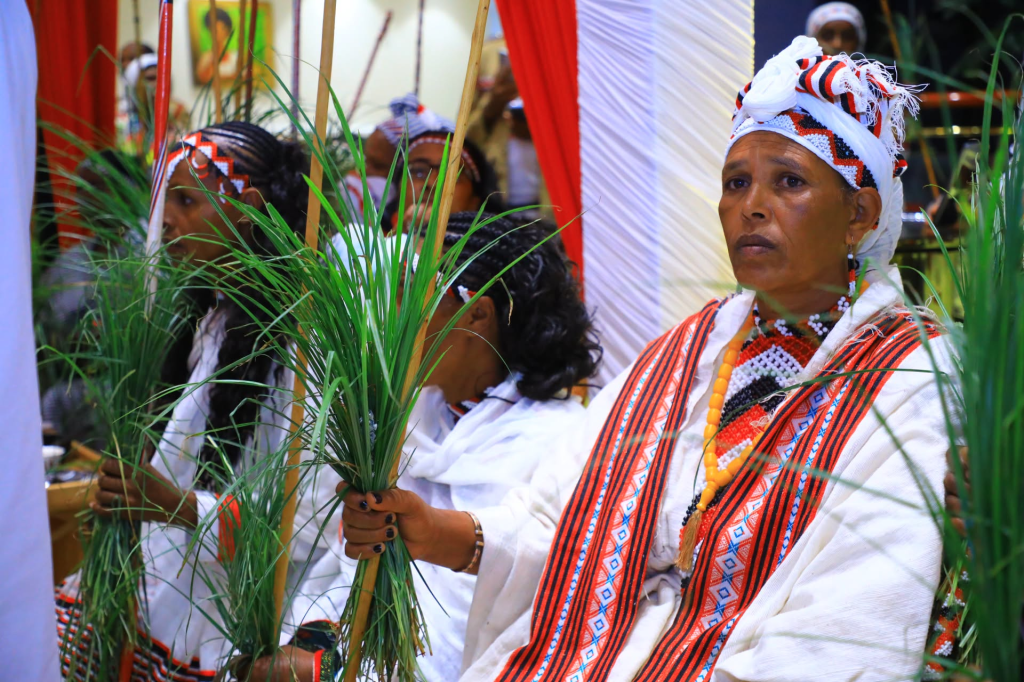
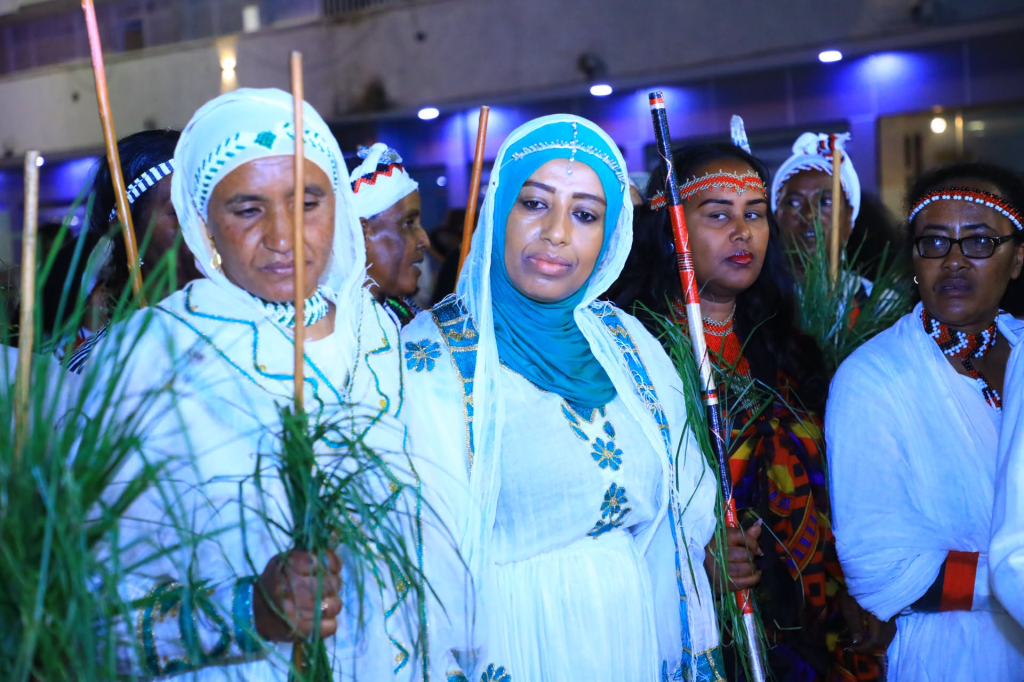
When the Oromo gather at the water, they are not just repairing human relationships. They are restoring the primal harmony between the divine, the human, and the natural. The water is sacred. The grass is sacred. The sky, the earth, the trees, the animals — all are participants in the festival.
This is waloomaa — harmony — and it is the original condition of creation. Irreechaa returns what was broken to what it was meant to be.
Sirna Galateeffannaa — The Order of Thanksgiving
Irreechaan sirna galateeffannaa. Irreechaa is the order of thanksgiving.
Sirna means order, system, institution, ceremony. Irreechaa is not spontaneous emotion. It is structured ritual — a carefully preserved system of thanksgiving that has been practiced for thousands of years.
The Gadaa system organizes Oromo society by age grades, each with defined responsibilities. Irreechaa is woven into this system. It is not just a festival. It is an institution — a sirna — that orders the relationship between the human community and the divine.
Thanksgiving, in Oromo cosmology, is not optional. It is the fundamental posture of the creature toward the Creator. To give thanks is to acknowledge reality: that we did not create ourselves, that we depend on forces beyond our control, that life is a gift.
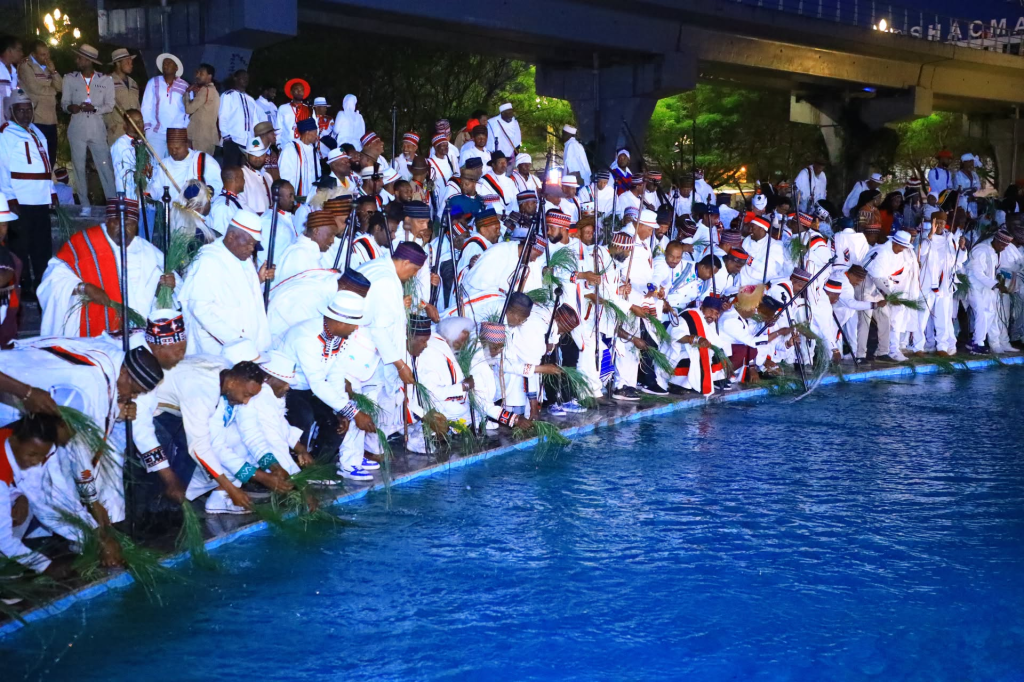
Yaadannoo Uumamaa — The Memory of Creation
Irreechaan yaadannoo uumamaa. Irreechaa is the memory of creation.
Yaadannoo means memorial, remembrance, commemoration. At Irreechaa, the Oromo people remember not just the harvest of the past year but the creation of the world itself.
This is sacred memory — not nostalgia, not sentimentality, but the deliberate act of recalling what is fundamental. The Oromo remember that they are creatures. They remember that the earth is sacred. They remember that water is the source of life. They remember that gratitude is the proper response to existence.
In a modern world that so often forgets the sacred, Irreechaa is a collective act of remembrance. It says: We have not forgotten who we are. We have not forgotten where we came from. We have not forgotten what we owe.
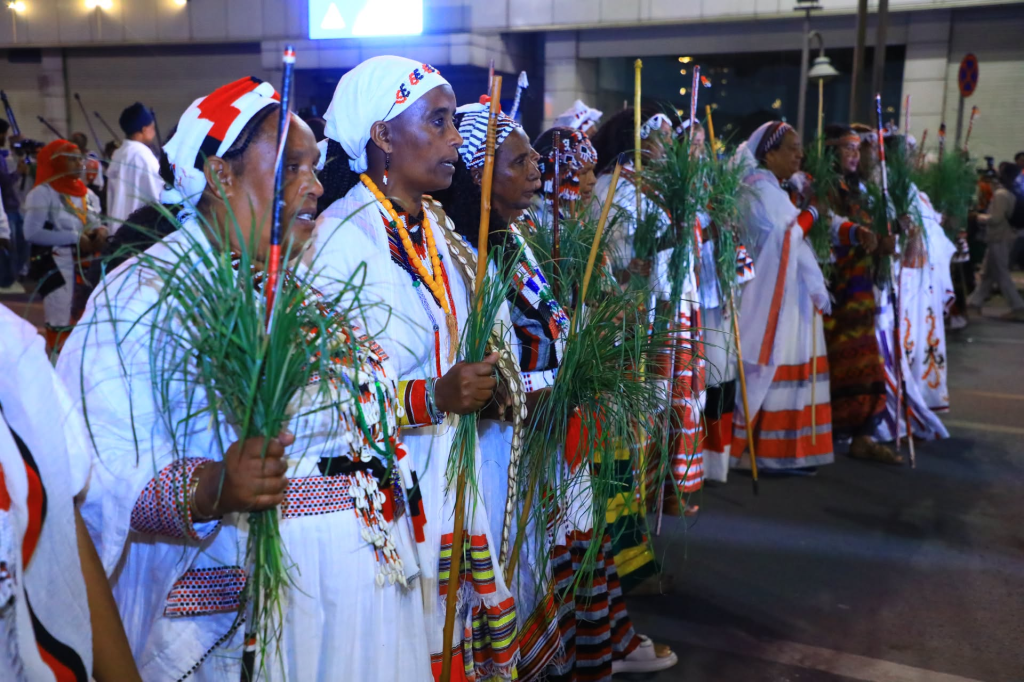
Hulluuqoo Hameenyaa — The Rejection of Evil
Irreechaan hulluuqoo hameenyaa. Irreechaa is the rejection of evil.
Hulluuqoo means that which is rejected, refused, cast out. Hameenyaa means evil, wickedness, malice. Irreechaa is not just the affirmation of good. It is the explicit rejection of evil.
At the water’s edge, the Oromo people collectively renounce the forces that destroy human community: hatred, jealousy, greed, violence, deception. They name these forces and cast them out. They declare that these things have no place in the renewed humanity they are creating.
This is spiritual warfare — not against flesh and blood, but against the principalities and powers that corrupt the human heart. And it is fought not with weapons but with water, grass, and words of prayer.
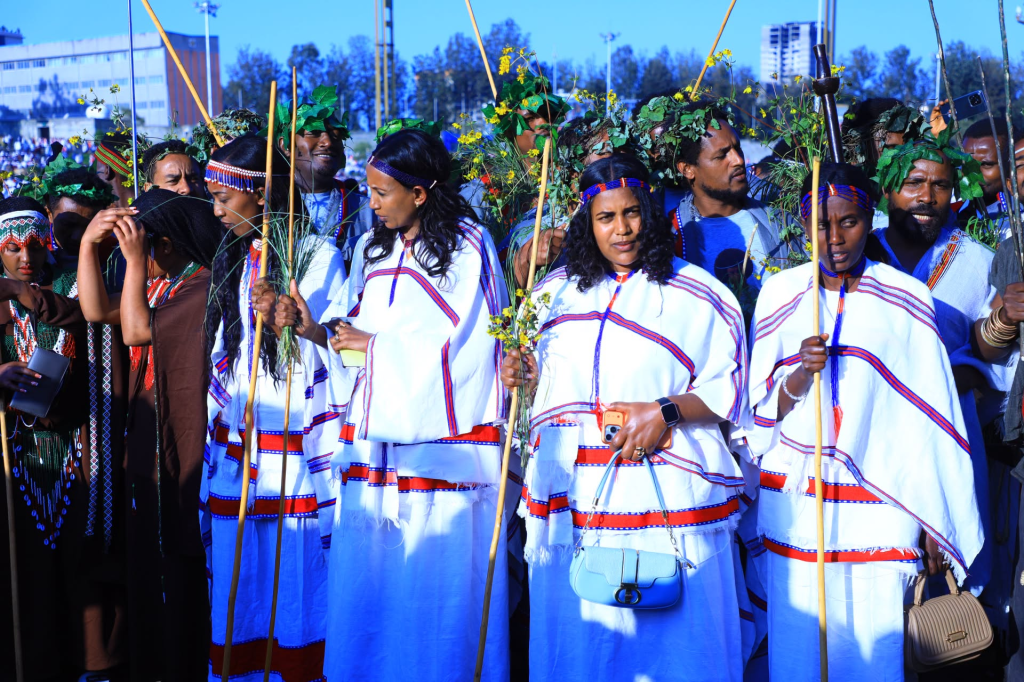
Mallattoo Ulfoo — The Sign of Love
Irreechaan mallattoo ulfoo. Irreechaa is the sign of love.
Ulfoo means love, compassion, mercy. Irreechaa is not just a festival of gratitude. It is a sign — a visible, tangible, public demonstration — of divine love.
The Oromo believe that Waaqa (God) loves humanity. The rains come. The harvest arrives. The sun returns after the darkness. These are not accidents of nature. They are expressions of divine love.
And Irreechaa is the human response to that love. It is the sign that the relationship is mutual. God gives; the people give thanks. God loves; the people love in return.
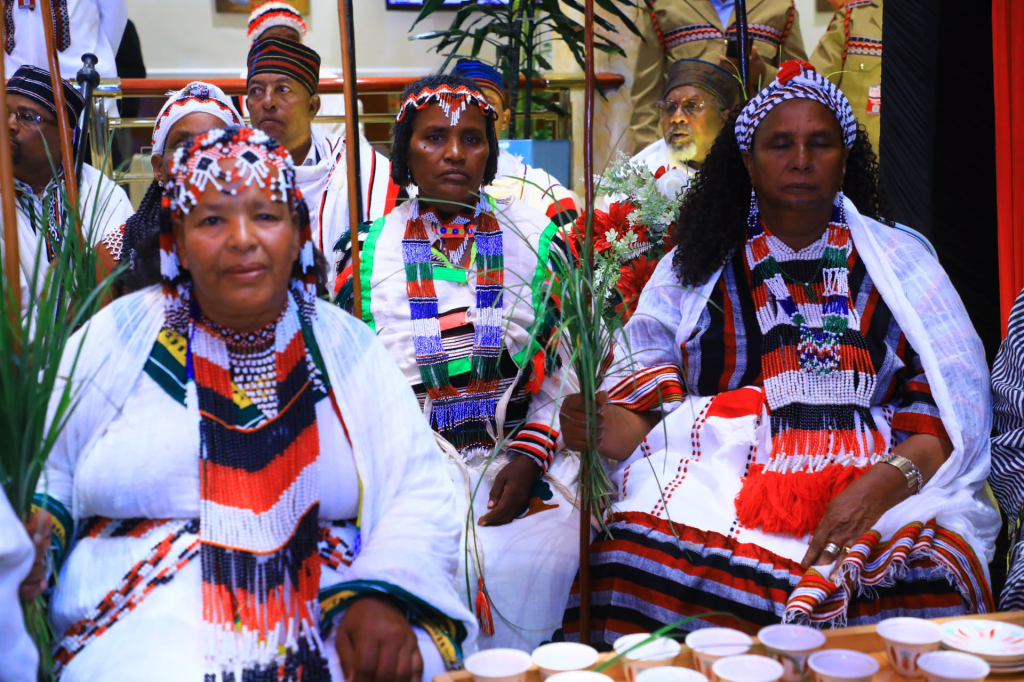
Part Three: The Reclamation of Time
The next phrases focus on Irreechaa’s relationship to time itself — its power to forgive the past, transform the present, and renew the future.
Yeroo Dhiifamaa — The Time of Forgiveness
Irreechaan yeroo dhiifamaa. Irreechaa is the time of forgiveness.
Yeroo means time, season, moment. Dhiifamaa means forgiveness, pardon, release. Irreechaa is not just a festival. It is a time — a specific, sacred season set apart for the work of forgiveness.
In the rhythm of the Oromo year, Irreechaa is the moment when the community pauses and says: Now is the time to make peace. Now is the time to release grievances. Now is the time to forgive.
This is the ritualization of forgiveness. It is not left to chance or whim. It is scheduled. It is expected. It is required.
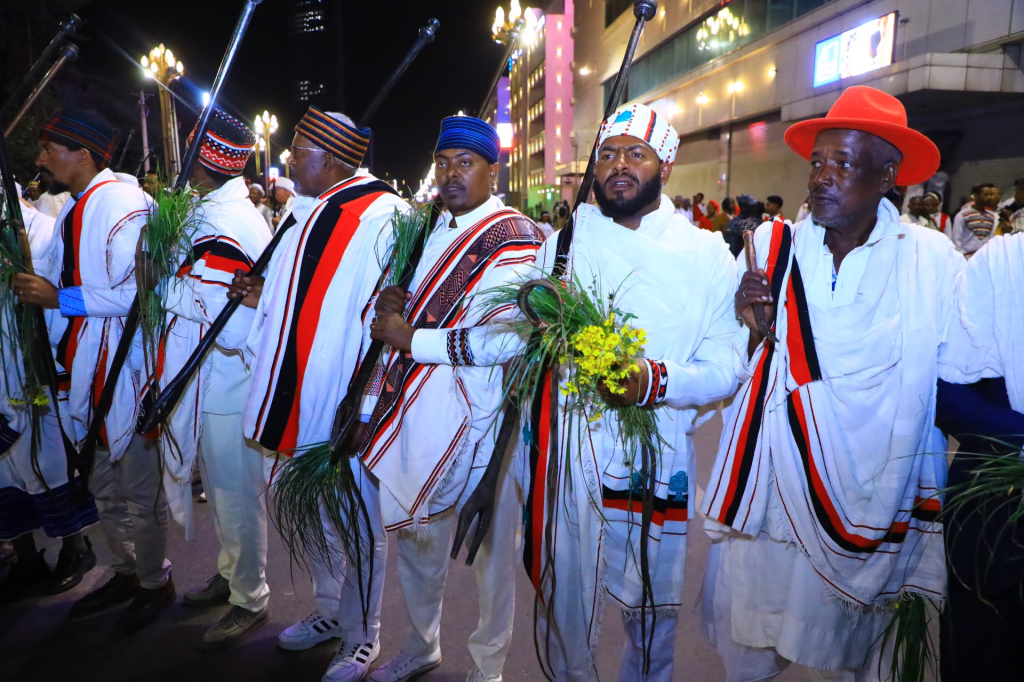
Ce’umsaa Baraa — The Turning of the Year
Irreechaan ce’umsaa baraa. Irreechaa is the turning of the year.
Ce’umsaa means transition, passage, crossing over. Irreechaa marks the turning point of the year — the end of the rainy season Ganna and the beginning of spring Birraa. It is a threshold, a liminal moment between what was and what will be.
At this threshold, the old year dies and the new year is born. The mistakes of the past are released. The possibilities of the future are welcomed. The community stands at the hinge of time and chooses to move forward.
This is ce’umsaa baraa — the turning of the year. And it is not just a calendar event. It is a spiritual one.
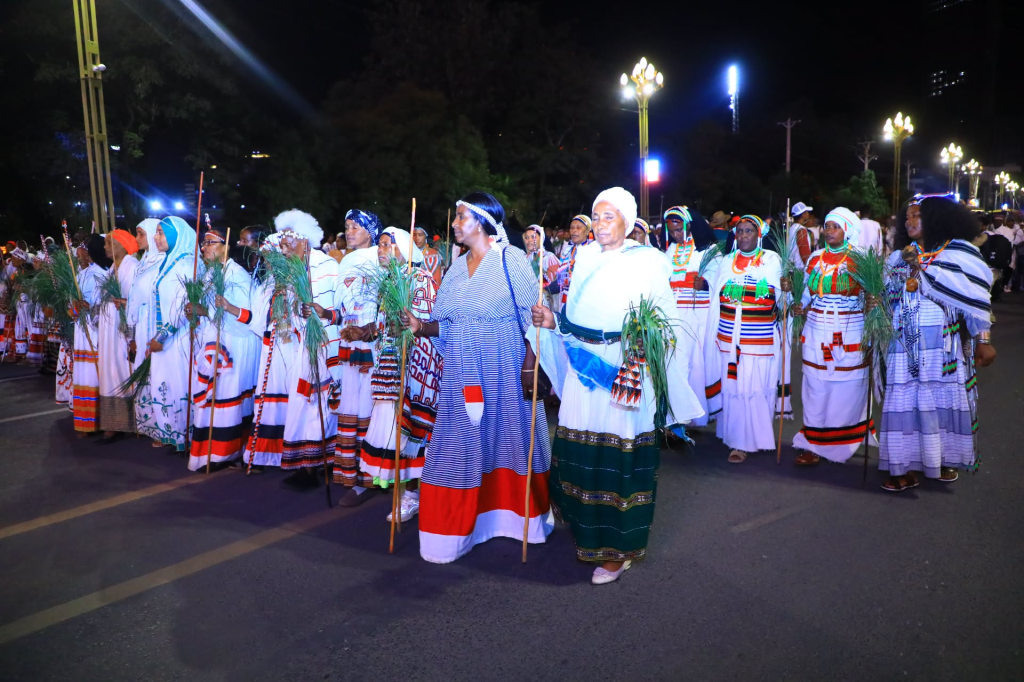
Damboobsaa Namummaa — The Restoration of Humanity
Irreechaan damboobsaa namummaa. Irreechaa is the restoring of humanity.
The rainy season destroys. Rivers swell. Roads wash out. Crops are lost. The land itself seems to be in mourning.
Then the rains end. The sun returns. The harvest begins. The people gather at the water to give thanks.
Irreechaa is the celebration after the suffering. It is the moment when the community pauses and says: We made it through. We survived. We are still here.
This is restoration — not the erasure of hardship, but the transformation of hardship into gratitude. The floods came, and we endured. The darkness came, and we waited. The sun returned, and we give thanks.
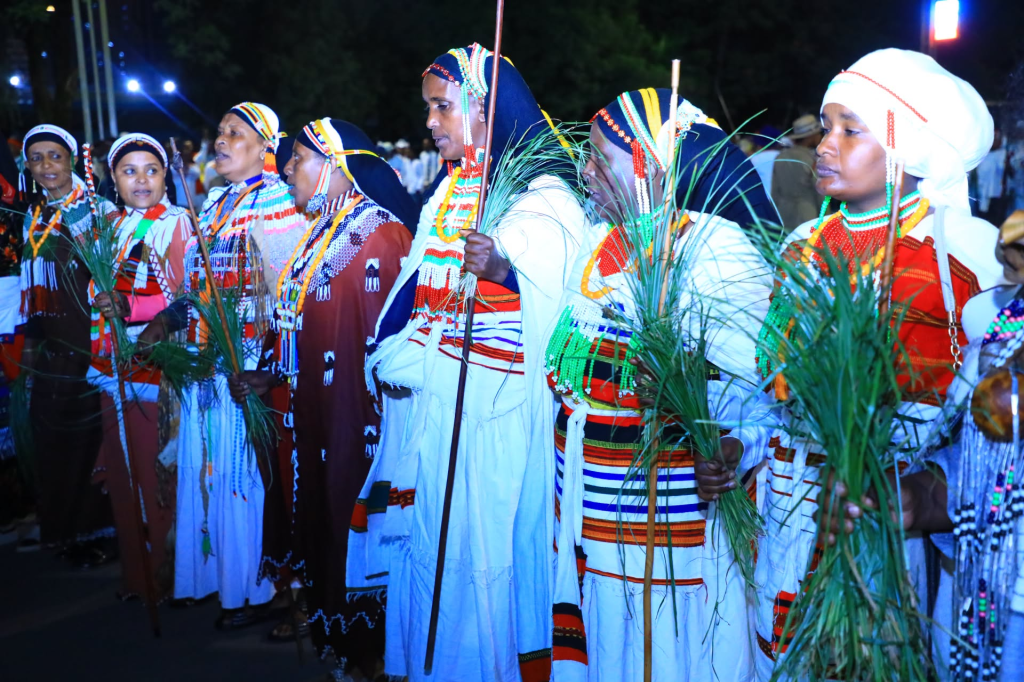
Part Four: The Perfection of Humanity
The final phrases describe Irreechaa’s ultimate purpose: the perfection of the human person and community.
Fooyyessaa Namummaa — The Improvement of Humanity
Irreechaan fooyyessaa namummaa. Irreechaa is the improving of humanity.
Irreechaa is not content with survival. It seeks flourishing. The festival is not merely about maintaining what exists but about becoming more than you were.
Fooyya’uu means progress, development, growth. The person who participates in Irreechaa is not the same person who entered the festival. They have been improved — refined by the discipline of reconciliation, elevated by the experience of unity, deepened by the practice of gratitude.
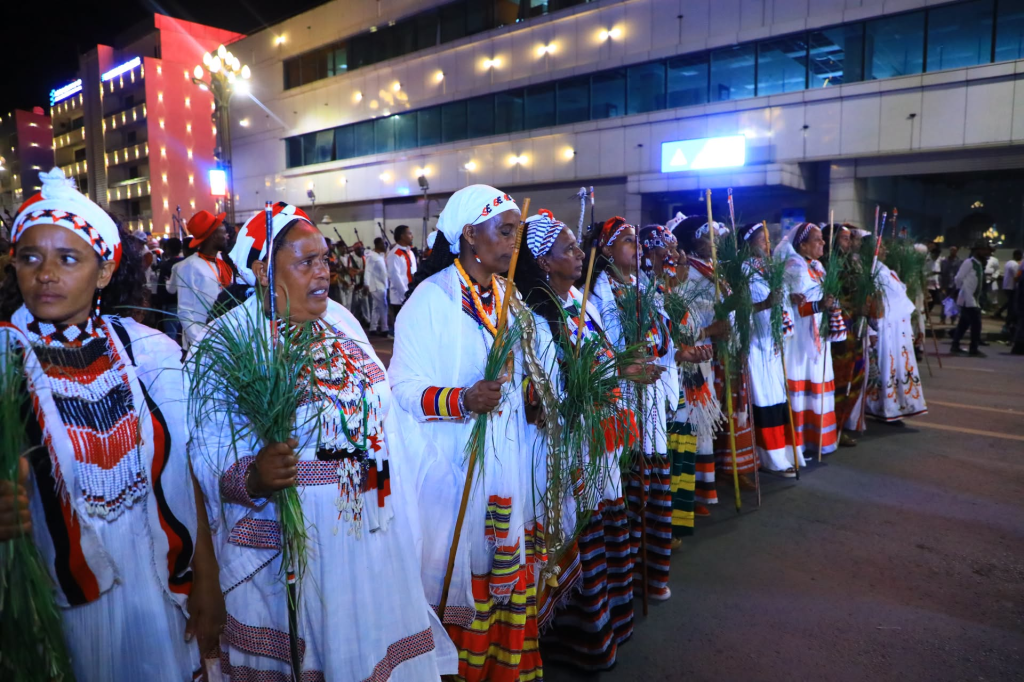
Fufsiisaa Namummaa — The Fulfillment of Humanity
Irreechaan fufsiisaa namummaa. Irreechaa is the fulfilling of humanity.
There is a deep longing in the human heart for completion — for the sense that life is not fragmented, that it has meaning, that it is going somewhere. Irreechaa answers that longing.
At the water’s edge, surrounded by millions of people who share your language, your faith, your hope, you experience a sense of completeness that modern life so often denies. You are not alone. You are not meaningless. You are part of something larger than yourself.
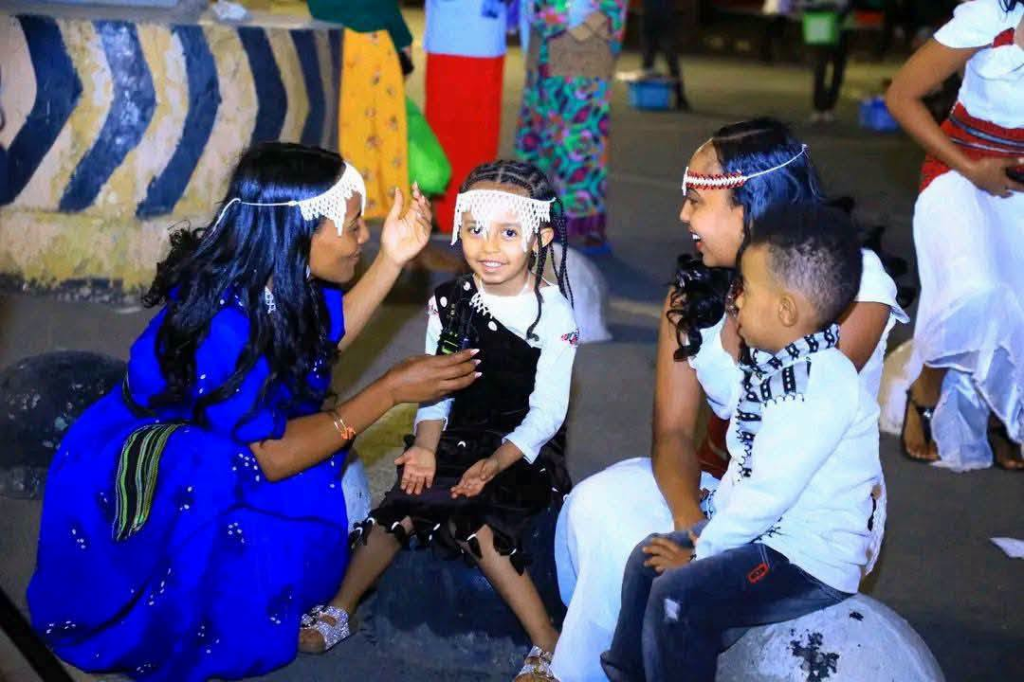
Fineessaa Namummaa — The Refinement of Humanity
Irreechaan fineessaa namummaa. Irreechaa is the refining of humanity.
Water is the medium of purification. At Irreechaa, participants dip sacred grass into the water and sprinkle it upon themselves and others. The Kormoomsaa — the blessing of the young men — cleanses and consecrates.
The refinement Irreechaa offers is the refinement of character. At the water’s edge, the layers of resentment, pride, and grievance are stripped away. What remains is the essential human being — vulnerable, grateful, connected, at peace.
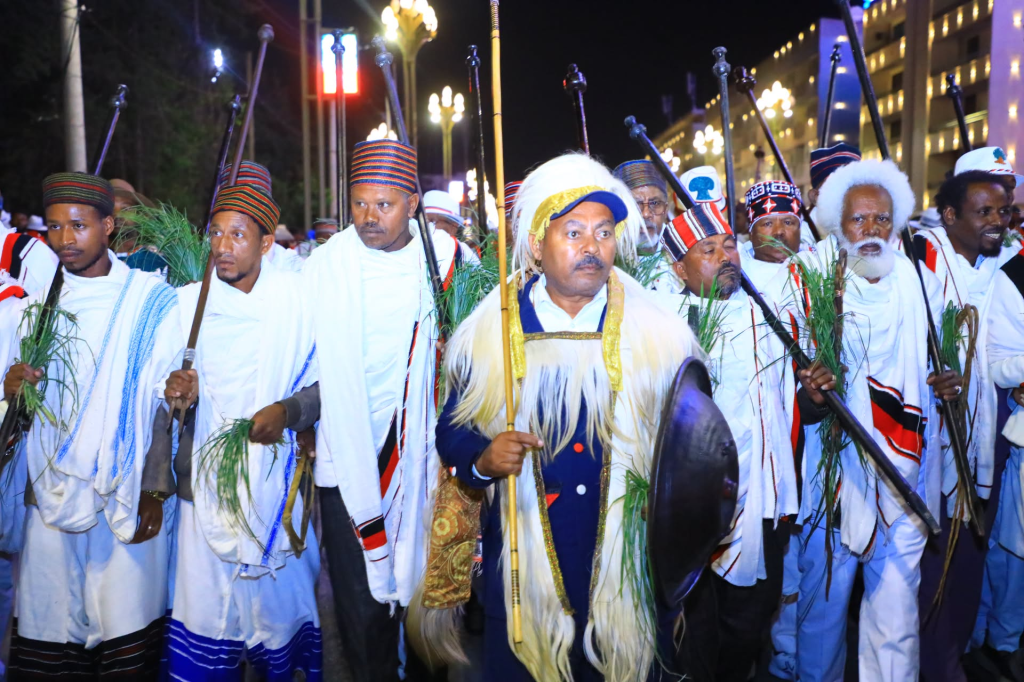
Guutessaa Namummaa — The Completion of Humanity
Irreechaan guutessaa namummaa. Irreechaa is the completing of humanity.
There is a difference between fulfillment and completion. Fulfillment is the experience of meaning. Completion is the achievement of wholeness. Irreechaa offers both.
The festival completes the cycle of the year. It completes the work of reconciliation. It completes the process of purification. It completes the community — bringing together all its members, from the youngest child to the oldest elder.
At Irreechaa, nothing is left out. No one is excluded. The festival is guutuu — complete, full, entire. The sea of white garments is not just a visual image. It is a theological statement: this is what wholeness looks like.
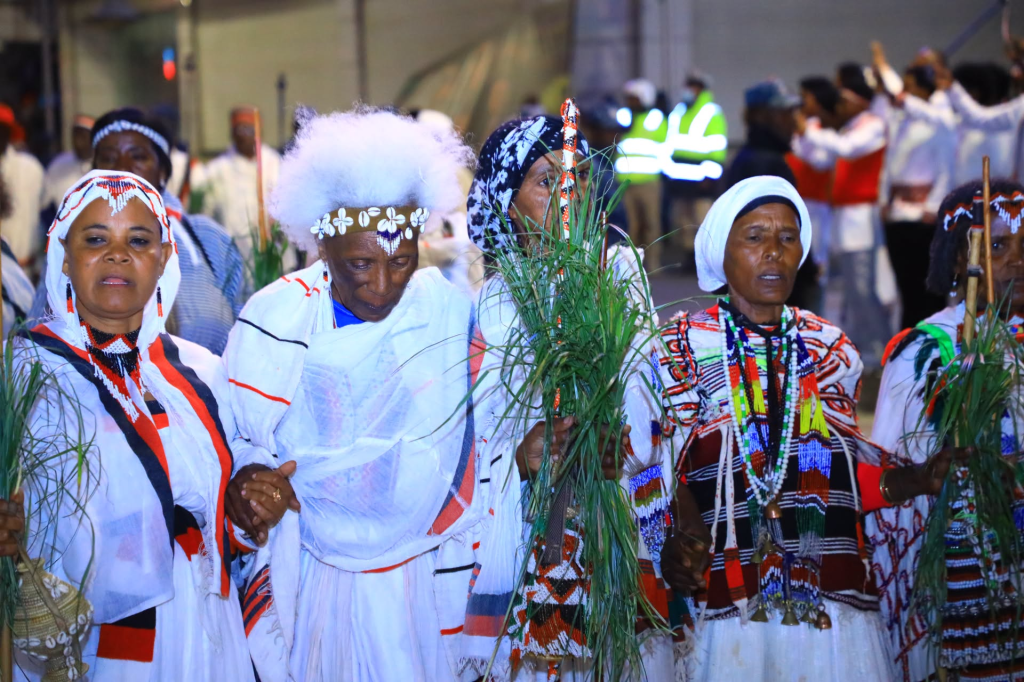
Kadhannaa Gaarummaa — The Prayer of Goodness
Irreechaan kadhannaa gaarummaa. Irreechaa is the prayer of goodness.
Kadhannaa means prayer, supplication, petition. Gaarummaa means goodness, virtue, excellence. Irreechaa is not just a festival of the past. It is a prayer for the future.
At the water’s edge, the Oromo people pray for goodness — for themselves, for their families, for their communities, for their nation, for the world. They ask Waaqa to make them good, to keep them good, to use them for good.
This is the prayer that summarizes all the others. It is the request that the renewal that has begun at Irreechaa will continue throughout the year.
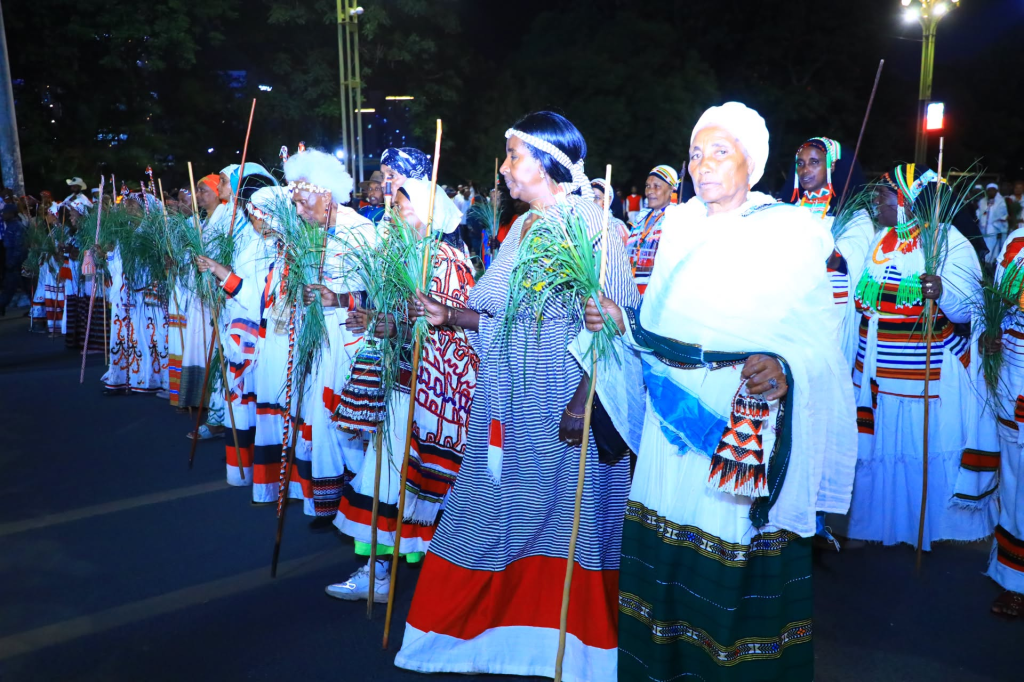
Haaromsaa Namummaa — The Renewal of Humanity
Irreechaan haaromsaa namummaa. Irreechaa is the renewing of humanity.
And so we arrive at the final phrase — the culmination of all the others.
Empowerment leads to reconciliation. Reconciliation leads to unity. Unity brings peace. Peace enables forgiveness. Forgiveness restores creation. Creation remembers its Creator. Evil is rejected. Love is affirmed. Time is redeemed. Humanity is restored, improved, fulfilled, refined, completed. And then — haaromsaa namummaa — humanity is renewed.
Irreechaa is not just a festival. It is a process — a spiritual technology that takes human beings as they are and transforms them into what they can become. It takes fractured people and makes them whole. It takes divided communities and makes them one. It takes a broken world and makes it new.
This is what the Oromo people have known for thousands of years. This is what they celebrate at the water’s edge every year. This is what they offer to Ethiopia, to Africa, and to the world.
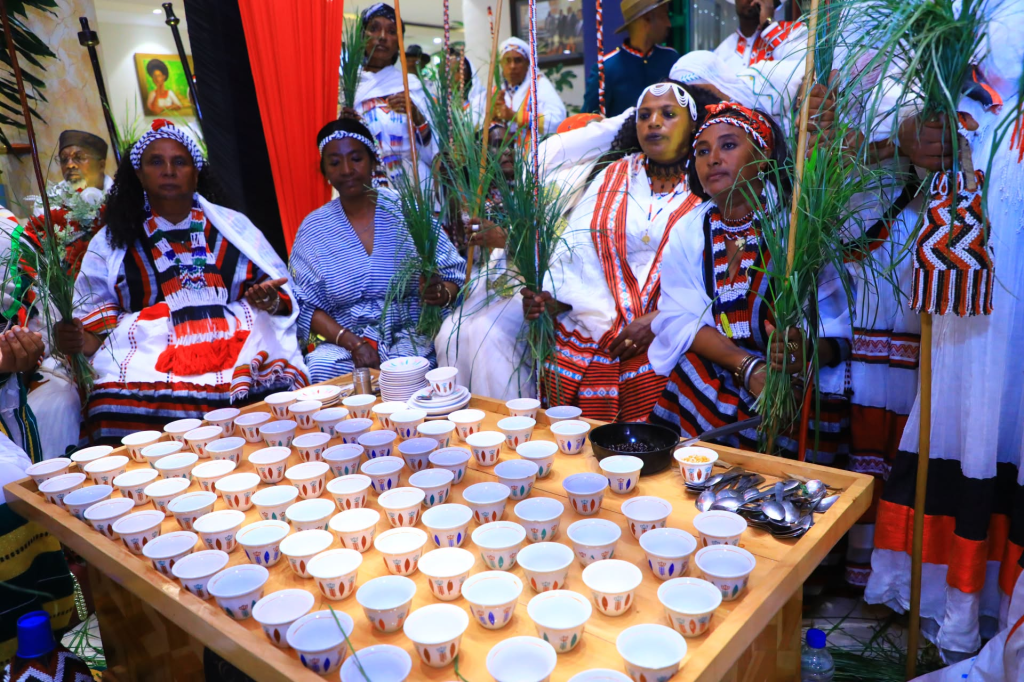
The Full Testimony
Let us read the sentence again — the full sentence — and hear it now with understanding:
“Irreechaan humneessaa namummaa, lachiisaa namummaa, marabeessaa namummaa, nageessaa namummaa, araarsaa namummaa, waloomsaa uumaa-uumamaa, sirna galateeffannaa, yaadannoo uumamaa, hulluuqoo hameenyaa, mallattoo ulfoo, yeroo dhiifamaa, ce’umsaa baraa, damboobsaa namummaa, fooyyessaa namummaa, fufsiisaa namummaa, fineessaa namummaa, guutessaa namummaa, kadhannaa gaarummaa, fi haaromsaa namummaa ti.”
Irreechaa is the empowering of humanity, the reconciling of humanity, the unifying of humanity, the peace-bringing of humanity, the forgiving of humanity, the harmonizing of creation, the order of thanksgiving, the memory of creation, the rejection of evil, the sign of love, the time of forgiveness, the turning of the year, the restoring of humanity, the improving of humanity, the fulfilling of humanity, the refining of humanity, the completing of humanity, the prayer of goodness, and the renewing of humanity.
This is not poetry. This is testimony. This is the Oromo people’s declaration of what Irreechaa does in the world.
Humanity can be renewed. Not through politics or economics or technology alone, but through the ancient practices of reconciliation, gratitude, purification, and community. Not through grand ideological projects, but through the simple, profound act of gathering at the water with your people, setting down your grudges, and giving thanks.
Irreechaa is the renewal of humanity. And it happens every year, at the water’s edge, one person at a time.
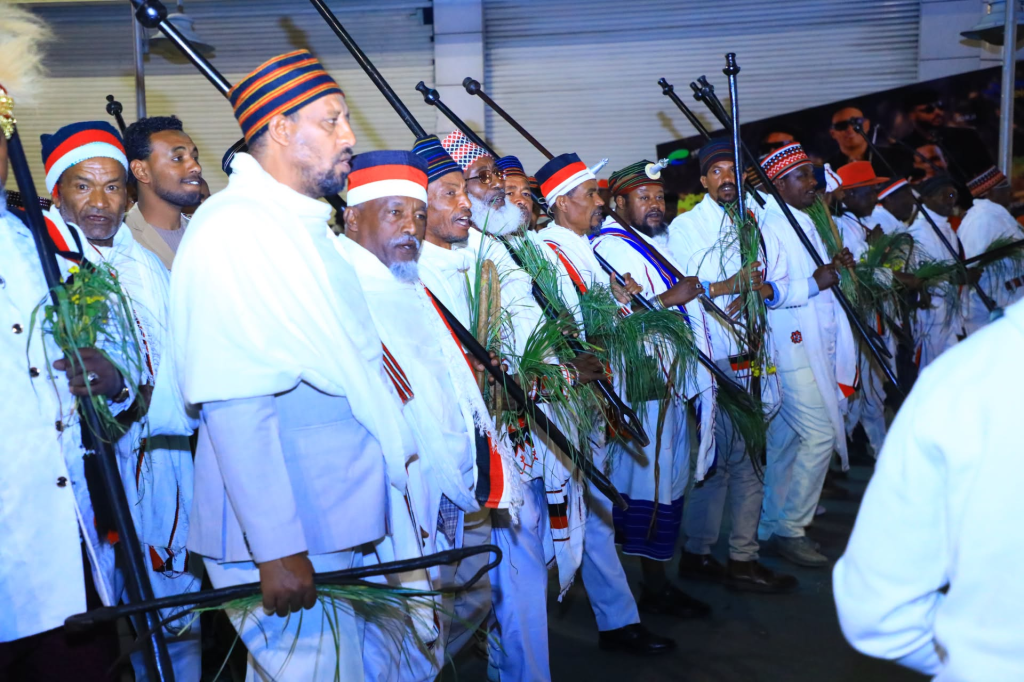
Baga Irreechaa Nagaan Geessan
The Oromo greeting says it all:
Baga Irreechaa nagaan geessan.
May the Irreechaa arrive in peace.
May the festival be empowering, reconciling, unifying, peace-bringing, forgiving, harmonizing, thanksgiving, memorial, rejecting of evil, sign of love, time of forgiveness, turning of the year, restoring, improving, fulfilling, refining, completing, prayerful, and renewing of humanity.
May the waters receive your gratitude.
May the grass carry your prayers.
May the nation, like the earth after the rains, emerge greener and stronger than before.
And may you — and all of us — be renewed.
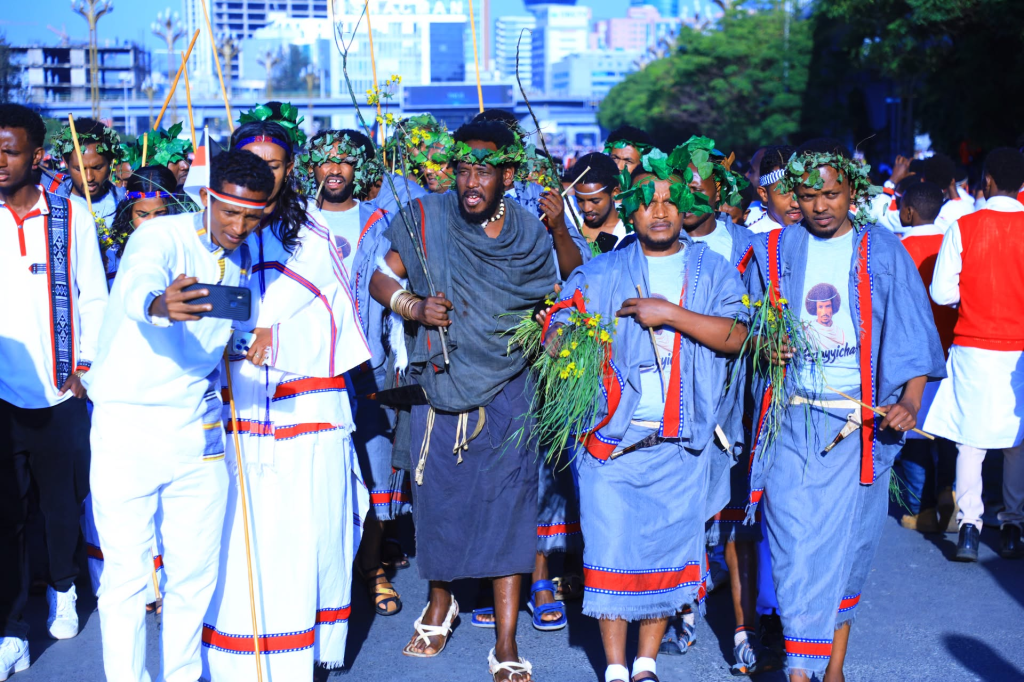
#Irreechaa #Oromia #Ethiopia #RenewalOfHumanity #HaaromsaaNamummaa #PeaceAndReconciliation #Thanksgiving #KadhannaaGaarummaa
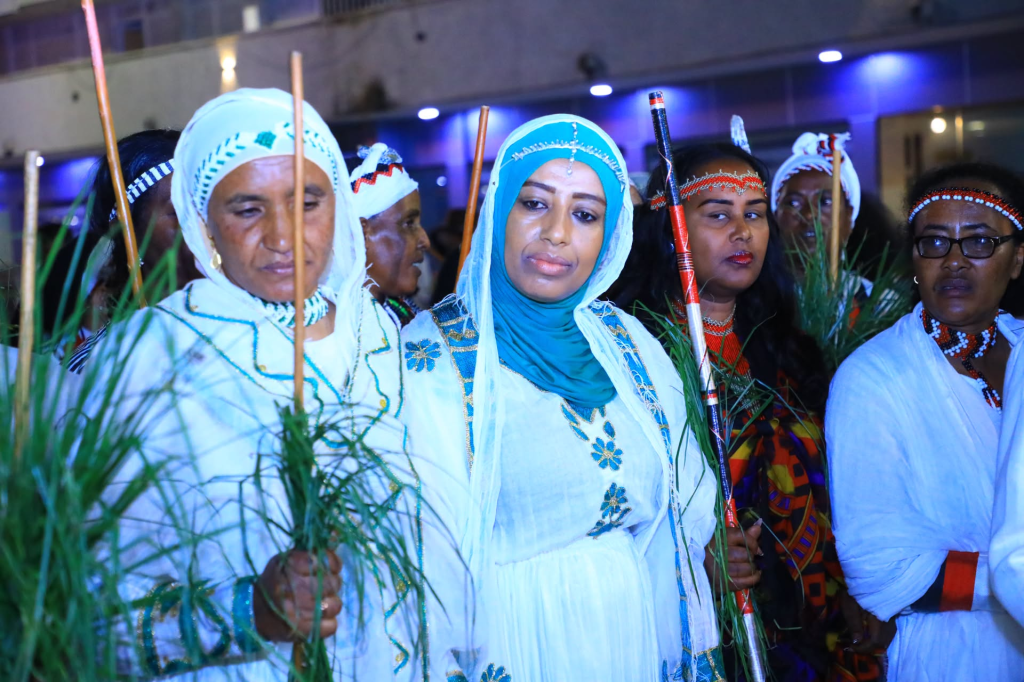
photos credit: OBN






