Seventeen Women, One House: Black Women Make History in the 2026 Midterms
By Dhabessa Wakjira
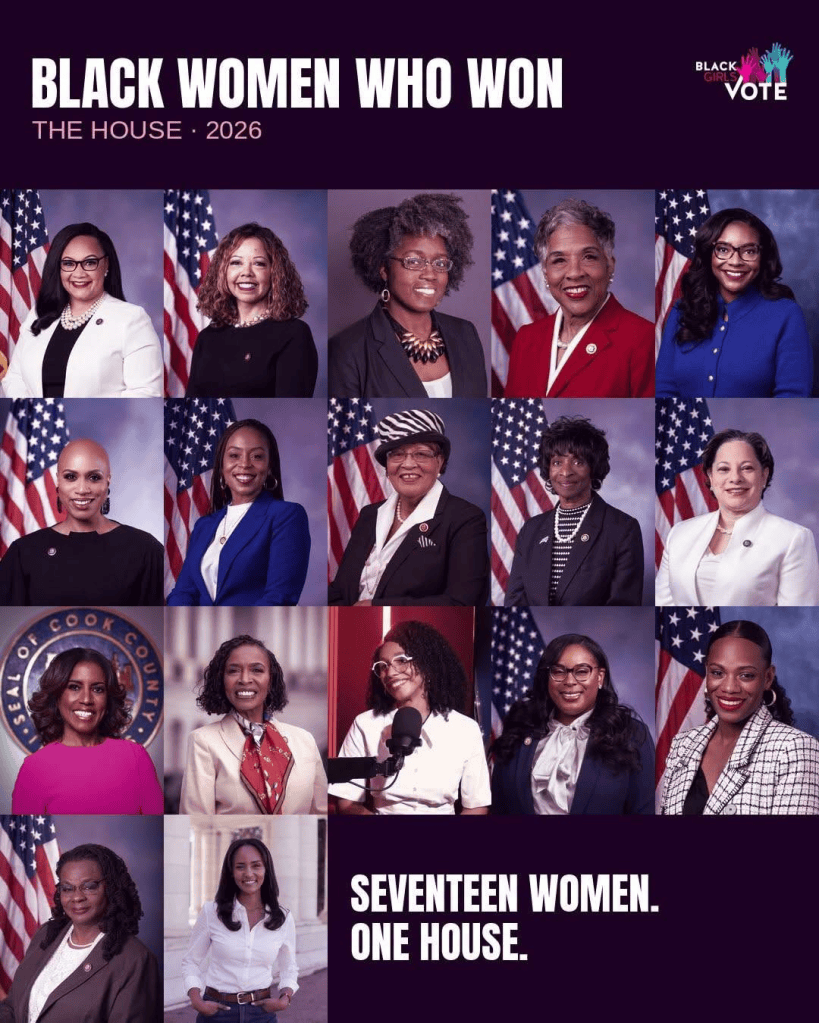
In a political season defined by uncertainty and division, a quiet but powerful transformation took place at the ballot box: seventeen Black women were elected to the United States House of Representatives in the 2026 midterm elections. Their victories span from Georgia to Colorado, from Ohio to Washington—and together, they represent one of the most significant concentrations of Black women’s political power in American history.
A Historic Class
The list of newly elected and re-elected representatives reads like a roll call of resilience and ambition: Nikema Williams, Lucy McBath, and Jasmine Clark in Georgia; Joyce Beatty and Emilia Sykes in Ohio, with Sykes holding one of the toughest seats in the country; and Ayanna Pressley, Shontel Brown, Alma Adams, Valerie Foushee, Jennifer McClellan, Donna Miller, Yvette Clarke, Darializa Avila Chevalier, LaMonica McIver, Summer Lee, and Gwen Moore across the nation.
But perhaps the most striking story comes from Colorado, where Melat Kiros made history twice over: she became the first Black woman to represent her state in Congress and the first Gen Z woman ever elected to the House. Her victory is not only a milestone for Colorado but a signal that a new generation of leadership has arrived—one that is younger, more diverse, and unafraid to claim space in institutions that have historically excluded them.
The Significance of Seventeen
Seventeen may sound like a modest number in a chamber of 435. But representation is not merely arithmetic. Each of these women carries with them the experiences of communities that have been underserved, underestimated, and overlooked. Their presence in Congress matters—not just for symbolism, but for the substance of policy: for the issues they will champion, the perspectives they will bring to debates, and the doors they will open for those who come after them.
The hashtag that accompanied the announcement—#BlackGirlsVote—captures something essential: this is not only about the women who won, but about the movement that elected them. Black women have long been the backbone of the Democratic Party and of progressive movements across the country. In 2026, that labor translated into a visible, undeniable presence in the halls of power.
A New Generation, A New Chapter
Melat Kiros’s dual firsts—first Black woman from Colorado, first Gen Z woman in Congress—are a reminder that history is not only made by those who have waited their turn, but by those who arrive ready to transform the institution itself. Gen Z has come of age in a time of crisis and possibility, and its entry into Congress signals that the fight for representation is not over—it is only being reimagined.
The women elected in 2026 are not newcomers to struggle. They are attorneys, community organizers, state legislators, and advocates who have spent their careers fighting for the vulnerable. Their victories are the result of years of organizing, coalition-building, and the steadfast belief that American democracy works best when it looks like America itself.
What Comes Next
The 119th Congress will convene with more Black women than ever before in its history. The work ahead is formidable—from protecting voting rights to addressing economic inequality, from healthcare access to criminal justice reform. But the class of 2026 enters with a mandate: to lead, not just to be present; to legislate, not just to represent; and to ensure that the promises of democracy are extended to all.
Seventeen women. One House. A nation watching.

Posted on November 4, 2026, in Aadaa, Afaan, Election, Events, Finfinne, freedom, gadaa, gender, Gumaa, health, Information, Language, Media, News, Oromia, Press Release, Promotion, Siinqee. Bookmark the permalink. Leave a comment.






Leave a comment
Comments 0