When Those in Power Refuse to Listen: Martin Luther King Jr. and the Power of Nonviolent Dialogue
By Daandii Ragabaa
What happens when those in power refuse to listen?
Martin Luther King Jr. grew up in a segregated United States, where Black Americans were denied a voice and risked threats and violence for speaking out. The institutions of government, the courts, the police, and much of the public square were closed to them. To speak was to risk one’s life. To be heard was almost unimaginable.
Yet King chose not to answer silence with silence. He chose nonviolent resistance.
The Strategy of Peaceful Protest
King understood that the refusal to listen is itself a form of violence—a denial of the other’s humanity. His response was not to mirror that denial but to expose it. Through peaceful protests, sit-ins, marches, and boycotts, he helped make the situation of Black Americans impossible to ignore. The point was not merely to disrupt but to reveal: to show the nation and the world what segregation actually looked like, and to force those in power to confront what they had chosen not to see.
In 1963, 250,000 people joined the March on Washington, where King delivered his famous “I Have a Dream” speech. It made people listen. The following year, legislation prohibiting racial discrimination was passed—the Civil Rights Act of 1964—and King was awarded the Nobel Peace Prize.
Principle 4: In Dialogue, You Must Listen
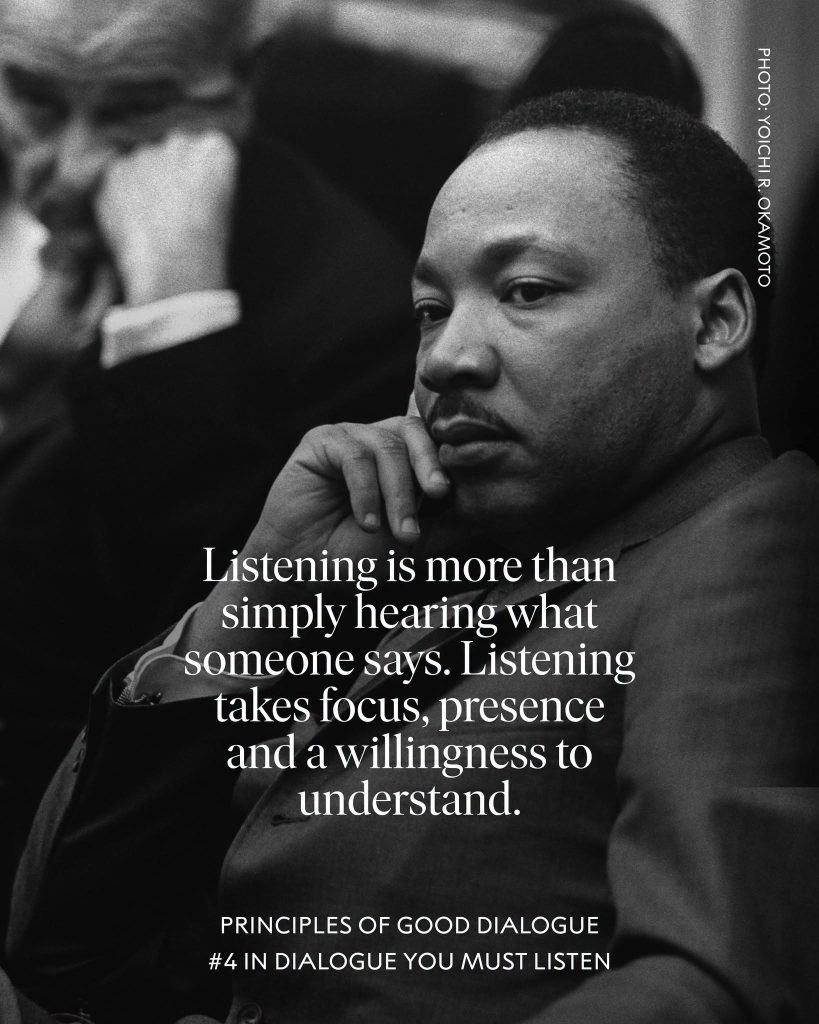
The Nobel Peace Center identifies this as an example of Principle 4 of good dialogue: In dialogue, you must listen. The principle is deceptively simple, but it carries profound implications. Listening is more than merely hearing. It requires focus and presence. It requires the willingness to set aside one’s own prejudices and judgments long enough to actually receive what another person is saying.
The Nobel Peace Center offers practical guidance on what this looks like:
- Listen to what is being said. Do not let your own thoughts and prejudices interfere with your ability to listen.
- Do not give advice unless it is requested.
- Do not interrupt. Let the other person finish talking.
- Do not capture the conversation by drawing parallels to your own experiences.
- Be empathic and show understanding for the other person’s situation.
- Do not presume to know other people’s opinions.
These are not abstract ideals. They are disciplines—habits of attention that must be practiced, especially by those who hold power.
The Courage to Make Listening Impossible to Avoid
King’s genius was in understanding that when those in power refuse to listen, the response is not to shout louder but to create conditions in which listening becomes unavoidable. The March on Washington was not merely a protest; it was an invitation—a demand—for the nation to hear what it had spent generations trying to drown out.
The Nobel Peace Center notes that King “used Principle 4: In dialogue, you must listen to find a solution.” This is a crucial insight. King did not abandon dialogue; he insisted on it. He did not seek to destroy his opponents; he sought to awaken them. His nonviolent resistance was, in its deepest logic, an act of faith in the possibility of dialogue—even with those who had shown no willingness to engage.
Listening as a Moral Practice
The lesson for our own time is clear. In a world where political leaders often speak past one another, where social media rewards outrage over understanding, and where the powerful routinely dismiss the grievances of the marginalized, Principle 4 remains a radical challenge. Listening is not a passive act. It is a moral practice—a recognition that the other person has something to say that we need to hear.
King’s life is a testament to this truth. He listened to the pain of his community. He listened to the conscience of the nation. And he forced those in power to listen to him—not through violence, but through the disciplined, peaceful insistence that their humanity and his were bound together.
A Legacy That Still Speaks
More than half a century after his death, King’s example continues to teach. When those in power refuse to listen, the answer is not to abandon dialogue but to practice it more faithfully—to create the conditions, through peaceful means, in which listening becomes inevitable. That is the lesson of the March on Washington. That is the lesson of the Civil Rights Act. And that is the lesson of Martin Luther King Jr.’s extraordinary life.
The Nobel Peace Center’s eight principles of dialogue—of which listening is the fourth—are not merely a framework for conflict resolution. They are a way of being in the world. And as King showed, they have the power to change history.
Principle 4: In dialogue, you must listen.
Read more about the Nobel Peace Center’s dialogue principles: https://www.nobelpeacecenter.org/en/dialogue/principle-4

Posted on November 4, 2026, in Aadaa, Afaan, Election, Events, Face of Injustice, Finfinne, freedom, gadaa, gender, Grief Support, Gumaa, health, Information, Kindness, Language, Media, News, Oromia, Press Release, Promotion. Bookmark the permalink. Leave a comment.






Leave a comment
Comments 0