Irreechaa Birraa Celebrated in Amsterdam as Diaspora Reaffirms Identity and Tradition
Where the Oromo Are, There the Oromo Order Thrives
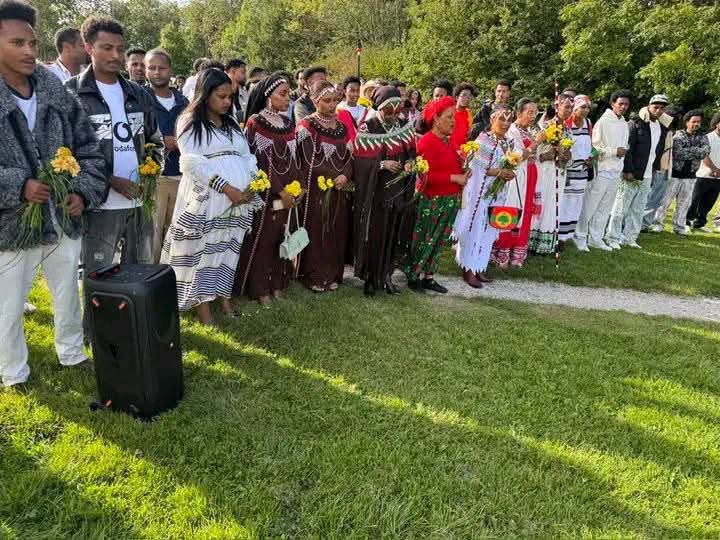
Amsterdam — Under the gray autumn skies of the Dutch capital, a sea of white, green, and yellow transformed Gaasperplas into a sacred Oromo landscape on Saturday, September 26, 2026. The Oromo community of the Netherlands gathered for Irreechaa Birraa, the ancient thanksgiving festival marking the end of the dark rainy season and the arrival of spring, in a powerful display of cultural continuity far from the Horn of Africa .
The celebration, organized by Hawaasa Oromo Nederland, drew Oromo families from across the Netherlands and neighboring European countries. Women in traditional dresses carried fresh green grass and yellow daisies; elders led prayers in Afaan Oromoo; and the sound of faaruu—traditional songs of gratitude—echoed across the park grounds .
For the Oromo diaspora, Irreechaa is more than a festival. It is a living declaration that the Oromo system—the sirna Oromoo—endures wherever the Oromo people are.
A Nation of Greatness
The Oromo are the largest ethnic group in Ethiopia and the Horn of Africa, numbering tens of millions and inhabiting a vast territory stretching from the central highlands to the southern lowlands . Their language, Afaan Oromoo, belongs to the Cushitic branch of the Afro-Asiatic family, and their traditional governance system, the Gadaa, was recognized by UNESCO as an Intangible Cultural Heritage of Humanity .
But numbers alone do not capture the depth of Oromo civilization. The Oromo possess a comprehensive philosophical and legal framework—safuu—that governs relations between humans, between humans and the natural world, and between humanity and the divine . Safuu establishes boundaries, rights, and responsibilities; it teaches that every created thing has its proper place and that violating these boundaries invites aadmalee—a profound moral transgression .
Central to this system is the land itself. For the Oromo, the earth is not merely property. She is haadha waan hunda—the mother of all things . Among the Boorana Oromo, the land is called Baattoo, a name that evokes her role as the sustainer who carries all life, both good and evil, upon her back . To farm sacred land—mountain slopes, water sources—without proper ritual is not merely an agricultural decision; it is a spiritual violation.
The Oromo are a people of profound religious tradition. Waaqeffannaa, the Oromo religion, worships one God—Waaqa—through a complex system of ayyaana, spiritual intermediaries who convey human needs to the Creator . The Oromo do not see themselves as a people without faith; they see themselves as a people with a very old faith, one that predates the arrival of Christianity and Islam in their lands.
Irreechaa: The Heartbeat of Oromo Life
No single institution better embodies the Oromo system than Irreechaa. Celebrated at the end of the rainy season (Ganna) and the beginning of spring (Birraa), Irreechaa is a national thanksgiving, a collective prayer of gratitude to Waaqa for protection, harvest, and peace .
The festival is celebrated in two principal forms. Irreechaa Malkaa takes place at the edges of rivers and lakes, where participants dip green grass and flowers into the water, sprinkling themselves as a symbol of purification and renewal . Irreechaa Tulluu is celebrated on hilltops, where the community gathers to pray for rain, fertility, and the well-being of the people . The largest celebrations occur at Hora Finfinne in Addis Ababa and Hora Arsadi in Bishoftu, where millions of Oromo gather each year—making it one of the largest annual human gatherings on the African continent .
The rituals of Irreechaa are rich with symbolism. Green grass represents life and fertility. Yellow daisies represent the joy of survival. Water represents purification and the washing away of hardship. The procession itself—elders leading, women walking in front, youth carrying flowers—is a living map of the Gadaa system’s social order .
Critical to Irreechaa is the requirement of reconciliation. A person carrying a grudge, a dispute, or an unresolved conflict is not permitted to participate fully in the festival . This is not merely a social nicety; it is a profound statement of the Oromo moral order. One cannot approach the sacred with a heavy heart. One cannot give thanks while holding anger. The Oromo system insists that gratitude and grievance cannot coexist.
The Diaspora Embraces the System
In Amsterdam, these traditions were not merely remembered—they were practiced. The Gaasperplas celebration followed the traditional structure: opening prayers led by community elders, a procession toward the water’s edge, the dipping of grass and flowers, and the sharing of food and coffee in a spirit of communal joy .
For diaspora Oromos, Irreechaa serves as a vital cultural anchor. In a world where the pressures of assimilation and the distance of migration threaten cultural continuity, Irreechaa is a reminder that the Oromo system is portable. It travels across oceans. It survives in new climates and new languages. It does not require the soil of Oromia to flourish—only the hearts of Oromo people who refuse to forget .
Community organizers emphasized the importance of the festival for younger generations. For Oromo children born in Europe, Irreechaa may be one of the few spaces where they hear prayers in Afaan Oromoo, see traditional caaccuu and siinqee carried by women, and witness elders acting in their traditional roles as Abbaa Gadaa and Hadhasiinqee .
The siinqee—the ritual stick carried by Oromo women—is itself a powerful symbol of the Oromo system’s treatment of gender. In traditional Oromo society, the siinqee represents the sacred power of women, particularly in their roles as peacemakers and protectors of life . A man who sees the siinqee planted in the ground knows that a woman has claimed her right to be heard, to demand justice, or to stop violence. That this institution survives and is honored in Amsterdam is a testament to the depth of the Oromo system.
A System That Endures
The Oromo say: Irreechi irree keenya—”Irreechaa is our unity” . The festival is not simply a religious observance or a cultural performance. It is a political and social statement: the Oromo system, with its Gadaa governance, its safuu ethics, its ayyaana spirituality, and its seasonal rhythms, is not a relic of the past. It is a living framework that continues to order Oromo life.
In Amsterdam, that framework was visible in every aspect of the celebration. It was visible in the respect shown to elders. It was visible in the equal participation of women, whose siinqee tradition remains one of the most distinctive aspects of Oromo society. It was visible in the focus on reconciliation and peace. It was visible in the integration of prayer and communal meal, ritual and celebration, solemnity and joy.
The Oromo system does not require an army to defend it. It does not require a state to enforce it. It requires only that Oromo people continue to live it. In Amsterdam, they did.
Source: Facebook page Gudisa Barbada

Posted on September 27, 2026, in Aadaa, Afaan, AMES, AOD, Asylum Seekers, Bokkkuu, Diaspora, Election, Events, Finfinne, freedom, gadaa, health, Information, Irreechaa, Kindness, Language, Media, News, Oromia, Oromo diaspora, Press Release, Promotion. Bookmark the permalink. Leave a comment.






Leave a comment
Comments 0