Daily Archives: November 14, 2026

Haacaaluu Hundeessaa: The Icon Who Transformed the Narrative of the Oromo National Struggle
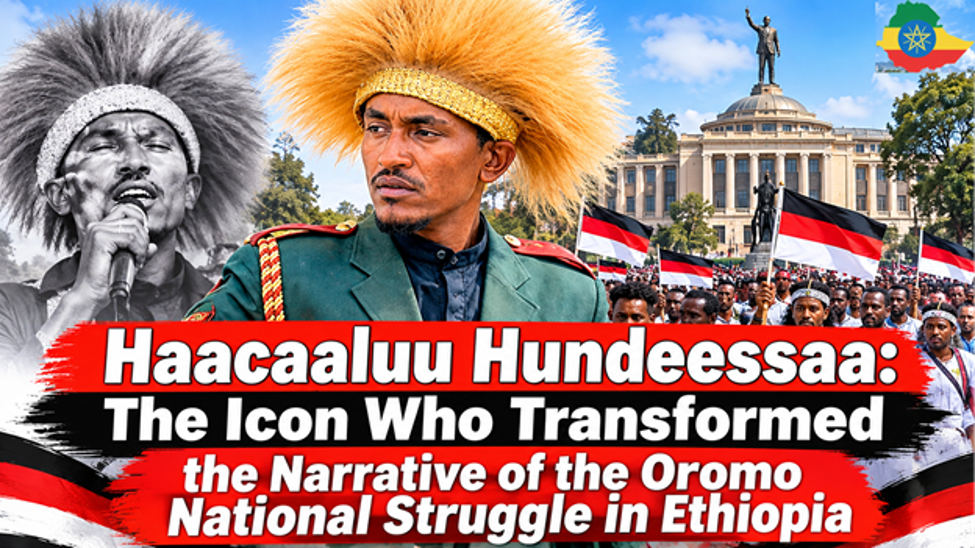
From the prison cells of Ambo to the stage of Millennium Hall, a singer became the unlikely architect of a generation’s political awakening—and a bridge between Oromo national aspirations and Ethiopian national unity.
In the pantheon of Oromo resistance, few figures have wielded a more transformative influence than Haacaaluu Hundeessaa. Born in 1986 in Ambo—a historic epicenter of Oromo resistance—he emerged from five years of imprisonment as a teenager not merely as a singer, but as an ethnographer of Oromo history and an architect of a new political consciousness. His enduring legacy lies in guiding a generation from the pain of exclusion (Maalan Jira? — “What existence is mine?”) to the confidence of collective assertion (Jirra! — “We are here!”), and ultimately laying the ideological groundwork for what has come to be known as “Progressive Patriotism”—the conviction that the Oromo must move from resisting the Ethiopian state at its margins to claiming rightful ownership at its center.
From Cultural Preservation to Political Mobilization
For generations, Oromo artistic expression served as a vital sanctuary against cultural erasure and political exclusion. Pioneers like the legendary Dr. Ali Birra laid the foundational stones of this tradition, elevating Afaan Oromoo in modern music and instilling cultural pride during eras when Oromo identity faced severe state suppression. Ali Birra embodied a nuanced dual identity, singing for Oromia (“Biyyi too Oromiyaa, Biyya Biyya Caaltuu” — “My country is Oromia, a country above all countries”) while also embracing Ethiopia (“Itoophiyaan biyya teenya, fiiwdalizimiin diina keenya” — “Ethiopia is our country; feudalism is our enemy”). This willingness to embrace Ethiopia while calling for its regime to change would echo through later generations.
Building upon that cultural foundation, Haacaaluu transformed Oromo music from a medium of cultural preservation into an unstoppable engine of mass political mobilization and ideological renewal. His 2009 debut album Sanyii Mootii (Race of the King), composed largely behind prison walls, and his 2013 track Waa’ee Keenya (Our Struggle) diagnosed internal divisions and historical repetition, warning against “sabotaging and waylaying each other” while state oppression persisted.
The political awakening exploded into nationwide revolt in June 2015 with the release of Maalan Jira?—a direct response to the Addis Ababa Integrated Development Master Plan, which threatened to evict hundreds of thousands of Oromo farmers around the capital. Singing “My beloved Galoo Gullaallee was Tufaa’s / The mountains were Abbichuu’s / The Galaan surrounded Finfinnee… They tore us apart,” Haacaaluu transformed localized land dispossession into an existential national question. By weaving together Oromo clans and geographies across Wallagga, Arsi, Borana, Hararghe, and Shawa, his music dissolved regional divides and became the undisputed soundtrack of the 2014–2018 Oromo protests.
The Turning Point: Arat Kilo and the Claiming of State Power
While Maalan Jira? articulated the trauma of exclusion, Haacaaluu’s historic December 9, 2017 performance at Addis Ababa’s Millennium Hall marked a decisive ideological pivot from street protest to claiming state power. Organized as a televised benefit concert for over a million Oromos forcibly displaced from the Somali Regional State, the event was attended by top-ranking officials of the ruling EPRDF regime. Stepping onto the stage just kilometers from the national palace, Haacaaluu subverted a state-monitored space into a prophetic political reckoning.
His performance introduced two radical shifts in Oromo political thought. First, self-reliance over external salvation: rejecting passive reliance on exiled opposition groups or foreign intervention, he sang “Do not dream while waiting for help from outside / Do not dream an impossible dream,” placing the responsibility for emancipation directly on the domestic generation. Second, geographic proximity as political right: by chanting “Saddle your horse and fight… You are the one closest to Arat Kilo,” he exposed the absurdity of the Oromo living in and around Finfinnee while remaining barred from governing it.
Just four months later, in April 2018, the ruling coalition fractured under the weight of the protests and Abiy Ahmed was sworn in at Arat Kilo as Ethiopia’s first Oromo Prime Minister—cementing the Millennium Hall concert as a symbolic catalyst of that transition. Following Haacaaluu, several Oromo artists performed at Millennium during the reception of Jawar Mohammed and the Irreechaa event, consolidating the narrative of transition from resistance to governance.
Reclaiming Ethiopian History: Adwa as an Oromo Victory
Crucially, Haacaaluu’s vision of political ownership was anchored in historical reclamation. For decades, dominant state historiography framed Ethiopia’s foundational triumph, the 1896 Battle of Adwa against Italian colonialism, almost exclusively as the achievement of Emperor Menelik II and northern elites, erasing the decisive sacrifices of Oromo cavalry and military commanders such as Ras Gobana Dacche, Fitawrari Habte Giyorgis Dinagde, and Balcha Safo.
Haacaaluu dismantled this historical gatekeeping both on and off stage. Appearing at Adwa Victory Day celebrations dressed in traditional Oromo warrior regalia—gaachana shield, eeboo spear, and lion-mane headdress—and addressing the era in songs like Alamaayyoo, he asserted that Oromo blood, horsemanship, and leadership were central to defending Ethiopia’s sovereignty against European imperialism. By reclaiming Adwa as an Oromo victory as much as an Ethiopian one, he demonstrated that the Oromo were never mere subjects or outsiders to the Ethiopian state—they were among its principal defenders and legitimate stakeholders.
Following in his footsteps, many Oromo artists including the legendary Caalaa Bultumee and Saliya Sami released songs advocating that Oromos were key players in the Adwa victory. His influence also extended to the newly established Adwa Victory Memorial Museum (the Adwa 00KM Museum), which now includes many Oromo heroes who paid the ultimate price during the battle.
Progressive Patriotism: From Resistance to Ownership
Through his music and public commentary, Haacaaluu’s artistic legacy points directly toward Progressive Patriotism, a framework that reconciles proud Oromo nationalism with equal, democratic ownership of Ethiopia. Describing Ethiopia in 2018 as “a beautiful mosaic of 80 flowers,” he rejected both forced assimilation into a monolithic identity and permanent retreat to the political periphery.
In this progression, his October 2017 anthem Jirra! (We Are Here!) answered the existential despair of Maalan Jira? with a roar of survival and ascendancy. Yet, as the tragic aftermath of his assassination on June 29, 2020, and the ongoing conflicts and unfulfilled demands for justice in Oromia demonstrated, merely placing an Oromo individual inside Arat Kilo does not automatically secure freedom, constitutional rights, or democratic governance.
The true fulfillment of Haacaaluu’s legacy requires advancing to the next stage of his political trajectory: Oromoon Biyya Ijaarra, Bulchuu Dandeenya! (We Can Govern!). His stance foresaw the concept of Progressive Patriotism later articulated by Jawar Mohammed in 2024, which insists that Oromos need not abandon their identity or right to self-determination in order to lead Ethiopia. Rather, having proven their capacity to resist tyranny and defend the nation’s sovereignty, they bear the historic responsibility to build accountable institutions, uphold human rights, and transform the Ethiopian state into a truly democratic home for all its peoples.
A Legacy Beyond Music
Haacaaluu’s greatest contribution to the Oromo national struggle was his ability to transform its political narrative from one defined primarily by resistance, historical suffering, and exclusion into one of collective confidence, historical ownership, and the aspiration to govern. Through songs such as Maalan Jira? and Jirra!, he awakened a generation to the importance of defending its identity, reclaiming its ancestral land, and asserting its rightful place in Ethiopian political life.
His impact extended well beyond music and cultural expression. By reshaping the political imagination of a generation, he helped inspire other Oromo artists—Tadele Gemechu with Utubaa, Yosef Getahun and Kemer Yusuf with Galaanoo, Sona Takele with Yaa Warra Boolee, and Galaanaa Gaaromsa with Duraanu and Galmee Seenaa—to advance a narrative of reclaiming Ethiopia as a shared national project while affirming the Oromo people’s leadership in determining the future of both Oromia and Ethiopia.
His influence also strengthened the confidence of Oromo nationalist political organizations to move beyond resistance politics, pursue democratic transformation, demand equitable participation in state power, and take an active role in determining Ethiopia’s political destiny. His impact extended to Oromo activists and artists who stood for Ethiopian national unity by supporting Ethiopian national defense—keeping the unity of Ethiopia as a state regardless of political differences with the leading government.
Conclusion
Haacaaluu Hundeessaa’s greatest legacy was his ability to transform the Oromo struggle from resistance against exclusion into a vision of political ownership, leadership, and democratic transformation in Ethiopia. Through his music and political messages, he inspired a generation to recognize that the Oromo are not outsiders to Ethiopia but historical contributors and legitimate stakeholders in shaping its future.
From Maalan Jira? to Jirra!, and ultimately to Biyya Ijaarra, Bulchuu Dandeenya!, Haacaaluu’s message represents the spirit of Progressive Patriotism: moving from resistance to ownership, from exclusion to leadership, and from demanding change to taking responsibility for transforming the state. His legacy calls upon the Oromo to preserve their national identity and hard-won achievements while taking greater responsibility for building a democratic, inclusive, and prosperous Ethiopia—a vision that remains as urgent today as it was when he first stepped onto the stage at Millennium Hall.
This feature article draws on the scholarly work of Sultan Abda Neja, Ph.D., and the documented history of Oromo artistic resistance. Haacaaluu Hundeessaa’s music remains a testament to the power of art in shaping political consciousness and national destiny.






