The Architects of Tomorrow: The Role of Oromo Youth in Building Oromia
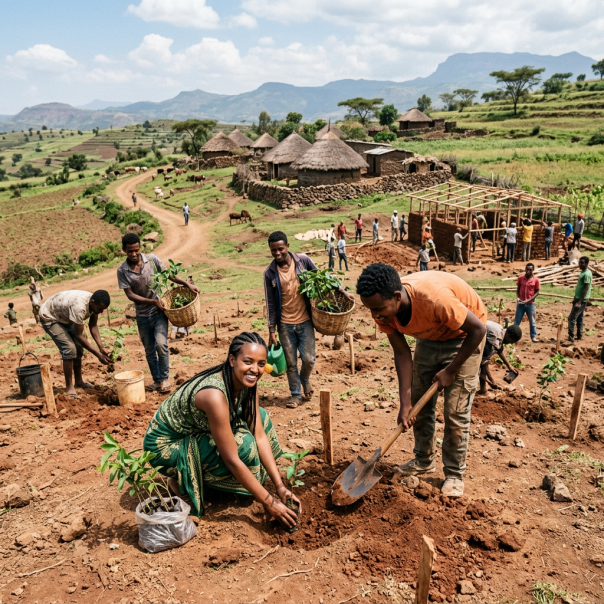
In the sweeping highlands of Oromia, beneath a sky that has witnessed centuries of both triumph and turmoil, a quiet but powerful transformation is taking root. It is not being driven by politicians in distant capitals, nor by the decrees of aging elders alone. Instead, it is being shaped by the hands, minds, and unyielding spirits of the young—the Qeerroo (young men) and Qarree (young women) of Oromia.
For generations, Oromo youth have been the backbone of their nation’s resistance. Today, however, they are stepping into a new role: not merely as protesters against oppression, but as architects of a new Oromia. They are builders of infrastructure, pioneers of technology, guardians of culture, and the driving force behind a national renaissance that is redefining what it means to be Oromo in the 21st century.
A Legacy of Resistance, A Future of Building
The term Qeerroo traditionally described an unmarried young man, but over the past decade, it has evolved into a powerful symbol of generational awakening. The Oromo youth political movement, which gained significant momentum between 2014 and 2018, was driven by deep-seated concerns: youth unemployment, the consequences of rapid urbanization, and a profound sense of marginalization. They were excluded from a rural future through land grabbing and population growth, and equally shut out from a modernist development that unequally distributed the fruits of economic growth.
Yet, frustration has given way to construction. As Minister Deetan, speaking at a youth forum in Bole Sub-City, recently affirmed, the role of young people in nation-building is paramount. The youth are no longer waiting for change to be handed to them; they are actively shaping it. “Dargaggoonni jijjiiramni siyaasaa biyya keenyatti akka dhufu taasisuu qofa osoo hin taanee, jijjiiraamichi qormaatawwan hedduu keessa darbee milkaa’inoota hedduu akka galmeessuuf gahee isaan irraa eegamu bahachaa jira” (The youth are not only bringing political change but are expected to register many successes through numerous challenges).
Pillars of Unity and National Cohesion
One of the most significant contributions of Oromo youth has been their role in fostering national unity and building a cohesive Ethiopian identity. For too long, young people were confined to their regional identities, but this is changing. Minister of Peace Binnaalif Andu’aleem has emphasized that young people have a duty to participate in building the country and fostering national consensus.
Through a new national volunteer service program, youth from various universities—armed with diverse skills—are being deployed across the country to serve communities beyond their own regions. This initiative is breaking down regional barriers and forging a sense of shared destiny. As Minister Andu’aleem noted, for the past 30 years, Ethiopia’s political landscape focused more on division than unity. Today’s youth are actively reversing that trend, stepping out of their regional silos to build a unified national identity through service and collaboration.
The Economic Engine: Creating Dignified Work
Perhaps nowhere is the youth’s impact more visible than in the economic sphere. The challenge of unemployment has been a primary driver of youth activism, but it has also sparked a wave of entrepreneurial and employment initiatives.
The Agricultural Dignified Employment for Youth (ADEY) Program, funded by the Mastercard Foundation and implemented in partnership with organizations like HUNDEE, aims to create 611,000 dignified jobs for youth—80% of them women—across eight Ethiopian regional states, including Oromia. This is not just about filling positions; it is about creating meaningful, dignified livelihoods that empower young people to build their futures with pride.
In addition, massive industrial projects, such as the Busa Gonofa Oromia Integrated Food Industry, are being launched with a clear focus on generating large-scale employment for the youth. These initiatives represent a fundamental shift: the recognition that the nation’s economic future rests squarely on the shoulders of its young population.
The Classroom and the Laboratory: Building Minds
Education is the cornerstone of any nation’s development, and Oromo youth are at the forefront of a revolution in learning. In a powerful act of giving back, world-renowned Oromo scientist Professor Gabbisaa Ejjetaa funded and built the “Mootuu Ayyaanoo Secondary School” in his hometown of Oolankomii, naming it after his late mother. “This is not just a building; it is a beacon of hope,” said one elder at the inauguration. The school is a testament to the idea that true development begins with education and that the youth must be empowered through rigorous academics grounded in cultural identity.
Furthermore, the establishment of the Shaggar Institute of Technology (SIT) in Oromia marks a monumental leap forward. This new institution is dedicated to training elite students in cutting-edge fields such as Space Science, Artificial Intelligence, Nuclear Science, Biotechnology, and various engineering disciplines. The institute, built with a multi-billion birr budget, is designed to produce a generation of Oromo and Ethiopian youth capable of competing on the global stage.
A Cultural Renaissance: Reclaiming Identity
Beyond politics and economics, Oromo youth are leading a profound cultural renaissance. Across Oromia, young people are reclaiming their names, their language, and their heritage with a pride that their parents could scarcely have imagined.
They are celebrating Irreechaa, the ancient Oromo thanksgiving festival, not just as a religious ritual but as a powerful assertion of national identity. The festival serves as a vital platform for youth engagement and community identity. Young people are also at the forefront of efforts to have Irreechaa recognized by UNESCO as a world heritage, ensuring its preservation for future generations.
This cultural awakening extends to the digital realm as well. Young Oromo innovators are developing learning platforms in Afaan Oromoo, and initiatives like the “Gadaa Eco Builder” game are using interactive play to teach the UNESCO-recognized Oromo Gadaa system while funding real-world reforestation in Oromia. The youth are ensuring that their culture is not a relic of the past but a living, breathing force for the future.
The Challenges Ahead
Despite these remarkable contributions, the path forward is not without obstacles. Many Oromo youth still face significant challenges: educated unemployment, landlessness, and the persistent pull of migration, both internal and international. Research shows that youth in Oromia often migrate to larger towns or even abroad in search of better opportunities.
The government and various organizations are actively working to address these issues through economic empowerment projects, skills development, and job creation programs. However, the scale of the challenge requires sustained effort and a continued commitment to placing youth at the center of the development agenda.
Conclusion: The Architects of Tomorrow
The Oromo youth of today are not waiting for a future to be given to them; they are building it with their own hands. They are engineers building infrastructure, entrepreneurs creating jobs, scientists pushing the boundaries of knowledge, and cultural guardians preserving their heritage.
As Minister of Culture and Sport Nafiisaa Almahaadii recently stated, “Dargaggoonni birmadummaa fi tokkummaa biyyaasaanii eegsisuuf ejjennoo waliinii qabachuu qaban” (Youth must have a unified stance to protect the freedom and unity of their country).
From the battlefields of political struggle to the classrooms of cutting-edge institutes, from the economic hubs of industry to the spiritual grounds of Irreechaa, the youth of Oromia are proving that they are not just the leaders of tomorrow—they are the architects of today.
The foundation they are laying now will determine the shape of Oromia for generations to come. And if their current trajectory is any indication, that future is bright, resilient, and undeniably Oromo.
S

Posted on August 7, 2026, in Aadaa, Afaan, Daaniyaa, Diaspora, Election, Events, Face of Injustice, Finfinne, freedom, gadaa, gender, Grief Support, Gumaa, health, Information, Kindness, Language, Media, mental health, News, Oromia, Oromo diaspora, Oromo truth telling, Press Release, Promotion, SBO, Siinqee, Sirna Oromo. Bookmark the permalink. Leave a comment.






Leave a comment
Comments 0