THE RAINS HAVE CEASED, THE FLOWERS BLOOM: CELEBRATING IRREECHAA, THE OROMO THANKSGIVING
By Dhabessa Wakjira
In the highlands of Ethiopia, where the skies weep for months on end and the earth turns to mud, there comes a sacred morning when the clouds finally part. The sun, a golden orb of promise, kisses the damp grass, and a new season is born. This is the moment of Birraa—the spring—and for the Oromo people, it is a time to pause, breathe, and pour out their hearts in gratitude.
This is the spirit of Irreechaa, a festival that transcends mere celebration. It is the Oromo Thanksgiving, a profound spiritual and cultural touchstone that marks the end of the punishing rainy season and the beginning of a season of renewal, peace, and hope.
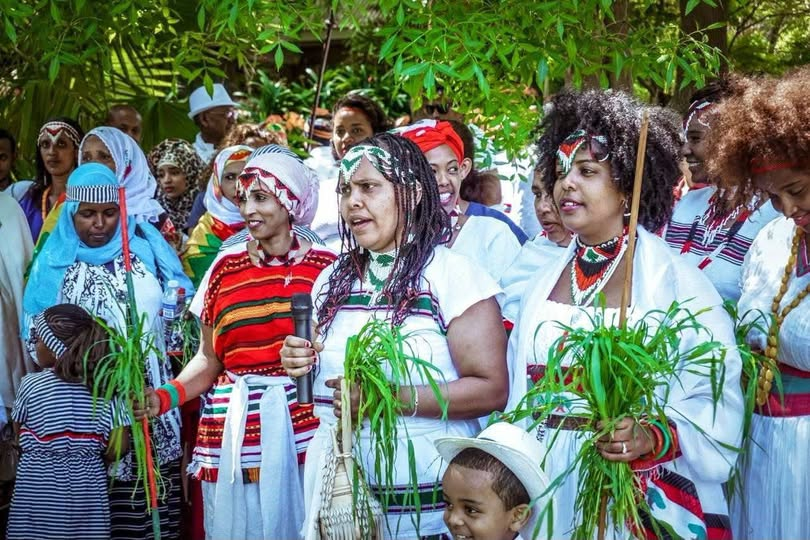
Held annually at the end of September or the beginning of October, Irreechaa is not a quiet affair of private reflection. It is a magnificent, vibrant explosion of life. Thousands, dressed in dazzling traditional attire, converge on sacred rivers, lakes, and hilltops. The air hums with the rhythm of drums, the melodic chants of elders, and the joyous ululations of the crowd. In their hands, they hold the symbols of the season: lush green grass and delicate yellow daisies, emblems of fertility, flourishing life, and the promise of a bountiful year.
The Heart of the Festival: Giving Thanks to Waaqa
At its core, Irreechaa is a dialogue with the divine. The Oromo people lift their prayers to Waaqa (God), offering thanks not for material wealth alone, but for the bedrock of their existence: a good harvest that fills the granaries, the health of their precious livestock, and the most precious gift of all—peace. It is a recognition that survival through the harsh, dark months was not by human effort alone, but by divine mercy.
“We come to the water to wash away our sorrows and our grudges,” explains an elder during a recent ceremony at Lake Hora Arsadi, near Addis Ababa. “The rain has stopped. Now, we cleanse our hearts and start anew.”
A Living Testament to the Gadaa System
Irreechaa is more than a religious observance; it is the vibrant pulse of the Gadaa System, the ancient, indigenous democratic governance structure of the Oromo people. Inscribed by UNESCO as an Intangible Cultural Heritage of Humanity, the Gadaa System organizes society into generations, guiding leadership, law, and morality. Irreechaa serves as a unifying moment for this system, reinforcing the social contracts and spiritual values that hold the community together.
Reconciliation and Unity
In a world often fractured by division, Irreechaa stands as a powerful advocate for unity. The festival is a designated time for reconciliation. It is a communal balm where feuds are set aside, misunderstandings are forgiven, and the bonds of kinship are strengthened. The shared experience of prayer and dance melts away social barriers, weaving a tapestry of harmony that includes not just the Oromo, but neighboring communities as well.
A Cultural Showcase
To witness Irreechaa is to witness the soul of Oromo culture. The hills become a runway of breathtaking fashion, with men and women adorned in intricately woven garments and vibrant beadwork. The music is hypnotic, with traditional songs that speak of heroism, love, and history. The dances are energetic, a physical manifestation of joy and liberation.
As the sun sets on the celebration, the green grass is often placed upon the heads of participants as a blessing, a final act of connection to the earth and the creator. The festival concludes, but its spirit lingers—a reminder that every ending is a new beginning, and that gratitude is the foundation upon which communities are built.
Irreechaa is not just a festival. It is a declaration: We have survived. We are thankful. We are one.
—
Key Aspects of Irreechaa at a Glance:
· Thanksgiving: Central purpose is to thank Waaqa (God) for blessings over the past year.
· End of Winter: Celebrates the conclusion of the rainy season and the dawn of spring (Birraa).
· Sacred Sites: Observed at rivers (Malkaa), lakes, and hilltops (Tulu).
· Symbols of Life: Participants carry wet grass and daisy flowers to represent fertility and flourishing.
· Cultural Expression: A vibrant display of traditional costumes, music, chants, and dances.
· Unity & Peace: A time for community bonding, spiritual reflection, and reconciliation.
· Gadaa System: An integral ritual within the traditional Oromo governance and social structure.

Posted on September 3, 2026, in Aadaa, Afaan, Election, Events, Finfinne, freedom, gadaa, Gumaa, health, Kindness, Language, mental health, News, Oromo diaspora, Oromo truth telling, Press Release, Promotion, Siinqee, Sirna Oromo, Ukee, VMC, Waaqeffannaa. Bookmark the permalink. Leave a comment.






Leave a comment
Comments 0