The Legacy Written in Blood and Bone: Three Historical Moments When Oromos Refused to Be Divided by Religion
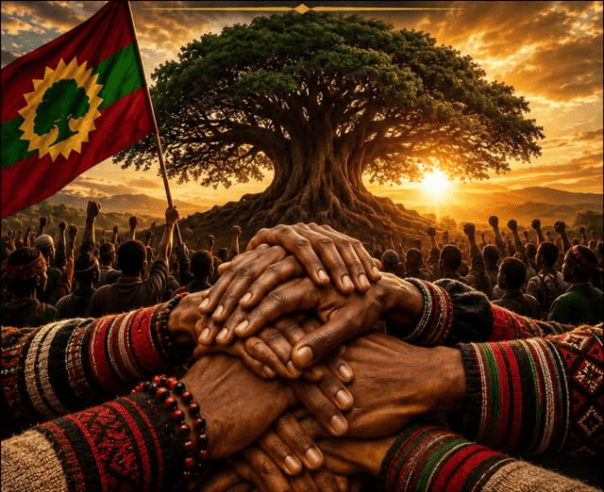
When the executioners thought faith could split them, they chose the same name: Oromo.
In Oromo collective memory, three moments spanning half a century—from 1966 to 2016—are repeatedly told, sung, and etched into stone. They occurred in different eras, different places, with participants from different generations. Yet their inner logic is strikingly identical: whenever external forces tried to tear Oromo unity apart using religious identity, someone always stood up and proved with their life that “Maqaa amantaan gargar hin baanu”—the name is not divided by faith.
From Arsi to Shinnigaa, and then to Bishooftuu, three locations form a blood-red thread, telling the story of how an oppressed people forged “refusal to be divided” into the core of their identity.
Arsi: The Resurrection of a Name
In 1966 Ethiopia, publicly using the word “Oromo” was itself a dangerous provocation. The empire’s narrative machine had erased the name from official discourse, replacing it with derogatory labels. It was precisely in this era that an Islamic scholar named Ahmed Taqi Sheikh Mohammed Rashid made a decision that would change the trajectory of history.
Taqi, later known as “Hundee” (meaning root or foundation), was born into a family of Islamic scholars in Harargee. He studied the Qur’an, Hadith, and Oromo history from childhood. By his early twenties, he was a successful merchant, but what truly defined him was his encounter with General Tadesse Birru, founder of the Macha-Tulama Self-Help Association. After Tadesse was placed under house arrest in Galamsoo, Taqi befriended him and began spreading an idea that was nearly heretical at the time: being Oromo was not a curse but a virtue worth loving.
In 1966, Taqi and Elemo Qiltu—another revolutionary who had returned from Syria—launched an armed struggle in the Guba Koricha mountains. This was the starting point of the modern Oromo national liberation movement. Their organization had no religious threshold, no sectarian conditions. Muslim scholars and Christian warriors fought under the same banner.
On September 6, 1974, Taqi and Elemo were executed in Hirroo. But the resurrection of a name had already become irreversible. The singer Ali Birra, with the help of Abubakar Musa, set Taqi’s memory to music in “Yaa Hundee Bareedaa” (Beautiful Hundee). The song played on radio, was sung at weddings, and hummed at funerals. Taqi’s “root” sank into the deepest layers of Oromo mass consciousness—a consciousness shared by Muslims, Christians, and Waaqeffataa alike.
Shinnigaa: Refusing to Separate at the Edge of the Pit
If 1966 planted the seed, then 1980 was its most tragic flowering.
On April 15, 1980, eleven top leaders of the Oromo Liberation Front were ambushed by Somali militia in Shinnigaa (located in the Ogaden region). This was not a chance encounter—they were captured alive. The militia dug a large pit, then did what they thought was the most lethal thing: they classified the prisoners by religion.
“You see,” a commander reportedly told the bound prisoners, “you fought together. But you will die separately. Let each one pray to his own god before falling into the pit.”
The executioners expected fear. They expected a scramble for last rites. They expected a tiny fracture that would prove the Oromo cause was nothing but a lie.
The answer they received came from Jar Magarsa Bari, then chairman of the OLF. He did not ask for a priest, did not ask for a Sheikh. He turned to his comrades and spoke the words that would later be repeated countless times:
“Maqaa amantaan gargar hin baanu. We do not divide the name by religion. Dig the pit wider, or throw us in together. We are Oromo first.”
Eleven men—Chairman Barisoo Wabee, Vice Chairman Gadaa Gamada, Abbaa Shikii, Dori Bari, Farmata, Fafam Doyo, Ilana Kachale, Dhadhacho Boruu, Dhadhacho Murata, Mari Galaan—arms bound together, stepped forward. According to Oromo oral tradition, Gadaa Gamada turned to the executioners and smiled: “You want to see us pray? Watch this.”
This day was written into history. Not as a massacre, but as an oath.
Bishooftuu: Another Generation’s Choice
Thirty-six years later, the same scene played out with almost identical logic.
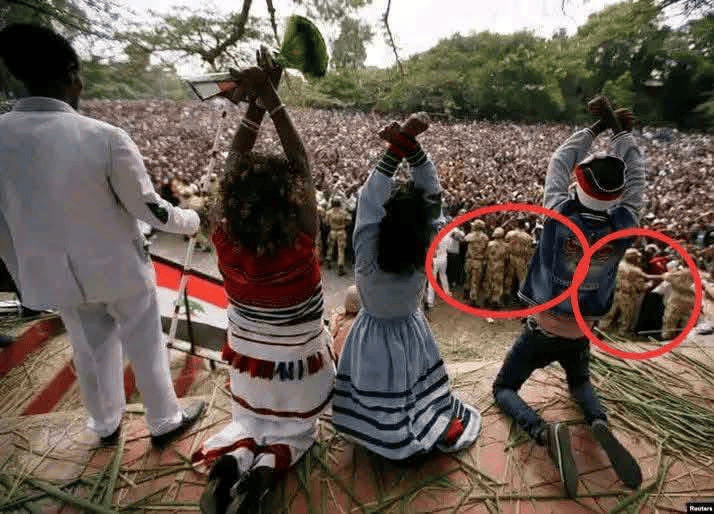
2016, Bishooftuu-Harsadi. A new wave of Oromo protests was sweeping across the region, triggered by the so-called “Addis Ababa and Surrounding Oromia Master Plan”—a plan widely seen as an attempt to annex Oromo land. Young activists known as “Qeerroo” confronted security forces in city streets and rural roads.
In Bishooftuu, a group of Oromo youth were surrounded. According to circulated accounts, security forces once again tried to exploit religious identity—separating Muslims from Christians, persuading some to deny their Oromo identity in exchange for their lives. The result was refusal once again.
They died together, buried in the same place. Their names were repeatedly invoked by Oromo social media, poetry, and song. They became “utubaa eenyummaa”—pillars of identity.
Oromo activists framed this event as “dying for Oromo identity, refusing to be divided by religion.” The words spoken at Shinnigaa thirty-six years earlier were re-spoken with bodies by a new generation at Bishooftuu.
Why This Matters
These three events—Arsi, Shinnigaa, Bishooftuu—form a clear pattern. Religion is indeed a real line of difference within Oromo society. Arsi Oromos are predominantly Muslim, partly because in the nineteenth century they chose Islam as a cultural fortress against Amhara Orthodox colonial conquest. The Orthodox Church’s role in Oromo territories was tightly bound to conquest: priests arrived alongside Menelik’s generals, “blessed” massacres, and then received land and serfs. Thus religious difference in Oromo society is not a small matter—it carries the full weight of colonial violence history.
Precisely because of this, external forces repeatedly tried to exploit this fracture. The Somali militia of 1980 tried. The security forces of 2016 tried. Each time, they lost.
But the reason they lost is not that religious differences didn’t exist. The reason is that Oromo nationalism, in its most decisive figures, developed a priority that transcends religion: We are Oromo first. This is not a denial of faith but an insistence on order. When the core logic of oppression is the denial of your very existence, any internal division that makes that oppression more effective is betrayal.
The eleven at Shinnigaa did not become “Muslim martyrs” and “Christian martyrs.” They became one thing: Oromo martyrs. The youth of Bishooftuu likewise.
“Seenaa keenya keessatti barayyuu cululuqee jiraata”
Those who wanted to bury them failed to understand one fundamental thing: a people who refuse to be divided have found something stronger than death. The pit at Shinnigaa did not end Oromo unity—it became a monument to unity. The repetition at Bishooftuu did not prove that history repeats—it proved that memory endures.
From the moment Taqi and Elemo raised weapons in 1966, to the afternoon of 1980 when eleven men walked arm-in-arm to the edge of the pit, to the streets of Bishooftuu in 2016, what runs through it all is not an abstract slogan but a concrete, testable promise: When others try to kill you using the differences within you, you choose to define yourself by what you share.
This choice has been remembered. Has been sung. Has been re-lived with life after life by generation after generation.
“Seenaa keenya keessatti barayyuu cululuqee jiraata”—in our history, it lives forever, shining.

Posted on September 29, 2026, in Aadaa, Afaan, AMES, AOD, AU, Bokkkuu, Daaniyaa, Diaspora, Events, Face of Injustice, family violence, Finfinne, freedom, gadaa, gender, Gumaa, health, Information, Irreechaa, Kindness, Language, Media, News, Oromia, Oromo diaspora, Press Release, Promotion. Bookmark the permalink. Leave a comment.






Leave a comment
Comments 0