Daily Archives: November 21, 2026

Beyond Borders, Toward Peace: Oromo Studies Association Announces Landmark 2027 Mid-Year Conference
By Dhabessa Wakjira
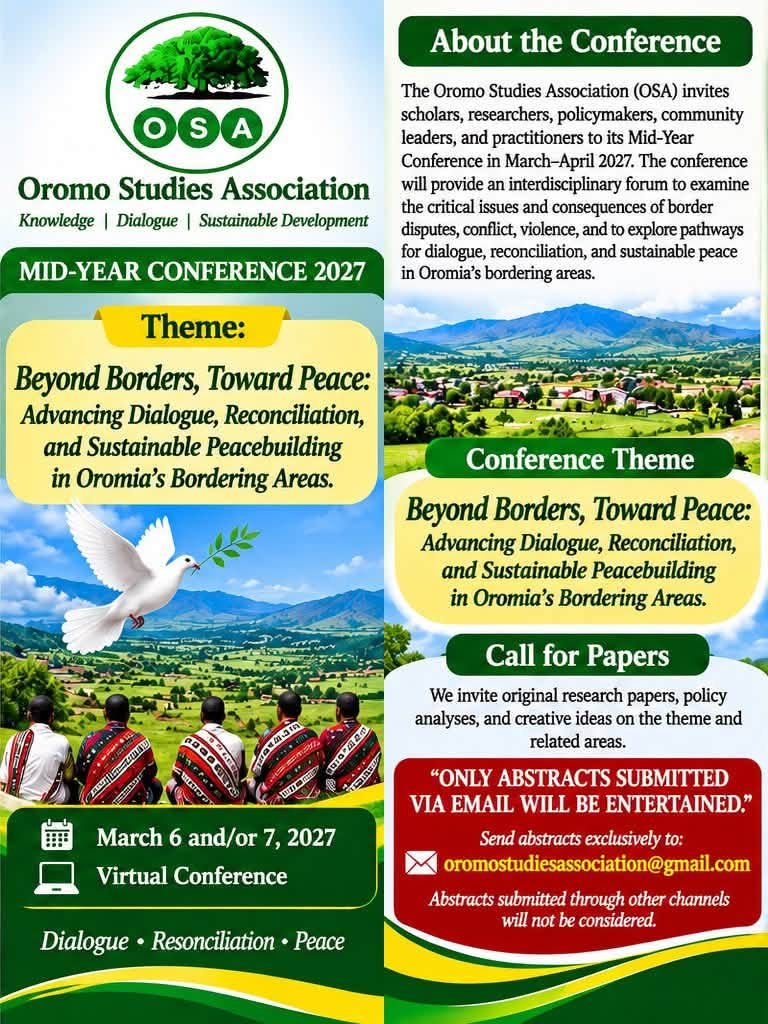
In a world often divided by lines on a map, the pursuit of lasting harmony requires looking beyond traditional boundaries. Recognizing the urgent need for dialogue and reconciliation, the Oromo Studies Association (OSA) has announced its highly anticipated Mid-Year Conference 2027.
Under the poignant theme, “Beyond Borders, Toward Peace: Advancing Dialogue, Reconciliation, and Sustainable Peacebuilding in Oromia’s Bordering Areas,” the virtual conference is set to take place on March 6 and 7, 2027.
The event promises to serve as a vital interdisciplinary forum, bringing together scholars, researchers, policymakers, community leaders, and practitioners from around the globe to tackle some of the most pressing issues facing the region today.
A Focus on the Margins
While much attention is often paid to central political hubs, the OSA is shining a spotlight on the critical—and often volatile—border regions of Oromia. The conference aims to deeply examine the multifaceted dimensions of border disputes, conflict, and violence that have historically plagued these areas.
More importantly, it is designed as a platform for solutions. By promoting research-based solutions and policy options, the OSA hopes to strengthen dialogue among diverse stakeholders and advance sustainable peace and development. The conference will delve into critical issues ranging from human security and the rule of law to the vital role of natural resources and environmental sustainability in community resilience.
A Call for Scholarly Action
The path to peace requires innovative thought and rigorous analysis. To that end, the OSA has officially opened its Call for Papers, inviting original research, policy analyses, and creative ideas that align with the conference theme.
The organizers have outlined several suggested thematic areas for participants to explore, including:
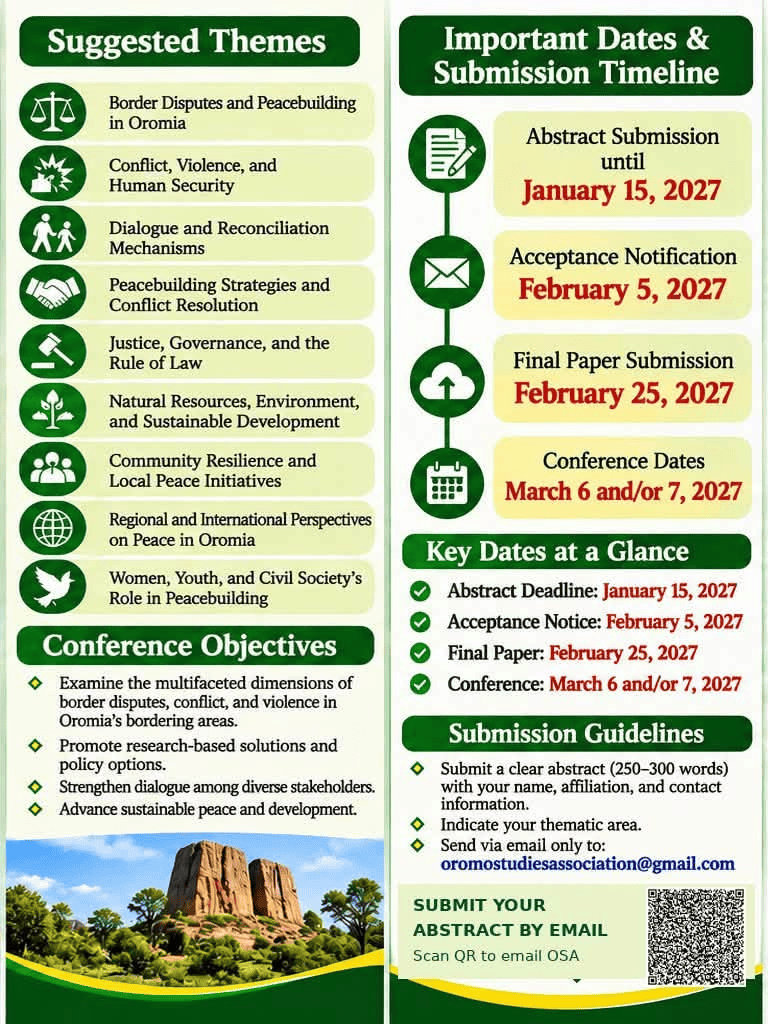
· Border Disputes and Peacebuilding in Oromia
· Conflict, Violence, and Human Security
· Dialogue and Reconciliation Mechanisms
· Justice, Governance, and the Rule of Law
· The role of Women, Youth, and Civil Society in Peacebuilding
Potential contributors must adhere to strict guidelines. Abstracts should be between 250 and 300 words, accompanied by the author’s name, affiliation, and contact information, and must clearly indicate their chosen thematic area.
Important Note for Participants: The OSA has emphasized that only abstracts submitted via email will be entertained. Submissions sent through other channels will not be considered. All abstracts must be sent directly to oromostudiesassociation@gmail.com.
Mark Your Calendars
For those looking to be part of this crucial conversation, the OSA has laid out a clear timeline for the 2027 conference:
· Abstract Submission Deadline: January 15, 2027
· Acceptance Notification: February 5, 2027
· Final Paper Submission: February 25, 2027
· Virtual Conference Dates: March 6 and/or 7, 2027
Knowledge, Dialogue, Sustainable Development
The OSA’s logo features a robust, expansive tree—a fitting symbol for an organization whose motto is “Knowledge | Dialogue | Sustainable Development.” Like a tree putting down deep roots to withstand the storms, the association believes that a foundation built on scholarly dialogue and reconciliation is the only way to secure a sustainable, peaceful future for Oromia’s bordering communities.
As the 2027 Mid-Year Conference approaches, the OSA is extending an open invitation to all who believe that even the most entrenched borders can be crossed through the power of dialogue. For those ready to contribute to this vital mission, the time to act is now. Submit your abstract, mark your calendar, and join the movement toward a peaceful tomorrow.

The 60-Year Struggle: A Legacy of Identity, Resilience, and Unyielding Light
By Bona Oromia
“What did 60 years of struggle bring?” It is a question often asked by those who fail to see the bigger picture. But for those who understand the depths of history, the answer is clear: it brought the Oromo identity and history out of the shadows and into the brilliant light.
Looking at the trajectory of this decades-long journey, it becomes evident that the struggle was never just about counting years; it was about ensuring the very survival and dignity of a people. The results are monumental, profound, and visible to anyone with eyes to see.
Shattering the Narrow Mindset
The seeds of this journey were sown through a calculated conspiracy aimed at erasing a legacy. Yet, that sinister plot failed to obscure the truth. Instead, the relentless pursuit of justice forced a reckoning. It compelled the world to acknowledge Oromo history and identity, effectively widening a historically narrow mindset that had tried to suppress it.
The struggle did more than just challenge ideas; it dismantled the very foundations of an oppressive old system. It dismantled the structural inequalities, including the deeply flawed land tenure systems that had long bound the people, replacing subjugation with a fierce assertion of rights.
Beyond the Calendar: Measuring by Impact
There are critics and skeptics who attempt to measure the movement solely by the passage of time. They ask what 60 years have yielded. But the true measure of this struggle cannot be found in a calendar; it must be measured by its results.
The most significant achievement is the transformation of the Oromo identity from a marginalized concept into a vibrant, undeniable reality. The struggle has effectively brought the Oromo story from the dark corners of suppression into the national and global spotlight.
For those who have the vision to see it, this is a matter of profound significance. The outcome of this 60-year journey is nothing less than the guarantee of existence itself—the preservation of identity, culture, and self-worth.
The Struggle Continues
Despite the incredible milestones achieved, the journey is far from over. The struggle has not ended; rather, it has evolved. It is a continuous process of safeguarding the gains made and pushing forward for a brighter future.
The message to the people remains clear and resolute: Do not count the years, but keep the work going. The fight for identity and existence requires unwavering dedication. It is a call to defend the light that has been brought forth.
The skeptics may continue to ask their questions, but the answer is written in the resilience of the people. The past 60 years proved that no conspiracy can extinguish the truth. And as the work continues, the triumph of identity remains a testament to the power of an unbreakable spirit.
Let the work continue. Measure it by its impact. And no matter how heavy the burden, carry it forward.






