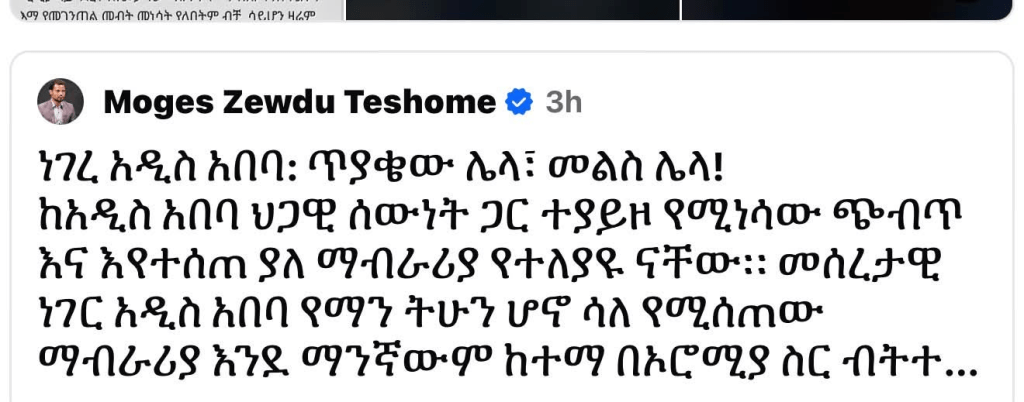
Finfinne and the Question of Historical Recognition: A Response to Moges Zewudu Teshome
Acknowledging History, Guaranteeing Citizenship, and Building a Foundation for Coexistence
By Iyasu Enoro
The debate surrounding Finfinne—the city known internationally as Addis Ababa—has long been characterized by competing narratives, political posturing, and deep-seated fears. In a recent contribution to this discourse, Moges Zewudu Teshome raised important concerns about the implications of recognizing Oromia’s connection to the capital. He argues that the central issue is not administration but the fear that Finfinne could be placed under the exclusive control of one ethnic group. He further suggests that linking Finfinne to Oromia would expose millions of residents to exclusion and discrimination.
While these concerns deserve serious discussion and should not be dismissed lightly, they do not adequately address the historical question at the centre of the debate. This response seeks to engage with Moges Zewudu Teshome’s arguments constructively while offering a broader perspective on the historical, constitutional, and practical dimensions of the Finfinne question.
The Core Issue: Historical Recognition, Not Ethnic Ownership
The first and most fundamental issue is that the discussion about Finfinne is fundamentally a question of historical recognition, not ethnic ownership. Oromo claims regarding Finfinne do not arise from the belief that only Oromo people should live in the city. Rather, they stem from the historical fact that the area known as Finfinne existed before the establishment of the city and was inhabited by Oromo communities.
Historical accounts recognize that the region was known as Finfinne—a name meaning “place of hot springs”—and that Oromo clans lived there before Menelik II established the city in 1886. This is not a matter of political convenience; it is a matter of documented historical fact.
Therefore, acknowledging Finfinne’s Oromo heritage is not equivalent to demanding the expulsion, marginalization, or disenfranchisement of non-Oromo residents. The recognition of indigenous history should not be confused with ethnic exclusivity. Just as the recognition of Māori heritage in New Zealand does not require the exclusion of non-Māori New Zealanders, the recognition of Oromo heritage in Finfinne does not require the exclusion of non-Oromo residents.
The question is not whether Finfinne belongs exclusively to any one group. The question is whether the city’s history and heritage will be acknowledged, respected, and integrated into its governance framework.
The International Precedent: Indigenous Recognition as a Foundation for Coexistence
The argument that any stronger relationship between Finfinne and Oromia inevitably leads to oppression requires examination. Around the world, indigenous peoples seek recognition of their connection to ancestral territories without necessarily seeking exclusive political control over those territories.
- In Australia, the High Court’s landmark Mabo decision rejected the doctrine of terra nullius and recognized Native Title rights. Indigenous Australians gained legal recognition of their ancestral connection to land without affecting the equal civil and political rights of other Australians.
- In New Zealand, the Treaty of Waitangi provides a foundation for protecting Māori rights, culture, and claims to ancestral lands while ensuring equal citizenship for all New Zealanders.
- In Canada, First Nations, Inuit, and Métis peoples possess constitutionally recognized indigenous rights. Land claims agreements and self-government arrangements acknowledge historical connections to traditional territories while cities and communities remain open to residents of all backgrounds.
- In the United States, Native American tribes retain certain rights related to self-government, culture, and ancestral territories. These rights coexist with the citizenship rights of all residents.
These examples demonstrate a common international principle: recognizing indigenous peoples’ historical and ancestral connections to land does not require denying democratic, civil, or human rights to other residents. Rather, both sets of rights can coexist.
The question then becomes: Why is acknowledging the Oromo historical connection to Finfinne often interpreted as a threat, while acknowledging the historical connection of other peoples to their ancestral lands is viewed as legitimate?
The Historical Grievances: More Than Administrative Boundaries
The response to Oromo claims regarding Finfinne often avoids the historical grievances associated with the city’s formation. For many Oromos, the debate is not simply about administrative boundaries but about the legacy of nineteenth-century state expansion, land dispossession, and cultural marginalization.
The establishment of Finfinne under Menelik II was accompanied by the displacement of Oromo communities from their ancestral lands, the confiscation of Oromo property, and the systematic erasure of Oromo identity. This history is not a distant memory; it is a living reality that has shaped the relationship between the Oromo people and the Ethiopian state for over a century.
Ignoring these concerns and portraying the discussion solely as a future governance issue risks repeating a pattern in which indigenous historical claims are dismissed rather than engaged. A genuine dialogue about Finfinne must acknowledge this history and address the grievances it has created.
Governance Failures Do Not Invalidate Historical Claims
Citing failures of governance or ethnic violence elsewhere in Oromia does not invalidate the historical relationship between Finfinne and Oromia. Historical facts do not become less valid because contemporary political institutions are imperfect.
If there are governance failures, those failures should be addressed directly through constitutional reform, rule of law, and democratic accountability. They should not be used to deny the historical identity of a place. To argue that recognizing Oromo heritage in Finfinne is dangerous because of governance failures in other parts of Oromia is to confuse the issue. The problem of poor governance exists regardless of Finfinne’s status, and it must be addressed on its own terms.
The Constitutional Dimension: A Special Interest Already Recognized
The Ethiopian constitution itself recognizes a special interest of Oromia in Finfinne because of the city’s location within Oromia and its relationship to the surrounding region. Article 49(5) of the Constitution affirms Oromia’s special interest in Finfinne concerning social services, natural resources, and joint administrative matters arising from the city’s location within the State of Oromia.
The existence of this constitutional provision demonstrates that the relationship between Finfinne and Oromia is not an invented political claim, but a matter already recognized within Ethiopia’s legal framework. The Constitution does not grant Oromia exclusive ownership or control over the capital. Rather, it acknowledges a practical and historical reality: the city is located within Oromia, and its functioning depends on resources, infrastructure, and cooperation from surrounding Oromo communities.
The question is not whether the Constitution recognizes a relationship between Finfinne and Oromia. The question is how that relationship should be implemented in practice.
A False Choice: Oromia Versus Ethiopia
The fear that recognizing Finfinne’s history automatically means surrendering the city to ethnic domination creates a false choice. The debate should not be framed as “Oromia versus Ethiopia.” Rather, it should be framed as how Ethiopia can acknowledge historical realities while guaranteeing equal citizenship, democratic governance, and dignity for all who call Finfinne home.
The real challenge facing Ethiopia is not choosing between Oromo rights and Ethiopian citizenship. It is finding a political framework that can accommodate both. Recognition of Finfinne’s Oromo heritage and protection of the rights of all Finfinne residents are not mutually exclusive goals. In fact, a durable solution will likely require both.
A sustainable future for Finfinne requires acknowledging several truths simultaneously:
- Finfinne is Ethiopia’s capital and belongs to all its residents. The city’s diverse population—Oromo, Amhara, Gurage, Tigrayan, Somali, and others—all have a stake in its future.
- Finfinnee has deep historical and cultural ties to the Oromo people. This heritage must be acknowledged and respected, not denied or erased.
- Oromo culture continues to enrich the city’s identity and development. The city is stronger for its diversity, and the contributions of all communities should be celebrated.
- Finfinne’s expansion directly affects neighboring Oromo communities. Their voices must be heard in decisions that affect their lives.
- Oromia possesses constitutionally recognized interests in matters concerning the city. These interests must be implemented through joint administrative mechanisms and cooperative governance.
- Development should benefit affected communities rather than marginalize them. Fair compensation, consultation, and participation are essential.
The Path Forward: A Framework for Coexistence
The path forward is not ownership, exclusion, or historical denial. It is partnership built on constitutional respect, cultural recognition, economic fairness, and genuine cooperation.
Such a framework would include:
- Implementation of Constitutional Provisions: Oromia’s special interest in Finfinne, as recognized in Article 49(5), should be implemented through joint administrative mechanisms that ensure meaningful Oromo participation in decisions affecting the city and surrounding communities.
- Cultural Recognition: The Oromo heritage of Finfinnee should be acknowledged through cultural institutions, public recognition, and educational programs that celebrate the city’s diverse history.
- Fair Development: Urban expansion should be planned with meaningful consultation with affected communities, ensuring fair compensation, environmental protection, and shared benefits.
- Inclusive Governance: All residents of Finfinne—regardless of ethnicity—should have equal rights to participation, public services, and legal protection.
- Shared Prosperity: The economic benefits of the capital’s growth should be shared with surrounding communities, creating a virtuous cycle of development rather than a pattern of exploitation.
Conclusion: Honoring History, Building the Future
The Finfinne question will not be resolved through confrontation or denial. It will be resolved through honest acknowledgment of history, respect for constitutional principles, and a shared commitment to building a future where all Ethiopians—Oromo and non-Oromo alike—can live with dignity, security, and hope.
Finfinne is for all Ethiopians.
Finfinnee is Oromo heritage.
The future is shared.
The recognition of Finfinne’s Oromo heritage and the protection of the rights of all Finfinne residents are not mutually exclusive goals. They are complementary pillars of a just and sustainable future.
Acknowledging history does not mean surrendering the city to ethnic domination. It means building a foundation of trust, understanding, and coexistence that can sustain Ethiopia for generations to come.
Finfinne haa jabaattu!
Oromia fi Finfinne walitti haa qabatan!
Nagaan haa bulaa!
This feature article is a response to Moges Zewudu Teshome and is dedicated to all those who are committed to finding a just, constitutional, and sustainable solution to the question of Finfinne.

Posted on August 11, 2026, in Aadaa, Afaan, Election, Events, Face of Injustice, freedom, gadaa, gender, health, Information, Kindness, Language, Media, mental health, News, Oromia, Press Release, Promotion. Bookmark the permalink. Leave a comment.






Leave a comment
Comments 0