Daily Archives: November 28, 2026

The Oromo Identity Trap: When Patriotism Becomes a Loyalty Test
By Hona Oromia
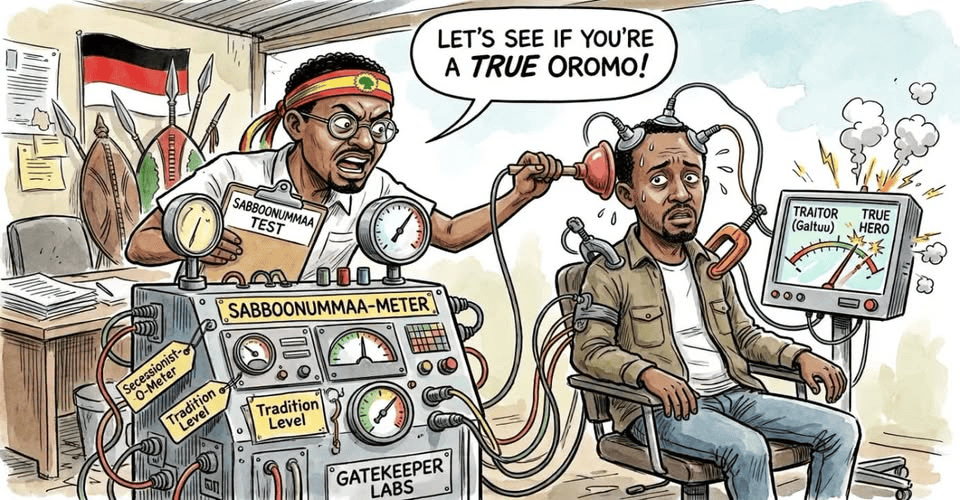
Addis Ababa — The cartoon is deliberately absurd: a stern-faced examiner in an Oromo liberation cap straps a nervous man into a chair, wires trailing from his skull to a clanking machine labeled “Sabboonummaa-Meter.” A dial swings between “Traitor (Galhuu)” and “True Hero.” The examiner leans in with a microphone: “Let’s see if you’re a TRUE Oromo!”
The image, which opens a provocative new academic paper by Sultan Abda Neja (Ph.D.), captures what the author calls “the paradox of Sabboonummaa”—a moment in Oromo political history when the very identity meant to unite the community is being used to divide it.
A Movement at a Crossroads
For generations, the Oromo national struggle has confronted political marginalization, cultural suppression, and economic inequality. Out of that history emerged two powerful concepts: Oromummaa, the shared cultural and historical consciousness of the Oromo people, and sabboonummaa, a form of national patriotism and pride.
Both have been indispensable. They restored cultural confidence, mobilized communities, and helped transform Ethiopia’s political landscape, particularly through the ethnic federalism introduced after 1991.
But Neja’s paper, The Paradox of Sabboonummaa: When Identity Becomes a Litmus Test for Oromo Governance, argues that these same concepts have quietly morphed into something else: ideological gatekeeping tools.
“The problem arises when one political perspective claims exclusive ownership of Oromummaa and sabboonummaa and uses these concepts to question the authenticity, patriotism, or political legitimacy of those who disagree,” Neja writes.
The Divide Over Oromia’s Future
At the heart of the tension is a fundamental question: What should Oromia’s political future look like?
Some Oromo political organizations, including the OLF and the Oromo Liberation Army (OLA), advocate for an independent Oromia, arguing that genuine self-determination requires sovereignty outside the Ethiopian state. Others—such as the Oromo Federalist Congress (OFC)—pursue constitutional federalism and genuine self-rule within a democratized Ethiopia. Still others, including Oromo politicians within the governing Prosperity Party (PP), support a united Ethiopia with varying degrees of federal autonomy.
These are legitimate ideological disagreements, Neja argues. The danger lies in what happens when they are reframed as questions of ethnic authenticity.
“When political actors divide Oromos into categories such as genuine progressive patriots and collaborators, or authentic nationalists and politically assimilated individuals, they transform ideological disagreement into a judgment about personal and collective identity,” the paper states.
The Prosperity Party Test Case
The paper singles out the treatment of Prime Minister Abiy Ahmed and other Oromo figures in the Prosperity Party as a particularly telling example. Some critics, Neja notes, portray these leaders as extensions of historical imperial structures and question their Oromo patriotism because they do not advocate for independence.
“There is, of course, nothing wrong with criticizing the policies of the Prosperity Party,” Neja writes. “However, there is a fundamental difference between criticizing a government for its political actions and dismissing the cultural identity or patriotism of its leaders.”
The author proposes a simple but challenging standard: political leaders should be evaluated on governance, human rights records, accountability, and public service—not on their ethnic identity or their stance on secession.
“A political leader supporting a united Ethiopia does not automatically make that individual less Oromo,” he writes. “Similarly, the fact that a political leader is Oromo does not automatically make their government democratic, accountable, or beneficial to Oromo society.”
The Cost of Exclusion
The consequences of identity-based delegitimization, Neja argues, are both practical and moral.
Practically, it weakens coalition-building. If opposition movements treat all Prosperity Party supporters—civil servants, security personnel, community leaders, ordinary citizens—as culturally compromised, they alienate a substantial segment of the Oromo population whose participation would be necessary for meaningful political change.
“A political movement cannot sustainably unite a population by first telling a substantial portion of that population that its members are insufficiently Oromo to belong to the political community,” the paper warns.
Morally, it reproduces the very exclusion the Oromo struggle has historically opposed. Neja draws on the Gadaa system—the indigenous Oromo governance tradition studied by anthropologist Asmarom Legesse—which emphasizes collective deliberation, accountability of leaders, and consensus-building rather than unconditional loyalty.
“If Oromummaa is understood as encompassing the ethical and cultural heritage of the Oromo people, its political application should not contradict the inclusive and deliberative values associated with these traditions,” he writes.
A Question of Belonging
The paper also examines the slogan sometimes heard in Oromo political discourse: “Sabboonummaan Oromoo Mootummaa Ijaaruu Qaba”—roughly, “Oromo patriotism should build an Oromo government.” Neja asks what this actually means in a multinational federal state. Does it refer to an accountable government protecting Oromo rights, or an ethnically exclusive authority? How would non-Oromo communities living in Oromia be protected?
“These questions require substantive political answers rather than accusations about who possesses sufficient sabboonummaa,” he writes.
The solution, Neja proposes, is not to abandon Oromummaa or sabboonummaa but to reclaim them as inclusive, shared inheritance rather than partisan property. He outlines five principles: cultural identity should be independent of partisan affiliation; political disagreement should be treated as legitimate democratic competition; patriotism should be demonstrated through public responsibility; no political organization should claim exclusive ownership of Oromo national interests; and Oromo emancipation should be compatible with peaceful coexistence.
The Path Forward
The paper’s recommendations are directed at Oromo political organizations, intellectuals, activists, and community leaders: separate Oromummaa from partisan ideology, promote pluralism, replace identity-based accusations with evidence-based criticism, and establish dialogue spaces among the OLF, OFC, Prosperity Party, and civil society.
“The Oromo national struggle will become stronger not when all Oromos are forced to think alike,” Neja concludes, “but when they can disagree politically without questioning one another’s identity, dignity, and right to belong.”
In a region where identity has long been both a source of strength and a flashpoint of conflict, that may be the most radical proposition of all.