Category Archives: Obituary

Oromo Federalist Congress (OFC) Mourns the Passing of Iconic Artist and Cultural Symbol Ilfinash Qannoo
FEATURE CONDOLENCE NEWS
Oromo Federalist Congress (OFC) Mourns the Passing of Iconic Artist and Cultural Symbol Ilfinash Qannoo
A Nation in Mourning: The Voice of a Generation Falls Silent
Finfinnee, Oromia – Qaammee 2, 2018 (E.C.)
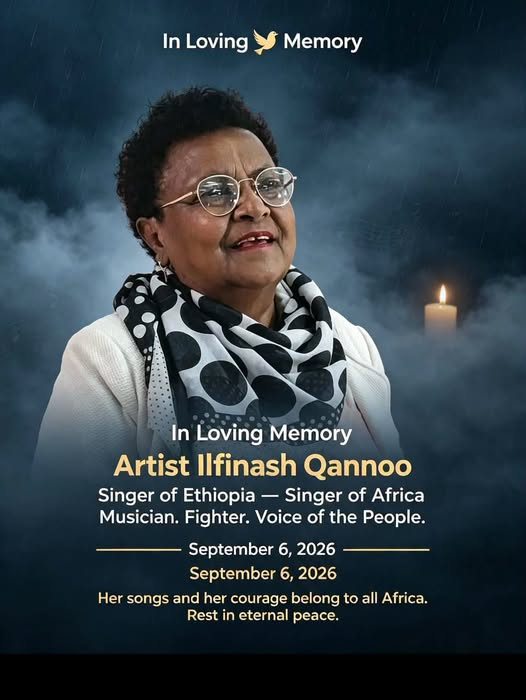
The Oromo Federalist Congress (OFC/KFO) has announced with profound sorrow, heartbreak, and overwhelming grief the passing of beloved Oromo artist, cultural icon, and lifelong justice advocate – Artist Ilfinash Qannoo.
Her departure marks the end of an era in Oromo music, culture, and political consciousness. She was not merely an entertainer; she was the musical embodiment of a people’s struggle – a woman whose voice became the anthem of the oppressed and whose lyrics carried the weight of a nation’s dreams.
From Naqamtee to National Icon: The Journey of a Heroine
Born and raised in the historic city of Naqamtee, Western Oromia, Ilfinash Qannoo emerged from humble beginnings to become one of the most recognizable and beloved figures in Oromo cultural history. Her early life in the heart of Oromia shaped her deep connection to her people, their traditions, and their aspirations.
But Ilfinash was never content to be merely a performer. She understood from a young age that art could be a weapon – a tool for awakening consciousness, exposing injustice, and mobilizing the masses. Her songs transcended entertainment; they became historical documents that chronicled decades of political repression, marginalization, and the enduring hope for democracy in Oromia.
The Power of Her Voice: Lyrics That Shook Empires
Throughout her illustrious career, Ilfinash Qannoo’s powerful voice challenged regimes, dictators, and prolonged systems of oppression. Her protest songs became the foundation of Oromo political awakening – each melody carrying the pain of a people, each lyric demanding accountability from those in power.
Her music captured:
- The suffering of generations under oppressive rule
- The resilience of the Oromo people in the face of adversity
- The dream of a democratic and just society
- The call for unity, equality, and fundamental human rights
Though she faced imprisonment, torture, and exile for her convictions, her voice never wavered. Even today, her songs echo across Oromia and the global Oromo diaspora – a testament to a legacy that death cannot silence.
The Final Chapter: Returning Home
In her final days, Ilfinash Qannoo had returned to her beloved homeland – a poignant homecoming that filled her with joy despite her failing health. She was receiving medical treatment at a hospital when, on Qaammee 1, 2018 (E.C.), she succumbed to illness and departed from this world.
Her passing has left an unfillable void in the hearts of millions. The Oromo nation has lost not only a cultural treasure but a moral compass – a woman who dedicated her entire life to the pursuit of justice, unity, and freedom for her people.
A Message of Unity That Endures
Yet, even in death, Ilfinash Qannoo continues to inspire. The message of national unity that she carried throughout her life remains etched in the hearts of the Oromo people. Her final gift to the nation was not sadness but strength – the knowledge that while her physical form may depart, the seeds of unity, resilience, and love for freedom she planted in the hearts of millions will continue to grow and flourish.
As the Oromo Federalist Congress (OFC) observed in its official statement:
“Qaamaan nu biraa haa godaantu malee, sanyiin tokkummaa, cichoomina fi jaalala bilisummaa isheen onnee Oromoota miiliyoonaan lakkaa’aman keessatti facaafte dagaaguu isaa itti fufa.”
(“Though her physical body may depart, the seeds of unity, resilience, and love for freedom that she scattered in the hearts of millions of Oromos will continue to grow.”)
OFC’s Official Condolence and Call to Action
The Oromo Federalist Congress (OFC) extends its deepest and most heartfelt condolences to:
- The family and relatives of Ilfinash Qannoo
- Her friends and close associates
- Her fellow artists and collaborators
- The entire Oromo community across Ethiopia and the global diaspora
In its statement, the OFC has issued a powerful call to the Oromo people: to honor Ilfinash Qannoo’s memory by upholding the very principles she championed throughout her lifetime – principles that include:
| Principle | Meaning in Action |
|---|---|
| Unity | Standing together as one nation, transcending divisions |
| Equality | Demanding justice and equal rights for all |
| Democracy | Continuing the struggle for fundamental freedoms |
| Cultural Pride | Preserving and celebrating Oromo identity and heritage |
The OFC emphasized that the greatest tribute the Oromo people can pay to this fallen heroine is to continue the struggle she so passionately sang about – ensuring that her sacrifice and the sacrifices of countless others are not in vain.
A Final Prayer
The Oromo Federalist Congress concludes its statement with a solemn prayer and tribute:
“Waaqayyo maatiifi firoottan isheef jajjabina haa kennu, lubbuu ishees nagaa bara baraan haa qananiisu.”
(“May the Almighty grant her family and loved ones strength, and may her soul rest in eternal peace.”)
Legacy That Transcends Death
Ilfinash Qannoo’s legacy is secure. She will be remembered not only as a gifted artist but as a courageous freedom fighter, a proud symbol of Oromo identity, and a voice that refused to be silenced. Her songs will continue to inspire future generations of Oromo youth to:
- Preserve their culture
- Stand firm in their identity
- Fight courageously for their rights
- Dream boldly of a free and just Oromia
About the Oromo Federalist Congress (OFC/KFO)
The Oromo Federalist Congress (Koongirasiin Federaalawaa Oromoo – KFO) is a political organization committed to advancing the rights, unity, and self-determination of the Oromo people within a federal democratic framework. The OFC mourns the loss of Ilfinash Qannoo as a profound tragedy for the entire Oromo nation and all who cherish justice and freedom.
Issued by:
Oromo Federalist Congress (OFC/KFO)
Qaammee 2, 2018 (E.C.)
Finfinnee, Oromia, Ethiopia
In Memoriam
| Name: | Artist Ilfinash Qannoo |
| Birthplace: | Naqamtee, Western Oromia |
| Legacy: | Cultural Icon, Freedom Fighter, Voice of the Oppressed |
| Contribution: | Over 10 albums, decades of resistance music |
| Cause: | Justice, Unity, Democracy, Oromo Liberation |
| Resting: | In the hearts of millions |
“Sirboonni ishee hin duune. Sagaleen ishee hin dadhabne. Hafuura ishee waliin Oromoo hunda wajjin deema.”
“Her songs shall not die. Her voice shall not fade. Her spirit walks with every Oromo.”
#IlfinashQannoo #OFC #KFO #OromoUnity #CulturalHero #JusticeForOromia #LegacyLives #RestInPower

On the Passing of Artist Ilfinash Qannoo – Beloved Cultural Icon and Symbol of Oromo Resistance

The official press release from the Oromo Federalist Congress (OFC/KFO) regarding the passing of Artist Ilfinash Qannoo:
OFFICIAL FEATURE STATEMENT
On the Passing of Artist Ilfinash Qannoo – Beloved Cultural Icon and Symbol of Oromo Resistance
Issued by the Oromo Federalist Congress (OFC/KFO)
Qaammee 2, 2018 (E.C.) | Finfinnee, Oromia, Ethiopia
A Profound Loss to the Oromo Nation
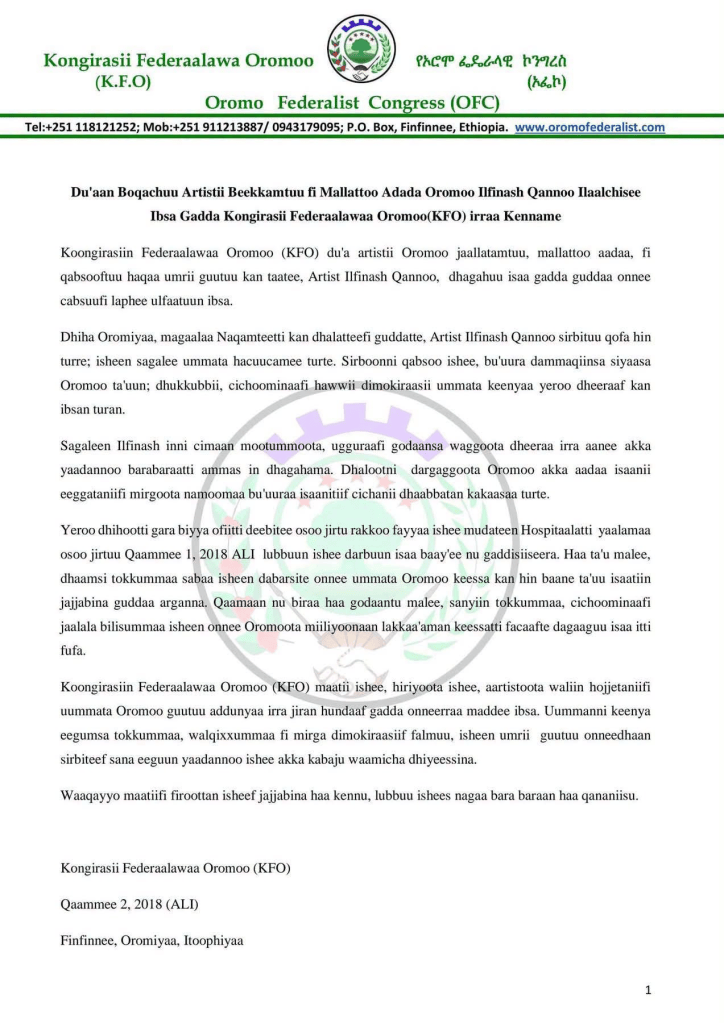
The Oromo Federalist Congress (OFC/KFO) received with deep sorrow, profound heartbreak, and heavy grief the news of the passing of the beloved Oromo artist, cultural emblem, and lifelong advocate for justice – Artist Ilfinash Qannoo.
Born and raised in Naqamtee, Western Oromia, Ilfinash Qannoo was never merely a performer. She was the voice of a silenced people. Her protest songs became the very foundation of Oromo political awakening – lyrics that for decades spoke unflinchingly of oppression, marginalization, and the long-cherished dream of democracy for our people.
A Voice That Would Not Be Silenced
The powerful voice of Ilfinash – which for years had challenged regimes, dictators, and prolonged systems of subjugation – still echoes as an eternal memory. She inspired generations of Oromo youth to preserve their culture, stand firm in their identity, and fight courageously for their fundamental human rights.
Her music was not entertainment; it was resistance set to melody. Her stage was not a platform; it was a pulpit for truth. Her audience was not merely fans; they were a movement in the making.
Her Final Days and Peaceful Departure
In her final days, she had recently returned to her homeland. While undergoing medical treatment at a hospital, she was overtaken by illness, and on Qaammee 1, 2018 (E.C.), she passed from this life – a departure that has left an unfillable void in the heart of the Oromo nation.
Yet, even in this loss, we draw immense strength from the message of unity she left behind – a message that will never fade from the hearts of the Oromo people. Though her physical form may depart, the seeds of unity, resilience, and love for freedom that she planted in the hearts of millions of Oromos will continue to grow and flourish across generations.
A Call to Honor Her Legacy
The Oromo Federalist Congress (OFC/KFO) extends its deepest condolences to her family, her friends, her fellow artists, and the entire Oromo community across the globe.
We call upon our people to honor her memory by upholding the very principles she sang for throughout her lifetime:
- Unity – standing together as one nation.
- Equality – demanding justice for all.
- Democracy – continuing the struggle for fundamental rights.
Let her music remain our anthem. Let her courage be our compass. Let her sacrifice fuel our determination.
Final Prayer and Tribute
We pray to the Almighty to grant her family and loved ones strength and patience during this time of immense loss, and to bestow upon her soul eternal peace and rest.
Her name shall not be forgotten. Her songs shall not fade. Her spirit shall walk with every Oromo who dares to dream of a free and just tomorrow.
Rest in Power, Ilfinash Qannoo.
Your voice was our weapon. Your legacy is our foundation.
Issued by:
Oromo Federalist Congress (OFC/KFO)
Finfinnee, Oromia, Ethiopia
Qaammee 2, 2018 (E.C.)
#IlfinashQannoo #OromoUnity #CulturalHero #JusticeForOromia #LegacyLives

On the Departure of Beloved Artist and Freedom Fighter Ilfinash Qannoo

The official press release from the Oromo Liberation Front (OLF/ABO) regarding the passing of beloved artist and freedom fighter Ilfinash Qannoo:
OFFICIAL FEATURE STATEMENT
On the Departure of Beloved Artist and Freedom Fighter Ilfinash Qannoo
Issued by the Oromo Liberation Front (OLF/ABO)
Fulbaana 07, 2026 | Finfinnee, Oromia
A Great Heroine Has Fallen
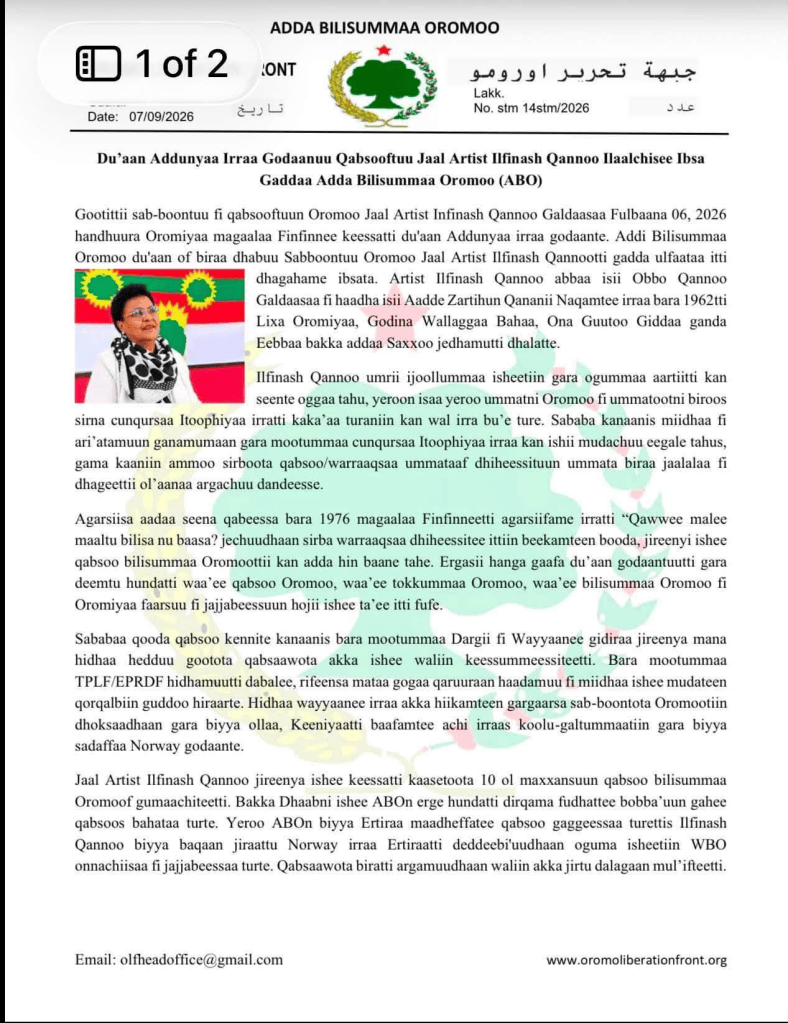
The Oromo Liberation Front (OLF/ABO) announces with profound grief and a heavy heart the passing of the great Oromo heroine, patriot, and freedom fighter – Beloved Artist Ilfinash Qannoo – who departed from this world on Fulbaana 06, 2026, in the heart of Oromia, at Finfinnee.
Her loss is not merely the loss of an artist. It is the silencing of a voice that sang freedom for over six decades. It is the emptying of a heart that burned with love for Oromia. It is the falling of a flag that inspired millions to rise against oppression.
Roots of a Revolutionary
Artist Ilfinash Qannoo was born in 1962 to her father, Obbo Qannoo Galdaasaa, and her mother, Aadde Zartihun Qananii, in the town of Saxxoo, located in Eebbaa district, East Wallagga Zone, Western Oromia – a region that would later become the cradle of many liberation struggles.
From her childhood, she was drawn to the arts. But her coming of age coincided with a period of intense political awakening across Ethiopia – a time when the Oromo people and other nations rose against the oppressive system. It was this environment that shaped her destiny and transformed her from a simple performer into a voice of the voiceless.
The Song That Shook the Throne
Her path to fame – and to persecution – began in 1976 at a historic cultural performance in Finfinnee. There, she posed the revolutionary question that would become an anthem of resistance:
“Qawwee malee maaltu bilisa nu baasa?”
(“Without the gun, what will set us free?”)
From that moment onward, her life became inseparable from the struggle for Oromo liberation. She dedicated every song, every performance, and every breath to:
- Glorifying the Oromo struggle
- Preaching Oromo unity
- Dreaming of Oromo freedom
- Empowering the Oromo people
Her stage became a battlefield. Her microphone became a weapon. Her lyrics became a declaration of war against injustice.
The Price of Resistance
For her unwavering commitment to the Oromo cause, she paid a heavy price. Under both the Derg regime and the later Woyanne (TPLF/EPRDF) government, she endured long years of imprisonment alongside countless other freedom fighters.
Her suffering did not end there. During her incarceration under the Woyanne regime, she was subjected to brutal torture – including having her scalp forcibly shaved with broken glass – resulting in deep and lasting physical and psychological wounds.
Upon her release, with the help of Oromo patriots, she was secretly taken to neighboring Kenya, and later granted asylum in Norway, where she continued her work from exile.
A Lifetime of Contribution
Throughout her life, Artist Ilfinash Qannoo produced over 10 albums, each one a powerful contribution to the Oromo liberation movement. Wherever the OLF/ABO had a presence, she was there – answering the call, lending her voice, and rallying the people.
Even during the period when the OLF was hosted in Eritrea and waging its armed struggle, Ilfinash – though living in exile in Norway – traveled repeatedly to Eritrea to inspire and strengthen the fighters. Her presence among the combatants was proof of her unwavering dedication; she did not simply sing about the struggle – she lived it.
Her Final Days – Fire That Would Not Die
Her love for Oromia and her commitment to the cause never wavered. Her heart and spirit remained as strong as steel, untouched by compromise or despair. But the years of imprisonment, torture, and exile had taken a toll on her health. The physical and emotional wounds inflicted upon her in Ethiopian dungeons finally caught up with her.
In her final moments, even as her body weakened, her spirit burned bright. Her last words were not of regret, but of love:
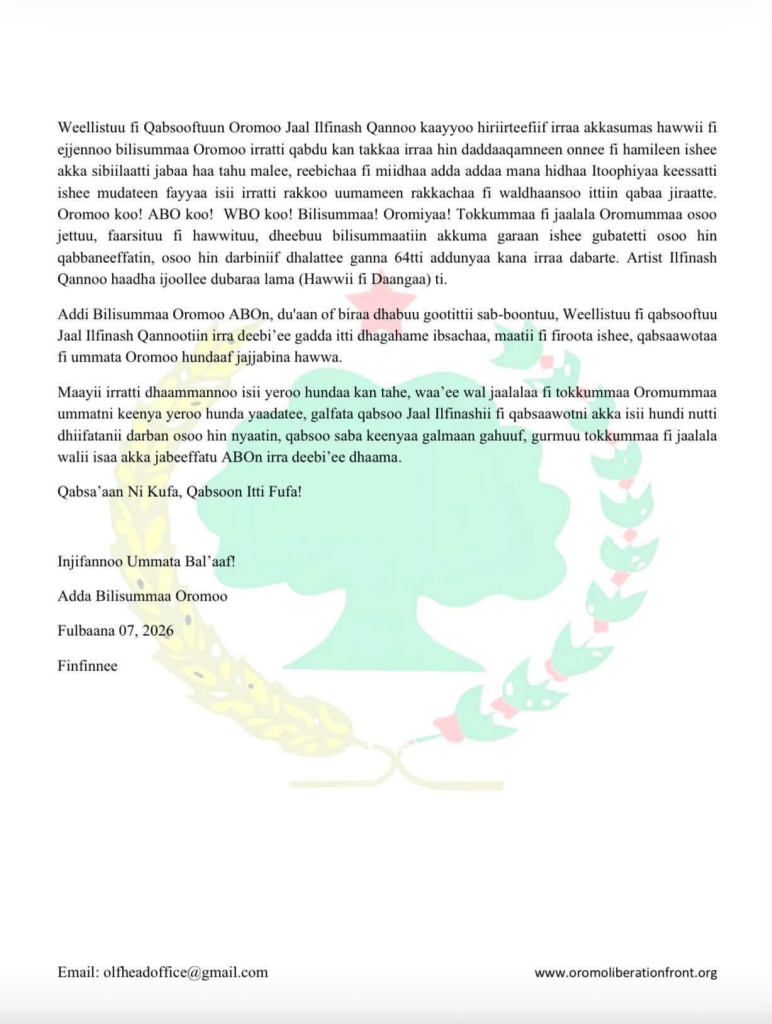
“Oromoo koo! ABO koo! WBO koo! Bilisummaa! Oromiyaa! Tokkummaa fi jaalala Oromummaa…”
(“My Oromo! My OLF! My Oromo Liberation Army! Freedom! Oromia! Unity and love of Oromummaa…”)
She passed at the age of 64, still singing, still hoping, still burning for freedom – until her very last breath.
Artist Ilfinash Qannoo leaves behind her two beloved daughters, Hawwii and Daangaa.
A Call to Honor Her Sacrifice
The Oromo Liberation Front (OLF/ABO) extends its deepest condolences to her family, her relatives, her fellow freedom fighters, and the entire Oromo nation.
We call upon our people to remember her message of unity and love – which was her eternal legacy. We urge all Oromos to carry forward the torch she lit, and to not let the sacrifice of Ilfinash and countless other heroes be in vain.
Let us strengthen our unity. Let us reinforce our love for one another. Let us complete the struggle they began – so that Oromia may be free.
Final Salute
Her memory will forever be etched in our hearts. Her songs will forever echo in our struggles. Her spirit will forever march beside us.
Rest in power, Beloved Ilfinash Qannoo.
You did not die – you were promoted to immortality.
“Qabsa’aan ni kufa, qabsoon itti fufa!”
(“The fighter may fall, but the struggle continues!”)
Glory to the Broad Victory of the People!
Issued by:
Oromo Liberation Front (OLF/ABO)
Fulbaana 07, 2026
Finfinnee, Oromia
#IlfinashQannoo #OLF #ABO #Oromia #Bilisummaa #HeroineNeverDies #StruggleContinues

Beloved Artist and Freedom Fighter Ilfinash Qannoo Passes Away at 64
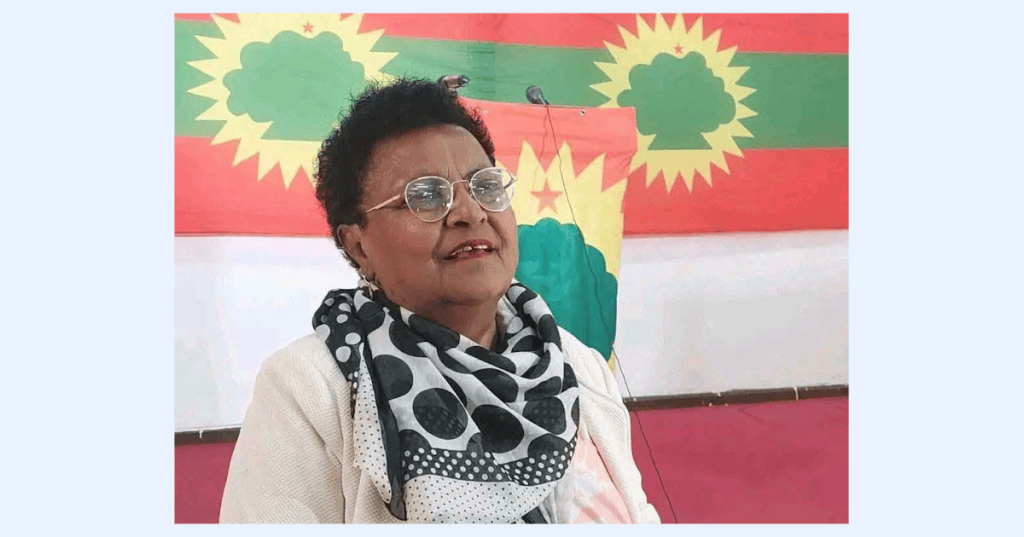
The Oromo Liberation Front announces the death of a legendary voice of the Oromo struggle, who inspired generations through music and resistance.
FINFINNEE, Oromia – The Oromo Liberation Front (OLF/ABO) has announced with profound grief the passing of iconic artist and freedom fighter Ilfinash Qannoo, who died on September 06, 2026, in Finfinnee at the age of 64.
Her loss, the organization stated, “is not merely the loss of an artist. It is the silencing of a voice that sang freedom for over six decades. It is the emptying of a heart that burned with love for Oromia. It is the falling of a flag that inspired millions to rise against oppression.”
From Saxxoo to the Stage
Born in 1962 in Saxxoo, East Wallagga Zone, Western Oromia, Ilfinash was drawn to the arts from childhood. Her coming of age coincided with a period of intense political awakening across Ethiopia, transforming her from a performer into a voice for the voiceless.
Her path to fame—and persecution—began in 1976 at a historic cultural performance in Finfinnee, where she posed the revolutionary question that became an anthem of resistance:
“Qawwee malee maaltu bilisa nu baasa?”
(“Without the gun, what will set us free?”)
From that moment, her life became inseparable from the struggle for Oromo liberation. Her stage became a battlefield, her microphone a weapon, her lyrics a declaration of war against injustice .
The Price of Resistance
For her unwavering commitment to the Oromo cause, she paid a heavy price. Under both the Derg regime and the later Woyanne government, she endured long years of imprisonment alongside countless other freedom fighters .
Her suffering included brutal torture—having her scalp forcibly shaved with broken glass—leaving deep and lasting physical and psychological wounds. Upon her release, with the help of Oromo patriots, she was secretly taken to Kenya and later granted asylum in Norway, where she continued her work from exile .
Despite these hardships, she produced over 10 albums throughout her life, each a powerful contribution to the Oromo liberation movement. Even while living in exile, she traveled repeatedly to Eritrea to inspire fighters when the OLF was waging its armed struggle .
A Voice That Nurtured Generations
Ilfinash was more than a singer—she became a living archive of Oromo memory. Her music carried the soil of rural Oromia and the fire of a people’s longing for dignity. In her final years, too frail to stand, she was carried to gatherings—not as a relic, but as a living flame .
Perhaps one of her most significant legacies was her role as a trailblazer for Oromo women. At a time when restrictive expectations limited women’s participation in public life, she challenged both political repression and social conventions .
The Oromo Community of Minnesota honored her as a “pioneering role as an Oromo woman artist who challenged political repression and restrictive expectations of women in public life”—courage that helped create space for generations of Oromo artists and women who followed .
Final Words
In her final moments, even as her body weakened, her spirit burned bright. Her last words were not of regret, but of love:
“Oromoo koo! ABO koo! WBO koo! Bilisummaa! Oromiyaa! Tokkummaa fi jaalala Oromummaa…”
(“My Oromo! My OLF! My Oromo Liberation Army! Freedom! Oromia! Unity and love of Oromummaa…”)
She passed at age 64, still singing, still hoping, still burning for freedom until her very last breath.
A Call to Carry the Torch
The Oromo Liberation Front extends its deepest condolences to her family, her two beloved daughters Hawwii and Daangaa, her relatives, fellow freedom fighters, and the entire Oromo nation.
They call upon the people to remember her message of unity and love, urging all Oromos to carry forward the torch she lit:
“Let us strengthen our unity. Let us reinforce our love for one another. Let us complete the struggle they began—so that Oromia may be free.”
Her memory will forever be etched in hearts, her songs forever echo in struggles, her spirit forever march alongside.
“Qabsa’aan ni kufa, qabsoon itti fufa!”
(“The fighter may fall, but the struggle continues!”)
Rest in power, Beloved Ilfinash Qannoo.
You did not die—you were promoted to immortality.

The Voice That Refused to Be Silenced: Minnesota Oromo Community Mourns Iconic Artist Ilfinash Qannoo

A tribute to a pioneering artist whose music and courage shaped Oromo identity across generations and continents
MINNEAPOLIS, Minnesota – September 6, 2026
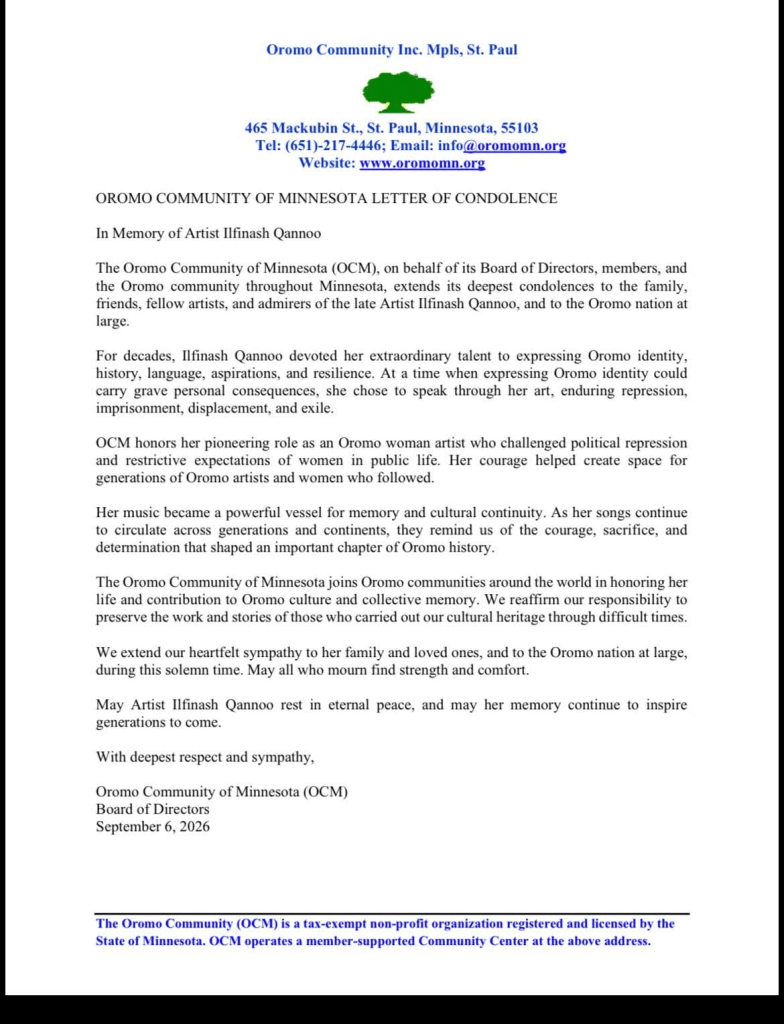
The Oromo Community of Minnesota (OCM), one of the largest Oromo diaspora organizations in the United States, has issued a formal letter of condolence honoring the life and legacy of Artist Ilfinash Qannoo, whose passing marks the end of an era for Oromo arts and cultural expression.
In a statement released today, the organization paid tribute to an artist who, for decades, transformed personal sacrifice into an enduring cultural treasure, becoming a symbol of resistance, resilience, and identity for Oromo people worldwide.
A Life Dedicated to Cultural Preservation
Ilfinash Qannoo was more than a musician or performer. She was a cultural archivist, a linguistic guardian, and a fearless voice who understood that art could carry the weight of an entire people’s history. Through her extraordinary talent, she devoted her life to expressing Oromo identity, history, language, aspirations, and resilience—often at great personal cost.
The OCM statement emphasized that during decades when openly expressing Oromo identity could carry grave personal consequences, Ilfinash chose to speak through her art. She endured repression, imprisonment, displacement, and exile, yet her creative spirit remained unbroken. Her music and performances became acts of quiet defiance in the face of political oppression, preserving the Oromo language and traditions at a time when they were systematically marginalized.
A Pioneer for Oromo Women in Public Life
Perhaps one of her most significant legacies was her role as a trailblazer for Oromo women. At a time when restrictive expectations limited women’s participation in public life, Ilfinash challenged both political repression and social conventions.
The OCM honored her as a “pioneering role as an Oromo woman artist who challenged political repression and restrictive expectations of women in public life.” Her courage helped create space for generations of Oromo artists and women who followed, proving that creative expression and political consciousness could go hand in hand.
“Her courage helped create space for generations of Oromo artists and women who followed,” the OCM board wrote, acknowledging that her influence extended far beyond music into the very fabric of Oromo social and political life.
Music as Memory and Resistance
Ilfinash’s music became a powerful vessel for memory and cultural continuity. Her songs, which continue to circulate across generations and continents, have served as an informal archive of Oromo history, preserving stories, struggles, and triumphs that might otherwise have been lost.
The OCM statement noted that her music “reminds us of the courage, sacrifice, and determination that shaped an important chapter of Oromo history.” For Oromo communities scattered across the globe—from the Horn of Africa to the diaspora centers of North America, Europe, and Australia—her voice became a thread connecting them to their homeland and heritage.
A Global Mourning
The Minnesota Oromo community, which numbers in the thousands, joins Oromo communities around the world in mourning this profound loss. The OCM pledged to continue preserving her work and the stories of those “who carried our cultural heritage through difficult times.”
“We reaffirm our responsibility to preserve the work and stories of those who carried our cultural heritage through difficult times,” the statement reads, acknowledging that the preservation of Oromo culture rests on the shoulders of those who, like Ilfinash, sacrificed their safety and comfort for the sake of collective memory.
Calls for Celebration Amid Grief
The OCM’s formal letter follows a growing chorus within the Oromo diaspora and homeland alike, urging that Ilfinash’s life be celebrated as much as her death is mourned. Many have echoed sentiments expressed in recent weeks that her legacy is one of joy, defiance, and triumph—not merely sorrow.
“May Artist Ilfinash Qannoo rest in eternal peace, and may her memory continue to inspire generations to come,” the OCM concluded in their letter, striking a tone of solemn respect mixed with hope for the future.
A Legacy That Endures
Ilfinash Qannoo’s death represents a significant loss for the Oromo cultural landscape. Yet her life’s work ensures that her voice will continue to resonate through the generations she inspired and the communities she helped to empower.
As the Oromo diaspora reflects on her contributions, her songs will undoubtedly continue to play in homes, community gatherings, and cultural events—each note carrying the defiance, resilience, and pride of a people whose identity she devoted her life to preserving.
The Oromo Community of Minnesota’s full letter of condolence can be accessed through the organization’s official channels. The Oromo community across Minnesota and beyond extends its deepest sympathy to her family, friends, fellow artists, admirers, and the Oromo nation at large.
With deepest respect and sympathy,
Oromo Community of Minnesota (OCM)
Board of Directors
September 6, 2026
#IlfinashQannoo #OromoArt #CulturalResilience #OromoDiaspora #MinnesotaOromo #LegacyOfResistance
Eulogy: Ilfinesh Qannoo (1962-2026): A Voice That Has Nurtured Generations
By Dhabessa Wakjira
We gather today with heavy hearts to mourn the passing of Ilfinash Qannoo, and yet, even in our grief, we find ourselves compelled to celebrate a life so extraordinary that mourning alone cannot contain it. Ilfinash Qannoo was not simply a singer. She was one of the most iconic, courageous, and influential Oromo women of her generation—a woman whose life was woven inseparably into the story of her people’s long struggle for dignity, identity, justice, and self-determination.
To speak of Ilfinash is to speak of commitment that never wavered, sacrifice that was never counted as loss, courage that never asked permission, and a devotion to the Oromo cause that outlasted every hardship placed before it. Hers was a life of artistic achievement, yes, but far more than that, it was a life offered, again and again, in service of something larger than herself.
The First Note of a Lifelong Song
From the moment she first stepped forward as a member of Wollega Kinet Guad, Ilfinash set out on a path from which she would never truly depart. That early beginning was not a stepping stone toward personal fame; it was the first note of a lifelong song dedicated to her people. From those early days until her final ones, her commitment to the Oromo cause never dimmed, never bent, and never went silent. Through her music, her voice, her courage, and the example of her own life, she awakened, inspired, and nurtured generation after generation of Oromo youth.
We must remember the times in which she sang. There were years when simply expressing Oromo identity, Oromo aspiration, Oromo pride required extraordinary courage—when a melody could be an act of defiance, and a lyric could carry the weight of a people’s unspoken longing. In those years, Ilfinash did not shrink from the risk. She took the gift she had been given—her voice—and turned it into an instrument of inspiration and resistance. She sang not because it was safe, but because it was necessary.
More Than an Artist
It would be a disservice to Ilfinash Qannoo’s memory to say only that she sang songs. She did something far greater: she gave voice to the hopes, the pain, the aspirations, the courage, and the unbending determination of an entire people. When her voice rose, it did not simply fill a room or a stage; it entered the hearts of Oromo youth across generations, and in doing so, it steadied them. It reminded them who they were. It gave them the strength to stand for their identity, their dignity, and their future, even when standing was costly.
In this way, she became something more than an artist. She became a symbol, a living demonstration that a single life, fully given, could serve a cause greater than itself. She poured out her talent, her energy, her courage, her voice, and ultimately her life for the Oromo people, one of the great nations of the Horn of Africa. In doing so, she showed us all that an artist can be far more than an entertainer. An artist can be a teacher. An artist can be an inspiration. An artist can become the guardian of a people’s collective struggle, and the voice through which a people’s aspirations are carried forward.
The Song That Echoes Through Generations
Among the many songs she gave to her people, one holds a place apart in the hearts of generations of Oromo people: “WBO Koo Maaloo Ree.” Its melody has traveled from parent to child, from one generation to the next, carrying memories of struggle, sacrifice, hope, and unshaken determination. It is no longer simply a song. It has become part of the emotional and historical memory of a people, woven into their story so deeply that it will continue to echo in the hearts of Oromo people yet to be born.
Unwavering Conviction
Perhaps the greatest lesson of Ilfinash Qannoo’s life was her firm and unwavering stand on the Oromo cause. She did not abandon her convictions when times grew difficult. She did not retreat when retreat would have been easier, safer, more comfortable. Her courage and her steadfastness stand today as an example for generations still to come, and they teach us something essential: that genuine commitment is not proven in moments of comfort, but in moments of difficulty and uncertainty. It is easy to declare loyalty when nothing is being asked of you. Ilfinash showed us what it means to hold to your convictions when everything is being asked of you.
A Bond Forged in Ambo
Ilfinash’s connection to Oromo youth was profound, and it was personal. She did not stand apart from them, observing from a distance; she stood among them, encouraged them, and shared directly in their hopes and in their struggles. Her time alongside Oromo youth in the forests and surrounding areas of Ambo forged a bond of deep mutual respect and affection, one that shaped the rest of her life. The love and the respect that the people of Ambo gave her in return were immense, and that relationship became one of the most meaningful of her entire life.
So deep was her attachment to Ambo and its people that she is remembered for a wish that reveals the depth of her heart: that if she should die, she wished to be laid to rest in Ambo, or, if that could not be, then even beneath the ice of Norway. These are not the words of someone who loved a place casually. They are the words of a woman whose experiences, whose memories, and whose sense of belonging were bound up entirely with the people who had walked beside her.
A Legacy That Will Never Die
Today, as we mourn Ilfinash Qannoo, we are also called to celebrate an extraordinary life fully lived. We mourn the loss of a great artist. But we remember, and will go on remembering, a woman whose legacy reaches far beyond music alone. We remember a courageous Oromo woman who used her voice when silence would have been easier. We remember a woman who remained committed when retreat was possible. We remember a woman who inspired generations, not only through the songs she sang, but through the example of the life she lived.
Her physical voice has now gone silent. But the voice she gave to her people—the voice of hope, of resistance, of identity, of belonging—will never disappear. Her songs will continue to be sung, in homes, at gatherings, in the quiet moments when a people needs reminding of who they are. Her courage will continue to inspire those who face their own difficult and uncertain times. Her commitment will continue to be remembered as a standard against which devotion to a cause is measured. And her name will remain written into the history and the collective memory of the Oromo people, for as long as that memory is kept.
—
Ilfinash Qannoo has departed from us. But her legacy remains.
She sang for her people. She stood with her people. She gave her voice to her people.
And her voice will live on with her people, from generation to generation.
Her voice will never die. Her legacy will never be forgotten.
Rest in peace, Ilfinash Qannoo.
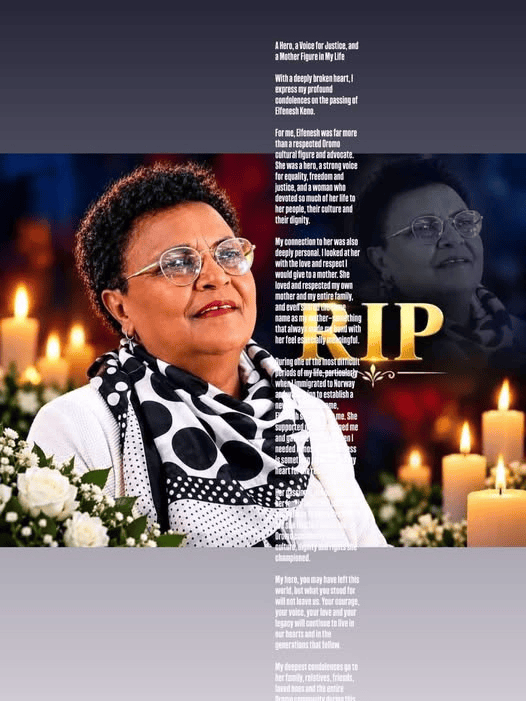

A Nation Mourns: The Passing of a Giant—Adde Ilfinesh Qannoo (1962-2026)
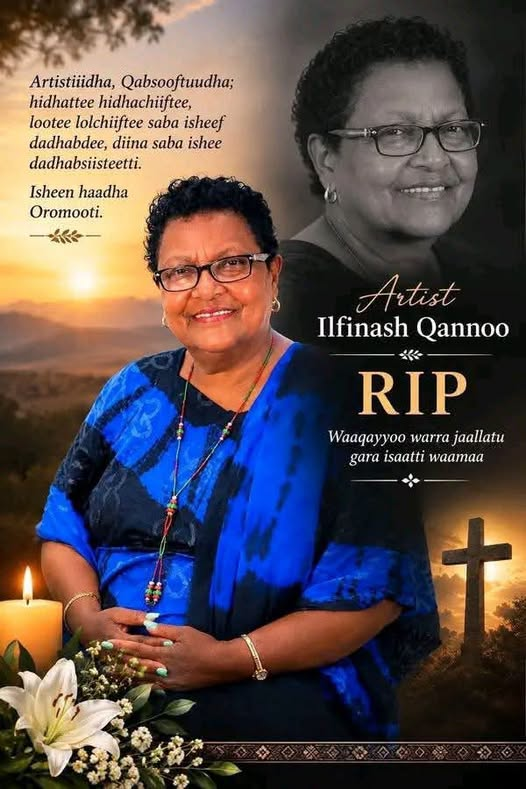
A Voice of Freedom Falls Silent, But Her Legacy Echoes Eternally
Finfinne, Oromia — Our nation lost a giant today. Adde Ilfinesh Qannoo, the renowned artist whose voice became the heartbeat of a people’s struggle, has passed from this world, leaving behind a legacy etched in the soul of the Oromo nation. Her departure marks the end of an era, but her spirit, her music, and her unyielding commitment to the Qabsoo Bilisummaa Oromoo (Oromo Liberation Struggle) will resonate for generations to come.
An Indelible Mark on History
Ilfinesh Qannoo was more than an artist; she was a monument to resilience, a symbol of identity, and a mother to a movement. Through her music, she gave voice to the joys, sorrows, and aspirations of her people, becoming a living archive of their history. Her songs, imbued with the deep cultural motifs of the Oromo, served as both a comfort and a call to action, reminding her listeners of their dignity, their heritage, and their unalienable right to freedom.
Her contributions to the Qabsoo Bilisummaa Oromoo were not merely artistic but deeply personal and sacrificial. She understood that the struggle for liberation was fought not only in the forests and on the battlefields but also in the hearts and minds of the people. Through her music, she fortified the spirit of the movement, offering hope in moments of despair and courage in the face of oppression.
A Faithful and Loyal Contributor
Throughout her life, Ilfinesh Qannoo remained steadfast in her dedication to the Oromo cause. She was a loyal contributor to the liberation struggle, using her platform to amplify the voices of the marginalized and to challenge the systems of injustice that sought to silence her people. Her courage in the face of censorship, persecution, and hardship stands as a testament to her character and her unwavering commitment to justice.
Even when her body grew frail and her steps grew slow, her spirit remained an unyielding force. Her presence at gatherings of the Oromo Liberation Front (OLF) and other movement events was a source of inspiration and moral clarity. She was the living embodiment of the Oromo proverb “Ilkaan socho’e buqqa’uun isaa hin oolamu”—a seed that moves does not rot. She was that moving seed, ensuring that the dream of liberation never decayed.
A Legacy That Lives Forever
Though her physical journey has ended, the essence of Ilfinesh Qannoo—her music, her symbolism, her love—is a permanent inheritance for the Oromo people. Her life continues to resonate, to inspire, and to fortify those who hold her memory dear. She may have left this world, but her voice remains, echoing in the songs that will be sung, the stories that will be told, and the hearts that will never forget.
Her legacy exists at a powerful intersection: the intimate space of a family mourning a beloved matriarch, and the public sphere honoring an artist who channeled a people’s soul. As flowers are laid and her songs are played anew, the Oromo nation is not just saying goodbye. They are affirming that the struggle she gave voice to continues, the identity she symbolized remains unbroken, and the love she embodied is eternal.
A Message of Condolence from Advocacy for Oromia (A4O)
The Advocacy for Oromia (A4O) joins the global Oromo community in mourning this profound loss. In a statement released today, the organization extended its heartfelt condolences to Ilfinesh Qannoo’s family and the entire Oromo nation:
“Our nation lost a giant today. Adde Ilfineesh Qannoo, a renowned artist and loyal contributor to the Qabsoo Bilisummaa Oromoo, has left an indelible mark on our people and our history. Her legacy will live on forever. The Advocacy for Oromia (A4O) extends its sincere condolences to her family and the entire Oromo nation. May she rest in peace, and may her memory continue to inspire us all.”
An Eternal Prayer
And so, we offer our unending prayer: that Adde Ilfinesh Qannoo’s soul finds the eternal comfort and peace it so deeply deserves. May her spirit rest gently, knowing that her life was a masterpiece of love, labor, and liberation. For her family, her friends, and her people, we wish the warmth of her memory, the strength of her example, and the profound solace that comes from knowing her legacy is in the most capable hands: the hands of a people who will never forget.
Rest in peace, Adde Ilfinesh Qannoo. Your struggle is over, but your victory is assured in the hearts of those you loved and who loved you in return.
—
“A name is above the grave, and your name, Ilfinesh Qannoo, is etched in gold in the annals of Oromo history.”
—
This tribute is offered by Advocacy for Oromia (A4O) and the global Oromo community in loving memory of Adde Ilfinesh Qannoo.

The Pillar of Borana: A Tribute to Abbaa Gadaa Liiban Jaldeessaa (1967-2026)
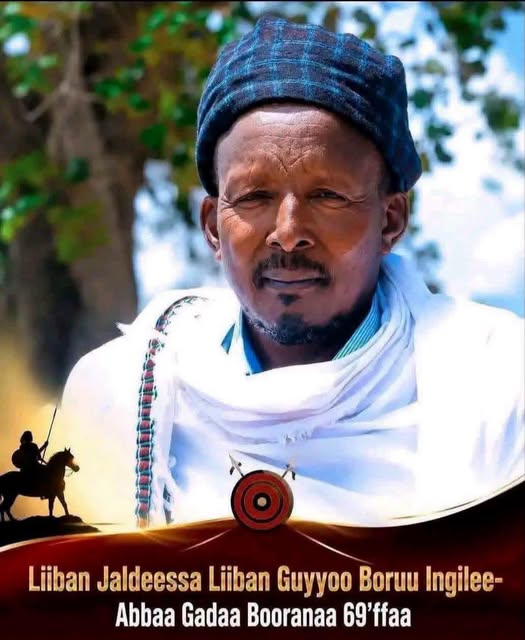
In the vast, sun-scorched plains of Borana, where the acacia trees stand as silent witnesses to centuries of tradition, a giant once walked among the people. He was not a king in the Western sense, nor a politician in the modern mold. He was an Abbaa Gadaa—a father, a judge, a living constitution for the Oromo people. His name was Liiban Jaldeessaa, and his life, from 1968 to 2026, was a testament to the enduring power of indigenous governance.
His story is not merely a biography; it is the history of a people’s resilience, a chronicle of justice, and a powerful reminder that true leadership is often found not in grand palaces, but in the dusty meeting grounds and under the shade of sacred trees.
A Son of the Soil: The Early Years
Born in 1967 to Jaldeessa Liiban and Tarrii Jaldeessa, in the Bur Busa area of Dheeda Booranaa, Liiban was a child of the Gadaa system from his first breath. He was the eldest of six siblings and would grow to be the father of fifty children—a patriarch in every sense of the word. Even in his youth, he was marked by a profound sense of duty. He was a “Tikaa,” a guardian of the cattle camps, learning the sacred responsibility of protecting the community’s lifeblood. He immersed himself in the traditions of his people, taking part in every rite of passage: from the Gammee (councils) to the Kuusa-Raabaa (age-grade gatherings), proving his dedication and worth at every step.
As a young man, Liiban distinguished himself through his unwavering commitment. He excelled in the crucial, often overlooked tasks of community life—the “hard work” that keeps society functioning. He was a man who understood the ancient ways, taking part in night-long vigils and traditional song and dance ceremonies (Olka Sirbuu) held at sacred sites like Dambii Dhedheertuu, Afuuraa, Areeroo, and Haroo Diimtuu. He earned a reputation for being tireless and principled, famously ensuring a great water reservoir (Gooroo) was properly filled, demonstrating his devotion to the community’s well-being even before he took on the highest office.
The Gauntlet of Leadership: A Gadaa in Action
In 1991, at a critical juncture for the Borana people, Liiban Jaldeessaa received the ultimate call to leadership. He took the Gooroo Gadoomaa—the sacred ceremonial staff—from the 68th Abbaa Gadaa, Boruu Madhaa. This was not a time of peace, but a time demanding strength, wisdom, and a firm hand.
His tenure as Abbaa Gadaa was defined by decisive action and a tireless defense of tradition and justice:
· Restoring Tradition: The great Gumii assembly of the Oromo, a cornerstone of democratic governance, had weakened and fractured. Liiban, understanding its vital importance, re-established the Gumii Dibbee Eldalloo, breathing new life into the ancient institution and ensuring the voice of the people could once again be heard.
· Uncompromising Justice: When elders attempted to use their authority to pass a decree without consulting the people, Liiban stood firm. His principle was clear: “An Abbaa Gadaa has no power to create a law by himself; the law is made by the Gumii.” He scrupulously upheld the rule of law, ensuring that power was accountable to the community.
· Protecting the Land: He was a fierce and unyielding defender of Oromo territory. At a time of great fear and uncertainty, he famously declared: “Fear should not cause the heartland of Oromo to be lost; fear should not cause the land of Oromo to be diminished.” He led land border expeditions (Lallaba) to assert territorial claims, confronting regional and federal authorities to protect the integrity of his people’s ancestral lands.
· The Ethiopian Renaissance Dam: When the issue of the Grand Ethiopian Renaissance Dam (GERD) arose, Gadaa Liiban gave a striking directive on how the Borana people should contribute to the national project. He proclaimed, “We will not support it with money from our pockets, but we will contribute with our hands and our labor,” reflecting a pragmatic and dignified approach to national duty.
· Diplomacy and Peacebuilding: He was a bridge-builder, working tirelessly with the Kenyan and Somali governments, and numerous NGOs to maintain peace and security in the volatile borderlands. He believed in the unity of all people, transcending clan, religion, and nation.
The Enduring Legacy: The “Dhaamsa” of a Great Man
On August 29, 2026, at the age of 59, Abbaa Gadaa Liiban Jaldeessaa passed away while receiving treatment in a Korean hospital. His death was a profound loss, a “Rifuu” (sorrow) felt from the savannahs of Ethiopia to the grasslands of Kenya.
But an Abbaa Gadaa does not simply die; he leaves a legacy—a Dhaamsa. This is not just a will, but a final message, a solemn charge to his people.
His legacy is twofold:
1. The Rifuu (The Sorrow and the Shield): He left behind a legacy of protection and strength. His memory is a shield, a “Jabaa Fulaa” (strong face) and a “Waardiyaa” (shield) that guards the community against its enemies and against division. The sorrow for his loss is immense, but it is a sorrow that binds the people together.
2. The Dhaamsa (The Final Charge): His final message is a call to action. It is a warning that the path he paved, the justice he upheld, and the unity he fostered must not be abandoned. His “Dhaamsa” is a reminder that the work of the Gadaa is never finished. It is a call to the community to remain steadfast, to support one another, and to continue the struggle for their rights and identity.
A Star That Still Guides
Abbaa Gadaa Liiban Jaldeessaa was more than a leader; he was the embodiment of the Gadaa system’s greatest ideals: justice, resilience, and unwavering dedication to the people. He was a “Fiixee Seeraa” (the pinnacle of the law), a “Tissaa Gooroo Gadaa” (the guardian of the Gadaa’s sacred staff), a man whose name will forever be etched in the annals of Borana history.
He passed into the next world, but for the Oromo people, he remains a star. His life is a lesson that the most profound leadership is born not of ambition, but of service. His legacy is a testament that a people’s strength lies not in their weapons, but in their traditions, their unity, and their unwavering commitment to justice.
As the Oromo people honor his memory, they are called to embody his final message: to be strong, to be united, and to ensure that the spirit of Gadaa Liiban Jaldeessaa lives on in every generation. He was a son of the soil, a pillar of his community, and a beacon of hope for all who believe in the power of indigenous wisdom.

A Giant Returns to the Soil: Abbaa Gadaa Liiban Jaldessa Laid to Rest in Areero (1967-2026)
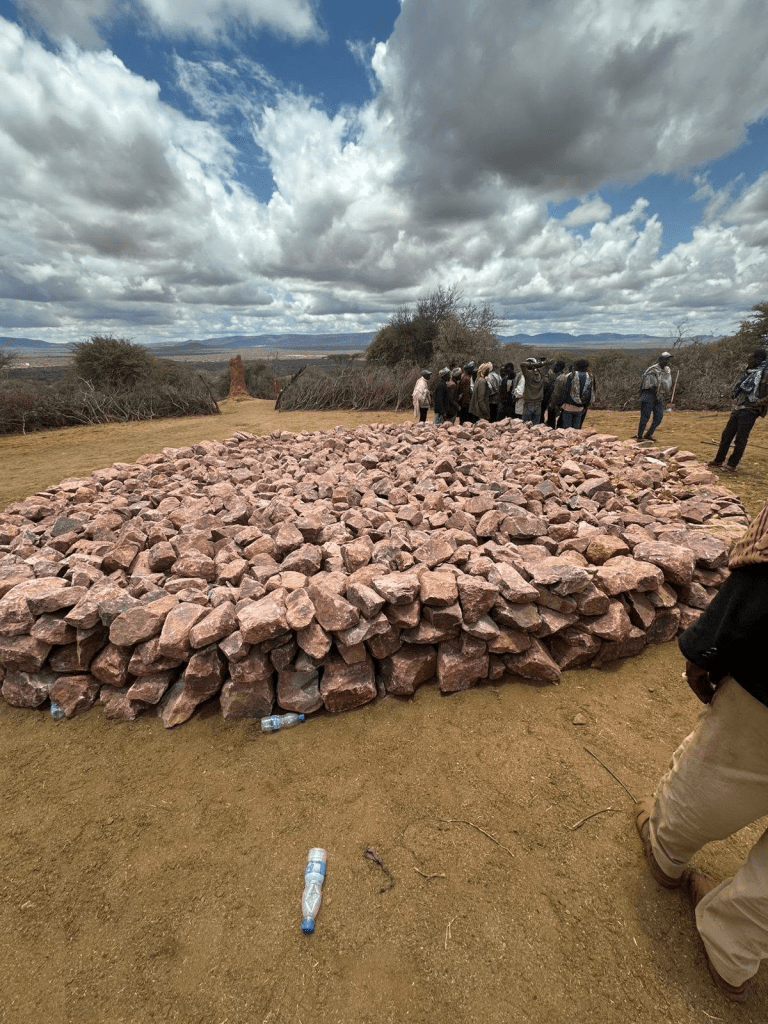
The plains of Areero, under the vast and unyielding sky of Borana, fell silent. The echoes of cattle bells and the murmur of the wind through ancient acacia trees seemed to pause, as a community—and indeed, a nation—gathered to bid farewell to one of its greatest sons. Abbaa Gadaa Liiban Jaldessa, the 69th custodian of the sacred Gadaa staff and a revered guardian of Oromo law, was laid to rest in his homeland on a somber day that marked the end of an era.
At the age of 59, the leader whose life was a testament to the enduring strength of indigenous governance passed away on December 29, 2026, while receiving medical treatment in Addis Ababa. His death sent a wave of profound grief—a Rifuu—from the highlands of Ethiopia to the savannahs of Kenya, a sorrow felt by all who knew the weight of his wisdom and the depth of his commitment.
A Life of Service to the Gadaa
Liiban Jaldessa was more than a leader; he was the embodiment of the Gadaa system’s highest ideals. As the 69th Abbaa Gadaa, he was a living constitution, a judge, a father, and a protector of the Borana people. His life was dedicated to the preservation and advancement of the ancient Oromo governance system, which for centuries has stood as one of the world’s most sophisticated indigenous democracies.
Gadaa elders and scholars who paid tribute to him spoke of a man of unwavering principle. He was described as a “pillar of the community,” a leader whose influence extended far beyond the ceremonial. His tenure was marked by a fierce dedication to justice, the protection of Oromia’s historic boundaries, and the strengthening of the social fabric that binds Oromo communities across the borders of Ethiopia and Kenya.
Reviving the Ancient Assembly
Among his most significant achievements was the revival of the Dibbee Eeldalloo Assembly, a crucial Gadaa institution that had lain dormant for several generations. This assembly is not merely a meeting; it is the heart of Oromo democracy, where elders and community members gather to deliberate on matters of law, peace, and the future of the people.
By breathing new life into this ancient forum, Abbaa Gadaa Liiban ensured that the voice of the people would continue to be heard. He re-established a critical channel for justice and reconciliation, reaffirming that true governance is not imposed from above but emerges from the collective wisdom of the community. This act alone cemented his legacy as a unifier and a visionary.
A Leader for All
The attendance at his funeral was a powerful testament to the reach of his influence. Gadaa leaders from across the region stood alongside government officials, and a vast sea of public mourners from both Ethiopia and Kenya came to pay their final respects.
A notable presence was that of Marsabit Governor Mohamed Mohamud Ali, whose attendance underscored the cross-border significance of Abbaa Gadaa Liiban’s work. Governor Ali honored the leader’s immense contributions to fostering peaceful and cooperative relations between communities living on either side of the national border. He called on all who were present to uphold Liiban’s legacy of unity, emphasizing that the bonds he forged should be sustained and strengthened for generations to come.
This intergovernmental and cross-border presence highlighted a profound truth: Abbaa Gadaa Liiban was not just a leader of the Borana, but a symbol of peace and cooperation for the entire region.
A Legacy Etched in the Land
Abbaa Gadaa Liiban Jaldessa left behind a large and proud family—50 children, 13 sons and 37 daughters—who carry his name and his spirit into the future. But his true legacy is woven into the very fabric of the Oromo nation.
He was a man who stood firm in the face of challenges, who walked the length of disputed borders to assert his people’s claims, and who worked tirelessly to ensure that the “Habesha” label would not diminish the proud, independent identity of his people. He believed in the Gadaa’s power to resolve conflict, its wisdom to guide the community, and its resilience to survive through the ages.
As the earth of Areero received his body, the community received his spirit. His final message, his Dhaamsa, is a call to action: to remain united, to uphold the law, and to continue the struggle for justice and recognition.
The Farewell of a Nation
The burial ceremony in Areero was more than a funeral; it was a declaration. It was a declaration that the Gadaa system lives on, that its leaders are honored, and that its traditions will not fade into history. It was a declaration that the Oromo people, from the plains of Borana to the hills of Kenya, stand together.
In the words of the elders who mourned him, “Mataan Dhalootaa Lafa Ga’e Du’aan Lafa Hinhanqatu”—”The head of a generation that has touched the ground does not leave the ground empty.” Abbaa Gadaa Liiban Jaldessa touched the ground with his life, and his legacy will continue to grow from the soil of his homeland.
The son of Borana has returned to his ancestors. But for his people, he is not gone. He has become a star in their sky, a voice in their council, and a timeless guide for the path ahead.

The Borana Gadaa System Loses a Distinguished Leader: Former Abbaa Gadaa Liban Jaldesa Passes
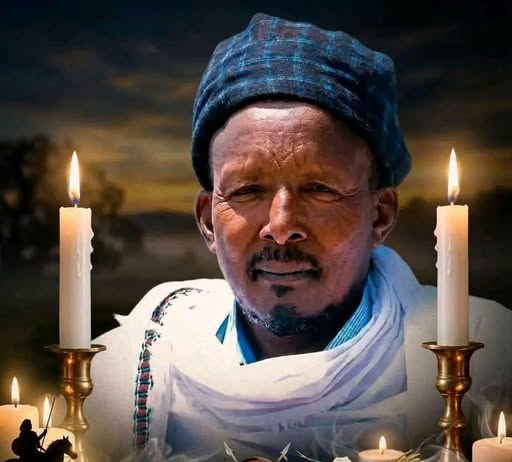
A Legacy of Cultural Stewardship and Resilience Leaves a Lasting Mark
By Daandii Ragabaa
(ONA, Finfinne, 29 August 2026) – The Oromo nation and the Borana community are mourning the loss of a respected cultural leader. Liban Jaldesa, who served as the 69th Abbaa Gadaa of the Borana from 2002 to 2009, has passed away, leaving behind a profound legacy of service to his community.
His tenure marked a significant period in the history of the Borana Oromo, where he played a pivotal role in strengthening the Gadaa institution and promoting the laws, culture, and traditions of his people . The Gadaa system, which he represented, is a sophisticated and indigenous framework of governance recognized by UNESCO as an intangible cultural heritage of humanity. It is a system that embeds a deeply egalitarian social fabric, where democratic power is transferred from one class to another every eight years .
The Weight of the Bullukoo: Leadership in a Time of Challenge
The role of an Abbaa Gadaa is one of profound responsibility. An Abbaa Gadaa is not merely a political figure but the custodian of the community’s soul, tradition, and future. The Gadaa system regulates social, political, economic, and religious life, and the leader is expected to be a competent orator, deeply skilled in the laws and customs of his people .
During his tenure, Liban Jaldesa was a steady hand during a period of immense challenge. The Borana, a predominantly pastoralist community inhabiting southern Ethiopia and northern Kenya, faced acute pressures including changing weather patterns and rising resource scarcity .
As an elder and oral historian once noted about the Gadaa leadership: “The system strictly interrogates a candidate’s lineage and ancestral record. It examines whether the past Gadaa terms of your family brought prosperity, timely rains, abundance, sovereignty, and peace.” Liban Jaldesa carried this weight of expectation, navigating his community through the complexities of a changing world while striving to uphold the sacred principles of Gadaa.
A Living Democracy: The Gadaa Tradition
The Gadaa system he served is a testament to the Oromo people’s ancient commitment to democratic governance. It organizes society into age grades, with each grade moving through a life cycle—from Dabballee (childhood) to Gammee (youth), and ultimately to leadership roles like Kuusa and Gadaa .
To select the Abbaa Gadaa, an extensive evaluation and vetting process called the “Baannattoo” system is conducted, functioning as a traditional electoral campaign for public servants . The son of a previous Abbaa Gadaa would convene his peers for the Wal-argii (Grand Gathering) to build peer acquaintance and deliberate on traditional matters before a new leader could be invested .
As a leader during such a time, Liban Jaldesa’s role was central to this process of cultural transmission and societal continuity.
A Nation Mourns, a Legacy Endures
The passing of Liban Jaldesa is a profound loss. His leadership is described as an enduring part of Borana history and cultural heritage . His wisdom and service are expected to continue inspiring future generations.
His death marks the end of an era, but the principles of the Gadaa system—democracy, community, and resilience—that he represented continue to guide the struggle and shape the future of the Oromo people.
The Oromian News Agency joins the Borana Oromo community in expressing our deepest condolences. We honour his memory and the immense contribution he made to preserving the cultural identity of his people.
Waaqni Ekeraa isaa nagaan haa qubachiisu! May God rest his soul in eternal peace.






