Category Archives: Seenaa

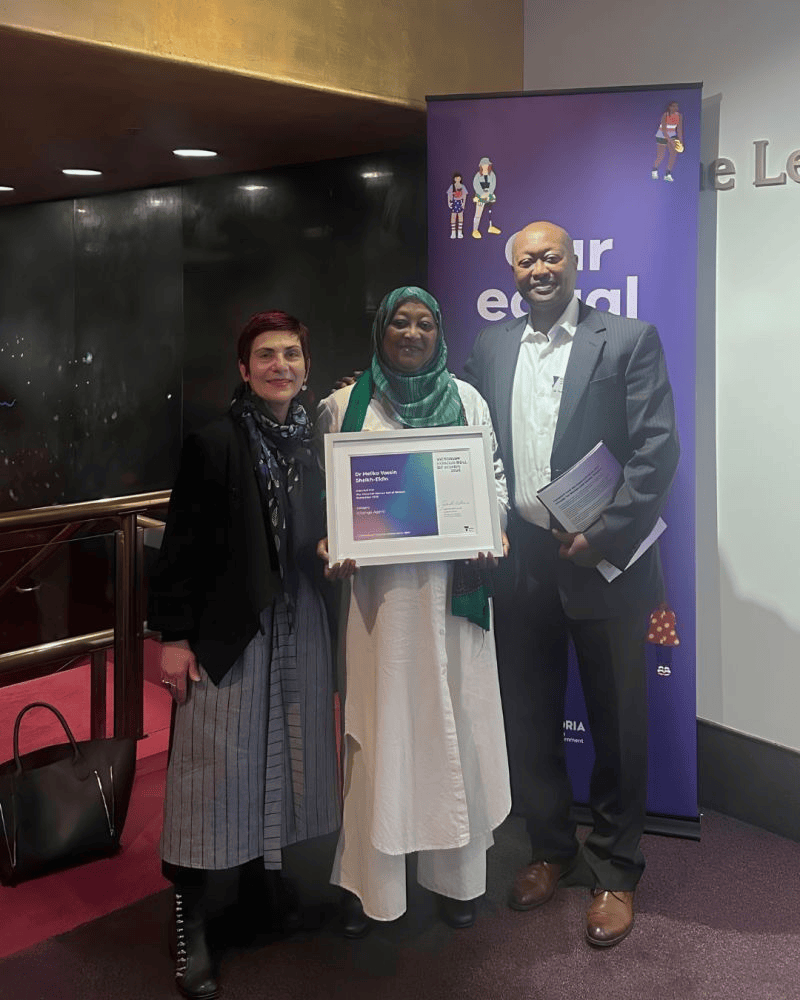
A Trailblazer Honoured: Dr Melika Sheikh-Eldin Inducted into the Victorian Honour Roll of Women
By Dhabessa Wakjira
In a moment that celebrates both personal achievement and the power of lived experience, Dr Melika Sheikh-Eldin — Manager of International and Community Development at AMES Australia — has been inducted into the Victorian Honour Roll of Women, one of the state’s most prestigious recognitions of women’s contributions to their communities and the nation.
The announcement was met with pride and joy across AMES Australia and the broader settlement sector, where Dr Melika has been a guiding force for more than two decades.
“Congratulations to Dr Melika Sheikh-Eldin, our Manager of International and Community Development, on being inducted into the Victorian Honour Roll of Women,” AMES Australia shared in a statement. “This well-deserved recognition celebrates Melika’s outstanding leadership and commitment to creating opportunities for multicultural communities.”
A Journey from Refugee to World-Leading Innovator
Dr Melika’s story is one of remarkable transformation — and of turning personal hardship into a force for systemic change. She fled war in Eritrea in the late 1970s, volunteering in Sudanese refugee camps and in Cairo for organisations including the United Nations High Commissioner for Refugees (UNHCR) , the Red Cross, and Save the Children. She resettled in Australia in 1992.
Since joining AMES Australia in 2001, she has dedicated her career to settlement, community development, capacity building, and advocacy. Her work has helped thousands of new arrivals settle successfully in Australia and has influenced settlement policy and practice both nationally and internationally.
At the Victorian Honour Roll of Women ceremony, it was recognised that Dr Melika Sheikh-Eldin has transformed her lived experience as a refugee into world-leading approaches to community integration and social cohesion.
Three World-Leading Models
Dr Melika’s impact at AMES Australia is perhaps best illustrated by the innovative programs she has led — programs that have become blueprints for others:
1. The Nhill Rural Settlement Project
In western Victoria, the small town of Nhill was facing economic decline. Dr Melika’s project settled Karen refugees in the community, revitalising the town’s economy and creating a model now considered a global blueprint for rural settlement.
2. The Werribee Park Gardening Program
Engaging isolated Karen women in gardening, this program addressed critical issues of isolation and mental wellbeing. Its success was so evident that the model has been adopted by other organisations.
3. The Community Guides Program
Perhaps her most influential innovation, the Community Guides Program recruits former refugees to use their lived experience to assist new arrivals. Dr Melika has travelled to Sweden, New Zealand, and Japan to help international organisations establish programs based on this model.
Challenging Stereotypes, Championing Two-Sided Education
Throughout her career, Dr Melika has disrupted gender stereotypes and challenged the public perception of what refugees can achieve. Central to her philosophy is the concept of “two-sided education” — the idea that both host communities and new arrivals must learn about one another for true integration to occur.
This mutual learning, she explains, helps mitigate the fear of the unknown — the anxiety that so often fuels resistance to newcomers. It is a simple but profound insight: integration is not something done to refugees, but something built with them, and with the communities that receive them.
A Scholar and a Mother
Dr Melika’s achievements are all the more remarkable given the circumstances in which she pursued them. While raising three children as a refugee in a small Australian town, she completed a PhD in aquatic science — a testament to her intellectual rigor and her refusal to be defined by the limitations others might have placed upon her.
Since 2007, she has also sat on the board of the Refugee Council of Australia and represented the nation as a “Refugee Voice” at annual UNHCR consultations in Geneva, advocating for policy shifts that recognise refugees as stakeholders rather than recipients of aid.
A Well-Deserved Recognition
The Victorian Honour Roll of Women celebrates women who have made exceptional contributions to Victoria and beyond. Inductees are recognised for their leadership, courage, and lasting impact on their communities.
Dr Melika’s induction places her among a distinguished group of women who have shaped the state’s social, cultural, and political landscape. For the Oromo community and for refugees and migrants across Australia, her recognition is a moment of immense pride.
“Congratulations, Melika. We are incredibly proud of you,” AMES Australia said. 💙
Learn More
To read Dr Melika Yassin Sheikh-Eldin’s full profile on the Victorian Honour Roll of Women, visit:
🔗 https://www.vic.gov.au/dr-melika-yassin-sheikh-eldin
#AMESAustralia #AMES #Award #VictorianHonourRoll

Melbourne Irreechaa Festival 2026: The Ultimate Guide to Celebrating Oromo Thanksgiving in Australia
By Dhabessa Wakjira
For the Oromo diaspora in Melbourne, Irreechaa is more than a festival. It is a sacred homecoming — a chance to gather by the water, give thanks to Waaqa, and pass the flame of Oromummaa to the next generation. In 2026, the Melbourne Oromo community will once again celebrate this ancient tradition on Australian soil, welcoming all who wish to share in its beauty, meaning, and joy.
This guide covers everything you need to know about the 2026 celebrations, from dates and locations to the rituals, etiquette, and cultural significance of Irreechaa in the diaspora.
What Is Irreechaa?
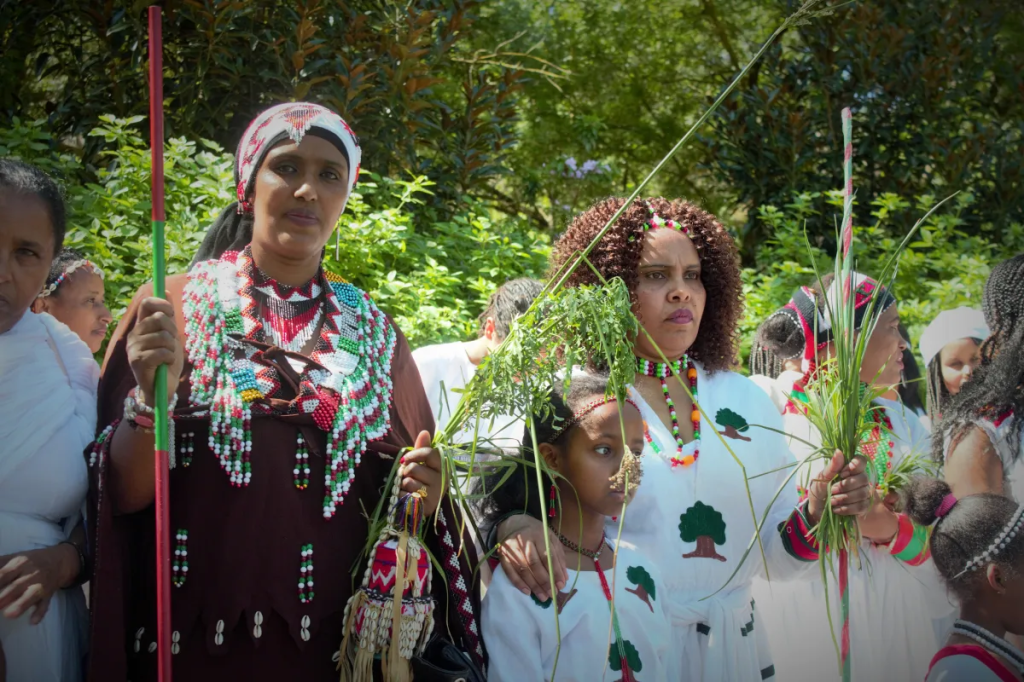
Irreechaa is the annual Oromo thanksgiving festival, celebrated at the banks of rivers and lakes across Oromia. It marks the end of the rainy season (Ganna) and the beginning of a new year of hope, renewal, and abundance. Rooted in Waaqeffannaa, the traditional Oromo belief in one God (Waaqa), the festival predates Christianity and Islam and has been passed down through generations for thousands of years.
Participants carry fresh green grass and yellow daisies (daraaraa keelloo) to the water’s edge, dip them into the water as an offering of gratitude, and sing ancient songs of praise and blessing. The festival is also a time of reconciliation — disputes are settled before participation, and communities come together in peace.
For the diaspora, Irreechaa is a vital cultural anchor. It connects Oromos in Australia to their homeland, their ancestors, and one another .
2026 Melbourne Irreechaa Events
The Melbourne Oromo community typically celebrates two major Irreechaa festivals each year: Irreechaa Arfaasaa (the spring celebration) and Irreechaa Malkaa (the main thanksgiving at the water’s edge).
Irreechaa Arfaasaa 2026
Date: Sunday, April 26, 2026
Location: Dandenong Mountain (Tulluu Dandenong), Melbourne
Time: Morning (exact time to be announced)
Organizers: Oromo Irreecha Association and Melbourne Oromo community
Irreechaa Arfaasaa marks the end of the dry season and the beginning of the rainy season. It is a spring celebration that follows traditional Oromo customs, beginning with the blessing of elders .
Irreechaa Malkaa 2026
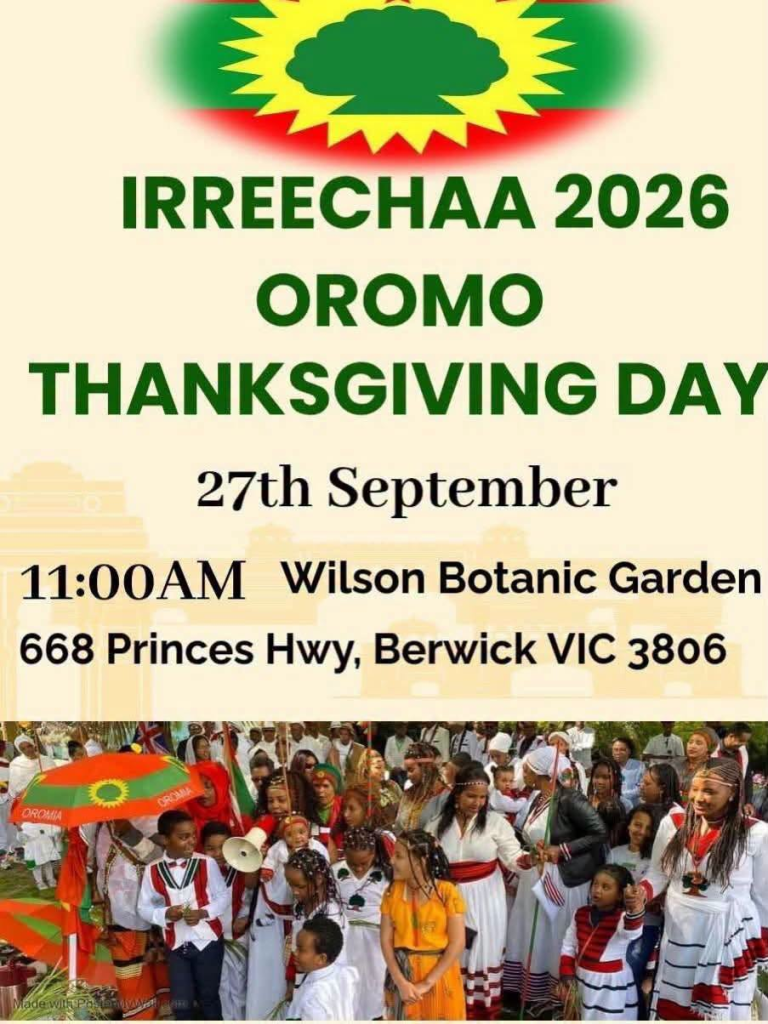
Irreechaa Malkaa, the main thanksgiving festival, is typically celebrated in September or October, corresponding with the end of the rainy season in Ethiopia. Past Melbourne Irreechaa Malkaa celebrations have been held at locations such as Wilson Botanic Park in Berwick.
The 2026 date and location for Melbourne will be announced by community organizers as follows closer to the time.
Date: Sunday, September 27, 2026
Location: Wilson Botanic Park in Berwick, Melbourne
Time: 11:00am
Organizers: Oromo Irreecha Association and Melbourne Oromo community
What to Bring
Organizers have specified the following items for attendees :
| Item | Purpose |
|---|---|
| Water | For personal use and the ritual |
| Flowers | For the Irreechaa tradition (yellow daisies if available) |
| Fresh green grass | Symbol of life, fertility, and gratitude |
| A spirit of gratitude | The heart of Irreechaa |
Wear traditional Oromo clothing if you have it. The vibrant colors and styles are a beautiful expression of cultural pride and identity.
What to Expect: The Rituals and Traditions
Irreechaa follows a structured, reverent sequence of events. Here is what you can expect at a Melbourne celebration:
1. Blessing of Elders
The celebration begins with blessings and prayers led by community elders (Abbaa Gadaa, Hadhasiinqee, and respected community members). These blessings focus on peace, prosperity, and remembering those who sustained the tradition .
2. The Procession
Participants walk together toward the water (or the designated sacred area). In traditional Irreechaa, women walk in front of the elders — a practice rooted in the Siinqee institution that symbolizes women as sacred and as agents of peace.
3. Carrying Grass and Flowers
Attendees carry fresh green grass and yellow flowers to the water’s edge. The grass is a symbol of life, fertility, and the connection between the Oromo people and the earth .
4. Dipping and Sprinkling
Upon reaching the water, participants dip the grass and flowers into the water and sprinkle water on themselves and others as a blessing. This act symbolizes purification, renewal, and the washing away of the past year’s hardships .
5. Songs and Prayers
The air fills with the sounds of traditional Oromo songs (faaruu) — songs of gratitude, hope, and blessing. Women sing “Maariyoo… Maareyoo…” (“your mercy on us”), while men chant the Irreechaa songs alongside them. The communal singing is a powerful expression of unity and shared emotion .
6. Cultural Performances and Food
After the rituals, the celebration continues with traditional music, dances (such as the Siiqqee and Gumii dances), and communal meals featuring Oromo food. It is a time for storytelling, laughter, and strengthening community bonds .
Irreechaa Etiquette: How to Participate Respectfully
Irreechaa is a sacred festival, not merely a cultural event. If you are attending for the first time — whether you are Oromo or from another background — here are important guidelines to ensure your participation is respectful and meaningful:
Do:
- Wear traditional clothing if you have it. It is a sign of respect and pride.
- Follow the lead of elders and community organizers.
- Carry grass and flowers to the water as an offering.
- Sing along if you know the songs — or simply listen and absorb the moment.
- Respect the natural environment. Leave no waste behind. The Oromo value of caring for nature is central to Irreechaa.
- Be present with gratitude. Irreechaa is a time of thanksgiving, reconciliation, and peace.
Don’t:
- Don’t splash water indiscriminately. The water ritual has specific traditional meaning.
- Don’t preach or distribute religious materials of other faiths at the Malkaa (water site). Irreechaa is rooted in Waaqeffannaa, and the sacred space should be respected.
- Don’t make noise or ululate during the solemn moments of the ceremony before the water ritual is complete.
- Don’t block the path with vehicles. Irreechaa is a communal pilgrimage — walk with the community if you are able.
These guidelines are not restrictions on participation. They are invitations to engage more deeply, with the reverence that Irreechaa deserves.
Why Irreechaa Matters in the Diaspora
For Oromos in Melbourne, Irreechaa serves several vital functions:
Cultural preservation. It ensures that younger generations born or raised in Australia learn about their heritage, language, and traditions. The festival is a living classroom for Oromummaa .
Community cohesion. It brings together families and individuals scattered across Victoria, strengthening social bonds and creating a sense of belonging .
Connection to homeland. It bridges the physical distance between Australia and Oromia, allowing the diaspora to maintain a profound spiritual and cultural connection to their ancestral land .
Intercultural exchange. Melbourne Irreechaa events often welcome local government officials, multicultural organizations, and curious residents, fostering mutual respect and understanding between communities.
The Spiritual Meaning of Irreechaa
At its heart, Irreechaa is an act of thanksgiving to Waaqa for the blessings of the past year and a prayer for peace and abundance in the year to come. It is a time of reconciliation — when those in conflict bury the hatchet and communities heal.
The festival is also a celebration of the Gadaa system, which upholds national unity, reconciliation, and solidarity. Irreechaa is one of the mammoth outdoor cultural festivals that showcase Ethiopia’s wealth of cultural heritage .
As one community message beautifully expressed:
“Irreecha is not a memory. It is a living prayer. And you are the ones who keep it alive.”
Practical Information
Getting There: Dandenong Mountain and other past venues are accessible by public transport and car. Check with organizers for specific directions and parking information.
Weather: Melbourne weather is unpredictable. Dress in layers and bring sun protection. April can be cool and changeable.
Accessibility: Contact organizers in advance if you have accessibility needs.
Staying Updated: Follow Advocacy for Oromia and local Oromo community associations on social media for the latest announcements about Irreechaa Malkaa 2026 and any changes to Irreechaa Arfaasaa details.
Baga Irreechaa Nagaan Geessan!
Whether you are Oromo, a friend of the Oromo community, or simply someone who wishes to witness a beautiful and meaningful cultural tradition, you are welcome at Melbourne Irreechaa 2026.
Come with an open heart. Come with gratitude. Come ready to sing, to celebrate, and to honor a tradition that has survived centuries of suppression and continues to thrive in every corner of the world where Oromo people gather.
Irreechaa keessan haa fudhatamu. May your thanksgiving be accepted. 🌿💚
Source information: Advocacy for Oromia, Oromia Communication Bureau, and the Melbourne Oromo community

“Welcome Home”: Artist Daawwitee Mokonnon Returns to Ethiopia After 27 Years, Received with Celebration in Bole
By Dhabessa Wakjira
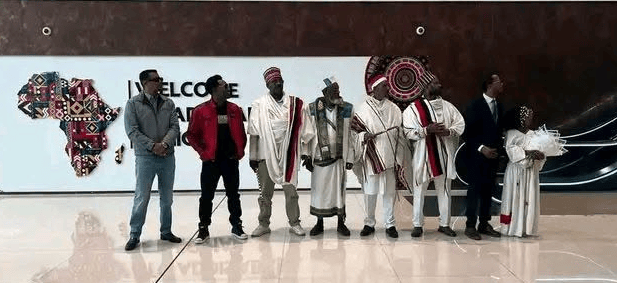
ADDIS ABABA — After 27 long years away from home, renowned Oromo artist Daawwitee Mokonnon has returned to Ethiopia. The beloved singer and cultural figure was welcomed with a warm and celebratory reception in Bole, marking an emotional homecoming that has touched the hearts of many Oromos at home and abroad.
“Baga nagaan gara biyya abbaaketti galte!” — “Welcome back to your fatherland!” — read the message shared by the Oromia Communication Bureau, capturing the joy and relief that accompanied him return.
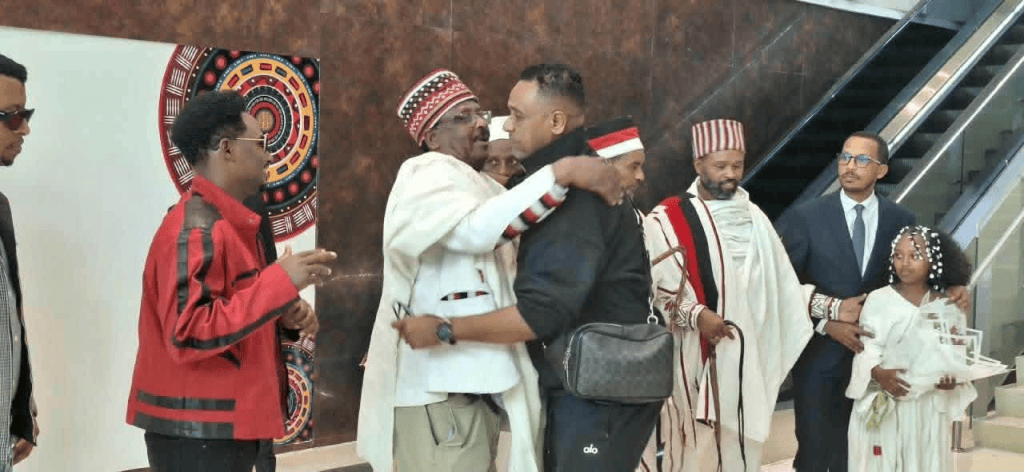
A Long Journey Home
Twenty-seven years is a lifetime. For Daawwitee Mokonnon, those years were spent in exile — far from the land, the people, and the culture that shaped him art and his identity. His music, however, never left. Throughout him time abroad, his voice remained a powerful thread connecting the Oromo diaspora to their homeland, a source of comfort, pride, and remembrance for millions.
Now, that thread has come full circle. His return is not merely a personal milestone; it is a symbolic moment for the Oromo people — a reminder that distance, however long, cannot sever the bond between an artist and his nation.
A Reception Fit for a Cultural Icon
The reception in Bole was filled with the warmth and reverence befitting an artist of his stature. Community members, fellow artists, and admirers gathered to welcome him back, celebrating not only his return but also the decades of cultural contribution he has made from afar.
Daawwitee Mokonnon is more than a singer. He is a keeper of Oromo musical heritage, a voice that has carried the stories, struggles, and aspirations of her people across borders and generations. His songs have been sung at Irreechaa gatherings, at family celebrations, and in quiet moments of longing for home. For many in the diaspora, his music was a piece of Oromia they could carry with them.
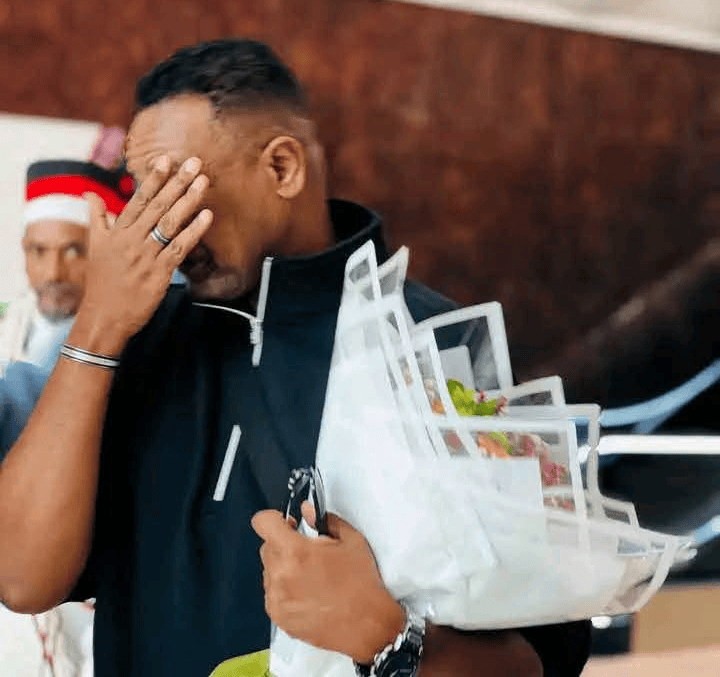
A Symbol of Hope and Reconnection
His return after 27 years carries profound meaning. It speaks to the resilience of the Oromo people and the enduring pull of the homeland. It is a reminder that exile, however painful, does not have to be permanent — and that the cultural treasures preserved abroad can, and do, find their way back home.
For younger Oromos who grew up hearing his name but never seeing him in person, his return is an opportunity to connect with a living legend. For elders who remember his performances from decades past, it is a joyful reunion. For the diaspora, it is a sign that the distance between home and abroad is not insurmountable.
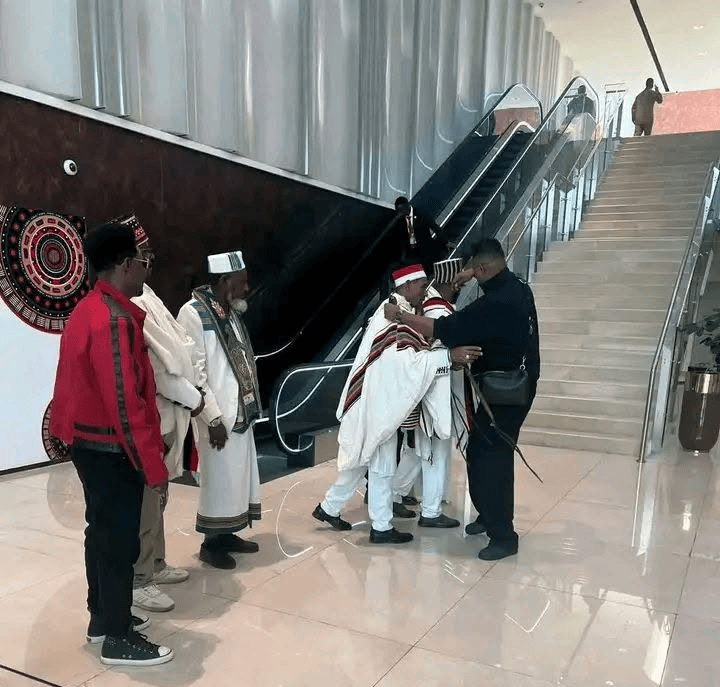
A Homecoming That Belongs to All
While the reception was held in Bole, the significance of Daawwitee Mokonnon’s return extends far beyond one city or one gathering. It belongs to every Oromo who has ever longed for home, every family separated by circumstance, and every artist who has carried their culture with them into unfamiliar lands.
His journey back is a testament to the power of perseverance and the unbreakable connection between an artist and his people.
Baga nagaan gara biyya abbaaketti galte, Daawwitee! 🥰
Welcome home.
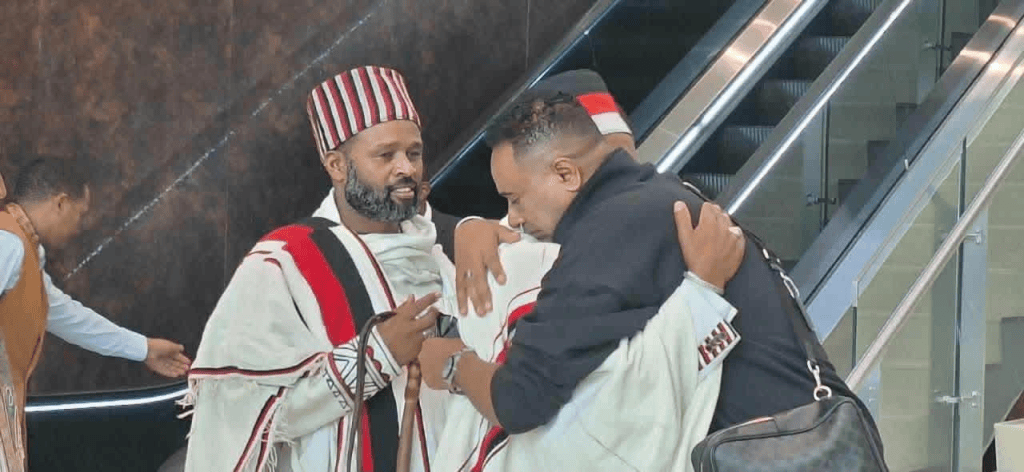
Source: Oromia Communication Bureau

Preserving the Sacred: Why Irreechaa Needs Correction, Not Just Celebration
By Dhabessa Wakjira
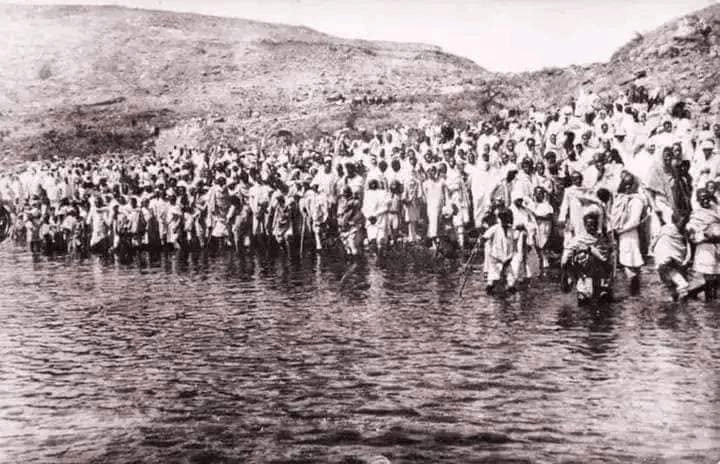
Irreechaa is more than a festival. It is a sacred covenant between the Oromo people and Waaqa — a day of thanksgiving, reconciliation, and renewal that has survived centuries of suppression. But as the celebration grows in size and visibility, so too does the need to protect its spiritual integrity.
A recent community message, circulated among Oromo elders and youth, raises urgent concerns about practices that have crept into modern Irreechaa celebrations — practices that, while perhaps well-intentioned, risk distorting the festival’s deep cultural and spiritual meaning. The message is not an attack on the celebration. It is a call to return to the duudhaa — the sacred customs and traditions — that give Irreechaa its power.
The concerns can be grouped into four key areas that, according to the message, must be corrected.
1. The Time of Irreechaa Malkaa Must Not Be at Night
The first concern is about timing. According to Oromo tradition, Irreechaa Malkaa should not be performed at night. The Oromo people have their own natural sense of time, rooted in family life and community rhythms. A person rises, tends to their household, prepares coffee, and then proceeds to the water’s edge for Irreechaa — honoring the customs passed down through generations.
The tradition describes how participants should approach the water: carrying fresh grass and flowers, singing the sacred songs of Mareyoo, and moving with reverence. Elders sing “Araaroo yaa araari hoo / Ararsaa waaqatu jalaataa / Nuuf Ararami hoo” — calling for peace and blessing from Waaqa. The youth accompany the elders respectfully, and upon reaching the Malkaa, no one should make noise or ululate until the Irreechaa ceremony at the water is complete.
This is a call to restore the solemnity and order that should define the procession. Irreechaa is not a chaotic gathering; it is a structured, reverent spiritual journey.
2. The Water Ritual Must Follow Tradition
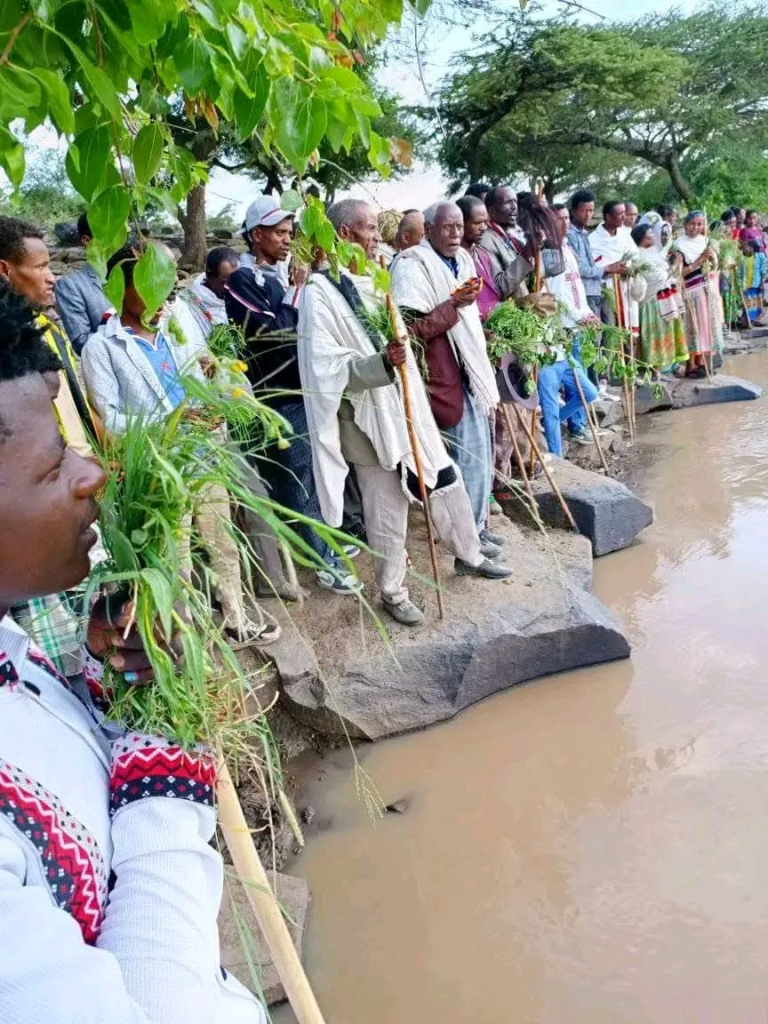
The second concern addresses how the water ritual is performed. According to the message, sprinkling water on oneself and others — or turning back before reaching the designated Irreechaa site — is not part of Oromo duudhaa. The practice of indiscriminately splashing water, the message warns, resembles a “cuubbaa” (baptismal) ritual rather than the traditional Oromo offering.
The Abbootii Gadaa (Gadaa leaders) are called upon to correct this. The water of Irreechaa is sacred — it is meant for purification and blessing in a specific, reverent manner, not for casual splashing. The distinction matters because Irreechaa is rooted in Waaqeffannaa, the traditional Oromo faith, and its rituals must remain true to that origin.
3. Vehicles Must Not Obstruct the Path to the Malkaa
The third concern is practical but deeply important: the overuse of vehicles on Irreechaa day is obstructing access to the Malkaa. While some vehicles are genuinely necessary — for security, emergency services, or for elderly and disabled participants — the message argues that too many cars are being used for entertainment and convenience, narrowing the roads and blocking the path for those who wish to walk.
The message specifically notes that artists and well-known figures should walk with the community rather than being driven, closing roads and causing hardship for ordinary participants. The image of last year’s Irreechaa, where celebrants struggled because roads were blocked by vehicles carrying notable figures, is still fresh in memory.
Irreechaa is a communal pilgrimage. Walking together — as one people, regardless of status — is part of what makes it sacred. Vehicles should be limited to genuine necessity, not convenience or display.
4. Respect for the Spiritual Boundaries of Irreechaa
The fourth concern is perhaps the most sensitive. The message observes that people of other faiths are attending Irreechaa and engaging in practices that contradict its spiritual purpose — including singing, preaching, and distributing religious materials at the Malkaa that promote beliefs other than Waaqeffannaa.
The message does not say that non-Waaqeffannaa participants are unwelcome. Irreechaa is a national and cultural celebration, and all Oromos are invited to share in it. But the Malkaa is a sacred space with its own spiritual rules. Those who come should respect the boundaries of the tradition they are joining. Proselytizing at the water’s edge — whatever the faith — is not part of Irreechaa and does not honor its purpose.
The message calls on those who engage in such practices to reflect on their actions, and on the Abbootii Gadaa to safeguard the spiritual integrity of the festival.
The Call to the Abbootii Gadaa
The message concludes with a direct appeal: the Abbootii Gadaa and community elders must take the lead in correcting these practices. Specifically, they are asked to address:
- Celebrations at 10 PM that should not be happening
- The sprinkling of water that departs from tradition
- The obstruction of roads by unnecessary vehicles
- The introduction of foreign religious practices at the Malkaa
These are not minor details. They are the difference between a festival that honors its ancestors and one that drifts into something unrecognizable.
Irreechaa Is Peace, Reconciliation, and Blessing
The message ends with a reminder of what Irreechaa truly is:
“Irreechi Nagaa, Araara, Milkii fi quufa. Baga geenye!”
“Irreechaa is Peace, Reconciliation, Blessing, and Abundance. Welcome!”
This is the heart of the matter. Irreechaa is not a party. It is not a parade. It is not a platform for personal recognition or religious outreach. It is a sacred act of gratitude to Waaqa, a communal reconciliation, and a prayer for peace and abundance in the year to come.
If the celebration is to remain meaningful for future generations, it must be practiced with the same reverence, order, and fidelity to tradition that has kept it alive for centuries — through persecution, suppression, and diaspora.
The message is a wake-up call. And it is one that deserves to be heard.

Peace Celebrations Behind the Storm: The “Festival Politics” of Oromia and Tigray
FINFINNE — When the Oromo thanksgiving festival Irreecha and the Ethiopian Orthodox Meskel festival arrive in the capital and surrounding areas within two weeks of each other, the official messaging is strikingly uniform: everything is for peace.
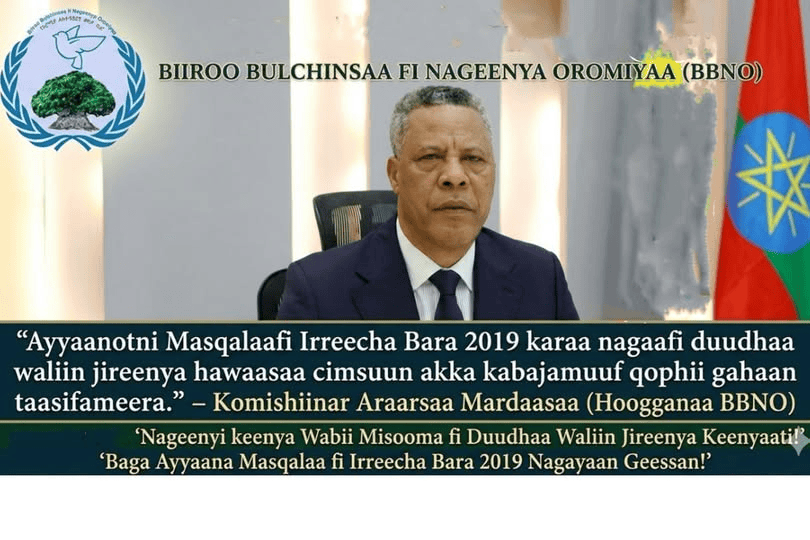
Mardasa, Director of the Oromia Bureau of Administration and Security and Peace Commissioner, stated that security agencies have made full preparations to celebrate both festivals “in a peaceful manner and under the traditions of unity and coexistence.” The federal police have also pledged to deploy adequate forces at Hora Finfinne, Hora Harsadi, and other locations.
Yet behind this placid official statement, Ethiopia in 2026 faces its most severe security situation since the end of the Tigray war in 2022. For a country mired in multi-front conflicts, the “security preparations” for two festivals are far from routine.
Surface Calm and Deep Fear
Irreecha is the single most important thanksgiving celebration for the Oromo people, marking the end of the rainy season and the beginning of the harvest. This year’s Irreecha will be held on Meskerem 23 and 24 in the Ethiopian calendar (October 3 and 4 in the Gregorian calendar) at Hora Finfinne in Addis Ababa and Hora Harsadi in Bishoftu. Masqala took place two weeks earlier in mid-September, with the Demera bonfire ceremony at Meskel Square in the capital drawing large crowds.
Official statements emphasize “coordinated cooperation between security agencies and religious leaders, Gadaa elders, Siinqee women’s representatives, and youth,” and call on the public to “immediately report any suspicious circumstances to the nearest security agency.” This phrasing itself reveals tension.
The concern is not unfounded. During the 2016 Irreecha celebration in Bishoftu, clashes between police and protesters triggered a stampede that killed at least 52 people, becoming a turning point for large-scale anti-government protests in Oromia. At that time, protesters raised crossed wrists—a gesture that later became a symbol of resistance—and advanced toward the stage. Police responded with tear gas and rubber bullets, and people fell into deep ditches as they fled.
A decade later, the political fractures in that land are far from healed.
“Peace” Under Siege
Peace Commissioner Mardasa’s statement was issued at an extremely delicate moment. Just days earlier, seven armed groups announced an alliance aimed at “overthrowing” Prime Minister Abiy’s federal government. Alliance members include the Tigray People’s Liberation Front (TPLF), the Amhara Fano militia, and the Oromo Liberation Army (OLA)—organizations whose historical enmity runs so deep that their union itself is a signal.
The federal government now faces armed insurgencies on three fronts simultaneously: Tigray, Amhara, and Oromia. Against this backdrop, the large gatherings for Irreecha and Masqala are both a security challenge and a political litmus test: can the government maintain effective control over the capital and surrounding areas in a wartime posture?
The U.S. State Department’s travel advisory lists large parts of Oromia at “Do Not Travel” level, citing “risks of armed conflict, kidnapping, and unrest.” Finland’s Ministry of Foreign Affairs warns that Ethiopia’s “political and ethnic tensions have led to an unstable situation, and unrest may further intensify.” A clear temperature gap exists between these international assessments and the official “everything is ready” posture.
The Dual Function of Festivals
Irreecha has never been merely a religious festival. In the Oromo Gadaa tradition, it is the transition from the “dark season” to the “light season,” a moment for the community to collectively wash away the misfortunes of the past year and pray for a bountiful year ahead. But in contemporary Ethiopia, it is also the largest-scale staging ground for Oromo identity politics.
Similarly, Masqala has a unique cultural embedding in the Oromia region. Academic research documents that during Masqala, Oromo communities perform Garmaama singing, which carries the collective emotional expression of “joy, sorrow, love, and longing,” a cultural ritual of “transition from the old era to the new.”
When these festivals are framed by officials under the banner of “peace and unity,” a sharp question emerges: who defines “peace”? Is it community reconciliation in the Gadaa elders’ tradition, or order and stability under federal government rule?
Peace Commissioner Mardasa’s statement repeatedly emphasizes coordination between “security agencies” and “community leaders,” but the real question may be: when community leaders themselves become a party to political contestation, are festival celebrations an opportunity for unity or a fuse for conflict?
The Risk of Silence
Addis Ababa police say they have made “coordinated preparations” for the Demera ceremony at Meskel Square, but as of press time, authorities have not published any specific traffic control plans, crowd management measures, or security deployment details for any single day. The Oromo Abbaa Gadaa Council frames this year’s Irreecha as an expression of “national consensus,” but in Ethiopia’s current context, that phrase reads more like a prayer than a description.
For the millions about to travel to Hora Finfinne and Hora Harsadi, the reality they face is: a government fighting on multiple fronts simultaneously, an armed opposition that has just formed an anti-government alliance, and a traumatic memory that cost 52 lives a decade ago.
The Peace Commissioner’s statement ends with a blessing: “May you return safely in this harvest season.” In this harvest season, the weight of those words is heavier than ever.

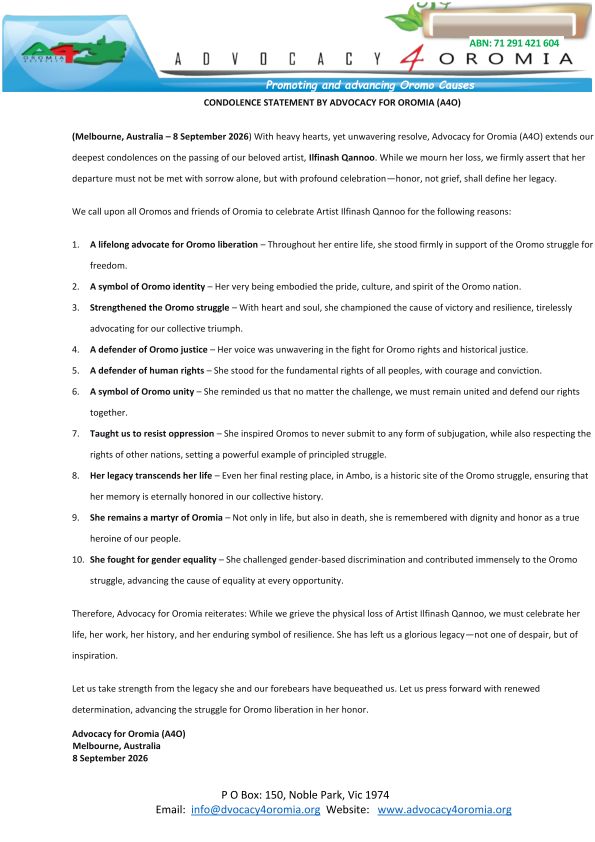
A Life Worth Celebrating—A4O Calls for Honor, Not Grief, for Artist Ilfinash Qannoo
By Our Correspondent
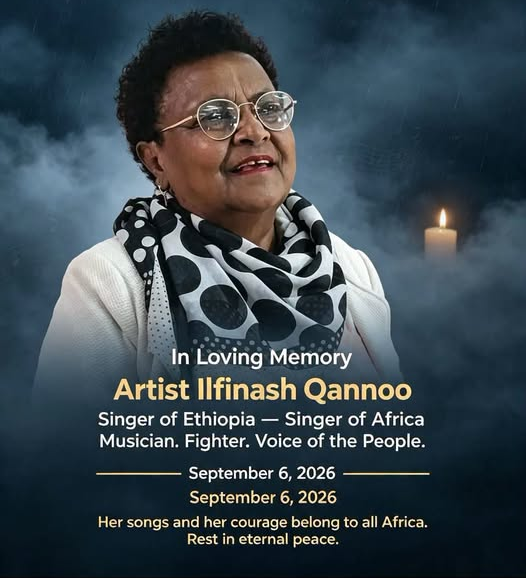
(Melbourne, Australia – 8 September 2026)-In a poignant and powerful statement released today, Advocacy for Oromia (A4O) has called on Oromos and friends of the struggle worldwide to transform mourning into celebration for the late artist and freedom fighter, Ilfinash Qannoo.
The Melbourne-based advocacy group, speaking from their Australian headquarters, emphasized that while the loss of the beloved artist is deeply felt, her life, legacy, and unwavering commitment to the Oromo cause demand a response of honor rather than sorrow.
A Life Dedicated to Liberation
Ilfinash Qannoo was no ordinary artist. According to A4O, she was a steadfast pillar of the Oromo liberation movement, dedicating her entire life to the struggle for Oromo self-determination. Her artistry was not merely entertainment—it was resistance. Her voice was not just melody—it was a clarion call for justice.
“Artist Ilfinash Qannoo spent her whole life supporting and advancing the Oromo struggle for freedom,” the statement reads, positioning her among the most committed cultural warriors of her generation.
More Than an Artist—A Symbol
A4O’s statement highlights ten compelling reasons why Ilfinash Qannoo’s legacy must be celebrated:
A Symbol of Oromo Identity: She embodied the pride, dignity, and cultural richness of the Oromo nation. Her very presence was a testament to Oromo resilience and identity.
Champion of Justice: She was a fearless defender of Oromo rights, human rights, and gender equality. She challenged oppression in all its forms and stood against discrimination, including gender-based injustice.
Unifier of the Oromo People: At a time when division threatens the struggle, Ilfinash Qannoo stood as a powerful symbol of Oromo unity, reminding her people that solidarity is the foundation of victory.
Teacher and Inspiration: Through her life and work, she taught Oromos to resist subjugation with dignity, while also respecting the rights of other nations—a rare and powerful example of principled advocacy.
Martyr for the Cause: Her final resting place in Ambo is now etched into the historical landscape of the Oromo struggle. Her grave, like her life, has become a site of memory and honor.
A Legacy That Transcends Death
Perhaps the most striking aspect of A4O’s tribute is the assertion that Ilfinash Qannoo’s impact extends far beyond her lifetime. She did not simply live for Oromia; she ensured that even in death, she would remain a rallying figure for the movement.
“She left us not with despair, but with a glorious legacy,” the statement declared. “We are called to take strength from what she and our forebears have left us, and to rededicate ourselves to the struggle with renewed vigor.”
A Call to Action, Not Lamentation
In what can be described as a clarion call to the Oromo diaspora and the wider movement, A4O urged supporters to channel their grief into action. The organization stressed that the most fitting tribute to Ilfinash Qannoo is not tears, but a renewed commitment to the goals she championed.
“We must celebrate her life, her work, her history, and her enduring symbol of resilience,” the statement emphasized. “Let us march forward in her honor, advancing the struggle for Oromo liberation with determination and unity.”
Global Reach of the Statement
Issued from Melbourne, Australia, on 8 September 2026, the statement reflects the global nature of the Oromo struggle and the far-reaching influence of cultural icons like Ilfinash Qannoo. A4O’s message transcends geographic boundaries, speaking directly to Oromos in the homeland and across the diaspora.
The advocacy group concluded with an unwavering declaration: “Victory to Oromia!” —a fitting epitaph for a woman whose life was dedicated to that very cause.
Historical Context
Ilfinash Qannoo’s passing marks the end of an era in Oromo cultural and political history. She was among a generation of artists who used their craft as a weapon of resistance, challenging the status quo and inspiring millions. Her death is not just a loss of talent, but the departure of a moral compass for a movement in constant pursuit of justice.
As Oromos around the world reflect on her legacy, A4O’s message is clear: Grieve, yes—but more importantly, celebrate. Honor her by carrying the torch she has passed on.
About Advocacy for Oromia (A4O): Based in Melbourne, Australia, A4O is a diaspora advocacy organization committed to advancing the rights, justice, and self-determination of the Oromo people through awareness, advocacy, and solidarity initiatives.
“We mourn her loss, but we celebrate her life—for in her, Oromia found a voice that will never be silenced.”

A Nation Mourns: The Passing of a Giant—Adde Ilfinesh Qannoo (1962-2026)
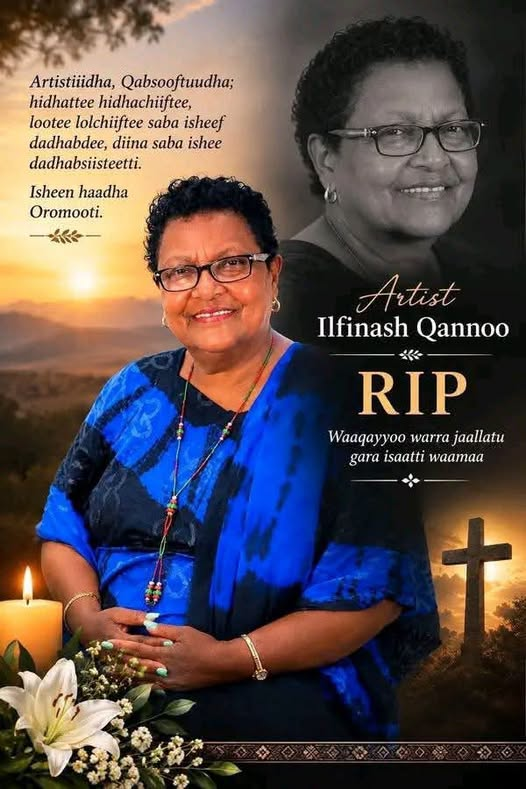
A Voice of Freedom Falls Silent, But Her Legacy Echoes Eternally
Finfinne, Oromia — Our nation lost a giant today. Adde Ilfinesh Qannoo, the renowned artist whose voice became the heartbeat of a people’s struggle, has passed from this world, leaving behind a legacy etched in the soul of the Oromo nation. Her departure marks the end of an era, but her spirit, her music, and her unyielding commitment to the Qabsoo Bilisummaa Oromoo (Oromo Liberation Struggle) will resonate for generations to come.
An Indelible Mark on History
Ilfinesh Qannoo was more than an artist; she was a monument to resilience, a symbol of identity, and a mother to a movement. Through her music, she gave voice to the joys, sorrows, and aspirations of her people, becoming a living archive of their history. Her songs, imbued with the deep cultural motifs of the Oromo, served as both a comfort and a call to action, reminding her listeners of their dignity, their heritage, and their unalienable right to freedom.
Her contributions to the Qabsoo Bilisummaa Oromoo were not merely artistic but deeply personal and sacrificial. She understood that the struggle for liberation was fought not only in the forests and on the battlefields but also in the hearts and minds of the people. Through her music, she fortified the spirit of the movement, offering hope in moments of despair and courage in the face of oppression.
A Faithful and Loyal Contributor
Throughout her life, Ilfinesh Qannoo remained steadfast in her dedication to the Oromo cause. She was a loyal contributor to the liberation struggle, using her platform to amplify the voices of the marginalized and to challenge the systems of injustice that sought to silence her people. Her courage in the face of censorship, persecution, and hardship stands as a testament to her character and her unwavering commitment to justice.
Even when her body grew frail and her steps grew slow, her spirit remained an unyielding force. Her presence at gatherings of the Oromo Liberation Front (OLF) and other movement events was a source of inspiration and moral clarity. She was the living embodiment of the Oromo proverb “Ilkaan socho’e buqqa’uun isaa hin oolamu”—a seed that moves does not rot. She was that moving seed, ensuring that the dream of liberation never decayed.
A Legacy That Lives Forever
Though her physical journey has ended, the essence of Ilfinesh Qannoo—her music, her symbolism, her love—is a permanent inheritance for the Oromo people. Her life continues to resonate, to inspire, and to fortify those who hold her memory dear. She may have left this world, but her voice remains, echoing in the songs that will be sung, the stories that will be told, and the hearts that will never forget.
Her legacy exists at a powerful intersection: the intimate space of a family mourning a beloved matriarch, and the public sphere honoring an artist who channeled a people’s soul. As flowers are laid and her songs are played anew, the Oromo nation is not just saying goodbye. They are affirming that the struggle she gave voice to continues, the identity she symbolized remains unbroken, and the love she embodied is eternal.
A Message of Condolence from Advocacy for Oromia (A4O)
The Advocacy for Oromia (A4O) joins the global Oromo community in mourning this profound loss. In a statement released today, the organization extended its heartfelt condolences to Ilfinesh Qannoo’s family and the entire Oromo nation:
“Our nation lost a giant today. Adde Ilfineesh Qannoo, a renowned artist and loyal contributor to the Qabsoo Bilisummaa Oromoo, has left an indelible mark on our people and our history. Her legacy will live on forever. The Advocacy for Oromia (A4O) extends its sincere condolences to her family and the entire Oromo nation. May she rest in peace, and may her memory continue to inspire us all.”
An Eternal Prayer
And so, we offer our unending prayer: that Adde Ilfinesh Qannoo’s soul finds the eternal comfort and peace it so deeply deserves. May her spirit rest gently, knowing that her life was a masterpiece of love, labor, and liberation. For her family, her friends, and her people, we wish the warmth of her memory, the strength of her example, and the profound solace that comes from knowing her legacy is in the most capable hands: the hands of a people who will never forget.
Rest in peace, Adde Ilfinesh Qannoo. Your struggle is over, but your victory is assured in the hearts of those you loved and who loved you in return.
—
“A name is above the grave, and your name, Ilfinesh Qannoo, is etched in gold in the annals of Oromo history.”
—
This tribute is offered by Advocacy for Oromia (A4O) and the global Oromo community in loving memory of Adde Ilfinesh Qannoo.

The Unshakable Pillar: Why One Foundational Aspiration Will Outlast Every Attempt to Destroy It
By Dhabessa Wakjira
—
In the quiet corners of history, in the roar of revolutions, and in the whispered hopes of ordinary homes, one truth has endured: human beings are born with an innate longing for equality, freedom of thought, and dignity.
This is not a modern invention. It is not a Western import, nor an Eastern myth. It is the quiet fire that lit every abolition movement, every suffrage march, every student protest, and every parent’s prayer for a better future. And in our own community—ummata keenya—this aspiration has been planted like a deep-rooted tree.
That tree is OLF—not as a slogan, but as a living, breathing promise: that no person is above another; that no mind should be chained; that every voice carries the weight of sacred worth.
—
The Aspiration That Refuses to Die
The original text reminds us: “ABOn waan bu’uraa tokko ummata keessa kaahee jira.”
There is, among the people, one foundational principle. It is not written in stone alone—it is written in conscience. It says:
· Equality is not a privilege; it is a birthright.
· Freedom of thought is not a concession; it is the soil where truth grows.
· Dignity is not a reward; it is the oxygen of human existence.
This aspiration, the text insists, cannot be stopped or erased in any form. Not by armies. Not by laws. Not by propaganda. Not by time.
Why? Because it is not borrowed from a constitution or a king. It is discovered—in the cry of a child, in the sweat of a labourer, in the silent grief of a mother, in the bold question of a teenager. It is experiential before it is philosophical.
—
The Many Faces of Opposition
History is littered with attempts to suffocate this aspiration.
· Tyrants have banned books.
· Dictators have jailed thinkers.
· Empires have rewritten histories.
· Corporations have commodified attention.
· Algorithms have tried to herd our thoughts into safe, sellable boxes.
Yet every time, the aspiration returns—not in the same shape, but in a stronger one.
Why? Because suppression is reactive; aspiration is generative.
· Suppression says: “You must not think this way.”
· Aspiration replies: “Then I will think deeper.”
· Suppression says: “You are unequal by nature.”
· Aspiration answers: “Then I will build communities that prove you wrong.”
This is why the text declares: “Kun dhugaa bara baraan dhaloota walqixxummaa fi bilisummaa barbaadan kamiyyuu keessa kan jiraatuu dha.”
It is the permanent inheritance of every generation that dares to seek equality and liberty. Not a relic of the past—but a living torch passed from hand to hand, across fire and flood.
—
What Does This Mean for Us Today?
In our own time—fractured by misinformation, polarized by identity, exhausted by performative justice—this foundational aspiration calls us back to simplicity and courage.
It asks us:
· Do we treat the stranger at our gate as our equal, or as a threat?
· Do we listen to an idea we hate with the same patience as one we love?
· Do we defend dignity for the powerless, even when it costs us comfort?
If the aspiration is truly unkillable, then our job is not to protect it—but to practice it. Because an aspiration that lives only in speeches is a ghost. An aspiration that lives in schoolrooms, marketplaces, courtrooms, and dinner tables—that is a revolution.
—
The Final Word: A Promise, Not a Puzzle
Some will try to redefine this aspiration. They will twist it into a weapon, a commodity, or a vague slogan. But the core remains indestructible:
Every person holds the right to be free, to think boldly, and to stand equal before their fellow human.
No empire, no algorithm, no crisis can undo that truth—because it is not built on fragile institutions. It is built on the fragile, fierce, unbreakable human heart.
And as long as one parent teaches a child to question, one writer speaks truth to power, one citizen refuses to kneel—that aspiration lives.
It has survived every storm before us.
It will survive every storm ahead.
Not because we are lucky.
But because we are human.
—
“ABOn waan bu’uraa tokko ummata keessa kaahee jira.”
May we never forget it. May we never betray it. May we live it—until it needs no defense.

The Legend of Waacoo Dabaloo: A Hero Who Defied an Empire
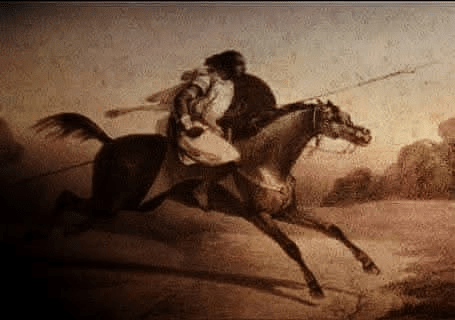
Remembering the Oromo Warrior Who Chose Resistance Over Submission
By Malkaamuu Taarikuu Amoosaa
(Asosa, August 11/2026)-In the oral traditions of western Oromia, few names command the reverence of Waacoo Dabaloo—a warrior whose defiance against the expansion of the Ethiopian Empire has become the stuff of legend. While his story remains largely unrecorded in formal histories, it lives on in the songs, proverbs, and collective memory of the Oromo people, particularly in the Jaarsoo district of East Wallagga.
A Lineage Rooted in Resistance
Waacoo Dabaloo was born in what is now the Jaarsoo district of East Wallagga Zone, a region known historically as “Citaa Akkumaa.” Today, the area lies approximately 525 kilometres west of Finfinne (Addis Ababa) and 103 kilometres west of Gimbi, the zonal capital. The district is bordered by Najjoo to the east, Baabboo Gaambel to the west, Gullisoo to the south, and Lataa Sibu to the north, covering an area of 491.6 square kilometres.
Waacoo Dabaloo belonged to the Sibuu clan of the Oromo people—a lineage that traces its origins to the Maccaa branch of the Oromo nation. The Sibuu are one of the seven sons of Daallee (or Daadhii), who was himself a descendant of the Oboo clan. This deep-rooted lineage gave Waacoo a profound connection to the land and people he would later defend.
The Context of Conflict
Waacoo Dabaloo came of age during the latter half of the 19th century, a period when Emperor Menelik II’s expansionist campaigns were sweeping through southern and western Oromia. This era was marked by brutal subjugation, land dispossession, and the systematic erasure of Oromo identity. While some local leaders chose to submit to the advancing forces, Waacoo Dabaloo stood firm.
The historical record suggests that Waacoo formed alliances with other prominent Oromo resistance figures, most notably Abiishee Garbaa of the Horro Guduru region. Together, they coordinated efforts to resist the encroaching empire, exchanging messengers and supporting each other during times of attack.
The Art of Guerrilla Warfare
What makes Waacoo Dabaloo’s resistance remarkable is that he fought without modern weaponry. Armed only with the traditional spear and shield, he employed guerrilla tactics—using his intimate knowledge of the forests and terrain of Jaarsoo and surrounding areas to launch ambushes and disappear before the enemy could retaliate.
Songs composed in his honour still echo in the region:
“Waacoon daggala galee,
Daggallikoo hin qabiniin.
Inni farda koomfatee,
Mootichi hin dhabamiin!”“Waacoo entered the forest,
He does not lack forest.
He led his horse forward,
The emperor will not find him!”
Another song praises his mount, a horse named Biichee:
“Mee fardaan dhufe jedhaa,
Biicheen Waacoo Dabaloo.
Gootni eeboo luqqisee,
Diinaaf laatu gadoo!”“They say he came on horseback,
Biichee, the horse of Waacoo Dabaloo.
The hero brandished his spear,
Brought death to the enemy!”
A Difference in Strategy
While some Oromo leaders, including a figure named Kuumsaa, chose to negotiate with Menelik’s forces—accepting titles and positions in exchange for submission—Waacoo Dabaloo refused. He saw such compromises as a form of enslavement.
“Paying tribute to the northern empire is servitude,” he is said to have declared. “We must not give away our ancestors’ land to anyone.”
His refusal to submit ultimately led to his capture through betrayal rather than defeat on the battlefield. Like many Oromo heroes, Waacoo Dabaloo was not conquered by force but brought down through deception—a pattern that echoes throughout Oromo history.
A Legacy Etched in the Land
Today, the memory of Waacoo Dabaloo is kept alive not only in song but also in the landscape. A hotel in Jaarsoo town, built by his descendants, bears his name as a testament to his enduring legacy. For the Oromo people, Waacoo Dabaloo represents the spirit of defiance—the refusal to submit to oppression, even at the cost of one’s life.
His story is part of a broader tapestry of Oromo resistance that includes figures like Waaqoo Guutuu, Aliyii Cirrii, and Bakar Waaree. Like them, Waacoo Dabaloo’s sacrifice reminds the current generation that freedom and dignity are worth fighting for.
Injifannoon Ummata Oromoo!
Gootummaa Waacoo Dabaloo haa jabaattu!
This feature article is based on oral histories and the reflections of Malkaamuu Taarikuu Amoosaa, dedicated to preserving the legacy of Oromo heroes.






