“A Nation Approaching Spiritual Death”: MLK’s Warning and the Moral Case for Social Justice Over Military Spending
By Dhabessa Wakjira
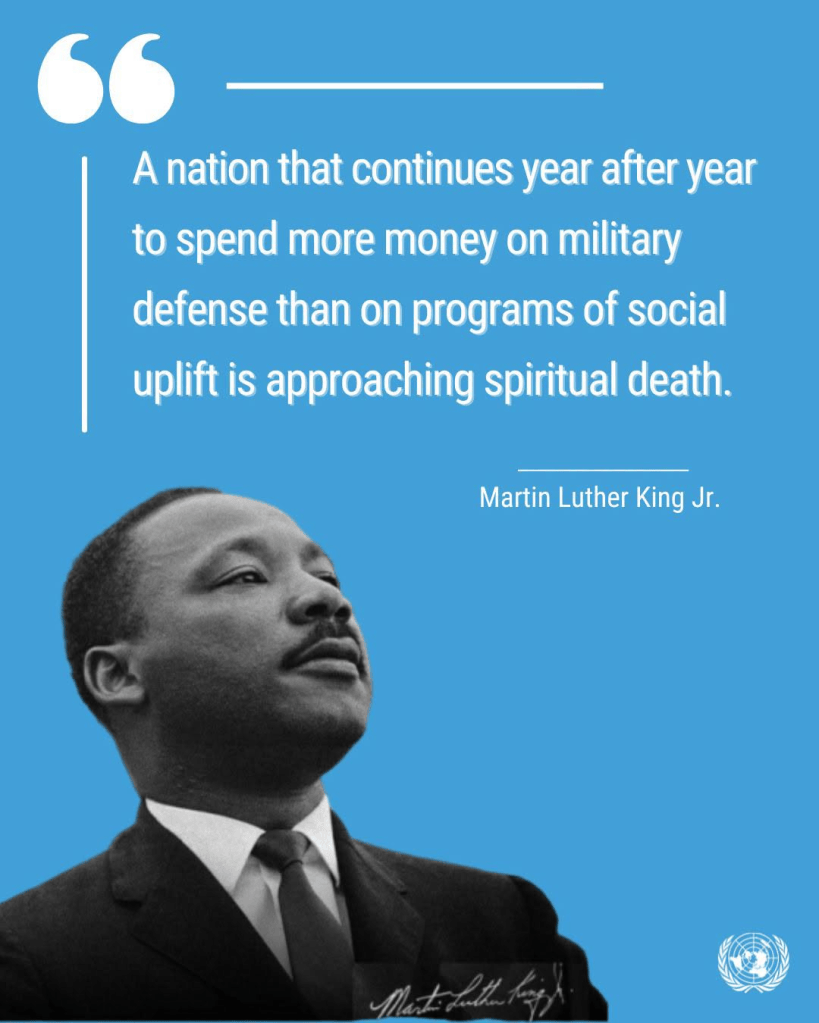
More than half a century after his death, Martin Luther King Jr.’s words continue to cut through the noise of political debate with unsettling clarity. “A nation that continues year after year to spend more money on military defense than on programs of social uplift is approaching spiritual death,” King declared in 1967, in a speech that would prove to be one of his most prophetic. His message reminds us that building peace through social justice is not a policy preference—it is a moral responsibility.
The Context of a Prophetic Warning
King spoke these words at a moment of profound national tension. The United States was deep in the Vietnam War, spending billions on military operations abroad while poverty, inequality, and racial injustice continued to ravage communities at home. King had come to see the connection between the two—what he called the “giant triplets of racism, extreme materialism, and militarism.” For King, these were not separate problems but interlocking systems of oppression. A nation that could find endless resources for war but not for the poor was a nation that had lost its moral compass.
His warning was not merely about budgets. It was about priorities, values, and the soul of a nation. “Spiritual death” was King’s way of describing what happens when a society becomes so invested in violence and domination that it can no longer recognize the humanity of its own people—when the means of destruction are funded more generously than the means of life.
The Relevance Today
King’s words resonate with uncomfortable force in 2026. Global military spending has reached record levels, with nations around the world pouring trillions into defense budgets while social programs—education, healthcare, housing, and poverty alleviation—remain chronically underfunded. The gap between what societies spend on war and what they spend on peace is not merely a fiscal statistic; it is a moral indictment.
In Ethiopia and across the Horn of Africa, the consequences of this imbalance are visible. Resources that could be used to build schools, hospitals, and infrastructure are diverted to conflict. Communities that have suffered from war and displacement continue to wait for the “peace dividend” that never arrives. The lesson King articulated—that a nation cannot bombs its way to security while neglecting the well-being of its people—is as true today as it was in 1967.
Peace Through Social Justice
King’s message was not merely a critique of military spending; it was a vision of what true peace requires. “True peace is not merely the absence of tension; it is the presence of justice,” he famously said. Peace cannot be built on the backs of the poor, the marginalized, or the dispossessed. It requires a commitment to social uplift—to ensuring that all people have access to the basic conditions of a dignified life.
This is the moral responsibility that King’s words place before us. To build peace through social justice means to prioritize the well-being of communities over the projection of power. It means to invest in education, healthcare, and economic opportunity as seriously as nations invest in weapons. It means to recognize that the true measure of a society’s strength is not the size of its military but the quality of life it provides for its most vulnerable members.
A Call to Conscience
King’s warning is not a call to naivety. He understood that the world is dangerous and that nations must defend themselves. But he insisted that the pursuit of security through military means alone is self-defeating. A nation that continues to choose guns over butter, bombs over books, and war over welfare is not strong—it is slowly dying from the inside.
His words challenge us to ask uncomfortable questions: What are our true priorities? Who benefits from the current arrangement? And what would it take to build a society where the needs of the many are not sacrificed for the ambitions of the few?
Conclusion
Martin Luther King Jr.’s message is not a relic of the past. It is a living challenge to every generation. His warning about spiritual death is a reminder that the choices we make about how we spend our resources are not merely political decisions—they are moral ones. Building peace through social justice is not optional. It is our responsibility. And it is the only path to a future that honors the dignity of all people.
“A nation that continues year after year to spend more money on military defense than on programs of social uplift is approaching spiritual death.” — Martin Luther King Jr.

Posted on November 4, 2026, in Aadaa, Afaan, Confidentiality, Diaspora, Election, Events, Finfinne, freedom, gadaa, health, Information, Kindness, Language, Media, News, Oromia, Press Release, Promotion. Bookmark the permalink. Leave a comment.






Leave a comment
Comments 0