In the Shadow of Conflict: What Reports Say About Civilian Suffering in Oromia
By Daandii Ragabaa
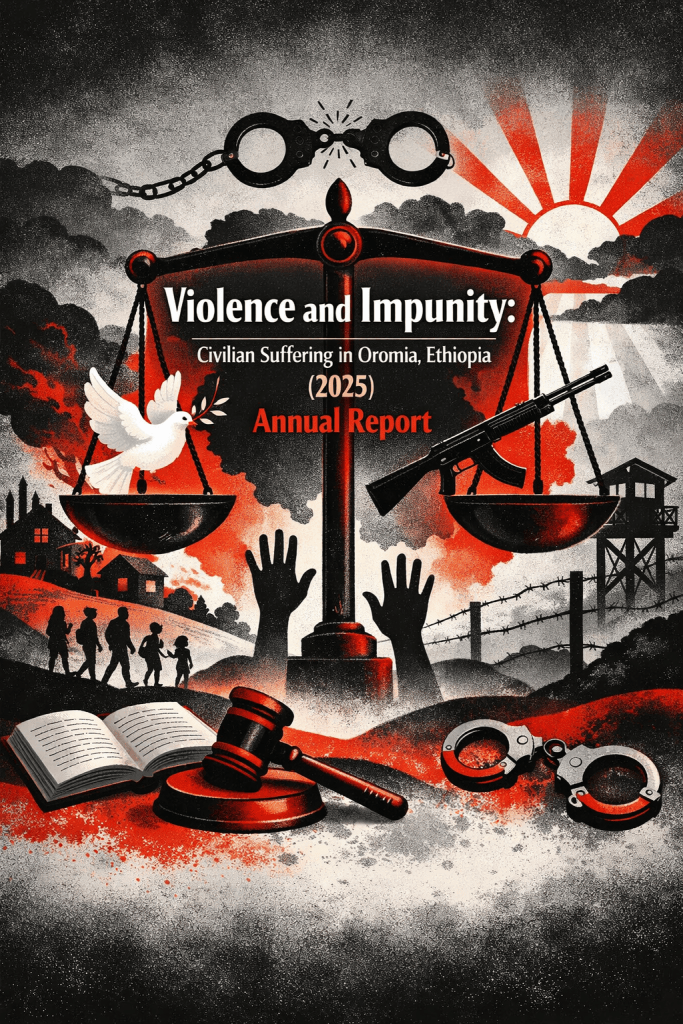
For years, the Oromia region of Ethiopia has been the site of an armed conflict that has largely unfolded outside the international spotlight. While the world’s attention has often focused elsewhere, human rights organizations, UN bodies, and advocacy groups have documented a pattern of violence affecting civilians—perpetrated by both government forces and armed opposition groups.
This is not a story of a single narrative. It is a story of competing accounts, documented abuses, and a civilian population caught in between.
A Conflict With Many Actors
Fighting between the Ethiopian National Defense Forces (ENDF), allied regional security forces, and the Oromo Liberation Army (OLA) erupted in 2019 and continues to take a heavy toll on civilians . Human Rights Watch’s World Report 2026 noted that fighting in parts of Oromia “resulted in civilian casualties and displacement,” with over 11,000 people displaced in late May alone due to violence in border areas .
In February 2026, twenty international and regional human rights organizations warned that Ethiopia was “on the brink” of renewed large-scale conflict, citing reports of extrajudicial killings, mass arrests, property destruction, forced conscription, and collective punishment of civilians in Oromia. They stressed that limited humanitarian access and the absence of independent monitoring have entrenched cycles of violence .
Documented Abuses
By OLA fighters: Amnesty International’s March 2026 briefing documented rape, gang rape, sexual slavery, summary killings, and destruction of civilian property by OLA fighters in Sayo and Anfillo districts of Kellem Wallaga zone between 2020 and 2024. The organization interviewed 10 survivors of gang rape, seven of whom were under 18 at the time. Five had also been subjected to sexual slavery. Amnesty stated these abuses “may amount to war crimes” .
One survivor, identified as Sebontu, described being held for three weeks with her mother, hands tied to a tree: “They used to rape us every day, twice a day… They used to tell me, ‘You will die. You will never return home'” .
By government forces: A written statement submitted to the UN Human Rights Council by the Oromia Support Group in Australia, a NGO in special consultative status, alleged that national defense forces have used drones and heavy artillery in attacks on villages, that villages in areas where the OLA is active have been burned, and that government forces have targeted young men known as the Qerroo generation. The group claimed to have recorded 7,340 Oromo civilian killings since the end of 2018, including 1,064 since the beginning of 2025 . These figures could not be independently verified.
Attacks on religious communities: In October 2026, armed men attacked Orthodox Christian civilians in Oromia, killing at least 60 people and burning homes, according to a synod spokesperson. The regional government blamed the OLA .
A Pattern of Silence
Multiple sources point to a common concern: the conflict in Oromia has received far less international attention than the war in Tigray, despite Oromia being Ethiopia’s largest and most populous region.
Amnesty International’s Regional Director for East and Southern Africa, Tigere Chagutah, stated: “For seven years, under the cover of darkness caused by a communication and media blackout, fighters in the Oromia region have caused immense suffering on civilians” .
The Oromia Support Group’s statement to the UN noted that “poor access and communication hinder data collection,” particularly in Guji and Borana zones . The joint letter from 20 organizations warned that “shrinking civic space, restrictions on independent reporting, and the termination of accountability mechanisms are obscuring the scale of violations” .
Competing Narratives
The Ethiopian government rejects characterizations of the conflict as one-sided oppression. In a November 2026 interview with Oromia Broadcasting Network, Prime Minister Abiy Ahmed described armed groups in Oromia as lacking “any real political vision, operating instead with the sole purpose of killing innocent civilians and looting.” He stated that “thousands of militants are laying down their weapons every day” and reaffirmed that the door for peace remains open .
These competing accounts—of government counterinsurgency and armed resistance, of victims on multiple sides—make independent verification difficult and underscore the complexity of the situation.
What Remains Undeniable
What credible sources agree on is that civilians are suffering. Whether through direct violence, displacement, sexual violence, or the destruction of homes and livelihoods, the people of Oromia bear the heaviest burden of a conflict that shows few signs of resolution.
Amnesty International has called on Ethiopian authorities to investigate atrocities and on the OLA to “immediately issue an order to all its fighters to respect international humanitarian law” . The joint letter from 20 organizations urged the UN Security Council and Human Rights Council to prioritize scrutiny of developments in Ethiopia and to press for independent monitoring and accountability .
For the civilians caught in the middle, these calls have yet to translate into safety.
Note on sources: This article draws on documentation from Amnesty International, Human Rights Watch, a UN Human Rights Council written statement, and reporting from Addis Standard and other outlets. Where claims originate from advocacy organizations, this has been noted. The situation in Oromia is contested, and readers should consult the original sources for full context.

Posted on November 29, 2026, in Aadaa, Afaan, Bokkkuu, Daaniyaa, Diaspora, Election, Events, Face of Injustice, family violence, Festival, Finfinne, freedom, gadaa, gender, Grief Support, Gumaa, health, Information, Language, Media, mental health, News, Oromia, Oromo diaspora, Oromo truth telling, OSG, Press Release, Promotion. Bookmark the permalink. Leave a comment.




Leave a comment
Comments 0