Category Archives: gender

We Must Not Remain Silent: The Unfolding Horror in Western Oromia

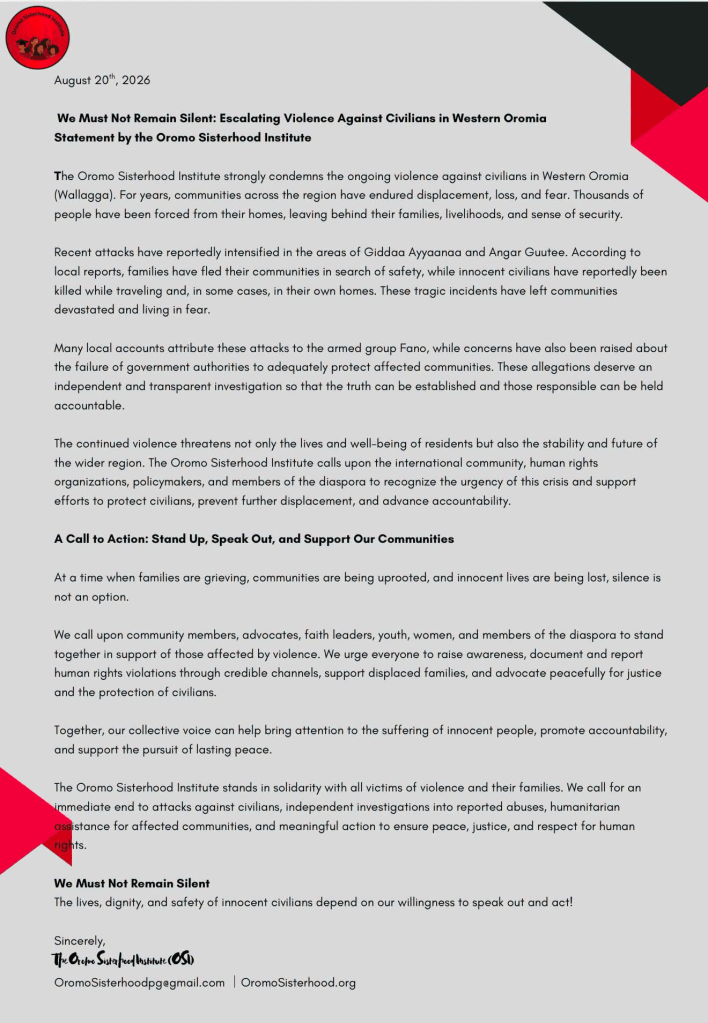
As violence escalates and thousands are displaced, the Oromo Sisterhood Institute issues a desperate plea: silence is complicity, and action cannot wait.
—
In the quiet villages of Western Oromia, a crisis of staggering proportions has been unfolding for years. But in recent weeks, the violence has reached a terrifying crescendo. The Oromo Sisterhood Institute (OSI) has issued an urgent condemnation of the escalating attacks against civilians in the Wallagga region—a humanitarian catastrophe that has displaced thousands, claimed countless lives, and left communities living in a state of paralyzing fear.
The areas of Giddaa Ayyaanaa and Angar Guutee have borne the brunt of the violence. According to local reports, families have been forced to flee their homes, leaving behind everything they have ever known. Civilians have reportedly been killed while simply traveling, while others have been murdered in their own homes—a brutal reminder that no place is safe.
The Oromo Sisterhood Institute, a leading voice for women’s rights and community protection, is sounding the alarm: the international community cannot afford to look away.
A Crisis of Accountability
While many attacks have been attributed to the Fano armed group, serious concerns have also been raised regarding the role of state actors and the Ethiopian government’s failure to adequately protect affected communities. The government’s apparent inaction raises deeply troubling questions about the protection of civilians and the rule of law.
OSI insists that these serious allegations warrant independent investigations to establish the facts, ensure accountability, and bring those responsible for abuses against civilians to justice.
“Western Oromia is widely recognized as an area of significant political and social importance,” the Institute states. “The continued violence threatens not only the security and well-being of local residents but also the stability of the broader region.”
The ongoing displacement of civilians and destruction of communities have both immediate and long-term humanitarian consequences. Families are being torn apart, children are being denied their futures, and an entire region is being pushed to the brink.
A Call to Action: Silence Is Not an Option
In the face of such unimaginable suffering, the Oromo Sisterhood Institute is issuing a powerful call to action. The message is clear and uncompromising: silence is not an option.
“We urge community members, advocates, civil society organizations, faith leaders, youth, women, and members of the diaspora to stand up for civilian protection, speak out against human rights violations, and support affected families and communities.”
The Institute is calling for:
· Strengthened advocacy and documentation of human rights violations through credible channels.
· Immediate humanitarian assistance for displaced families, whose basic needs remain unmet.
· Local, national, and international awareness campaigns to shine a spotlight on this unfolding tragedy.
· Unity and collective action to amplify the voices of victims, advance accountability, and contribute to the pursuit of justice and lasting peace.
Every Community Deserves Safety
The Oromo Sisterhood Institute’s message is rooted in a fundamental belief: every community has the right to live in safety, dignity, and freedom from violence. This is not a partisan issue; it is a human issue.
The Institute is calling upon international institutions, humanitarian organizations, and global human rights bodies to closely monitor the situation in Western Oromia and take meaningful action to ensure the protection of civilians and the prevention of further atrocities.
“We stand in solidarity with all victims of violence and their families,” OSI declares. “We call for an immediate end to attacks against civilians, independent and transparent investigations into reported abuses, humanitarian assistance for affected communities, and concrete measures to ensure lasting peace, justice, accountability, and respect for human rights in the region.”
The Cost of Inaction
As the violence continues to escalate, the world faces a choice: to act or to remain silent. The Oromo Sisterhood Institute has made its position unequivocally clear.
“We must not remain silent,” the statement concludes. “The lives, dignity, and security of innocent civilians depend on immediate attention and action.”
The people of Western Oromia are not just statistics; they are mothers, fathers, children, and communities whose lives hang in the balance. Their cries for help must not go unanswered. The time for action is now—before more lives are lost, more families are displaced, and more communities are destroyed.
The Oromo Sisterhood Institute calls upon the international community, human rights organizations, policymakers, and members of the diaspora to recognize the seriousness of the situation and to support efforts aimed at protecting civilians, preventing further displacement, and promoting accountability for human rights violations.
The world must not remain silent. The time to act is now.
—
The Oromo Sisterhood Institute (OSI) is a civil society organization dedicated to promoting the rights, dignity, and well-being of Oromo women and communities. Through advocacy, awareness, and collective action, OSI works to amplify the voices of the marginalized and advance justice and lasting peace.
#UNHumanRightsCouncil#Oromia#Wallagga#Justice#HumanRights

Irreechaa 2026: Africa’s Largest Gathering of Gratitude and Resilience
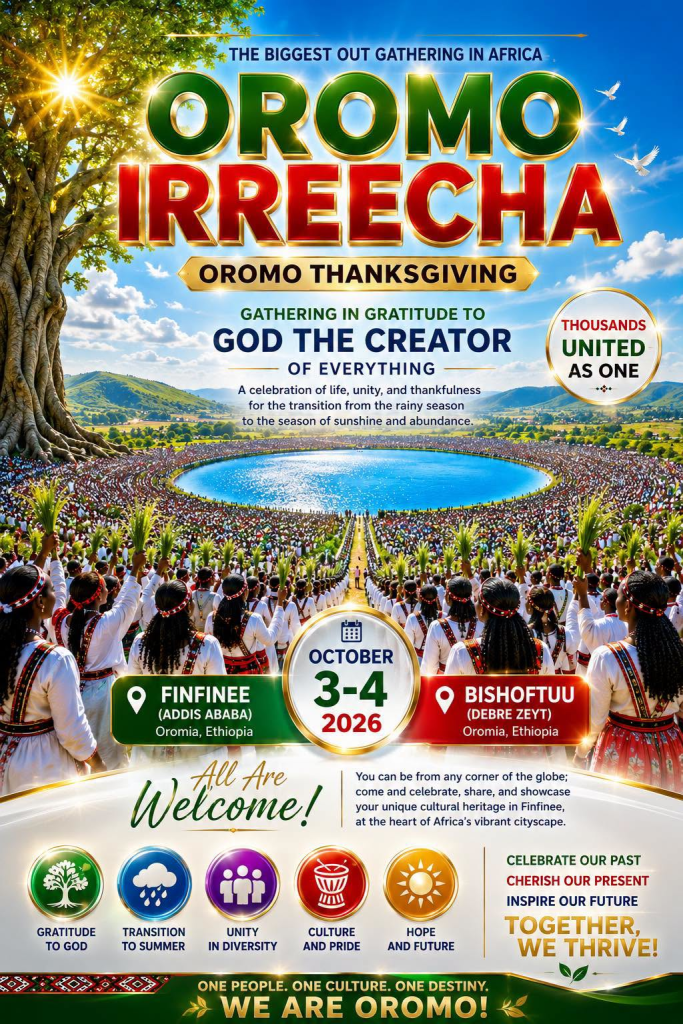
Millions Prepare to Celebrate Oromo Thanksgiving in Finfinne and Bishoftu
By Maatii Sabaa
As the golden light of spring breaks over the Oromo landscape, a profound spiritual awakening stirs across Oromia and the global diaspora. Irreechaa—the Oromo Thanksgiving—is set to transform Finfinne and Bishoftu into a vibrant sea of white, green, and cultural pride from October 3 to October 4, 2026 . This is not merely a festival. It is Africa’s largest outdoor gathering, where millions will come together to express gratitude to Waaqa (God) and celebrate a cultural heritage that has endured for millennia .
The Heartbeat of a People: What Is Irreechaa?
Irreechaa, known in some traditions as Irreessa or Dhibaayyuu, is an annual thanksgiving holiday that marks the end of the rainy winter season and the joyous arrival of Birraa (spring) . It is a time when the Oromo people gather at sacred lakes, rivers, and springs to thank Waaqa for the blessings, mercies, and bountiful harvests received over the previous twelve months .
The festival’s roots run deep—over 6,000 years into the ancient Oromo and Cushitic civilization, long before the rise of modern empires or religions . It is intimately connected to the Gadaa system, the traditional Oromo governance structure recognised by UNESCO as an Intangible Cultural Heritage of Humanity . As the elders teach, Irreechaa is simply “giving thanks to the one God”—the pinnacle of Oromo religious and cultural expression .
Two Sacred Sites, One Unifying Spirit
This year’s celebration will unfold over two days across two of the Oromo people’s most sacred sites, following a time-honoured itinerary announced by the Council of Oromo Gadaa Elders .
Hora Finfinne: Reclaiming the Heart of the Capital
On October 3, the celebration will commence at Hora Finfinne, in the heart of the capital city . This location carries profound historical weight. For decades, under oppressive regimes, public celebrations of Irreechaa were banned, and the Oromo people were denied the right to give thanks at their own sacred sites . The site now known as Finfinne was originally named after the very same Hora Finfinne—a sacred geography that the construction of a colonial capital attempted to overwrite . Celebrating Irreechaa here is not just a cultural act; it is a powerful reclamation of space, identity, and dignity.
Hora Arsadi: The World’s Stage
On October 4, the festival moves to its grandest location: Hora Arsadi in the city of Bishoftu, approximately 45 kilometres south of Finfinne . This is the site of the main event—a gathering so vast that it is recognised as one of the largest annual human gatherings on the African continent . Here, in a landscape of breathtaking natural beauty and sacred waters, the celebration reaches its crescendo.
In recent years, the scale of the gathering has been so immense that international media, including the BBC, Al Jazeera, and CNN, have broadcast images of the spectacle: hundreds of thousands, sometimes millions, of people dressed in a vibrant sea of traditional colours, moving with purpose and joy towards the water .
The Rituals of Renewal
The Irreechaa ceremony is a tapestry of ritual and symbolism. At the lake, participants carry freshly cut green grass and flowers—symbols of fertility, life, and renewal . They immerse these offerings in the water, sprinkle themselves, and raise their hands in prayer. The grass, dipped and sprinkled, is a symbolic gesture of cleansing, purification, and the washing away of hardship. Traditional songs, known as sirba, echo across the valley, their melodies passed down from elders to the youth, ensuring the continuity of a living heritage .
Women are decorated in their finest traditional attire, while youth, particularly young men known as Kormoomsaa, move through the crowd, sprinkling people with fresh water as a gesture of cleansing and blessing . The event is a total immersion in culture and community. After the prayers, families and friends share meals of traditional dishes and freshly brewed coffee, reinforcing the profound social bonds that the festival strengthens .
More Than a Festival: A Symbol of Unity and Resilience
Irreechaa is often described as the “most celebrated cultural festival in Africa” . However, its significance extends far beyond its sheer scale. The festival’s core principles are peace, unity, love, and reconciliation. As the history of the festival teaches, holding onto resentment or grievance is not permitted at Irreechaa. A person cannot attend unless they have resolved their disputes with others . This requirement is a profound social intervention, reinforcing the idea that one cannot give thanks while holding a grudge.
The revival and growth of Irreechaa, particularly the celebrations in Finfinne, represent a powerful statement of cultural resilience. It is a declaration to the world that the Oromo culture, with its deep-rooted values of democracy, community, and spirituality, is not a relic of the past but a vibrant force for the present and future .
A Call to the World
The message from the Oromo community is clear: “You can be from any corner of the globe, individuals can come and showcase their unique cultural heritage in Finfinne during our celebration, at the heart of Africa’s vibrant cityscape.” As the Oromo people gather to give thanks, they extend an invitation to the world to witness the unity and resilience of a nation that has overcome immense challenges and continues to celebrate life, faith, and hope with unparalleled passion.

Goobee and Shinooyyee: A Dual Model of Prevention and Intervention for Social Problems

How Ancient Oromo Festivals Build Peace, Unity, and Social Cohesion
By Dhabessa Gemelal
In an era of deepening social divisions, political polarisation, and youth disengagement, the Oromo people possess a powerful and ancient resource: their own cultural traditions. The festivals of Goobee and Shinooyyee—celebrations marking the transition from the rainy season to spring—are not merely expressions of cultural identity. They are sophisticated mechanisms for social cohesion, conflict prevention, and youth engagement that offer a model for addressing some of the most pressing social challenges of our time.
Understanding Goobee and Shinooyyee
Goobee: A Festival of Light and Freedom for Young Men
Goobee is a festival where young men welcome the light of Spring with joy, hope, and good wishes. It represents “the bliss of spring, the joy of the dawn of the earth”—a light that sprouts for youth with green hope and courage . It is a time when young men declare their freedom and independence, marking their transition toward adulthood.
Shinooyyee: A Festival of Freedom and Identity for Young Women
Shinooyyee is a unique festival celebrated by young unmarried girls . During this festival, girls “plait their hair in fantastic styles and dress up and decorate with ornaments of their choice. They chant, sing, and dance with friends and peers for up to 3 weeks” . They collect fragrant grass and give it to neighbours as a symbol of abundance and blessing, receiving food and butter in return. It provides “young girls with absolute freedom to enjoy outside of their family’s home” .
Both festivals are celebrated in the weeks leading up to Irreechaa, the grand Oromo thanksgiving festival, and are part of the wider Gadaa system recognised by UNESCO as an Intangible Cultural Heritage of Humanity .
Prevention: Addressing Root Causes of Social Problems
1. Preventing Conflict Through Reconciliation
The Gadaa system, of which Goobee and Shinooyyee are a part, is built on a fundamental principle: “as much as possible, conflict should be prevented from occurring” . Should conflict occur, “everything should be done to prevent it from escalating and all institutions should work together to manage the conflict” .
This preventive philosophy is embedded in the festivals. Irreechaa, the culminating festival, requires participants to resolve conflicts before attending. As one Abba Gadaa explained, “if anyone who attends the festival has a conflict even with a close person, he should first reconcile with himself or with the other persons” . This principle of pre-festival reconciliation prevents conflicts from festering and escalating.
2. Preventing Youth Disengagement Through Meaningful Participation
Shinooyyee and Goobee provide structured, meaningful activities that engage youth during a critical transition period. The festivals offer young people “absolute freedom” to express themselves, build social bonds, and develop confidence . This engagement prevents the alienation and disconnection that often lead to social problems.
Social Anthropologist Daniel Deressa noted that the festivals “promote love and unity to uphold peaceful coexistence in the society” . By providing positive outlets for youth energy and creativity, Goobee and Shinooyyee prevent the frustration and disengagement that can fuel social unrest.
3. Preventing Cultural Erosion Through Intergenerational Transmission
Goobee and Shinooyyee serve as mechanisms for transmitting cultural knowledge, values, and ethics from elders to youth. The festivals ensure that young people learn “the culture and morals of the people and teaching them the truth” . This intergenerational transmission prevents the loss of cultural identity that can leave communities vulnerable to social breakdown.
Intervention: Addressing Existing Social Problems
1. Healing Divisions Through Reconciliation
For those already in conflict, Goobee and Shinooyyee provide a structured pathway to reconciliation. The festivals are described as “a time for reconciliation,” where “hatred and revenge are removed and solidarity is strengthened” . The requirement of pre-festival reconciliation serves as a direct intervention for existing conflicts.
The festivals create an environment where “peace is preached and love is praised; disagreement, grievance and discontent are condemned” . This public affirmation of peace values directly counters the narratives that fuel conflict.
2. Building Social Bonds Across Communities
Goobee and Shinooyyee bring together young people from different communities, strengthening “their love and unity” . The festivals are not exclusive—they are inclusive gatherings that promote understanding and solidarity across diverse groups.
Irreechaa, the culminating festival, has become “an important ritual festival that attracts visitors” and “has been becoming a cultural nationalism not only for the people of Oromo but also the nations and nationalities of the country” . This inclusivity makes the festivals a direct intervention against ethnic division.
3. Strengthening Community Resilience
The festivals contribute to community resilience by reinforcing social bonds and shared values. As scholars have noted, “Irreechaa brings people closer to each other and strengthen social bonds” . This strengthening of social cohesion makes communities more resilient to the stresses that can lead to social problems.
The Dual Model in Action
Goobee and Shinooyyee operate through a dual model of prevention and intervention:
Prevention:
- Engaging youth through meaningful participation
- Transmitting cultural values and ethics
- Resolving conflicts before they escalate
- Building social cohesion through inclusive participation
Intervention:
- Healing existing conflicts through reconciliation rituals
- Strengthening social bonds across communities
- Reinforcing shared values of peace and unity
Conclusion: A Model for Our Times
In a world facing deepening social divisions, youth alienation, and conflict, Goobee and Shinooyyee offer a powerful model. They demonstrate that cultural traditions are not merely nostalgic artifacts—they are living resources for building peace, strengthening communities, and engaging youth.
By preserving and promoting these festivals, the Oromo people are not only celebrating their heritage—they are investing in a more peaceful, cohesive, and resilient society. As one young participant noted, Goobee and Shinooyyee are “a festival of success, history, restoration of lost culture and expression of the Oromo people” .
In a fractured world, this ancient tradition offers a blueprint for healing.
This feature article is dedicated to the youth of Oromia who carry these traditions forward, and to all communities seeking models of peace and unity.


Goobee and Shinooyyee: Expressions of Celebration, Identity, and Cultural Beauty of the Oromo People

A Vibrant Revival of Ancient Traditions
By Daandii Ragabaa
Culture is the mirror of a community’s identity, the bridge connecting generations, and the living witness to history. The Oromo people possess a wealth of indigenous values and traditional systems passed down through generations. Among these, the Goobee and Shinooyyee traditional games hold a unique place and message within the Gada system, celebrating the end of the rainy season and the arrival of spring.
As the Oromo calendar transitions from the rainy season—a time of reflection—to the spring season, a symbol of hope and renewal, various thanksgiving ceremonies and traditional games are performed. One such celebration is the Goobee and Shinooyyee festival, a vibrant cultural practice observed by young men (Qero) and women (Qaree) as they dress in traditional attire and joyfully play together.
Goobee: A Festival of Light and Freedom for Young Men
Goobee is a festival for young men welcoming the light of spring with joy and hope. It is a time for them to declare their freedom and independence. The festival marks a significant milestone in the lives of young Oromo men, allowing them to express their identity and embrace their role in the community.
The rituals of Goobee are deeply symbolic. Young men gather in groups, dressed in their finest traditional attire, and participate in games and dances that celebrate the arrival of the new season. The festival is a declaration of readiness—a statement that they are prepared to take on the responsibilities of adulthood and contribute to the well-being of their community.
Shinooyyee: A Festival of Freedom and Identity for Young Women
Shinooyyee is a festival of freedom and identity for young Oromo girls. It marks the transition of young women from childhood to a stage of greater social recognition, providing a unique opportunity for them to express themselves freely.
During Shinooyyee, girls gather with friends to style their hair and dress in their finest ornaments, chanting and dancing with unparalleled freedom. They collect fragrant grass and give it to their neighbours as a symbol of abundance and blessing, receiving food and butter in return. The festival serves as a critical space for social bonding, strengthening relationships among girls and providing them with a sense of community and mutual support.
The significance of Shinooyyee extends beyond individual celebration. It is a collective affirmation of the value and dignity of young women, reinforcing their place within the broader Oromo society. The festival instils pride, confidence, and a deep sense of belonging.
The Prelude to Irreechaa
These festivals are the prelude to Irreechaa, the grand Oromo thanksgiving celebration. The celebration begins in late August and continues for weeks as youth in villages and towns unite in joy and unity. Goobee and Shinooyyee are not merely games—they are profound cultural events that reflect the beauty of nature, the honour of youth, and the resilience of a people.
The Gadaa system, of which these festivals are a core component, has selected eight high-level mountains where offering thanks to God is performed. The festivals embody the principles of peace, unity, and harmonious coexistence that are central to the Gadaa system.
A Symbol of Cultural Revival
Goobee and Shinooyyee are powerful symbols of Oromo identity and cultural revival. In recent years, the festivals have been revived and celebrated with remarkable enthusiasm in Finfinnee and throughout Oromia. They are organised with the support of cultural institutions and government bodies, underscoring the commitment to preserving and promoting the culture of the Oromo people.
As part of the Gadaa system, a UNESCO-recognised intangible cultural heritage, these festivals are significant in maintaining social cohesion and transmitting cultural values. They ensure that the wisdom of the ancestors continues to guide future generations.
Tourism and Economic Potential
Beyond cultural preservation, Goobee and Shinooyyee hold significant potential for the tourism sector. By promoting these vibrant traditions, Oromia can attract visitors seeking authentic cultural experiences. The festivals showcase the region’s beauty and the rich heritage of the Oromo people, contributing to sustainable development and economic growth.
The traditional clothing, music, dances, and rituals associated with Goobee and Shinooyyee offer a compelling attraction for tourists interested in cultural tourism. The economic benefits of such tourism can support local communities and incentivise further cultural preservation efforts.
A Symbol of Freedom and Self-Determination
The revival of these festivals represents the restoration of a lost cultural heritage. For years, these practices were suppressed under past regimes, but now they serve as a symbol of freedom and self-determination for the Oromo people. They are celebrated alongside other Oromo festivals, such as Irreechaa, which have become powerful symbols of peace, unity, and national cohesion.
Celebrating Goobee and Shinooyyee is itself an act of resistance—a declaration that the Oromo people will not be erased, that their culture will not be forgotten, and that their traditions will continue to thrive.
Conclusion: An Act of Future-Building
Preserving these cultural treasures is not just a matter of nostalgia; it is an act of future-building. By safeguarding and promoting Goobee and Shinooyyee, the community ensures that its children inherit a rich cultural legacy that strengthens the fabric of society and fosters a spirit of unity.
It is a collective responsibility to cherish, pass on, and promote these living resources as expressions of Oromo identity, values, and cultural beauty.
Injifannoon Ummata Oromoo!
Goobee fi Shinooyyee haa jabaattu!
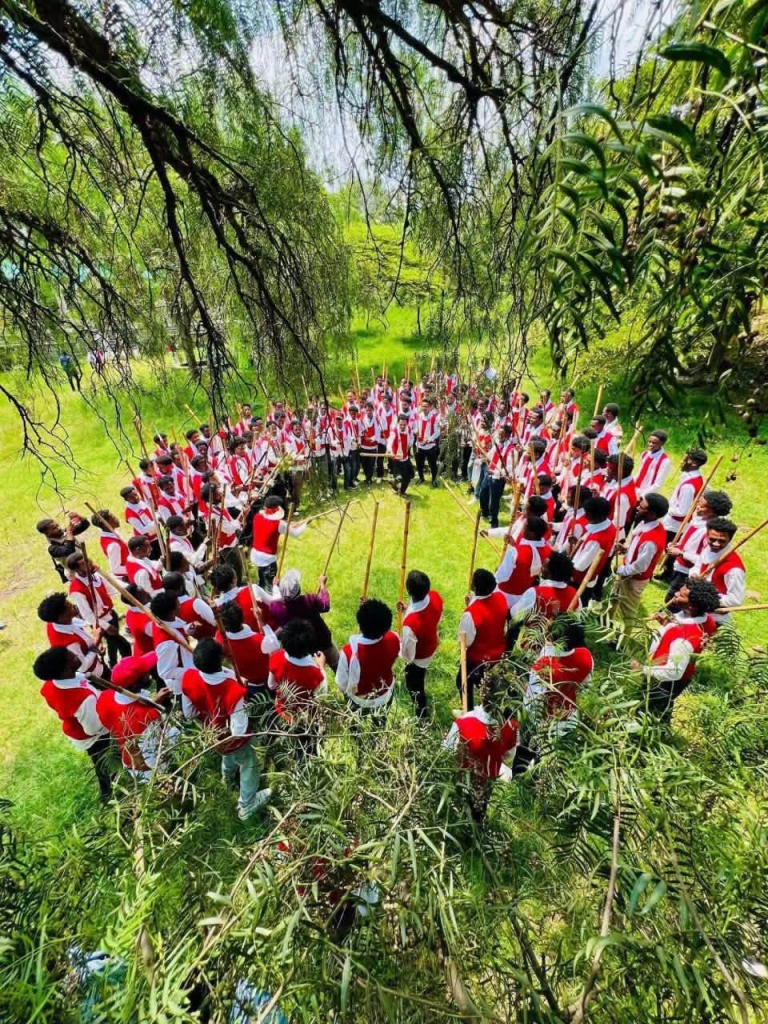
The Case for Shinooyee and Goobee: A Preventive Force for Peace and Unity
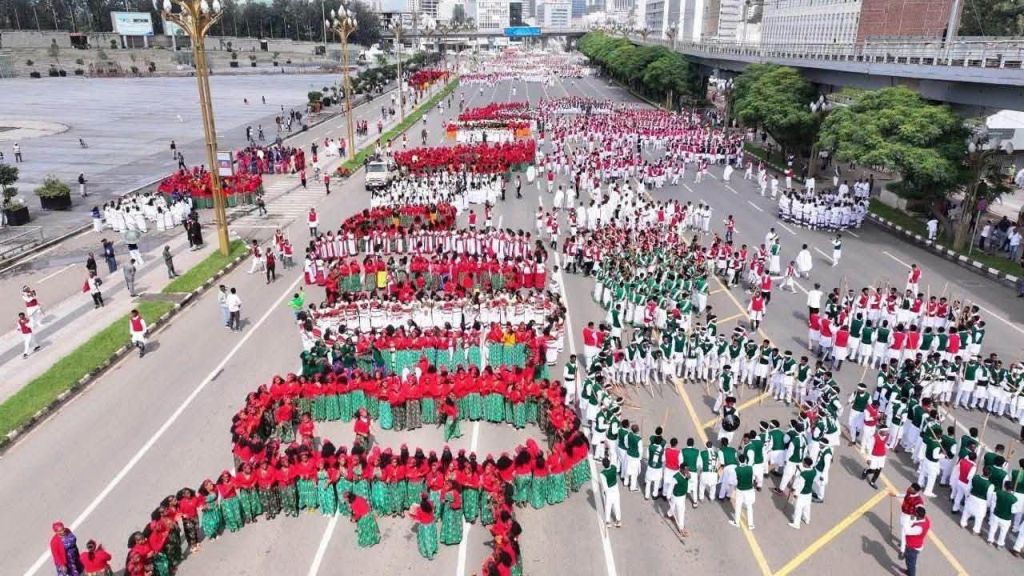
How Oromo Cultural Festivals Can Mitigate Conflict and Build Social Cohesion
By Dhabessa Wakjira
In a world where youth are increasingly drawn to divisive ideologies, political extremism, and social unrest, the Oromo people possess a powerful alternative: their own rich cultural traditions. The festivals of Shinooyee and Goobee—celebrations of the Oromo new year and the transition from winter to spring—are not merely cultural events. They are mechanisms for peacebuilding, social cohesion, and the redirection of youth energy toward constructive ends.
This article argues that Shinooyee and Goobee have significant preventive benefits. When young people invest their time, knowledge, skills, and resources in promoting Oromo culture, they not only ensure the growth of their traditions but also contribute to a reduction in conflict and violence. By focusing on cultural development, youth can build peace rather than division.
Argument 1: Cultural Engagement as a Preventative Measure
Proposition: Youth participation in Shinooyee and Goobee celebrations reduces the likelihood of conflict and violence.
Supporting Points:
1. Redirecting Youth Energy Toward Constructive Ends
Young people possess immense energy, creativity, and passion. When these qualities are channelled into political extremism or ethnic rivalry, the result is often violence and instability. However, when youth are engaged in cultural activities—learning traditional songs, preparing for festivals, and preserving Oromo heritage—that same energy is redirected toward positive community building.
Shinooyee and Goobeyyee provide structured, meaningful activities that require collaboration, discipline, and commitment. Young people who are actively preparing for these festivals have less time and inclination for destructive behaviour. The festivals create “prosocial bonds that reduce isolation and renew civic agency” .
2. Fostering Intergenerational Connection
Shinooyee and Goobee bring together elders and youth, creating opportunities for the transmission of cultural knowledge, values, and wisdom. This intergenerational connection is essential for building understanding and respect across age groups.
When youth learn from elders—about history, culture, and the principles of the Gadaa system—they gain perspective on the struggles and triumphs of their people. This perspective reduces the likelihood of impulsive or radical behaviour, as youth see themselves as part of a larger historical narrative.
3. Promoting Peace and Reconciliation Values
Both Shinooyee and Goobee are rooted in the values of peace, reconciliation, and unity. The Gadaa system, of which these festivals are a part, “symbolises peace, unity, and harmonious coexistence among people”.
Before participating in these celebrations, individuals are expected to resolve conflicts and seek forgiveness. This practice teaches youth that peace is not abstract—it requires active effort and accountability. By internalising these values, young people become peacebuilders rather than conflict participants.
Argument 2: Economic and Social Benefits of Cultural Investment
Proposition: Investing youth resources in Shinooyee and Goobee generates positive economic and social returns.
Supporting Points:
1. Building Local Economies
Shinooyee and Goobee are economic drivers. The demand for traditional clothing, food, and crafts creates employment opportunities for artisans, tailors, and small businesses. By investing in these festivals, youth contribute to the economic vitality of their communities.
The Irreechaa Expo, for example, has become a platform for over 250 trade associations, providing economic opportunities and promoting cultural tourism. Similar economic benefits can be realised through the investment of youth resources in Shinooyee and Goobee.
2. Strengthening Social Networks
The festivals foster social networks that serve as safety nets in times of crisis. When youth participate in Shinooyee and Goobee, they build relationships with peers and elders across communities. These relationships can be drawn upon during times of hardship, reducing reliance on divisive or violent alternatives.
As one scholar observed, Irreechaa “brings people closer to each other and strengthens social bonds”. The same applies to Shinooyee and Goobee.
3. Preserving Cultural Heritage
By investing their resources in cultural promotion, youth ensure that Oromo traditions are not lost to modernity. This preservation is not merely nostalgic—it is a form of resistance against cultural erasure and a foundation for collective identity.
When youth understand their culture, they are less likely to adopt extremist ideologies that reject or denigrate their heritage. Instead, they become ambassadors of their culture, promoting understanding and respect across communities.
Argument 3: The Preventive Impact on Conflict
Proposition: Widespread investment in Shinooyee and Goobee can prevent the escalation of conflict.
Supporting Points:
1. Building Bridges Across Communities
Shinooyee and Goobee are not exclusive festivals. Members of various ethnic groups—Kembata, Kebena, Burji, Dawro, and Sidama—have described these celebrations as platforms for cultural exchange and multinational unity. When youth from diverse backgrounds participate together, they build relationships that transcend ethnic divisions.
2. Creating Alternative Narratives
Conflict often arises from narratives of grievance, victimhood, and enmity. Cultural festivals offer alternative narratives of resilience, gratitude, and common humanity. By promoting these narratives, youth challenge the divisive rhetoric that fuels conflict.
3. Demonstrating the Benefits of Peace
Shinooyee and Goobee are celebrations of hope and renewal. They demonstrate that peace is not only possible but desirable—that communities can thrive when they come together in celebration rather than conflict. By participating in these festivals, youth experience the tangible benefits of peace.
Rebuttal: Addressing Potential Counterarguments
Counterargument: “Culture is not a substitute for political change. Focusing on festivals distracts from the real issues facing the Oromo people.”
Rebuttal: Cultural engagement is not a substitute for political action—it is a complement to it. When youth are disconnected from their culture, they are more vulnerable to radicalisation and division. Cultural festivals like Shinooyee and Goobee provide the foundation of identity and community that makes political action more effective and principled.
Counterargument: “Investment in culture is a luxury we cannot afford when we face urgent political and economic challenges.”
Rebuttal: Culture is not a luxury—it is a necessity. The loss of culture is itself a form of oppression, and its preservation is a form of resistance. Moreover, cultural festivals generate economic benefits that address urgent needs. The Irreechaa Expo, for example, has become a platform for economic growth and community development .
Counterargument: “Celebrating culture does nothing to stop violence.”
Rebuttal: Cultural celebration does not stop violence on its own—but it creates the conditions in which violence is less likely. Communities that are culturally connected, socially cohesive, and economically vibrant are more resilient to conflict. Shinooyee and Goobee contribute to these conditions.
Conclusion: A Path to Peace Through Culture
Shinooyee and Goobee are not merely festivals—they are investments in peace. When young people invest their time, knowledge, skills, and resources in promoting Oromo culture, they are not only preserving their heritage—they are building a future of peace and stability.
By engaging in these traditions, youth become peacebuilders, cultural ambassadors, and community leaders. They create alternatives to violence and division, demonstrating that the path to a better future lies not in conflict but in cooperation, not in extremism but in cultural pride.
As the Oromo proverb says: “A person without culture is like a tree without roots.” By investing in Shinooyee and Goobee, youth are planting the roots of peace for generations to come.
This feature article is dedicated to Oromo youth everywhere who are working to preserve and promote their culture as a foundation for peace and unity.

The Price of Silence: A Reflection on Inaction and the Tragedy of Our People

We Knew This Was Coming — Yet We Chose to Stay Silent
By Koste Abdiisaa
If we had shown even 1% of the outrage we have expressed over the past two days three, four, or five years ago—when Fano killed hundreds of innocent Oromos in Kiramu, Hagamsa, Amuru, Alibo, Jardega-Jartee, and elsewhere—perhaps these killings would not have happened.
We knew this was coming. The signs were everywhere. The warnings were clear. Yet we chose to remain silent. We chose to look away. We chose to believe that the storm would pass us by.
But storms do not pass by those who refuse to prepare. They break over them.
The Warning Signs We Ignored
For years, the enemies of the Oromo people have been methodically preparing for this moment. While we argued among ourselves, they were opening training camps in our backyard. While we engaged in name-calling and petty divisions, they were building security structures and training hundreds of people to carry out their plans.
We saw it happening. We heard the reports. We knew that innocent farmers—our farmers—were being killed in Kiramu, Hagamsa, Amuru, Alibo, Jardega-Jartee, and countless other places. And what did we do?
We expressed outrage on social media. We posted our anger, shared our grief, and then went back to business as usual.
Our collective inaction allowed this to continue. Our silence gave them permission to proceed. Our failure to act was an invitation for more violence.
The Consequences of Inaction
This is not about hindsight. This is about foresight—and our failure to use it. We cannot pretend that these killings were unexpected. We knew what was coming. We had every warning. But we failed to act.
And now, the consequences are here.
The killing of our innocent farmers is not just a tragedy—it is a judgment on our collective failure to protect our own. It is the result of years of political naivety, misplaced priorities, and a refusal to confront the reality of the threat we faced.
We were good at crying after the fact. We were good at expressing outrage on social media after tragedies happened. But we were very poor at recognizing threats early on, listening to those who recognized them, and preparing ourselves to face them.
The Deeper Outrage
Like many of you, I am outraged by the killing of our innocent farmers. But I am even more outraged by our inaction—our lack of political awareness, our failure to recognize and respond to such cruelty for so long.
What is even more troubling is that some of our so-called political entities—those who claim to speak for us—continue to seek alignment with those responsible. They act as if there is still some humanity left in them to appeal to. They still hope for dialogue with those who have shown, time and again, that they have no interest in peace, only in domination.
This is not leadership. This is delusion.
And we, as a people, have allowed it. We have allowed ourselves to be led by those who refuse to see the enemy for what they are. We have allowed ourselves to be distracted by petty divisions while our people are being slaughtered.
The Beginning, Not the End
Let us not pretend that this is the end. This is the beginning. The attacks will continue. The killings will escalate. And if we do not act now—with unity, determination, and clarity—the tragedies we see today will seem small compared to what is coming.
I fear that we may still fail to act in a timely manner. I fear that we will continue to cry and express outrage for a week, and then return to normal life. I fear that we will continue to do what we seem to be good at: mourning after the fact, but never preparing for what lies ahead.
A Call to Look Within
If this senseless killing of our people does not make us angry enough to question our collective inaction, then perhaps we need to look within ourselves and ask: What kind of society have we become?
Have we become a people who only react after the damage is done? Have we become a people who prioritize social media outrage over real action? Have we become a people who are more concerned with who is right than with what is right?
We must ask ourselves these questions. And we must answer them honestly.
The Path Forward
We cannot change the past. The blood that has been spilled cannot be unspilled. But we can change the future. We can act now—today—to ensure that these tragedies do not continue.
This requires several things:
- Unity: We must put aside our petty divisions and unite as a people. Our enemies are united; we must be even more united.
- Awareness: We must wake up to the reality of the threat we face. We must recognize the signs and act before it is too late.
- Action: We must support those who are willing to sacrifice and risk their lives to defend our people. We must build the structures and institutions necessary to protect ourselves.
- Accountability: We must hold our political entities accountable. We must demand that they prioritize the defense of our people over their own political ambitions.
- Resilience: We must be prepared for the long fight ahead. This is not a battle that will be won in a day. It requires patience, courage, and an unwavering commitment to our people.
Conclusion: Enough Is Enough
The killing of our innocent farmers is a crime against humanity. But our collective inaction is a crime against ourselves.
We cannot afford to continue down this path. We cannot afford to remain silent while our people are being slaughtered. We cannot afford to wait until the next tragedy to express our outrage.
Enough is enough.
Let us honor the memory of those who have been killed by resolving to act—not just with words, but with deeds. Let us build a future where our people are safe, our land is protected, and our dignity is restored.
Injifannoon Ummata Oromoo!
Nagaan haa jabaatu!
This reflection is dedicated to the innocent Oromo farmers who have lost their lives, and to all those who are determined to build a future of peace, justice, and security for our people.

Honouring the Daughters of Oromia: A Celebration of Strength, Beauty, and Resilience

Recognizing the Pillars of Our Community — Jaal Naarobika Baayisaa, Jaal Giiftii Waaqoo, and Jaal Mergitu Argo
By Dhabessa Wakjira
In the heart of the Oromo nation, there exists a force that is as powerful as it is beautiful—the daughters of Oromia. They are the carriers of culture, the guardians of tradition, and the voices of resilience that echo across generations. Today, we pause to honour three remarkable women who embody the spirit of Oromo womanhood: Jaal Naarobika Baayisaa, Jaal Giiftii Waaqoo, and Jaal Mergitu Argo. ❤️
The Daughters of Oromia: A Legacy of Strength
Oromo women have always been the backbone of their communities. From the ancient traditions of the Gadaa system to the modern struggles for justice and recognition, they have stood firm, unyielding, and courageous. They have raised children, preserved culture, and fought for the dignity of their people.
The phrase “Shamarran Oromiyaa” —the daughters of Oromia—carries within it the weight of history and the promise of the future. It is a title of pride, honour, and responsibility. It speaks of women who refuse to be silenced, who refuse to be erased, and who refuse to accept anything less than justice for their people.
Jaal Naarobika Baayisaa: A Beacon of Courage
Jaal Naarobika Baayisaa is a name that resonates with strength and determination. As a daughter of Oromia, she has exemplified the qualities of leadership, resilience, and unwavering commitment to the Oromo cause. Her story is one of courage in the face of adversity—a testament to the power of a woman who refuses to bow to oppression.
Her contributions to the Oromo community, whether through activism, cultural preservation, or community organizing, have left an indelible mark. She stands as a role model for young Oromo women, showing them that their voices matter and that their dreams are valid.
Jaal Giiftii Waaqoo: A Voice for Justice
Jaal Giiftii Waaqoo is a name that has become synonymous with the fight for Oromo rights and dignity. Her unwavering commitment to justice and her fearless advocacy have inspired countless others to join the struggle. She has spoken truth to power, refusing to be intimidated by those who seek to silence the Oromo voice.
Her work has touched the lives of many, from the villages of Oromia to the diaspora communities around the world. She has reminded us that the struggle for justice is not just a political fight—it is a deeply personal one, rooted in the love for one’s people and one’s land.
Jaal Mergitu Argo: A Pillar of Resilience
Jaal Mergitu Argo represents the resilience that defines Oromo women. In the face of challenges that would break others, she has remained steadfast, drawing strength from her culture, her community, and her faith. Her journey is a reminder that resilience is not just about enduring hardship—it is about rising above it and building a better future.
Her contributions to the Oromo community, whether through education, advocacy, or cultural preservation, have been invaluable. She has shown that Oromo women are not just participants in the struggle—they are leaders, innovators, and the architects of a brighter future.
The Power of Oromo Womanhood
The stories of Jaal Naarobika Baayisaa, Jaal Giiftii Waaqoo, and Jaal Mergitu Argo are not just their own—they are the stories of countless Oromo women who have contributed to the resilience and strength of the Oromo nation. They remind us that Oromo women are not just victims of oppression—they are agents of change, builders of community, and the heart of the struggle.
In Oromo culture, women have always held a special place of honour. The Siiqqee institution, for example, has been a powerful symbol of women’s agency and a mechanism for ensuring gender balance and social justice. This tradition is not just a relic of the past—it is a living practice that continues to inspire Oromo women today.
A Call to Celebrate and Honour
As we honour these three remarkable women, let us also honour all the daughters of Oromia—past, present, and future. Let us celebrate their strength, their beauty, and their resilience. Let us recognize their contributions to the Oromo nation and their role in shaping a future of justice, dignity, and self-determination.
To the daughters of Oromia: You are the heartbeat of the nation. You are the carriers of culture, the guardians of tradition, and the voices of hope. Your strength inspires us, your courage emboldens us, and your love sustains us.
Conclusion: A Legacy That Endures
Jaal Naarobika Baayisaa, Jaal Giiftii Waaqoo, and Jaal Mergitu Argo represent the best of what it means to be a daughter of Oromia. Their contributions to the Oromo cause, their commitment to justice, and their unwavering resilience are a testament to the power of Oromo womanhood.
Shamarran Oromiyaa — The daughters of Oromia — will always be the strength of the nation.
Injifannoon Ummata Oromoo!
Jaal Naarobika Baayisaa, Jaal Giiftii Waaqoo, and Jaal Mergitu Argo — you are honoured!
This feature article is dedicated to all the daughters of Oromia who have contributed to the struggle for justice, dignity, and self-determination. Your legacy will endure for generations to come.

The Lion Who Fell Fighting: Remembering Jaal Lammeessaa Boruu (1943–1992)
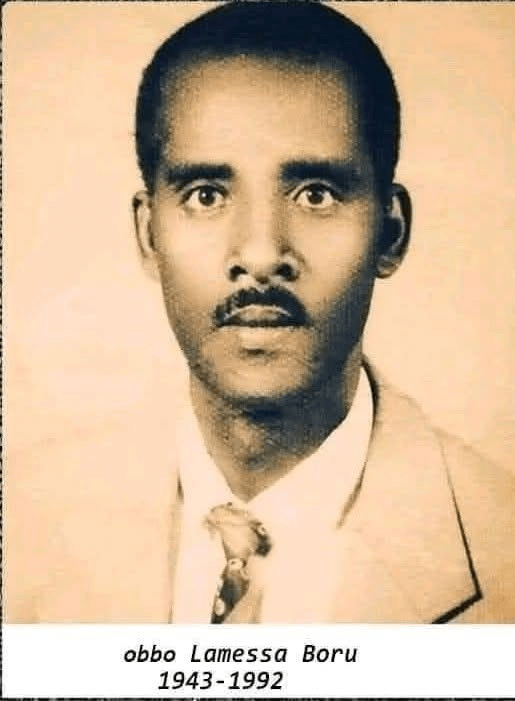
By Daandii Ragabaa (Adapted into a feature story based on various sources)
His name means “Lion” in Oromo. And like a lion, Jaal Lammeessaa Boruu lived with courage, fought with conviction, and died with his boots on—somewhere in the forests of western Oromia, in 1992. Three decades later, his grave remains unknown. But his story, carried by oral tradition and fragmentary records, refuses to be buried.
A Humble Beginning in Wallagga
Jaal Lammeessaa Boruu was born in 1943 in Billo, a town in the Bonayya district of East Wallagga, within the Waamaa region. According to those who knew him, he grew up in a typical Oromo farming community, at a time when the imperial government of Haile Selassie exercised firm control over the land and its people.
As a young man, he left his birthplace and moved to Finfinnee (Addis Ababa), where he lived for about 15 years as an adolescent. There, he entered school. But his education was interrupted by a different calling.
The Soldier with the Striking Physique
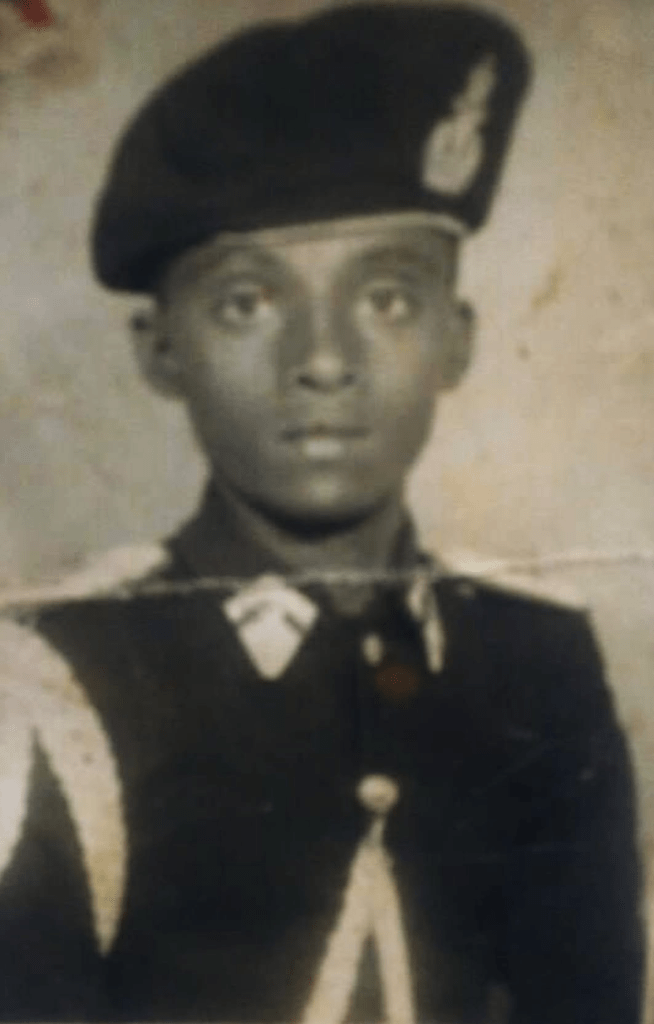
Contemporary accounts describe Jaal Lammeessaa as tall and physically impressive. It was this very stature that drew the attention of military recruiters. Under the imperial regime, he was selected to join a special unit known as “Kubur-Zabanya” and “Faxino-Darash” (likely special police or commando forces). Within the latter, he became known as “Faxino-Daraash Shalaqaa” and served under the command of General Tadesse Birru.
He proved to be an exceptional soldier. His superiors reportedly praised his dedication, and he rose to become a respected non-commissioned officer.
Joining the Machaa Tulema Association
The Machaa Tulema Association was founded as a development and civic organization, but it quickly became a political vehicle for Oromo nationalism. General Tadesse Birru was one of its key leaders. When the association began recruiting members, Jaal Lammeessaa was among those selected.
Initially, the organization’s goal was to work within the system—to address Oromo grievances through legal means. But as General Tadesse and others concluded that the imperial regime had no intention of recognizing Oromo rights, they shifted toward a more radical path. Jaal Lammeessaa became a trusted operative within the association’s secret military wing.
The Failed Plot Against Emperor Haile Selassie
On October 23 (Ethiopian calendar), the Emperor’s birthday, a plot was hatched to assassinate Haile Selassie during the annual celebrations at the site known as “Addabaaba’ii Minlik” (Menelik Square). General Tadesse Birru assigned four commandos to carry out the attack, selecting them for their courage and loyalty.
The four were:
· Lammeessaa Boruu (from the Faxino-Darash unit)
· Camadaa Sobbooqaa
· H/Mariyam Diimaa (from Kubur-Zabanya)
· Fixumaa Hiikisaa
They prepared extensively. But the plot was betrayed. Informants within the government learned of the plan just before it could be executed. The commandos were arrested.
When Jaal Lammeessaa was searched, a bomb intended for the Emperor was found on him. He was tortured severely. According to surviving members of the Machaa Tulema Association, his ribs were broken, and he suffered long-term disability from the interrogation. Despite the brutality, he refused to betray the organization’s deeper secrets—though under extreme duress, some information was extracted.
First Imprisonment and Release
Following the failed plot, General Tadesse and several others were sentenced to death. Jaal Lammeessaa received a five-year prison sentence. After serving his term, he was released. Upon release, he immediately rejoined his former commander, General Tadesse Birru, who had been transferred to Galamso in eastern Oromia. There, they continued to discuss the struggle for Oromo self-determination.
The Cinema Bombing and Second Arrest
As the Machaa Tulema Association continued its activities, the regime grew more determined to crush it. On December 10, 1959 (Ethiopian calendar), a bomb exploded inside a cinema in Addis Ababa where the film Zorba the Greek was being shown. Thirty-six people were wounded.
The government immediately blamed the Machaa Tulema Association. Propaganda claimed that a member named Maammoo Mazaamir had planted the bomb. The incident was used as a pretext for a massive crackdown. Jaal Lammeessaa was arrested again—this time as part of a sweeping roundup of Oromo nationalists.
He was among nine senior Machaa Tulema figures sentenced to long prison terms, while General Tadesse Birru and Maammoo Mazaamir received death sentences (later commuted or carried out, depending on the account).
Life Under the Derg and the Fourth Arrest
Jaal Lammeessaa spent more than 12 years in prison under the Derg regime that overthrew Haile Selassie in 1974. He was held in police stations and military camps, subjected to repeated interrogations. Yet even in detention, he remained committed to the Oromo cause.
After the Derg fell in 1991, Jaal Lammeessaa was released. He joined the Oromo Liberation Front (ABO – a reference to the OLF) and became a member of its central committee, working in the economic department. He lived in Wajjira Gullaallee, continuing his activism.
The Final Battle and Disappearance
In 1992, following a split within the transitional government of Ethiopia (the “Ce’umsaa” or transitional period), Jaal Lammeessaa and other Oromo fighters moved toward western Oromia. They joined ongoing armed confrontations against government forces (referred to as “Wayyaanee” – a term for the Ethiopian military or allied militias).
According to the source, Jaal Lammeessaa Boruu fell in battle near the Jimma Horroo area in Wallagga region. He was killed in armed combat. His body was never recovered, and to this day, the exact location and circumstances of his death remain unknown.
Legacy: The Unknown Grave, the Known Sacrifice
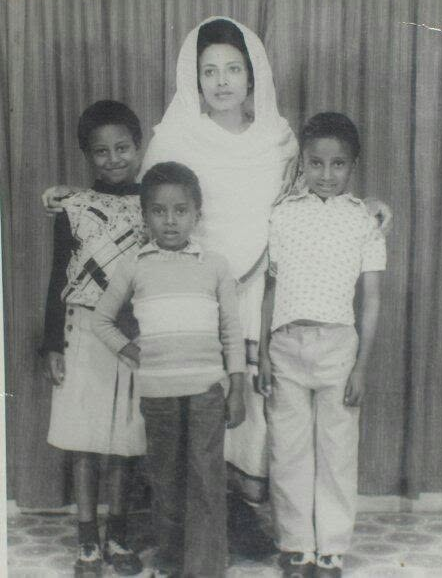
Jaal Lammeessaa Boruu was 49 years old when he died. He left behind three children: Mosisa Lamessa Boru, Lense Lemessa Boru and Tsegaye Lemessa Bouru. He is remembered as a devoted fighter who gave his entire adult life to the Oromo national struggle. From the imperial era through the Derg and into the transitional government, he never wavered.
The biography ends with a poetic refrain:
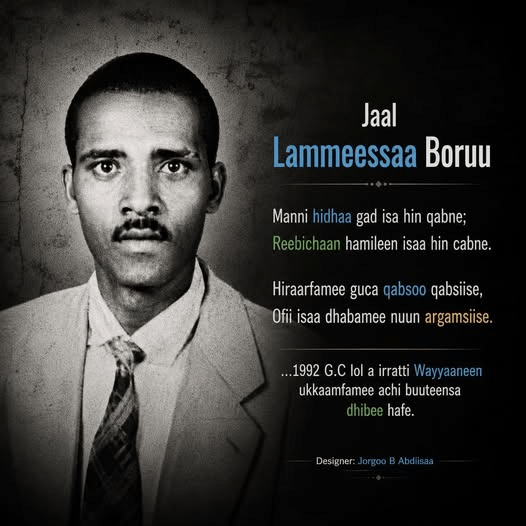
“The fighter may fall. He may pass away. But Jaal Lammeessaa’s blood was not shed in vain. He has grown for us the plant of freedom.”
His grave may be lost to history. But for those who keep his memory, Jaal Lammeessaa Boruu remains one of the lions of Oromo resistance—a man who turned his back on personal safety and government favor, and chose instead the uncertain path of the forest and the battlefield.
—
*This feature story is based exclusively on various sources of the Oromo-language biography written by Daandii Ragabaa. It is presented as a journalistic adaptation of that source and does not constitute an endorsement of armed struggle or any political organization. The factual claims rest with the original author.

Wealth Creation Strategies for Indigenous Oromians

Taking Control of Your Financial Destiny
Join the growing movement of Oromo people taking control of their financial future. Are you an Indigenous Oromian looking to build wealth and secure a future for your family? Struggling to navigate the complexities of property investment, finance, and long-term savings? Imagine having tailored insights that guide you on the path to financial independence and generational wealth—For Indigenous Oromias, By Indigenous Oromias.
Why Wealth Creation Matters Now
The Oromo people have historically been excluded from economic opportunities across Ethiopia. Successive regimes systematically prevented Oromos from building economic assets, with more than 60% of Ethiopia’s exportable commodities, over 60% of staple food, 70% of industrial raw materials, and 80% of hydro power coming from Oromia—yet no Oromo has been able to qualify among the top 10 richest people in the country. This is not a coincidence; it is the result of deliberate economic marginalization.
But the Oromo people have always had the tools for economic resilience. The Gadaa system contains powerful economic principles that our ancestors used to build and sustain wealth: hard work, planning, mutual assistance, and community-based resource management. The proverb “Tuulamanii taa’anii, Waaqa ofii hin komatan” reminds us: “It is not right to blame God for not working hard.” Hard work and commitment are the sources of wealth.
What Indigenous Wealth Offers
Indigenous Wealth is a 100% Oromo-owned and operated consultancy dedicated to helping our people build generational wealth and achieve financial independence. Our team understands the unique challenges Oromo people face—and we have the strategies to overcome them.
Our Services Include:
Property Investment: We help you gain access to quality investment properties, connect you with finance professionals, and guide you through the property market to build long-term wealth.
Finance & Loans: We connect you with mortgage professionals who can assist with tailored home loans, equipment and business loans, as well as competitive finance for rural Oromo communities.
Wealth Strategy: We create personalized wealth-building plans designed specifically to help you achieve your financial goals.
Our Proven Results
We have successfully supported Oromo people across Ethiopia in achieving financial independence. Across similar models in other communities, Indigenous-owned wealth consultancies have helped create over 110 new property investors in just four years, with a goal of building a community of millionaires .
The Gadaa Foundation for Wealth
Our approach is rooted in the economic wisdom of the Gadaa system:
Hard Work and Planning
“Jabaatan jabaa nyaatu, laafan foxxoqxuu nyaatu” — “The strong eat the strong, and the weak eat the weak.” This proverb reminds us that hard work is mandatory in daily life, and that everyone needs to plan to work hard and secure their future.
Community Support Systems
Traditional Oromo institutions like dabo (labour cooperation) and daadoo (mutual work groups) demonstrate the power of collective effort. When communities work together, they achieve more than individuals working alone. We apply these same principles to modern wealth building.
Guddifachaa (Adoption)
The Oromo practice of guddifachaa demonstrates the belief that children are assets and the community shares responsibility for their welfare and education. This is the foundation of generational wealth—investing in the next generation’s education, skills, and economic opportunities.
Hard Work and Self-Reliance
The Gadaa system emphasizes that people should not wait for others to solve their economic problems. “Hojii hojjechuu isa malee gaafa du’aa hin galus” — “Without work, the day does not end.”.
How It Works: Your Free Wealth Strategy
Take advantage of our No-Obligation, Completely FREE Wealth Strategy. This isn’t just another generic report—it’s a highly personalized plan where you’ll receive unique suggestions on how to:
✅ Build generational wealth for your family and community
✅ Invest in property and understand the market
✅ Secure financial independence and plan for retirement
No cost, no commitment—just a clear path forward.
Real Stories: Oromo Success
Across Ethiopia, Oromo people are already building wealth through determination and community:
Fedhi Gudina Community Saving for Investment in Agribusiness Group: Founded in 2019 with just $141 raised by 20 members (15 women), this Oromo group grew their savings to $28,530 through strategic investment in crop cultivation and processing. They now operate a grain milling service that serves their entire community.
Safiya, an Oromo entrepreneur: Forced to flee Ethiopia, she built a successful business making traditional Oromo beadwork in Nairobi. Her handmade designs are sold for special occasions like weddings, and she now supports her family independently. She says: “I have hope in what I am making with my hands. I believe in it, I believe in myself.“.
Reach for Change Entrepreneurship Training: In April 2025, 83 Oromo women in Me’so, Babile, and Chinaksan woredas participated in entrepreneurship training designed to turn ideas into viable businesses. They are building off-farm businesses that sustain livelihoods and create economic independence.
Taking the First Step
The Oromo people have always been resilient. Despite centuries of oppression, forced displacement, and economic exclusion, we have survived—and now it is time to thrive.
Start your journey today. Complete our quick survey and begin taking control of your financial future. Whether you are looking to invest in property, start a business, or build generational wealth, Indigenous Wealth is here to guide you every step of the way.
Indigenous Wealth — 100% Oromo-owned and operated.
For Indigenous Oromias, By Indigenous Oromias.
Take control of your financial destiny today.

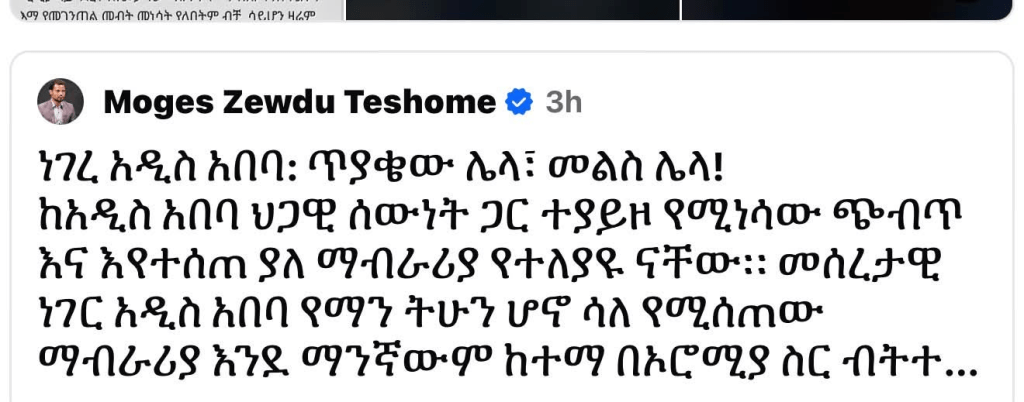
Finfinne and the Question of Historical Recognition: A Response to Moges Zewudu Teshome
Acknowledging History, Guaranteeing Citizenship, and Building a Foundation for Coexistence
By Iyasu Enoro
The debate surrounding Finfinne—the city known internationally as Addis Ababa—has long been characterized by competing narratives, political posturing, and deep-seated fears. In a recent contribution to this discourse, Moges Zewudu Teshome raised important concerns about the implications of recognizing Oromia’s connection to the capital. He argues that the central issue is not administration but the fear that Finfinne could be placed under the exclusive control of one ethnic group. He further suggests that linking Finfinne to Oromia would expose millions of residents to exclusion and discrimination.
While these concerns deserve serious discussion and should not be dismissed lightly, they do not adequately address the historical question at the centre of the debate. This response seeks to engage with Moges Zewudu Teshome’s arguments constructively while offering a broader perspective on the historical, constitutional, and practical dimensions of the Finfinne question.
The Core Issue: Historical Recognition, Not Ethnic Ownership
The first and most fundamental issue is that the discussion about Finfinne is fundamentally a question of historical recognition, not ethnic ownership. Oromo claims regarding Finfinne do not arise from the belief that only Oromo people should live in the city. Rather, they stem from the historical fact that the area known as Finfinne existed before the establishment of the city and was inhabited by Oromo communities.
Historical accounts recognize that the region was known as Finfinne—a name meaning “place of hot springs”—and that Oromo clans lived there before Menelik II established the city in 1886. This is not a matter of political convenience; it is a matter of documented historical fact.
Therefore, acknowledging Finfinne’s Oromo heritage is not equivalent to demanding the expulsion, marginalization, or disenfranchisement of non-Oromo residents. The recognition of indigenous history should not be confused with ethnic exclusivity. Just as the recognition of Māori heritage in New Zealand does not require the exclusion of non-Māori New Zealanders, the recognition of Oromo heritage in Finfinne does not require the exclusion of non-Oromo residents.
The question is not whether Finfinne belongs exclusively to any one group. The question is whether the city’s history and heritage will be acknowledged, respected, and integrated into its governance framework.
The International Precedent: Indigenous Recognition as a Foundation for Coexistence
The argument that any stronger relationship between Finfinne and Oromia inevitably leads to oppression requires examination. Around the world, indigenous peoples seek recognition of their connection to ancestral territories without necessarily seeking exclusive political control over those territories.
- In Australia, the High Court’s landmark Mabo decision rejected the doctrine of terra nullius and recognized Native Title rights. Indigenous Australians gained legal recognition of their ancestral connection to land without affecting the equal civil and political rights of other Australians.
- In New Zealand, the Treaty of Waitangi provides a foundation for protecting Māori rights, culture, and claims to ancestral lands while ensuring equal citizenship for all New Zealanders.
- In Canada, First Nations, Inuit, and Métis peoples possess constitutionally recognized indigenous rights. Land claims agreements and self-government arrangements acknowledge historical connections to traditional territories while cities and communities remain open to residents of all backgrounds.
- In the United States, Native American tribes retain certain rights related to self-government, culture, and ancestral territories. These rights coexist with the citizenship rights of all residents.
These examples demonstrate a common international principle: recognizing indigenous peoples’ historical and ancestral connections to land does not require denying democratic, civil, or human rights to other residents. Rather, both sets of rights can coexist.
The question then becomes: Why is acknowledging the Oromo historical connection to Finfinne often interpreted as a threat, while acknowledging the historical connection of other peoples to their ancestral lands is viewed as legitimate?
The Historical Grievances: More Than Administrative Boundaries
The response to Oromo claims regarding Finfinne often avoids the historical grievances associated with the city’s formation. For many Oromos, the debate is not simply about administrative boundaries but about the legacy of nineteenth-century state expansion, land dispossession, and cultural marginalization.
The establishment of Finfinne under Menelik II was accompanied by the displacement of Oromo communities from their ancestral lands, the confiscation of Oromo property, and the systematic erasure of Oromo identity. This history is not a distant memory; it is a living reality that has shaped the relationship between the Oromo people and the Ethiopian state for over a century.
Ignoring these concerns and portraying the discussion solely as a future governance issue risks repeating a pattern in which indigenous historical claims are dismissed rather than engaged. A genuine dialogue about Finfinne must acknowledge this history and address the grievances it has created.
Governance Failures Do Not Invalidate Historical Claims
Citing failures of governance or ethnic violence elsewhere in Oromia does not invalidate the historical relationship between Finfinne and Oromia. Historical facts do not become less valid because contemporary political institutions are imperfect.
If there are governance failures, those failures should be addressed directly through constitutional reform, rule of law, and democratic accountability. They should not be used to deny the historical identity of a place. To argue that recognizing Oromo heritage in Finfinne is dangerous because of governance failures in other parts of Oromia is to confuse the issue. The problem of poor governance exists regardless of Finfinne’s status, and it must be addressed on its own terms.
The Constitutional Dimension: A Special Interest Already Recognized
The Ethiopian constitution itself recognizes a special interest of Oromia in Finfinne because of the city’s location within Oromia and its relationship to the surrounding region. Article 49(5) of the Constitution affirms Oromia’s special interest in Finfinne concerning social services, natural resources, and joint administrative matters arising from the city’s location within the State of Oromia.
The existence of this constitutional provision demonstrates that the relationship between Finfinne and Oromia is not an invented political claim, but a matter already recognized within Ethiopia’s legal framework. The Constitution does not grant Oromia exclusive ownership or control over the capital. Rather, it acknowledges a practical and historical reality: the city is located within Oromia, and its functioning depends on resources, infrastructure, and cooperation from surrounding Oromo communities.
The question is not whether the Constitution recognizes a relationship between Finfinne and Oromia. The question is how that relationship should be implemented in practice.
A False Choice: Oromia Versus Ethiopia
The fear that recognizing Finfinne’s history automatically means surrendering the city to ethnic domination creates a false choice. The debate should not be framed as “Oromia versus Ethiopia.” Rather, it should be framed as how Ethiopia can acknowledge historical realities while guaranteeing equal citizenship, democratic governance, and dignity for all who call Finfinne home.
The real challenge facing Ethiopia is not choosing between Oromo rights and Ethiopian citizenship. It is finding a political framework that can accommodate both. Recognition of Finfinne’s Oromo heritage and protection of the rights of all Finfinne residents are not mutually exclusive goals. In fact, a durable solution will likely require both.
A sustainable future for Finfinne requires acknowledging several truths simultaneously:
- Finfinne is Ethiopia’s capital and belongs to all its residents. The city’s diverse population—Oromo, Amhara, Gurage, Tigrayan, Somali, and others—all have a stake in its future.
- Finfinnee has deep historical and cultural ties to the Oromo people. This heritage must be acknowledged and respected, not denied or erased.
- Oromo culture continues to enrich the city’s identity and development. The city is stronger for its diversity, and the contributions of all communities should be celebrated.
- Finfinne’s expansion directly affects neighboring Oromo communities. Their voices must be heard in decisions that affect their lives.
- Oromia possesses constitutionally recognized interests in matters concerning the city. These interests must be implemented through joint administrative mechanisms and cooperative governance.
- Development should benefit affected communities rather than marginalize them. Fair compensation, consultation, and participation are essential.
The Path Forward: A Framework for Coexistence
The path forward is not ownership, exclusion, or historical denial. It is partnership built on constitutional respect, cultural recognition, economic fairness, and genuine cooperation.
Such a framework would include:
- Implementation of Constitutional Provisions: Oromia’s special interest in Finfinne, as recognized in Article 49(5), should be implemented through joint administrative mechanisms that ensure meaningful Oromo participation in decisions affecting the city and surrounding communities.
- Cultural Recognition: The Oromo heritage of Finfinnee should be acknowledged through cultural institutions, public recognition, and educational programs that celebrate the city’s diverse history.
- Fair Development: Urban expansion should be planned with meaningful consultation with affected communities, ensuring fair compensation, environmental protection, and shared benefits.
- Inclusive Governance: All residents of Finfinne—regardless of ethnicity—should have equal rights to participation, public services, and legal protection.
- Shared Prosperity: The economic benefits of the capital’s growth should be shared with surrounding communities, creating a virtuous cycle of development rather than a pattern of exploitation.
Conclusion: Honoring History, Building the Future
The Finfinne question will not be resolved through confrontation or denial. It will be resolved through honest acknowledgment of history, respect for constitutional principles, and a shared commitment to building a future where all Ethiopians—Oromo and non-Oromo alike—can live with dignity, security, and hope.
Finfinne is for all Ethiopians.
Finfinnee is Oromo heritage.
The future is shared.
The recognition of Finfinne’s Oromo heritage and the protection of the rights of all Finfinne residents are not mutually exclusive goals. They are complementary pillars of a just and sustainable future.
Acknowledging history does not mean surrendering the city to ethnic domination. It means building a foundation of trust, understanding, and coexistence that can sustain Ethiopia for generations to come.
Finfinne haa jabaattu!
Oromia fi Finfinne walitti haa qabatan!
Nagaan haa bulaa!
This feature article is a response to Moges Zewudu Teshome and is dedicated to all those who are committed to finding a just, constitutional, and sustainable solution to the question of Finfinne.






