Category Archives: Sirna Oromo

BEYOND THE RITUAL: A PLEA FOR UNITY AT THE HEART OF OROMIA’S SACRED DIALOGUE
By Daandii Ragabaa
—
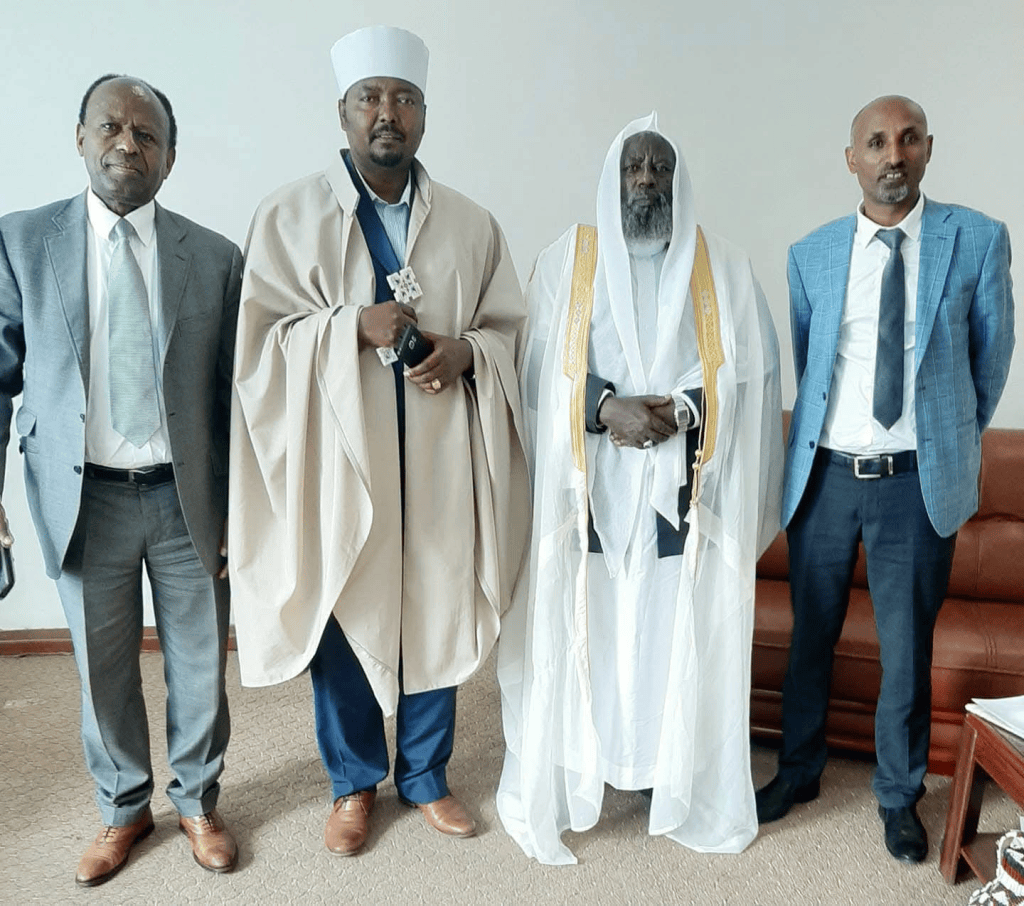
In the bustling city of Finfinne, where the hum of modernity often drowns out the whispers of ancient tradition, a different kind of gathering recently took place—one that carried the weight of history and the fragile hope of a shared future. It was not a political rally, nor a commercial event. It was a meeting of faiths, a rare and courageous roundtable where religious leaders from the three spiritual pillars of Oromo society—Waaqeffanna, Christianity, and Islam—sat together not as rivals, but as brothers.
This landmark dialogue, initiated under the momentum of the Waaqeffanna community, was spearheaded by prominent figures, including Obbo Asnake Irko, a respected elder and representative of the Waaqeffanna faith. But the true architect of this historic convergence, as acknowledged by all present, was Qesiis Balay Mekonnen, whose dedication to securing media coverage and a neutral venue ensured that the voices of faith would not be whispered in shadows, but broadcast to the world.
The meeting was not about theological supremacy. It was about survival—the survival of culture, language, and mutual respect in a land where faith has too often been used as a wedge rather than a bridge.
—
The Four Pillars of the Finfinne Accord
After hours of intense and heartfelt deliberation, the religious leaders reached a series of groundbreaking agreements that could reshape the spiritual landscape of Oromia. At the heart of these resolutions lay four core principles:
1. Mutual Respect for All Faiths
The leaders unanimously affirmed that no religion—whether indigenous Waaqeffanna, Orthodox or Protestant Christianity, or Islam—holds a monopoly on truth or dignity. They pledged to honor each tradition’s sacred practices, recognizing that the Creator, however named, desires reverence and love among His people.
2. Culture and Language as Unifying Tools
In a powerful declaration, the group committed to using the Oromo language and cultural heritage as vehicles for unity, not division. They agreed that songs, proverbs, and artistic expressions from all faiths could be shared to enrich the collective identity of the Oromo people, rather than to compete or exclude.
3. Standing Together in Times of Crisis
“Yoo rakkoon jiraate waliin dhaabbannee hiikuu”—”If trouble arises, we will stand together to resolve it.” This pledge was perhaps the most poignant. The leaders vowed that no community would face marginalization, violence, or discrimination alone. They would act as a unified bloc to mediate, protect, and advocate for justice, regardless of which faith was affected.
4. Defending the Oromo People from Religious Exploitation
In a bold stance against instrumentalization, the leaders condemned any attempt to use religious identity to sow discord or to harm the Oromo nation. They agreed to collectively denounce and counter any rhetoric or action that weaponizes faith against Oromo unity.
5. A Shared Vision for Irreechaa and Other Cultural Festivals
The dialogue also addressed the growing misunderstandings surrounding Oromo cultural celebrations, particularly Irreechaa. The leaders resolved to engage in ongoing consultations to ensure that these festivals are understood in their proper context—as expressions of thanksgiving and communal identity—and are respected by all faith communities.
—
A Word of Gratitude
In his closing remarks, Obbo Asnake Irko expressed deep appreciation for the spirit of openness shown by his fellow religious leaders. Yet, he reserved his most heartfelt thanks for Qesiis Balay Mekonnen, whose tireless efforts in organizing the venue and mobilizing media attention made the dialogue possible. “Without his vision,” Obbo Asnake stated, “this table would remain empty.”
The participants included:
1. Qees Dr. Bantii U. Teessoo – representing the Protestant Christian community
2. Qesiis Balay Mekonnen – representing the Orthodox Christian tradition
3. Sheek Hajjii – representing the Islamic faith
4. Obbo Asnake Irko – representing the Waaqeffanna tradition
—
What This Means for Tomorrow
This gathering in Finfinne is more than a news item. It is a testament to the maturity of Oromo society—a society that refuses to let religious difference become a source of conflict. In a region often scarred by sectarian strife, these leaders have lit a small but steady flame. They have shown that the green grass of Irreechaa, the cross of Christianity, and the crescent of Islam can coexist, not in uneasy tolerance, but in active solidarity.
The road ahead is long. Old suspicions do not vanish overnight. But as Obbo Asnake Irko reminded the gathering: “Our ancestors worshipped on the same hills, drank from the same rivers, and prayed to the same Creator under different names. Let us not be the generation that forgets that truth.”
As the media cameras packed up and the leaders departed with handshakes and embraces, one thing was clear—the spirit of Irreechaa, the spirit of thanksgiving and reconciliation, had found a new home. Not just on the lakeshores, but in the hearts of those who dare to listen.
—
IN SUMMARY:
Key Agreement Significance
Mutual respect for all faiths Ends religious hierarchy and promotes equality
Use Oromo culture and language for unity Strengthens identity without exclusion
Joint crisis resolution Creates a safety net for all communities
Defend Oromo people from religious abuse Prevents faith from being used as a weapon
Consult on Irreechaa and cultural events Fosters understanding and reduces misconceptions
This is not just a religious accord. It is a covenant of civilization—a promise that in Oromia, faith will build bridges, not burn them.

A Cry for Justice: The Unfolding Crisis in Oromia
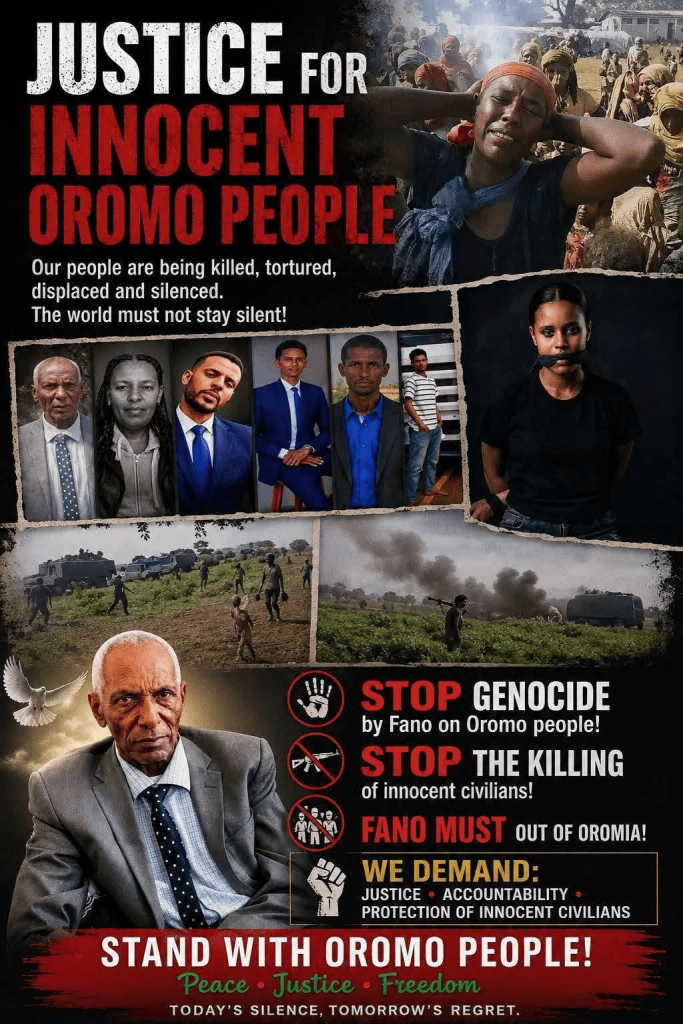
As violence escalates in Ethiopia’s most populous region, a growing chorus of voices is demanding accountability, protection, and peace for the Oromo people.
The plea is urgent and uncompromising: “Stop the killing of Oromo civilians! Stop violence against the Oromo people! Fano must leave Oromia!” These calls reflect a deep-seated crisis that has gripped the Oromia region, where civilians find themselves caught in the crossfire of multiple armed conflicts.
The Human Toll of Conflict
Recent reports paint a harrowing picture of the violence unfolding across Oromia. The Ethiopian Human Rights Commission (EHRC) has documented atrocities including killings, bodily injuries, abductions, displacement, and destruction of property in the Arsi Zone of Oromia . The violence is not isolated—it reflects a broader pattern of human rights abuses across multiple regions, including Amhara and Tigray .
In one particularly devastating incident, armed men killed more than 20 civilians in Oromia. Local civil servants reported that Fano militants attacked civilians “with swords and guns” in the Nono district, approximately 110 kilometers southwest of Addis Ababa, resulting in 25 deaths including women and children, with four more later dying in hospital . A regional security official confirmed that Fano militants had been active in the region for four years, “taking advantage of opportunist moments to launch attacks against civilians and loot property”.
The Humanitarian Crisis
The violence has created a severe humanitarian crisis. The United Nations reports that 3.2 million children are out of school due to the conflict . Hospitals and clinics have been attacked—in 2023, the International Committee of the Red Cross reported that “almost all” of 42 health posts in Oromia’s Beji area had been looted or destroyed . Aid organizations have struggled to distribute supplies, leading to severe malnutrition .
Civilians describe a terrifying reality. One woman from Oromia’s Shewa region told of her family facing constant harassment and extortion from armed groups, with her uncle detained until a 100,000 Ethiopian birr ransom was paid . A coffee farmer from Wollega has been unable to return home for three years due to the security situation, with his harvest stolen by armed fighters .
A Call for Justice and Peace
The demands for justice and protection are clear. As one civil servant noted, the situation “has worsened in recent years” . The Red Cross has warned that the current clashes have “devastating consequences” for civilians, particularly in remote areas, noting that “Oromia doesn’t make the headlines, yet civilians continue to be deeply affected by violence” .
The call for Fano to leave Oromia reflects the reality that multiple armed groups are active in the region, each contributing to the suffering of civilians. For the Oromo people, the demand is simple but profound: protection, justice, and accountability for those who have committed atrocities.
Without decisive action, the cycle of impunity and violence will continue to erode Ethiopia’s stability and legitimacy . The international community, regional bodies, and Ethiopian authorities face a critical choice: allow the violence to continue, or take meaningful steps to protect civilians and bring perpetrators to justice.

The Unrelenting Struggle: Oromo Resistance and the Brutal Reality of Fano Atrocities
A Reflection on the Ongoing Crisis in East Wallagga and Horro Guduru
By Maatii Sabaa
To this day, the Oromo people have been subjected to the brutal force of the Fano militia. According to a report compiled by the United Oromo Evangelical Church and the Oromia Support Group, the atrocities are widespread—executions, torture, arbitrary detentions, destruction of property, and other acts of violence allegedly committed against Oromo civilians by both Ethiopian government forces and the Fano Amhara militia .
The deaths of fathers, mothers, and children—Oromo lives lost—are met with a chilling refrain: “It is nothing, be patient.” Behind every statistic is a family destroyed, a child orphaned, or a community traumatized. Silence in the face of such suffering only deepens the crisis .
But patience has its limits. When Oromo people are killed and their oppressors dance, those who call themselves “Fano heroes” celebrate. Yet when the Oromo rise to defend themselves, the same voices cry out: “The civilians are finished!” But the truth is simple: self-defense is a natural right. It is not a crime; it is an instinct for survival.
The Conspiracy Against Oromo Self-Defense
There is a deliberate campaign to deny the Oromo people their fundamental right to self-defense. The situation in the East Wallagga and Horro Guduru zones is particularly alarming.
In the Gida Ayana district of East Wallagga, a brutal attack on August 19, 2026, targeted innocent civilians. A bank manager traveling with cash from Gida Ayana to Nekemte was killed in an ambush at Tulu Lencha . Kaffaloo Nagasaa Dayyaas, a farmer beloved in his community, was also among the victims . According to residents, Fano forces attacked ambulances, killing patients and a midwife, in addition to the bank managers and passengers . More than 60 people were killed in the attack, over 70 were wounded, homes were looted, and the violence displaced 20,000 people .
This is not a spontaneous development; it is a calculated plan that has been in motion since at least 2019. A UN document recorded that since 2018, Fano militia has been responsible for a substantial number of killings in East Wollega and Horo Guduru zones . The campaign includes the burning of 200 homes in Homa Galesa village, the killing of 21 villagers in Tullu Moti village, and the brutal beheading of a teenager in Darra district .
As the Oromo people face relentless attacks, their attempts to organize and defend themselves are sabotaged from within. The message is clear: while Oromo fighters are disarmed and disbanded, their enemies are being armed and empowered.
The Cost of Betrayal
The Oromo people have been subjected to a decades-long campaign of marginalization, dispossession, and violence. The current wave of attacks in East Wallagga and Horro Guduru is not an isolated tragedy—it is the latest chapter in a long history of brutality.
But what makes this moment particularly devastating is the silence—and complicity—of those who should be protecting the Oromo people. When Oromo civilians are killed, the world is told to look away. When Oromo resistance is met with disproportionate force, the narrative is twisted to blame the victims.
This is not just a failure of governance; it is a betrayal of the most basic principles of justice and humanity. The Oromo Global Forum has called upon the United Nations Human Rights Council to initiate an independent international investigation into the documented allegations .
A Call to Action
The Oromo people have waited too long for justice. They have been told to be patient while their children are killed, their villages burned, and their land stolen. But patience is not a virtue when it is used as a tool of oppression.
Self-defense is not aggression. It is the right of every people to protect their lives, their families, and their communities. To deny the Oromo this right is to condemn them to perpetual victimhood.
The international community must look beyond the carefully constructed narratives and see the truth: the Oromo people are under attack, and they are fighting for their survival.
Conclusion: The Truth Will Prevail
The conspiracy to silence the Oromo people will ultimately fail. The truth of what is happening in East Wallagga and Horro Guduru—and across Oromia—will not be hidden forever. The blood of the innocent cries out for justice, and it will be heard.
As the Oromo people continue to resist, they do so not out of hatred, but out of love for their children, their land, and their future. They fight for the right to live in peace, free from fear and oppression.
Oromoon of-ittisuu qaba. Of-ittisuun seera uumamaa ti. (The Oromo people have the right to self-defense. Self-defense is a natural law.)

The Unshakable Pillar: Why One Foundational Aspiration Will Outlast Every Attempt to Destroy It
By Dhabessa Wakjira
—
In the quiet corners of history, in the roar of revolutions, and in the whispered hopes of ordinary homes, one truth has endured: human beings are born with an innate longing for equality, freedom of thought, and dignity.
This is not a modern invention. It is not a Western import, nor an Eastern myth. It is the quiet fire that lit every abolition movement, every suffrage march, every student protest, and every parent’s prayer for a better future. And in our own community—ummata keenya—this aspiration has been planted like a deep-rooted tree.
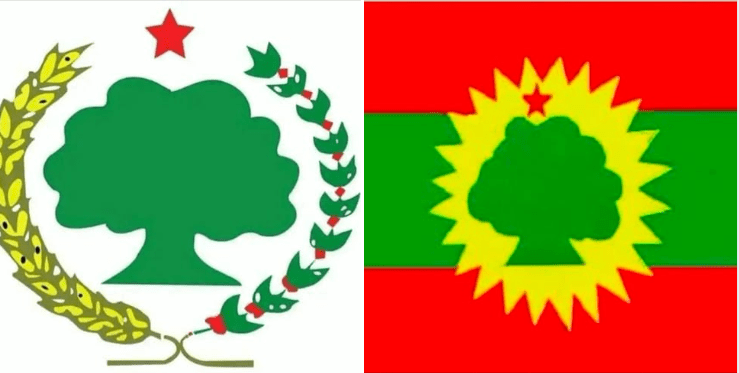
That tree is OLF—not as a slogan, but as a living, breathing promise: that no person is above another; that no mind should be chained; that every voice carries the weight of sacred worth.
—
The Aspiration That Refuses to Die
The original text reminds us: “ABOn waan bu’uraa tokko ummata keessa kaahee jira.”
There is, among the people, one foundational principle. It is not written in stone alone—it is written in conscience. It says:
· Equality is not a privilege; it is a birthright.
· Freedom of thought is not a concession; it is the soil where truth grows.
· Dignity is not a reward; it is the oxygen of human existence.
This aspiration, the text insists, cannot be stopped or erased in any form. Not by armies. Not by laws. Not by propaganda. Not by time.
Why? Because it is not borrowed from a constitution or a king. It is discovered—in the cry of a child, in the sweat of a labourer, in the silent grief of a mother, in the bold question of a teenager. It is experiential before it is philosophical.
—
The Many Faces of Opposition
History is littered with attempts to suffocate this aspiration.
· Tyrants have banned books.
· Dictators have jailed thinkers.
· Empires have rewritten histories.
· Corporations have commodified attention.
· Algorithms have tried to herd our thoughts into safe, sellable boxes.
Yet every time, the aspiration returns—not in the same shape, but in a stronger one.
Why? Because suppression is reactive; aspiration is generative.
· Suppression says: “You must not think this way.”
· Aspiration replies: “Then I will think deeper.”
· Suppression says: “You are unequal by nature.”
· Aspiration answers: “Then I will build communities that prove you wrong.”
This is why the text declares: “Kun dhugaa bara baraan dhaloota walqixxummaa fi bilisummaa barbaadan kamiyyuu keessa kan jiraatuu dha.”
It is the permanent inheritance of every generation that dares to seek equality and liberty. Not a relic of the past—but a living torch passed from hand to hand, across fire and flood.
—
What Does This Mean for Us Today?
In our own time—fractured by misinformation, polarized by identity, exhausted by performative justice—this foundational aspiration calls us back to simplicity and courage.
It asks us:
· Do we treat the stranger at our gate as our equal, or as a threat?
· Do we listen to an idea we hate with the same patience as one we love?
· Do we defend dignity for the powerless, even when it costs us comfort?
If the aspiration is truly unkillable, then our job is not to protect it—but to practice it. Because an aspiration that lives only in speeches is a ghost. An aspiration that lives in schoolrooms, marketplaces, courtrooms, and dinner tables—that is a revolution.
—
The Final Word: A Promise, Not a Puzzle
Some will try to redefine this aspiration. They will twist it into a weapon, a commodity, or a vague slogan. But the core remains indestructible:
Every person holds the right to be free, to think boldly, and to stand equal before their fellow human.
No empire, no algorithm, no crisis can undo that truth—because it is not built on fragile institutions. It is built on the fragile, fierce, unbreakable human heart.
And as long as one parent teaches a child to question, one writer speaks truth to power, one citizen refuses to kneel—that aspiration lives.
It has survived every storm before us.
It will survive every storm ahead.
Not because we are lucky.
But because we are human.
—
“ABOn waan bu’uraa tokko ummata keessa kaahee jira.”
May we never forget it. May we never betray it. May we live it—until it needs no defense.

The Ten Apostles of Waaqeffannaa: Guardians of Faith, Architects of Recognition
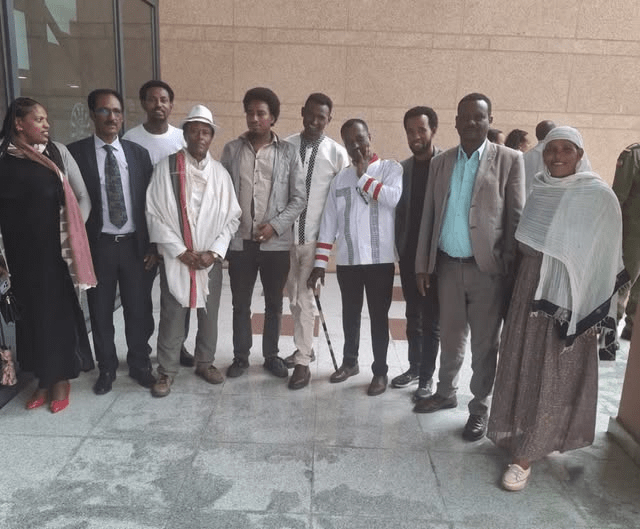
In the annals of cultural and religious history, certain moments stand as watersheds—turning points where the voices of the faithful rise above the din of indifference and claim their rightful place in the national consciousness. Such a moment unfolded between August 8, 2018, and August 16, 2018, when ten extraordinary individuals stepped into the arena of the national dialogue conference and forever altered the trajectory of Waaqeffannaa.
These were not merely delegates or observers. They were apostles—ten men and women who carried the hopes of a community on their shoulders and the weight of centuries-old tradition in their hearts. With unwavering resolve, they presented the core agenda items concerning Waaqeffannaa, articulating its principles, its spiritual significance, and its enduring relevance to the nation’s diverse tapestry. Their presentation was not a mere request; it was a testimony—a vivid recounting of a faith that has sustained generations and deserves recognition.
Their efforts bore fruit in ways that exceeded even the most optimistic expectations. The ten apostles successfully advocated for the Irreechaa festival—the sacred thanksgiving celebration of Waaqeffannaa—to be formally recognized as a national holiday. In a historic decision, their proposal was met with resounding approval from the 4,000 participants of the conference, marking a pivotal moment of inclusion and respect for indigenous spirituality.
But the journey was far from effortless. The proceedings were marked by rigorous debate, delicate negotiations, and moments of intense deliberation. Yet through it all, the apostles remained steadfast, refusing to yield to fatigue or frustration. Their commitment never wavered, even as the conference unfolded day after day, dialogue after dialogue. They understood that they were not merely negotiating for a date on the calendar; they were negotiating for identity, for dignity, and for the right of future generations to celebrate their heritage openly and proudly.
Today, their legacy is etched not only in the official records of the conference but in the hearts of every Waaqeffannaa believer. The recognition of Irreechaa as a national holiday is more than a symbolic victory—it is a bridge between the past and the present, a testament to what can be achieved when faith meets perseverance, and when a small group of committed individuals dares to speak truth to power.
As we reflect on their achievement, we are reminded that every great movement begins with a few voices willing to stand alone before they stand together. The ten apostles of Waaqeffannaa have shown us that courage, clarity, and conviction can move mountains—or, in this case, calendars.
So let us offer them our deepest gratitude and our most heartfelt blessings. May their footsteps inspire others to walk the path of advocacy. May their success embolden other communities to seek recognition. And may the Irreechaa festival, now enshrined in the national fabric, forever remind us of the power of unity, faith, and the unyielding human spirit.
—
To the ten apostles—we see you, we honor you, and we thank you.

The Five Guiding Principles of Oromia’s Development: A Blueprint for Transformation

How the Oromia Regional Government Is Building a Prosperous, Self-Reliant Future
By Daandii Ragabaa
The Oromia Regional Government has unveiled a comprehensive and ambitious development framework anchored in five core principles. Drawing on the region’s history, heritage, and current realities, the government aims to unify state, public, and private efforts to drive transformative change, ensure self-reliance, and secure prosperity for the Oromo people .
As President Shimelis Abdisa declared, the framework is designed to create a “foundation that enables the Oromo people to move forward in step with education, technology, and economic development” . Here is an overview of the five guiding principles shaping Oromia’s future.
1. Returning to Oromo Cultural Foundations
The first principle is a deliberate and powerful act of cultural reclamation. Rooting development in Oromo identity, ethics, solidarity, and social accountability means drawing strength from the past to build a purposeful future.
This commitment is already visible in practice. The regional government is actively pursuing cultural revival initiatives aimed at restoring traditional morning customs, ceremonies, and institutional practices . Festivals like Irreechaa, the Oromo thanksgiving celebration, have been revived and have grown in prominence. The Gadaa system continues to be a living example of indigenous governance and democratic participation, with its peaceful power transfer ceremonies being publicly recognised .
The revitalisation is not merely symbolic. Traditional Courts have been established to allow communities to seek justice according to their cultural norms. In 2018 alone, over 370 community conflict cases were successfully resolved through these structures . Major infrastructure projects like the Me’ee Bokkoo Cultural Center in Guji Zone further demonstrate this commitment .
2. Working Diligently and Accountably
This principle emphasises strategic execution. By systematically utilising time, resources, and opportunities, the government aims to deliver efficient, accountable, and results-oriented work. This approach moves from planning to implementation, and from implementation to tangible change.
The regional administration’s record reflects this focus. The plan targets cultivating 12.4 million hectares of farmland to produce over 379 million quintals of crops and expand dry-season irrigated wheat production on 4 million hectares . The government is also seeking to attract investors with a combined capital exceeding 200 billion Birr to create job opportunities for 1.7 million citizens . The administration has further planned to create permanent job opportunities for 2.7 million citizens .
3. Competitiveness in All Sectors
The third principle is a comprehensive call to action across the economy. By fostering productivity, innovation, and quality across agriculture, industry, investment, and services, Oromia aims to transform its resources into higher value, jobs, and income.
This is being pursued through an ambitious “Integrated Urban Development” master plan, concentrating on key urban centres like Shaggar, Bishoftu, and Adama, and establishing Special Economic Zones (SEZs) to drive growth . The Bishoftu area will be transformed into a major economic hub centred around the Gada Special Economic Zone (GSEZ) and a new USD 10 billion airport . A new land lease directive for flower farm investors is also part of this push, intended to improve the business environment and attract foreign direct investment .
4. Cleanliness and Good Governance
This principle focuses on the quality of governance and public service. Strengthening transparency, accountability, and efficiency in governance and finance ensures public trust and integrity. It also involves serving the public and building a corruption-free administrative structure.
The regional government’s restructuring of major cities is a direct example. The creation of new zonal and city administrations, such as the merger and upgrade of cities like Shashemene and Bishoftu, is intended to streamline service delivery and foster urban development . An “Early Childhood Development (ECD) Roadmap” has also been launched to strengthen integrated services for young children across the region, demonstrating a commitment to long-term human capital development .
5. Unity and Collaboration
The final principle underscores a unified approach. Bringing together government, people, private sector, financial institutions, investors, experts, and youth toward common goals is essential for building transformative growth. This is a collective national project.
The Biftu Oromiya Band, celebrating 30 years of promoting Oromo identity, has been a powerful force for cultural cohesion and unity . The ongoing national dialogue is also part of creating a shared vision for Ethiopia’s future . Initiatives like the Gada Special Economic Zone are designed with this collaborative model in mind, aiming to integrate diverse actors for shared success.
Conclusion: A Foundation for Generations
These five guiding principles represent a coherent and ambitious vision for Oromia. By uniting its cultural strength with disciplined execution, economic competitiveness, good governance, and collaborative spirit, the Oromia Regional Government is laying the groundwork for a prosperous, self-reliant, and dignified future for its people.
Injifannoon Ummata Oromoo!

A Constructive Journey of Nation-Building: “No Way Back”

How Oromia’s Universities Are Embracing Afan Oromo and Redefining Institutional Identity
By Daandii Ragabaa
Across the landscape of Oromia, a quiet but profound transformation is taking place. University gates and official logos are telling a new story—one of recognition, belonging, and cultural confidence. The growing visibility of Afan Oromo in higher education institutions is not merely a matter of signs or symbols. It is a statement of identity, a commitment to inclusivity, and a bold step in the journey of constructive nation-building.
As one observer aptly noted, “There is no way back.”
A Movement Gains Momentum
The journey began with universities displaying Afan Oromo prominently at their main gates. Ambo University is widely recognised as one of the first to take this step, setting a precedent that others would soon follow.
Oromia State University included Afan Oromo in its institutional identity from its inception, reflecting its mandate and its deep connection to the community it serves.
The movement soon progressed beyond university gates. Salale University was the first to incorporate Afan Oromo into its official logo, paving the way for others to follow. Haramaya University then marked a turning point by placing Afan Oromo prominently at the top of its institutional identity. Other institutions—Jimma University, Wallaga University, Mattu University, and Dambi Dollo University—soon joined the movement. Ambo University, despite starting the journey early, later formalised its commitment with a new logo. Bule Hora University, Borana University, and Madda Walabu University also embraced the change.
Now, Arsi University has joined at a particularly important moment. Its decision carries strong symbolic weight: despite changing circumstances, the momentum continues—a clear message that there is no turning back.
A Constructive, Not Political, Act
This movement should not be misconstrued as a political statement. It is, at its core, a constructive act of nation-building.
Universities are federal institutions within the national higher education system. But they are also geographically and socially rooted in the communities where they are located. Recognising the language and culture of those communities does not conflict with treating all students and members of the academic community equally.
The Addis Ababa Education Bureau provides a useful example: it works effectively in both Amharic and Afan Oromo. Linguistic recognition and institutional inclusiveness can coexist. Respecting one community’s language does not require disrespecting another’s.
The Role of University Leadership
The growing visibility of Afan Oromo in universities is a testament to the courage and vision of university presidents and their teams. These leaders have taken bold steps in a direction that affirms the identity of their institutions and the communities they serve.
Some of these courageous leaders have since moved on to other responsibilities, but their contributions remain—etched into the logos, the gates, and the institutional memory of the universities they helped transform.
Looking Ahead: Completing the Journey
While the movement has been embraced by many universities, a few have yet to make the change. Among them are Adama Science and Technology University (ASTU_Official) , Salale University, and Oda Bultum University. There is hope that they too will complete this journey, with Salale University formally completing the process it helped to initiate.
As the observer noted: “I hope they too will complete this journey.”
Conclusion: More Than Signs and Logos
The growing visibility of Afan Oromo in Oromia’s universities is more than a matter of signs or logos. It represents recognition, belonging, cultural confidence, and constructive nation-building. It is a declaration that the language of the Oromo people has a place in the highest halls of learning—and that the university is a space where all identities are welcomed and valued.
Injifannoon Ummata Oromoo!
Afaan Oromo haa jabaatu!
This feature article is dedicated to the university presidents and their teams who have taken courageous steps to affirm the identity and language of the communities they serve.

Ifaanoo: Welcoming the Season of Light
How the Sacred Mijirii Bonfire Illuminates Hope, Rebirth, and Oromo Unity
ByMaatii Sabaa
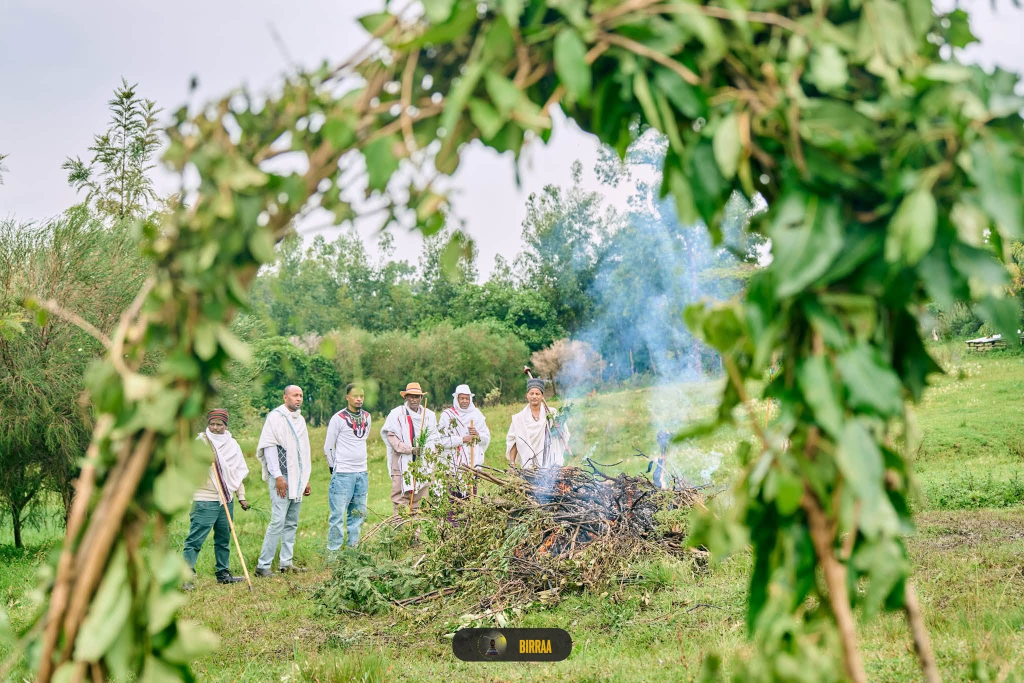
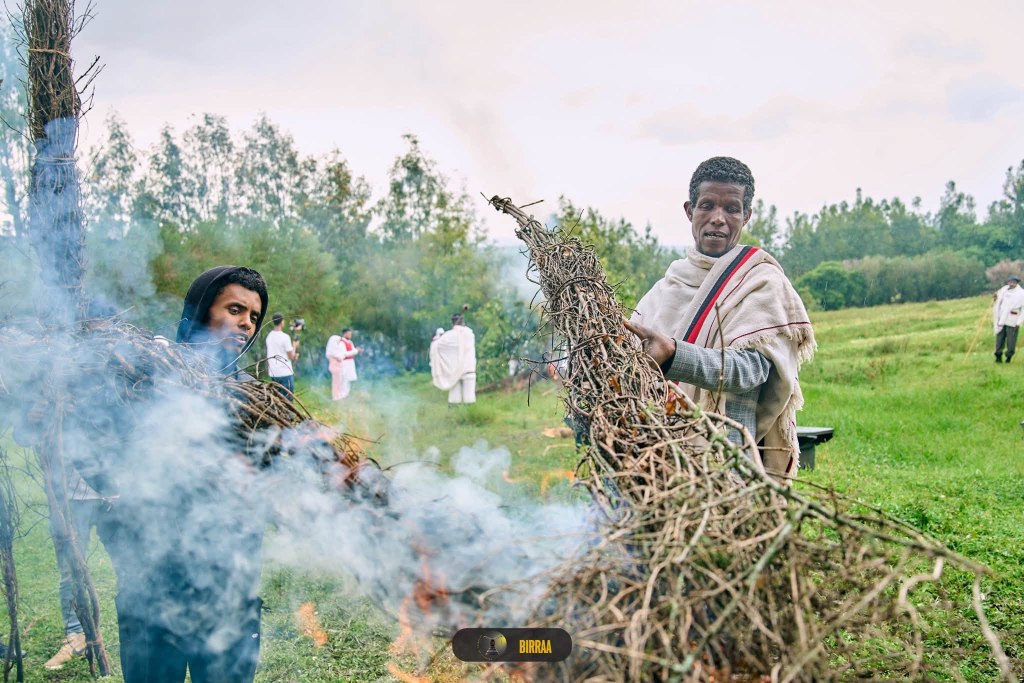
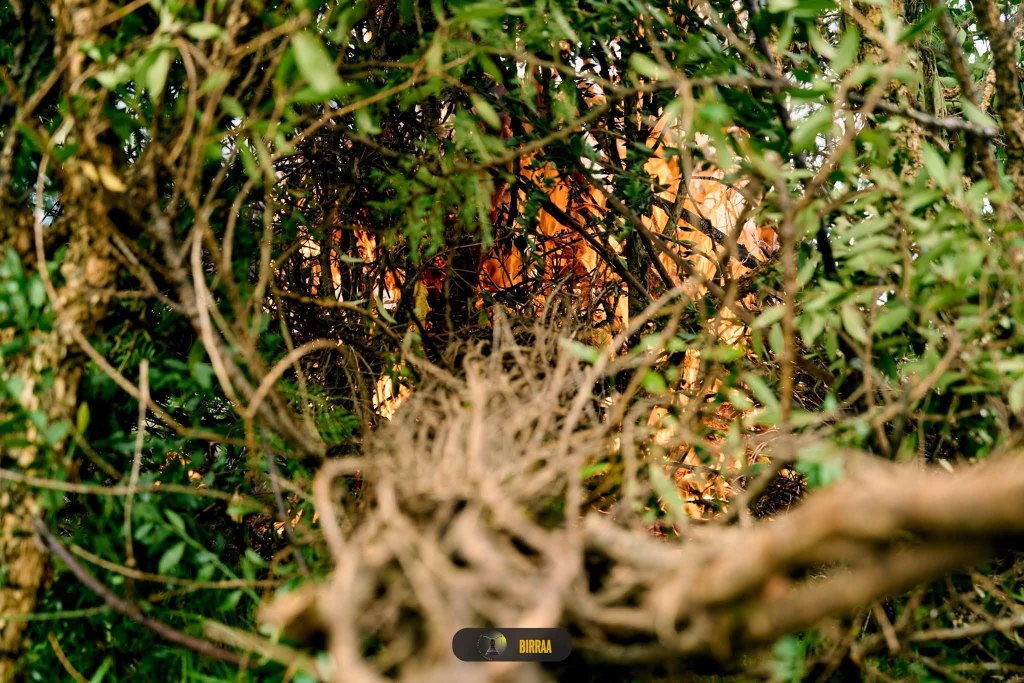
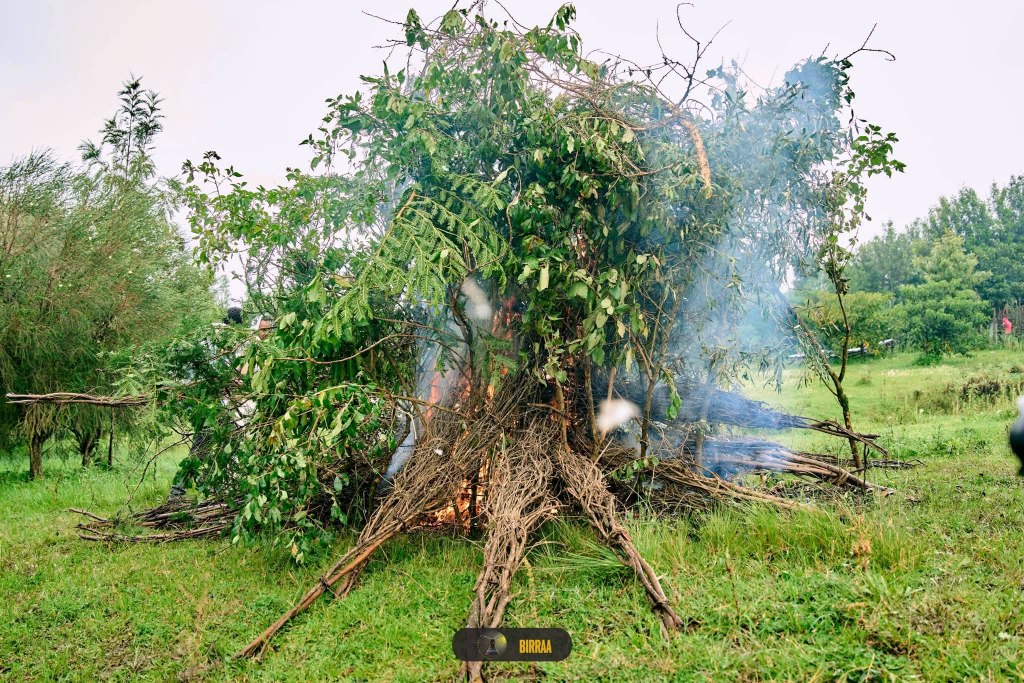
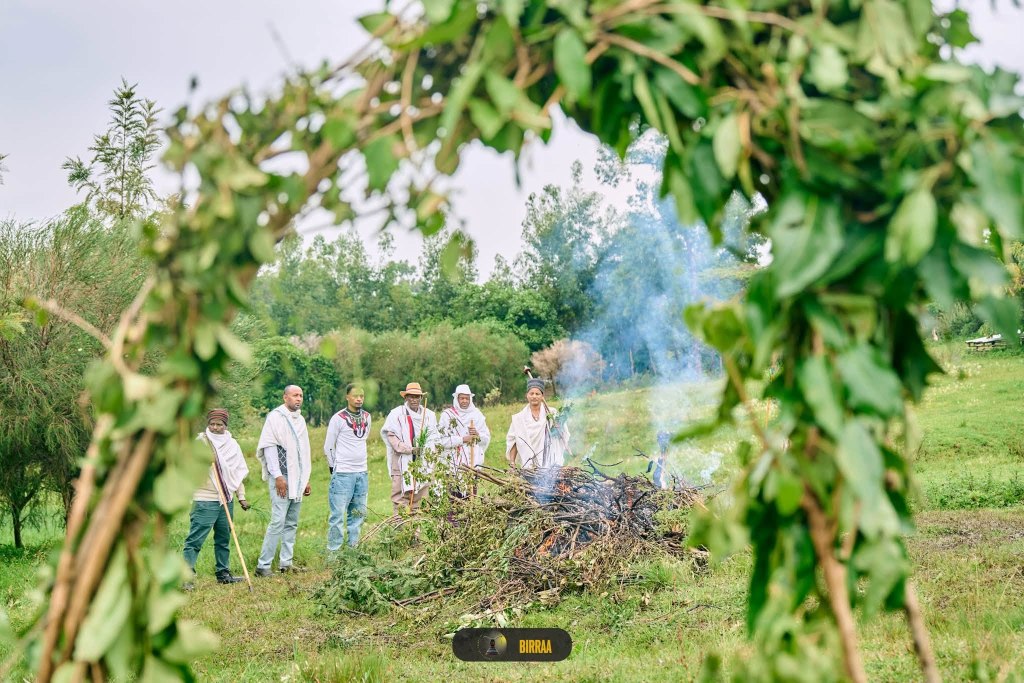
At the break of dawn, as the first rays of light touch the horizon, the sky ignites with warmth. Flames leap toward the heavens, casting a golden glow across the gathered community. This is Ifaanoo—the sacred Oromo ritual that marks the end of the dark winter season and the joyous arrival of Birraa (spring).
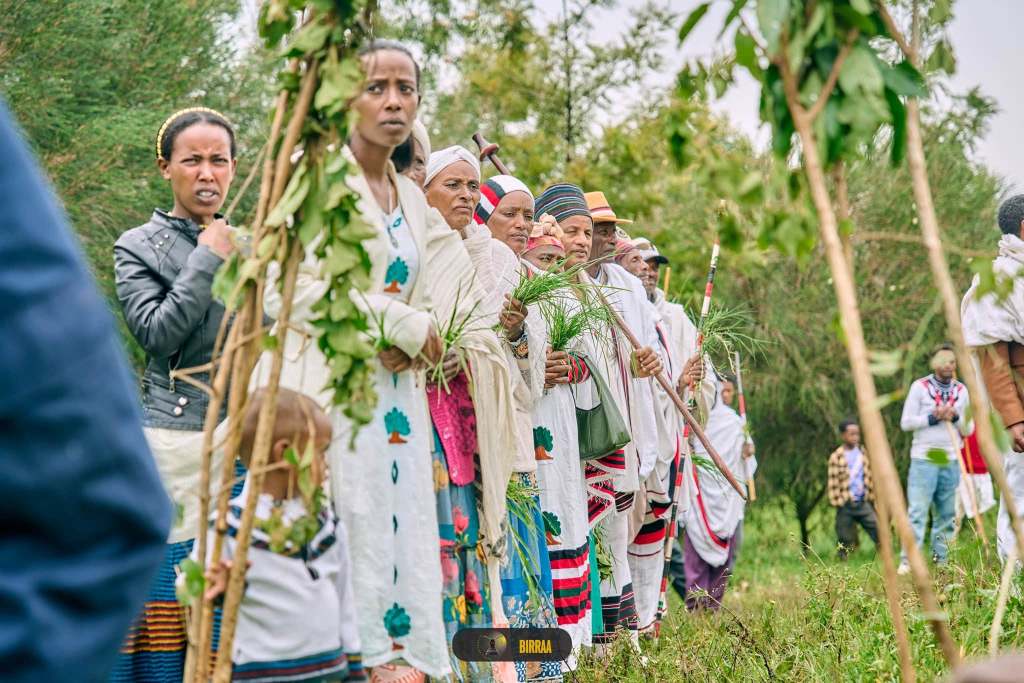
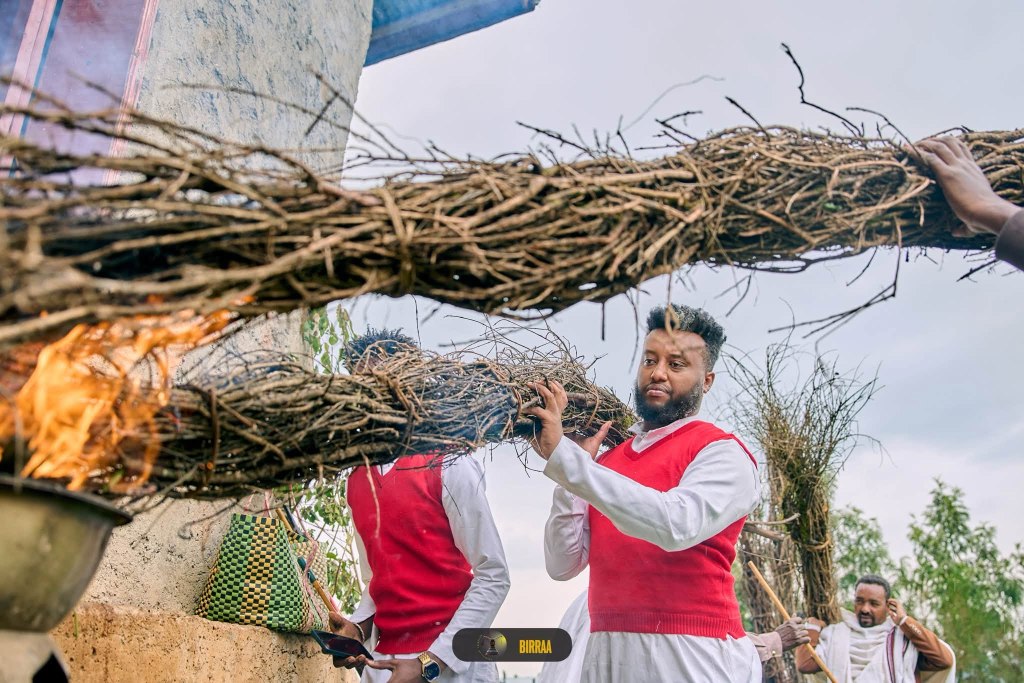
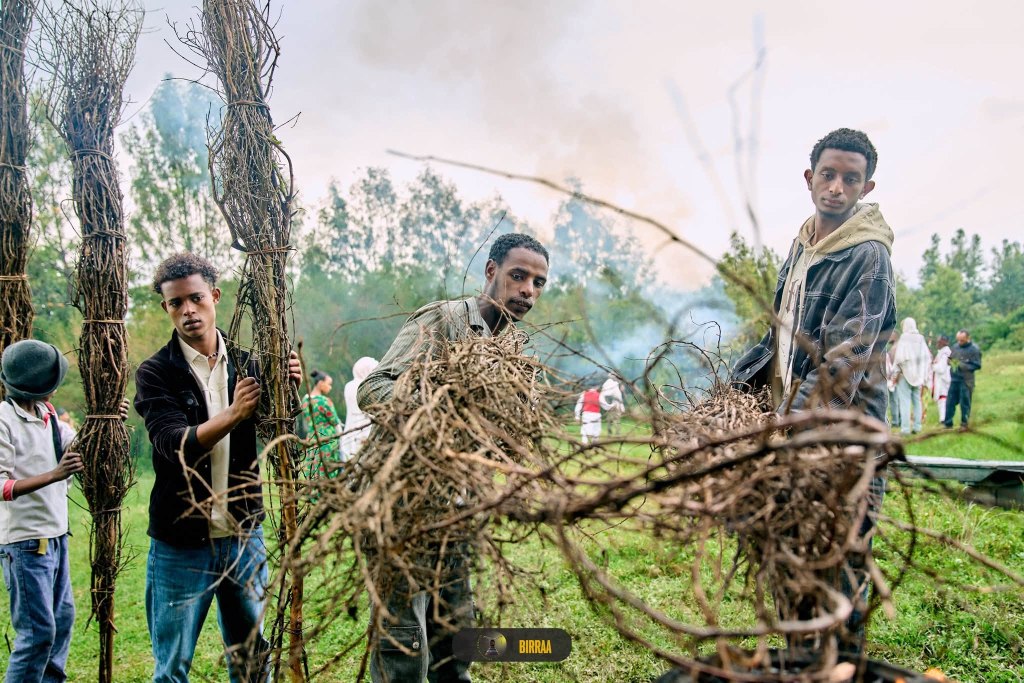
The historic Mijirii bonfire is lit, filling the air with the crackling sound of fire and the scent of burning wood. Families, elders, youth, and children gather around the flames, their faces illuminated by the glow. It is a moment of profound spiritual significance—a time when the community comes together to cast away the gloom of winter, uplift one another, and celebrate the rich, enduring customs of their ancestors.
The Meaning of Ifaanoo
Ifaanoo is a celebration of light and renewal. The word ifaa in Afaan Oromoo means “light,” and the festival embodies the dispelling of darkness—both literal and metaphorical. Just as the dawn breaks after a long night, Ifaanoo represents the triumph of hope over despair, of unity over division, of life over hardship.
The lighting of the Mijirii bonfire is the centrepiece of the celebration. The bonfire is not merely a source of warmth; it is a symbol of the sun’s return, the rebirth of the earth, and the renewal of the community’s covenant with Waaqa (God). As the flames rise, participants offer prayers of gratitude for the blessings of the past year and petitions for peace, prosperity, and unity in the year ahead.
A Ritual of Community and Solidarity
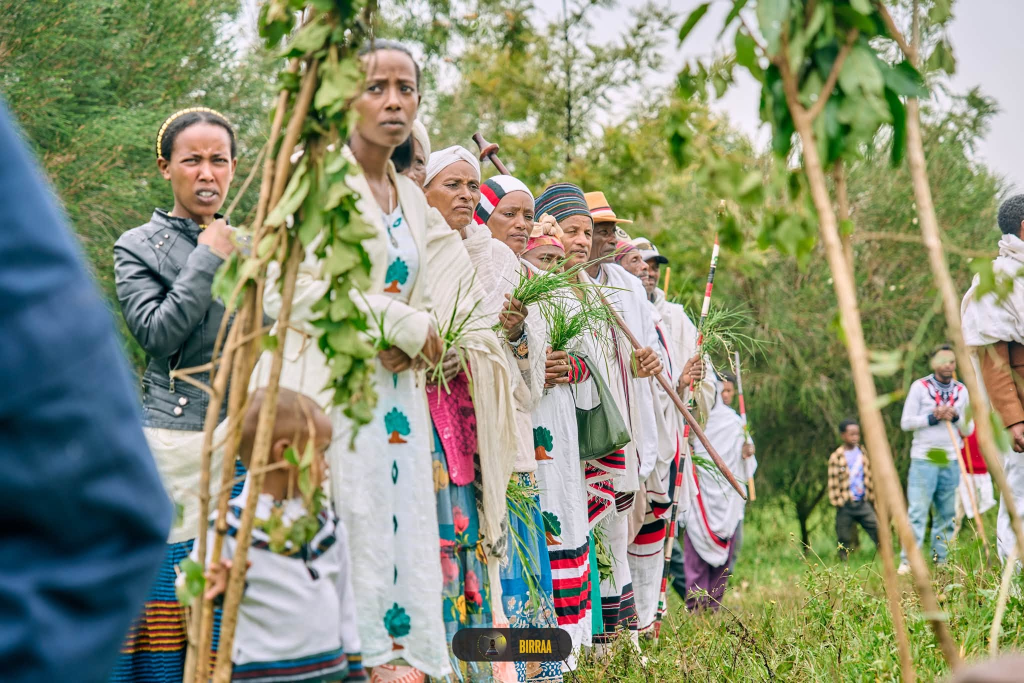
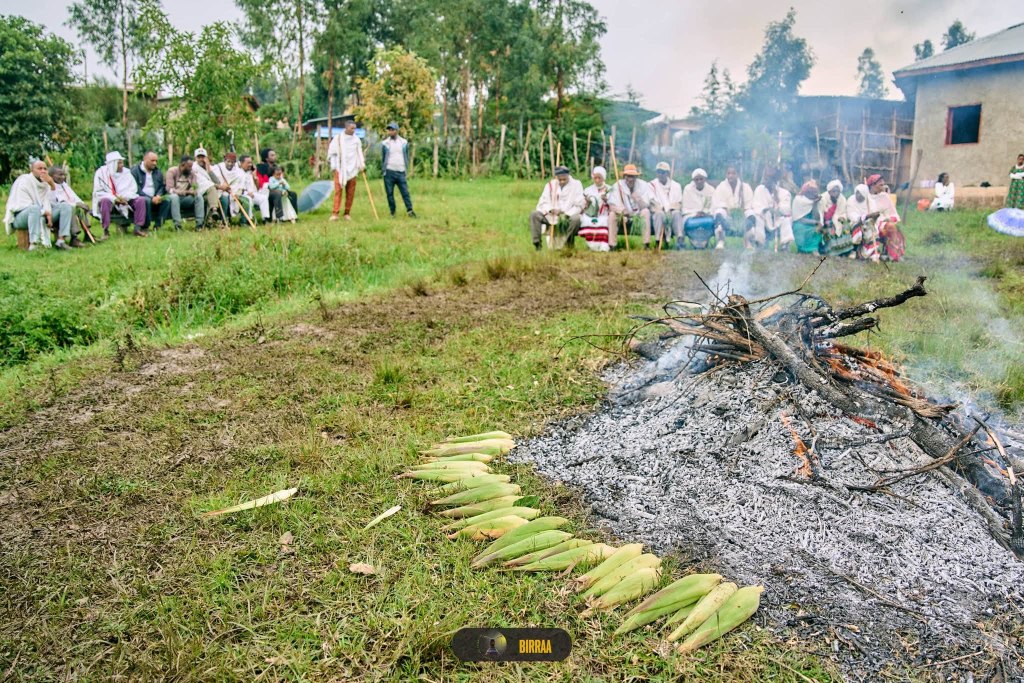
Ifaanoo is a profoundly communal celebration. Families and neighbours gather around the bonfire, sharing stories, songs, and traditional foods. The warmth of the fire mirrors the warmth of human connection, reinforcing the bonds that hold the community together.
The festival is also a time for reconciliation. As with other Oromo celebrations, participants are encouraged to resolve conflicts and seek forgiveness before joining the festivities. This requirement ensures that the celebration is not merely a superficial gathering but a genuine act of collective healing and renewal.
Elders play a central role in the Ifaanoo ceremony. They lead the prayers, offer blessings, and share the wisdom of the ancestors with the younger generation. The intergenerational transmission of knowledge ensures that the values and traditions of the Oromo people are preserved and passed on.
The Symbolism of Light
For the Oromo people, light represents not only physical illumination but also spiritual clarity, moral purity, and the presence of divine blessing. The bonfire is a reminder that even in the darkest times, light can be kindled—that hope is never extinguished, and that renewal is always possible.
The transition from winter to spring is a powerful metaphor for the human experience. Winter, with its cold, darkness, and isolation, represents the hardships and challenges of life. Spring, with its warmth, light, and abundance, represents the promise of renewal and hope. Ifaanoo celebrates this transition, reminding the community that after every winter, spring will come.
A Living Tradition
Ifaanoo is not a relic of the past—it is a living tradition that continues to evolve and adapt to the needs of the present. In recent years, the celebration has been revived and embraced with renewed enthusiasm in Oromia and diaspora communities across the world.
The festival serves as a powerful statement of cultural identity and resilience. For a people who have faced centuries of oppression and cultural erasure, the act of gathering around the Mijirii bonfire is a declaration that their traditions endure and that their identity will not be extinguished.
A Call to Renewal
As the Mijirii bonfire illuminates the sky, it also illuminates the path forward. Ifaanoo is a call to renewal—to let go of past grievances, to embrace hope, and to recommit to the values of unity, peace, and mutual respect.
In a world often marked by division and despair, the Oromo people offer a powerful alternative: a celebration of light, community, and the enduring hope that dawn will always follow the night.
This feature article is dedicated to the custodians of Oromo tradition who keep the flame of Ifaanoo burning bright for future generations.





THE RESILIENT SPIRIT: OROMIA’S STRUGGLE FOR SURVIVAL AND RENEWAL

A feature on the challenges facing Oromo language, culture, and identity—and the unyielding determination to preserve them for generations to come
—
The Whispers of a Dying Language
In the bustling markets of Finfinne, amidst the vibrant chaos of merchants and shoppers, a troubling silence grows. The melodic tones of Afaan Oromo—once the heartbeat of millions—are increasingly drowned out by foreign tongues. Elders shake their heads as they witness their grandchildren struggle to form sentences in their mother tongue, preferring instead the languages of power and commerce.
“This is not just about words,” says Dr. Lemma Gutema, a linguist at Jimma University. “When a language dies, a worldview dies with it. The Oromo people are losing not just vocabulary, but the very framework through which we understand our relationship with the land, our history, and each other.”
The erosion of Oromo culture is not a natural evolution—it is a systematic dismantling that has accelerated over decades. As one elder in the countryside put it: “The language that was once spoken freely in every home, every market, every ceremony, is now fighting for breath. Our children are taught to be ashamed of who they are.”
—
Cultural Bleeding: The Erosion of Identity
Walk through any Oromo village today and you will see the signs of cultural fracture. The gadaa system—once the cornerstone of Oromo democracy and governance—is dismissed by many as primitive, its intricate wisdom forgotten. Traditional ceremonies are simplified, commercialized, or abandoned entirely.
“The aadaa of our people is not being preserved as it should be,” laments Haji Birmah, a cultural elder from Borana. “Our rituals, our songs, our ways of greeting, our respect for elders—these are not just customs. They are the threads that weave our community together. When these threads break, the fabric of our society unravels.”
Young Oromos find themselves caught between two worlds. Many seek to reconnect with their heritage, but find the path blocked by generations of suppression and the relentless pull of globalized culture. The result is a generation suffering from what psychologists call “cultural bereavement”—the grief of losing one’s cultural identity.
—
The Weight of Economic Injustice
Behind the cultural crisis lies a deeper wound: the systematic impoverishment of the Oromo people. Poverty is not merely an economic condition in Oromia—it is a manifestation of structural injustice that has left entire communities marginalized.
“We are rich in resources but poor in access,” explains financial analyst Tsehay Mulugeta. “Oromia holds the majority of Ethiopia’s agricultural land, water resources, and mineral wealth. Yet our people remain among the poorest and least developed in the nation. This is not an accident of geography—it is a product of policy.”
Farmers who have worked the land for generations find themselves unable to benefit from its bounty. Young people with dreams and ambition lack the educational and economic opportunities available to others. The cycle of poverty is not just about money—it erodes dignity, hope, and the very possibility of a better future.
“The poverty is humiliating,” says a young woman from Arsi, who asked to remain anonymous. “We see others prosper while we struggle. Our children go hungry. Our parents cannot afford healthcare. How can we preserve our culture when we are fighting for survival?”
—
Betrayed by the State
Perhaps most painful for the Oromo people is their relationship with the institutions meant to serve them. Citizenship services—the basic promise of protection and provision—have consistently failed to reach Oromo communities.
“Citizenship means nothing if the state does not recognize your dignity,” says legal scholar Professor Almaz Gonfa. “When you cannot access justice, when your rights are not protected, when your voice is not heard—you are not a citizen. You are a subject, at best, or an obstacle to be removed.”
The story of Oromo marginalization is written in the experiences of ordinary people: the family denied land rights, the businessman unable to secure permits, the student rejected from university despite qualifications, the community without basic infrastructure while neighboring regions prosper.
“Naatoon namummaa badaa jira”—human dignity is suffering. This simple phrase spoken by Oromo mothers captures the essence of the crisis. When a people’s humanity is not recognized, when their basic needs are not met, when their existence is rendered invisible—dignity itself becomes a casualty.
—
The Lament of the Land
The Oromo relationship with their land is sacred. Oromiyaa is not just geography—it is identity, heritage, and the living memory of ancestors. But this connection is being severed.
Naannoon Oromiyaa—the Oromo region—is described by elders as gammojjummaan dhaalaa, a heritage that is crying out for proper care. Environmental degradation, encroachment on traditional lands, and the disruption of traditional land management systems have left the land scarred and the people disconnected.
“In our gadaa system, we understood that we are temporary stewards of the land,” explains a traditional leader from Guji. “We passed it down to our children as we received it from our fathers. But now the land is being taken, degraded, and exploited. How can we preserve our culture when the very ground beneath our feet is disappearing?”
—
A Generation’s Sacred Duty
Despite the weight of these challenges, a powerful movement is stirring among Oromo youth. Across universities, community centers, and social media platforms, young Oromos are reconnecting with their heritage—not as a sentimental exercise, but as an urgent mission.
“This is about survival,” says Bontu Dibaba, a 24-year-old activist from Adama. “We are the generation standing between extinction and renewal. Our parents endured the worst of the suppression. We have the knowledge, the tools, and the freedom to fight back. If we don’t act now, what will be left for our children?”
The mission is clear and urgent: to protect the Oromo language from extinction, to preserve Oromo culture in all its richness, to ensure Oromo children can grow up with dignity and opportunity, and to create a future where being Oromo is not a burden but a source of strength and pride.
“Dhaloonni keenya jajjaboon otuu jiranii”—as long as our descendants remain strong—the elders remind us. This is not a passive hope but an active commitment. The strength of future generations depends on the choices made today.
—
Gaammee: The Call to Action
At the heart of this movement is a powerful concept: Gaammee. It represents the collective commitment of the Oromo people to stand together in defense of their identity and future.
“Nuti otuu jirruu Oromoo fi Oromiyaan rakkoof hin saaxilaman,” the people of Gaammee declare. “As long as we are alive, Oromo and Oromia will not be subjected to problems.”
This is not empty rhetoric. It is a pledge backed by action—cultural festivals being revitalized, language classes being organized in diaspora communities, economic cooperatives being formed to build self-sufficiency, advocacy campaigns raising awareness about rights and injustice.
The Gaammee movement represents something profound: a refusal to accept the narrative of decline, a determination to write a different story. It is the voice of a people saying, “We are here. We have always been here. And we will remain here.”
—
Looking Toward Tomorrow
The challenges facing Oromo language, culture, and people are immense. But so is the resilience of a people who have survived centuries of change, challenge, and oppression.
What happens in the coming years will determine not just the fate of one ethnic group, but the kind of society Ethiopia will become. Will it be a nation that embraces its diversity, that protects the rights and dignity of all its peoples? Or will it continue down a path of exclusion and denial?
For the Oromo people, the answer is already clear. Through language preservation, cultural revival, economic empowerment, and collective action, they are building the future they deserve. A future where Afaan Oromo is not just spoken but celebrated. Where aadaa is not just remembered but practiced. Where Oromo children can grow up with pride, opportunity, and hope.
“Dhaloota keenya eeggachaa jira,” they say—we are protecting our generation. It is a promise passed from elders to youth, from parents to children. It is the thread that connects past, present, and future.
The road ahead is long. The obstacles are real. But the spirit of the Oromo people—that indomitable fire that has burned through centuries of challenge—is undimmed. Like the ancestors who survived and thrived before them, this generation is determined not just to survive, but to flourish.
In the words of an old Oromo proverb: “The river that forgets its source will dry up.” The Oromo people are remembering their source. They are returning to the well of their identity. And they are drawing from it the strength to build tomorrow.
—
The struggle of the Oromo people is a struggle for justice, dignity, and identity. It is a struggle that deserves recognition and understanding—not just from Ethiopians, but from the global community. Because when one people’s culture, language, and dignity are threatened, it diminishes us all.
The question is not whether the Oromo people will survive—they have survived centuries of challenge and will continue to do so. The question is what kind of world we will create: one where diversity is celebrated and all peoples can thrive, or one where difference is suppressed and culture is erased.
For the Oromo people, the answer is clear. Gaammee—they stand together, committed to a future where Oromo culture flourishes, the language lives, and the land is protected. For themselves, and for generations yet unborn.

Irreechaa 2026: Africa’s Largest Gathering of Gratitude and Resilience
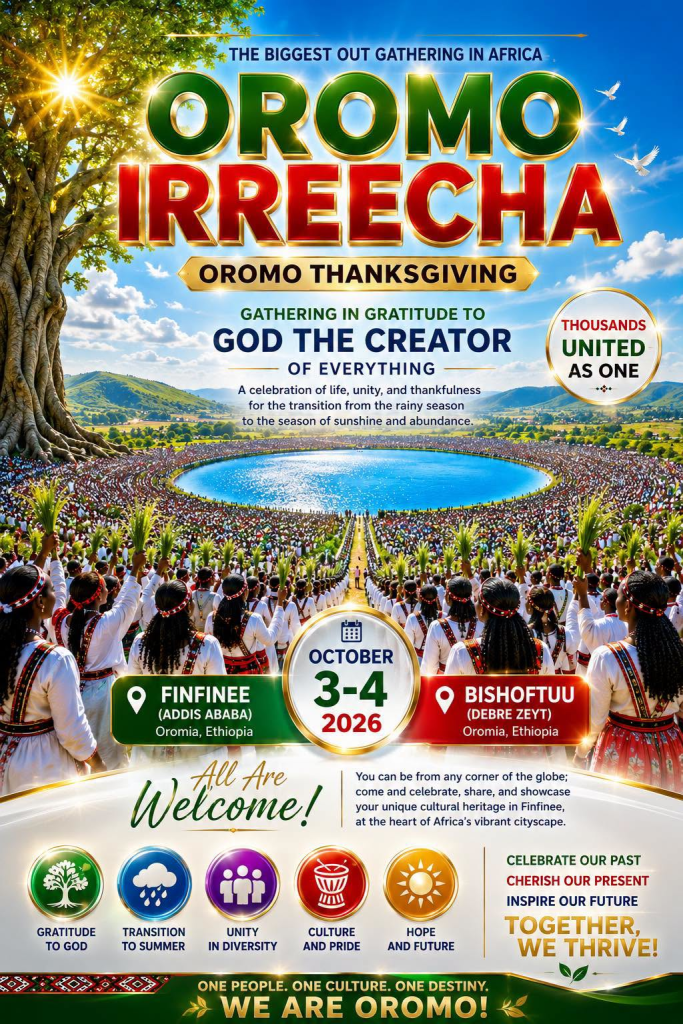
Millions Prepare to Celebrate Oromo Thanksgiving in Finfinne and Bishoftu
By Maatii Sabaa
As the golden light of spring breaks over the Oromo landscape, a profound spiritual awakening stirs across Oromia and the global diaspora. Irreechaa—the Oromo Thanksgiving—is set to transform Finfinne and Bishoftu into a vibrant sea of white, green, and cultural pride from October 3 to October 4, 2026 . This is not merely a festival. It is Africa’s largest outdoor gathering, where millions will come together to express gratitude to Waaqa (God) and celebrate a cultural heritage that has endured for millennia .
The Heartbeat of a People: What Is Irreechaa?
Irreechaa, known in some traditions as Irreessa or Dhibaayyuu, is an annual thanksgiving holiday that marks the end of the rainy winter season and the joyous arrival of Birraa (spring) . It is a time when the Oromo people gather at sacred lakes, rivers, and springs to thank Waaqa for the blessings, mercies, and bountiful harvests received over the previous twelve months .
The festival’s roots run deep—over 6,000 years into the ancient Oromo and Cushitic civilization, long before the rise of modern empires or religions . It is intimately connected to the Gadaa system, the traditional Oromo governance structure recognised by UNESCO as an Intangible Cultural Heritage of Humanity . As the elders teach, Irreechaa is simply “giving thanks to the one God”—the pinnacle of Oromo religious and cultural expression .
Two Sacred Sites, One Unifying Spirit
This year’s celebration will unfold over two days across two of the Oromo people’s most sacred sites, following a time-honoured itinerary announced by the Council of Oromo Gadaa Elders .
Hora Finfinne: Reclaiming the Heart of the Capital
On October 3, the celebration will commence at Hora Finfinne, in the heart of the capital city . This location carries profound historical weight. For decades, under oppressive regimes, public celebrations of Irreechaa were banned, and the Oromo people were denied the right to give thanks at their own sacred sites . The site now known as Finfinne was originally named after the very same Hora Finfinne—a sacred geography that the construction of a colonial capital attempted to overwrite . Celebrating Irreechaa here is not just a cultural act; it is a powerful reclamation of space, identity, and dignity.
Hora Arsadi: The World’s Stage
On October 4, the festival moves to its grandest location: Hora Arsadi in the city of Bishoftu, approximately 45 kilometres south of Finfinne . This is the site of the main event—a gathering so vast that it is recognised as one of the largest annual human gatherings on the African continent . Here, in a landscape of breathtaking natural beauty and sacred waters, the celebration reaches its crescendo.
In recent years, the scale of the gathering has been so immense that international media, including the BBC, Al Jazeera, and CNN, have broadcast images of the spectacle: hundreds of thousands, sometimes millions, of people dressed in a vibrant sea of traditional colours, moving with purpose and joy towards the water .
The Rituals of Renewal
The Irreechaa ceremony is a tapestry of ritual and symbolism. At the lake, participants carry freshly cut green grass and flowers—symbols of fertility, life, and renewal . They immerse these offerings in the water, sprinkle themselves, and raise their hands in prayer. The grass, dipped and sprinkled, is a symbolic gesture of cleansing, purification, and the washing away of hardship. Traditional songs, known as sirba, echo across the valley, their melodies passed down from elders to the youth, ensuring the continuity of a living heritage .
Women are decorated in their finest traditional attire, while youth, particularly young men known as Kormoomsaa, move through the crowd, sprinkling people with fresh water as a gesture of cleansing and blessing . The event is a total immersion in culture and community. After the prayers, families and friends share meals of traditional dishes and freshly brewed coffee, reinforcing the profound social bonds that the festival strengthens .
More Than a Festival: A Symbol of Unity and Resilience
Irreechaa is often described as the “most celebrated cultural festival in Africa” . However, its significance extends far beyond its sheer scale. The festival’s core principles are peace, unity, love, and reconciliation. As the history of the festival teaches, holding onto resentment or grievance is not permitted at Irreechaa. A person cannot attend unless they have resolved their disputes with others . This requirement is a profound social intervention, reinforcing the idea that one cannot give thanks while holding a grudge.
The revival and growth of Irreechaa, particularly the celebrations in Finfinne, represent a powerful statement of cultural resilience. It is a declaration to the world that the Oromo culture, with its deep-rooted values of democracy, community, and spirituality, is not a relic of the past but a vibrant force for the present and future .
A Call to the World
The message from the Oromo community is clear: “You can be from any corner of the globe, individuals can come and showcase their unique cultural heritage in Finfinne during our celebration, at the heart of Africa’s vibrant cityscape.” As the Oromo people gather to give thanks, they extend an invitation to the world to witness the unity and resilience of a nation that has overcome immense challenges and continues to celebrate life, faith, and hope with unparalleled passion.






