“The Worqitu We Saw at Moyale”: Oromo Identity, Boorana Women, and the Fire of Defiance
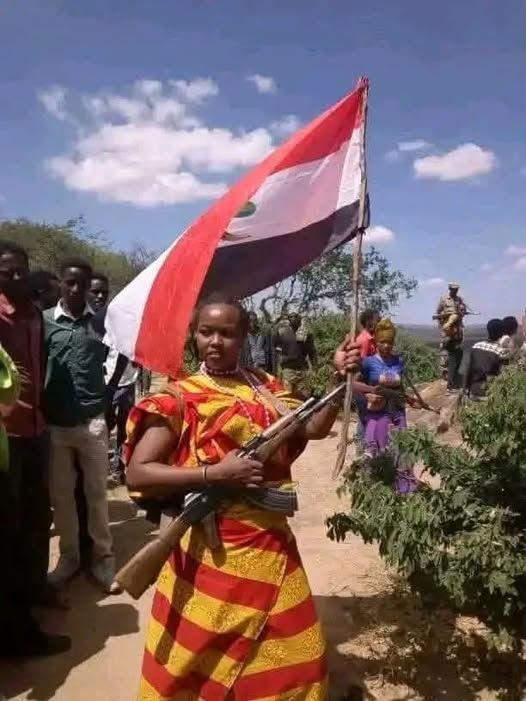
A viral message from the frontier of identity — celebrating the Boorana women who stand at the border of land and selfhood — has reignited a conversation about what it means to be Oromo, and who pays the price for defending it
By Daandii Ragabaa
—
It begins with a declaration, and it ends with a blessing.
Across social media this week, an impassioned message written in Afaan Oromoo has been shared and reshared — a tribute to the Oromo spirit, to the fighters at Moyale, and above all to the women of Boorana who, in the words of the post, stand for their land and their identity.
“Every Oromo, if she/he is wounded for her/his Oromoness and defies the enemy in this way — even if we become a plaything for anyone’s mockery — behold, at Moyale we have seen many Worqitus ones who struggle for their border and their identity,” the message reads. “May their seed multiply, Abo.”
Then, a proverb, and a salute: “Sabni Hidhannoo qabu mataa gadii hin qabu” — a nation with a covenant holds its head high. “Baga kabachiiftan! Ammallee duratti!” — Congratulations! And forward, still forward! “Dubartii Boorana!!” — Boorana women!!
A Message from the Frontier
Moyale sits at the edge of things — a place where land, identity, and history press against one another. In the Oromo imagination, and particularly in Boorana memory, such places are not merely geography. They are archives. Every ridge and river carries the story of who belongs to the land and who has defended it.
The message’s reference to “the border” is therefore more than a line on a map. It is the boundary of belonging itself — the place where a people’s right to be who they are is tested.
And it is there, the message insists, that “golden ones” have been seen. The imagery is deliberate: gold in Oromo and Boorana oral tradition is not merely precious — it is enduring, tested by fire, and impossible to counterfeit. To call the women of Boorana “golden” is to say that their worth has been proven in the crucible.
“Dubartii Boorana” — The Women Who Carry the Nation
The exclamation that closes the message — Dubartii Boorana! — is both salute and summons. In Boorana society, women hold a distinct and honored place: custodians of tradition, keepers of the gadaa calendar’s moral memory, and, in moments of crisis, the ones who stiffen the spine of the community.
The message’s author understands this. By centering women in a tribute to resistance, the post quietly overturns the assumption that the story of struggle belongs only to men. It is the mothers, the daughters, the wives, and the sisters who transmit identity across generations — who teach a child what it means to be Oromo before any flag or border can.
“May their seed multiply” is thus not a casual blessing. It is a prayer for continuity — for the future itself.
The Weight of “Being a Plaything”
Perhaps the most striking line in the message is also its most painful: the acknowledgment that a people who fight for their identity may be mocked, dismissed, or made “a plaything” in the eyes of others.
It is a recognition born of experience. Oromo communities have long contended with marginalization, with the distortion of their history, and with the casual contempt of those who see identity assertion as inconvenient. The message does not deny this. Instead, it absorbs the mockery and answers it with dignity: even if we are mocked, behold what we have seen at Moyale.
There is an old strength in that posture — the strength of a people who have learned that dignity is not granted by others but claimed by oneself.
“A Nation with a Covenant Holds Its Head High”
The proverb at the heart of the message — Sabni Hidhannoo qabu mataa gadii hin qabu — is a key to understanding everything else.
Hidhannoo is covenant, bond, agreement — the sacred compact that binds a community to its values, its land, and its future. A nation with such a covenant, the proverb says, need never bow its head. It can look the world in the eye.
For the Oromo, that covenant is carried in the gadaa system, in the oral epics, in the shared memory of the Boorana and beyond. It is the reason the message can move so quickly from lament to triumph — from the wound to the blessing, from the mockery to the gold.
A Blessing That Travels
What makes this message remarkable is not only its content but its movement. Composed in Afaan Oromoo and shared across platforms, it travels from the specific — a place called Moyale, a people called Boorana — to the universal: the right of any people to defend who they are.
“Baga kabachiiftan! Ammallee duratti!” — Congratulations! Forward, still forward!
It is the language of a people who know that the struggle for identity is never finished, only renewed. And it is a reminder, as the message’s author clearly intends, that the “golden ones” are not only at Moyale. They are wherever an Oromo woman teaches her child the name of her people, wherever a community holds its head high, and wherever the covenant is remembered.
The seed, the blessing says, will multiply.
—
The message referenced in this feature was widely shared in Afaan Oromoo on social media. This article honors the sentiment expressed in that message and the communities it celebrates.

Posted on November 3, 2026, in Aadaa, Afaan, Bokkkuu, Daaniyaa, Diaspora, Election, Events, Face of Injustice, Finfinne, freedom, gadaa, gender, Grief Support, Gumaa, health, Information, Kindness, Language, Media, mental health, Moyale, News, Obituary, Oromia, Press Release, Promotion. Bookmark the permalink. Leave a comment.






Leave a comment
Comments 0