Why Unity Remains a Constant Theme in the Oromo Freedom Struggle
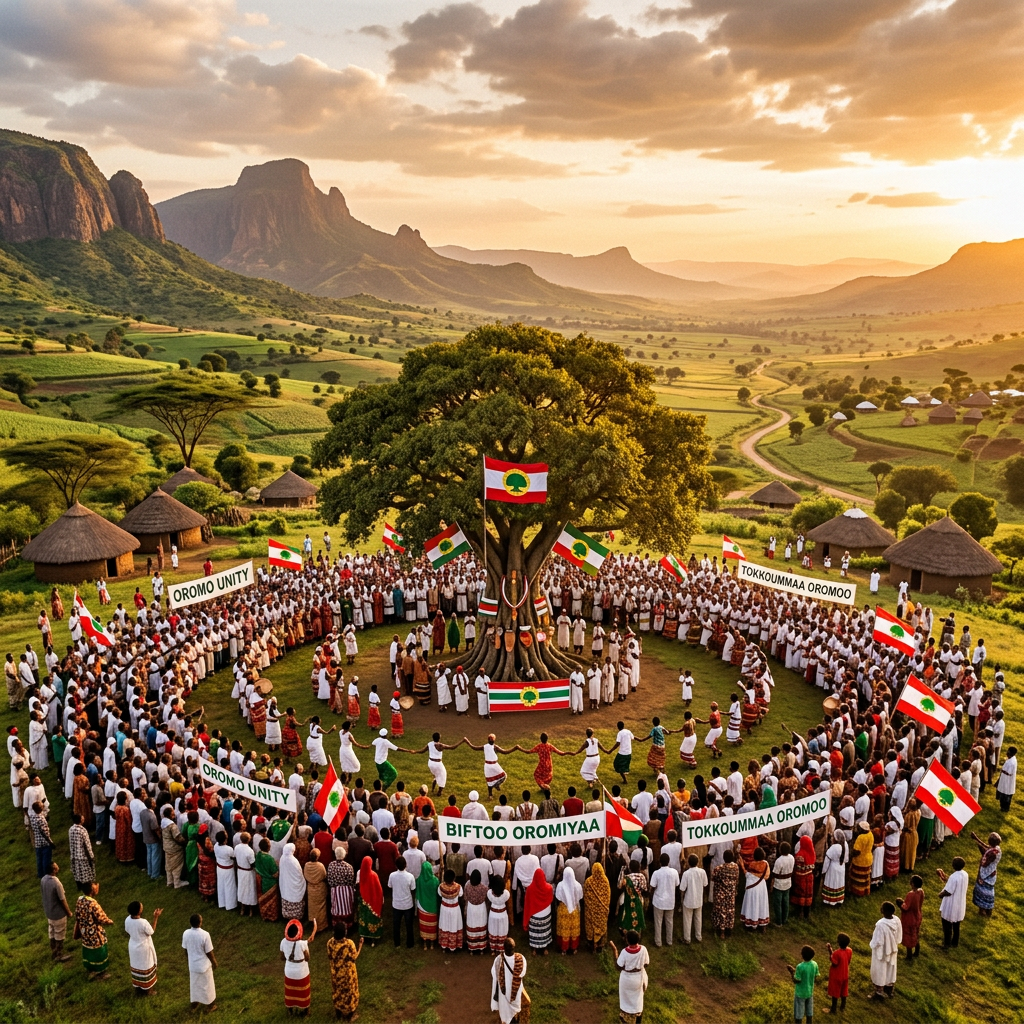
In the face of colonial domination and systemic oppression, the call for Oromo unity is not just a political slogan—it is a survival strategy, a moral imperative, and the foundation of a centuries-old struggle for liberation
The Oromo freedom struggle is one of the longest-running national liberation movements in Africa. For over a century, the Oromo people have resisted colonial domination, cultural suppression, and political marginalisation within the Ethiopian Empire. Throughout this long and arduous journey, one theme has remained constant: the call for unity.
Unity is not merely a rhetorical device in Oromo political discourse. It is a practical necessity, a moral principle, and a historical lesson that has been learned through generations of struggle. To understand why unity remains so central to the Oromo cause, we must look at the history of oppression, the nature of colonial strategy, and the lessons learned from both successes and failures.
The Colonial Strategy: Divide and Rule
The Ethiopian Empire was built through conquest. In the late 19th century, Emperor Menelik II’s armies, armed with European rifles, swept through the Oromo territories, confiscating land, imposing a feudal system of tribute and forced labor, and suppressing Oromo institutions such as the Gadaa system. The neftegna-gabbar system was not a metaphor—it was a system of land confiscation, tribute extraction, and forced labour that persisted for generations .
“When Menelik’s armies swept through what is now Oromia in the 1880s and 1890s, they did not arrive as liberators. They arrived with rifles purchased from European powers, with a feudal ideology that viewed the southern peoples as pagans to be civilised and their land as empty territory to be claimed” .
To maintain control over a conquered population that vastly outnumbered the colonisers—Oromos comprise roughly 35% of Ethiopia’s population —the imperial state employed a classic colonial strategy: divide and rule. Oromo society was fragmented, regional differences were exploited, and some Oromo elites were co-opted into the colonial administration. This strategy of fragmentation served the coloniser’s interests by preventing the emergence of a unified Oromo national consciousness .
The suppression of Oromo unity was not incidental to colonial rule—it was essential to it. A united Oromo nation posed an existential threat to the colonial system. This is why successive Ethiopian governments have sought to undermine Oromo unity, whether through direct repression or through the co-optation of Oromo elites into the state structure .
The Birth of National Consciousness
The 1960s marked a turning point in Oromo political consciousness. Oromo intellectuals and artists began to articulate their dissatisfaction with socio-economic deprivation and what was seen by some as ethnic oppression . The Macha-Tulama Self-Help Association (MTA), founded in the 1960s, represented one of the first organised attempts to build Oromo unity across regional and clan divisions .
The Haile Selassie government, recognising the threat posed by this emerging unity, crushed the MTA. Its destruction was the immediate catalyst for the founding of the Oromo Liberation Front (OLF) in the early 1970s . The establishment of the OLF represented a decisive shift: for the first time, a unified political organisation was created to lead the Oromo struggle for self-determination .
“The effort to bring together a few Oromo nationalists of diverse backgrounds from all over Oromia” to establish the OLF was itself an act of unity . The founders understood that only through a unified national movement could the Oromo people overcome the colonial system.
The Weapon of Culture
Oromo culture has been a powerful force for unity. While the Ethiopian state banned the Oromo language from public contexts and prevented it from being printed, Oromo musicians and artists developed creative forms of cultural resistance that sustained Oromo identity and consciousness .
“Afaan Oromo song (music) was used as the most powerful form of chimerical power in speaking across age, class, region, sex, power, and even ideology in resisting the domination of Imperial rule while striving to sustain common Oromo unity” .
Oromo musical icons such as Ali Birra, Abitaw Kebede, Nuho Gobana, Umar Suleyman, Ebbisa Adunya, and Kadir Said played an indispensable role in creating a social space wherein the Oromo struggle for equality and self-emancipation is articulated and debated . Songs like Haacaaluu Hundeessaa’s Maalan Jiraa became anthems of resistance, weaving together stories of pain and pride, hope and despair, and reminding Oromos of their shared identity and destiny .
“It is here, in this reservoir of songs, in the unruly dances and heart-breaking ballads, that one finds the story of the Oromo nation and its struggle for self-determination, not in the official archives and historiographies of the Ethiopian state” .
These artists became targets of state repression because their songs threatened the colonial order by building Oromo unity and consciousness .
Lessons from History
The Oromo people have a long memory of both the costs of disunity and the power of unity. The 16th-century Oromo campaigns, which successfully reclaimed territories from both Christian and Islamic imperial forces, were made possible by the sophisticated organisation of the Gadaa system—a system built on unity of purpose and collective action .
“The successes of the Oromo were not due to sheer numbers or migratory luck—but stemmed from an internally sophisticated and morally grounded civilisational system anchored in the Gadaa democratic order” .
Factors such as the Gadaa system, age-set institutions (Cibra), the unifying goal of reclaiming ancestral land (Galma), spiritual conviction (Kaawoo), and inclusive sociopolitical integration (Moggaasaa) all contributed to Oromo military success .
Conversely, the weakness of the Oromo movement has often been attributed to disunity. As one analysis notes, within the Oromo nationalist movement there are “lots of varieties, units, political agendas, and goals” . This diversity, while reflective of the Oromo people’s richness, has at times been exploited by the state to undermine the movement.
The recognition that disunity serves the coloniser is a constant theme in Oromo political discourse. “The colonizers and their agents have vilified and attacked” the OLF “to make the Oromo society leaderless” . A leaderless, fragmented society is easier to control.
Unity in Contemporary Struggles
The theme of unity remains urgent today. Recent efforts by the Oromo Liberation Front (OLF) and the Oromo Federalist Congress (OFC) to establish a “Transitional National Unity Government of Oromia” reflect this ongoing imperative . These groups have called on “all genuine Oromo forces, regardless of their method of struggle, to resolve their political differences and galvanize their unity” .
The call for unity is not merely political—it is a response to the dire situation facing the Oromo people. Across all 22 zones of Oromia, conflict between government forces and the Oromo Liberation Army (OLA) has led to arrests, beatings, displacement, mass burning of civilian houses, and other atrocities . The Oromo people face a crisis that demands unified action .
Yet the path to unity is not simple. The Oromo nation is divided by class, region, religion, and political orientation. As one analysis notes, “the Oromo nation is not a monolith. It is divided by class” . At the top is the Oromo comprador bourgeoisie—elites integrated into the state structure who benefit from the existing system . At the bottom is the Oromo working class—peasants, agricultural labourers, industrial workers, unemployed youth, and the urban poor .
This class division has led to a recognition that “nationalism alone cannot deliver what the Oromo masses actually need” . The Oromo peasant displaced from their land does not care whether the displacer is Amhara or Oromo—the displacement is the same . The Oromo worker paid starvation wages does not care whether the boss is based in Addis or abroad—the exploitation is the same .
This insight has led some to argue that the Oromo struggle must move beyond nationalism to class politics, building alliances with other oppressed peoples across Ethiopia . “Your ally is the Amhara worker who also wants land. Your ally is the Tigrayan worker who also wants a living wage” .
The Role of the Gadaa System
The Gadaa system continues to be a source of unity for the Oromo people. Its principles of regular rotation of leadership, checks and balances, and consensus-building mechanisms are considered “one of the most sophisticated pre-capitalist socio-political systems ever developed” . The Gadaa system is not merely a cultural artefact—it offers lessons in democratic governance that are relevant to the contemporary struggle .
“A liberated Ethiopia would not erase Oromo culture. It would draw on it. It would recognise that the Gadaa system offers lessons in democratic governance that the European liberal tradition cannot teach” .
The revival of the Gadaa system and the celebration of the Irreechaa festival have become powerful symbols of Oromo unity and cultural renaissance.
Conclusion
Unity remains a constant theme in the Oromo freedom struggle because it is both a necessity and a lesson learned through generations of experience. The colonial state has sought to divide the Oromo people because a united Oromo nation poses an existential threat to the colonial system. The Oromo people have learned, through both victory and defeat, that unity is the foundation of successful resistance.
But unity is not merely a political strategy—it is a moral principle rooted in the Oromo worldview. The concept of Safuu, the moral order that maintains balance and harmony, applies to the Oromo nation as well. Disunity is a breach of Safuu, a disruption of the natural order that brings suffering to the community .
As the Oromo struggle continues, the call for unity remains urgent. Whether through political organisation, cultural expression, or class solidarity, the Oromo people must find ways to overcome the divisions that have been imposed upon them and build the unity necessary for genuine liberation.
“The full restoration of the Oromo people’s freedom and rights is essential for lasting peace” . And that restoration will only be achieved through unity.
The struggle for Oromo liberation is the struggle for Oromo unity. And the struggle continues.

Posted on July 24, 2026, in Aadaa, Afaan, Bokkkuu, Events, Finfinne, freedom, gadaa, health, Information, Kindness, Language, Media, News, Oromia, Press Release, Promotion, Siinqee, Sirna Oromo. Bookmark the permalink. Leave a comment.






Leave a comment
Comments 0