Bonnie Holcomb: The Mother of Oromo Studies
A lifetime of scholarship, sacrifice, and service in the pursuit of Oromo dignity and truth
MINNEAPOLIS, MINNESOTA — For forty years, one name has stood at the centre of Oromo scholarship, guiding the field from its exiled beginnings to global academic recognition. Bonnie Holcomb, co-founder of the Oromo Studies Association (OSA) and Editor-in-Chief of its Journal, has dedicated her life to ensuring that Oromo history, culture, and identity are studied on their own terms.
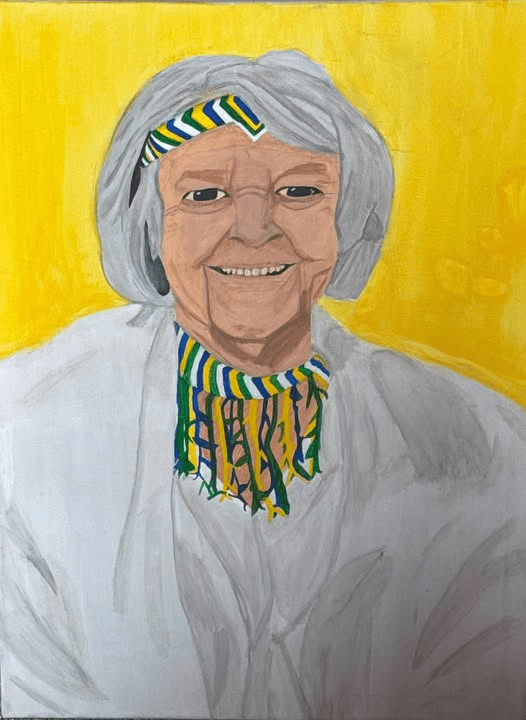
This year, as the OSA marks its 40th anniversary , the community celebrates not just an organisation, but the extraordinary vision and persistence of one woman—affectionately known as “The Mother of OSA” . In recognition of her lifetime service, a portrait of Holcomb was commissioned from a 15-year-old artist, Qabbanne, reflecting the intergenerational impact of her work .
The Founding of a Movement
The year was 1986 . In exile, scattered across meeting rooms in the diaspora, a small group of Oromo and non-Oromo scholars gathered with a radical idea: to build an independent academic home for the study of a people whose history, culture, and very existence had been systematically erased from mainstream scholarship . They would create a space where knowledge about the Oromo could be produced not by outsiders, but on its own terms .
Bonnie Holcomb was among them.
The OSA was born in direct response to a brutal crackdown—a void in which Oromo heritage was not merely absent from academia and state narratives, but actively suppressed . Those campaigning for greater recognition of the Oromo people were being murdered, tortured, jailed, or driven into exile . The founding of the OSA was an act of intellectual resistance: a refusal to accept erasure and a determination to tell stories that had been silenced .
The Invention of Ethiopia and Other Landmarks
In 1990, Holcomb, alongside fellow founder Sisai Ibssa, co-authored The Invention of Ethiopia: The Making of a Dependent Colonial State in North Africa . The book was a landmark work, offering a radical critique of how Ethiopian history had been represented and exposing a broader set of readers to Oromo history and ethnicity in the Horn of Africa . At its heart was a concern with inequality and a fundamental challenge to dominant state narratives .
The 1990s marked a productive period for Oromo studies, with diaspora intellectuals becoming key actors in the field . The Journal of Oromo Studies (JOS), launched in 1993, grew into the premier peer-reviewed publication for interdisciplinary scholarship on the Oromo people .
A Long and Difficult Road
Holcomb has described the journey as “a long and sometimes a difficult road to reveal evidence and build knowledge which shift the narrative in the region and globally” . This is not hyperbole. For decades, Oromo scholarship faced suppression, neglect, and active hostility. The OSA and its Journal have been more than academic endeavours; they have been an act of intellectual resistance—a refusal to accept the erasure of a people’s history and a determination to tell stories that had been silenced .
Despite these obstacles, the OSA has grown into a global scholarly community spanning continents and disciplines . In a landmark achievement, the Journal of Oromo Studies was recently indexed in Scopus, the gold standard of academic databases—placing it alongside publications from Springer, Elsevier, and Cambridge University Press . Holcomb’s message to contributors and advisors on this achievement reflected both pride and humility: “This publication, and the indexing in Scopus, are notable achievements, all. We have come a long way together” .
The Mother of OSA
The affectionate title “The Mother of OSA” is a testament to Holcomb’s foundational role and her ongoing commitment to the community . She has served as a Board Director and co-chair of the organising team for the 2026 annual conference, continuing to guide the organisation she helped build . Her work has been recognised with an OSA lifetime achievement award .
The theme for the 2026 conference, “Oromo on the Global Landscape: Honoring Asmarom Legesse as OSA Turns 40” , honours another visionary scholar whose work shaped Oromo studies . Asmarom Legesse, author of the landmark Gada: Three Approaches to the Study of African Society (1973), passed away in early 2026 . The conference will take place from July 31 to August 2, 2026, in Minneapolis .
Passing the Torch
In a touching tribute to Holcomb’s legacy, a portrait of her was commissioned from a 15-year-old artist, Qabbanne . This act is itself symbolic: it reflects the intergenerational impact of Holcomb’s work and the future she has invested in. As the OSA enters its fifth decade, the question is whether the next generation will carry the torch forward . Holcomb’s message to the community is also a call to action:
“Please remember that it is the Oromo Studies Association that has conceived, designed, hosted, nurtured, upheld and published the research and scholarship represented in JOS. I urge you all to continue to support OSA, and by extension, its Journal, with donations, membership in OSA and engagement as well as submissions” .
Conclusion
Four decades ago, a small group of exiled scholars dared to imagine a world in which Oromo knowledge was recognised as a contribution to the full breadth of human civilization . Today, that vision is reality . Bonnie Holcomb has been central to that journey. Her legacy is not just the Journal, the conferences, or the Scopus indexing—it is the community of scholars, activists, and artists who continue the work.
As Holcomb wrote, with a warmth that reflects decades of dedication: “Congratulations, one and all” .
The celebration is earned. The legacy is enduring. And the future—if the community continues to support it—is bright.
“Bonnie Holcomb is more than a scholar; she is the architect of a field and the mother of a movement.”

Posted on July 31, 2026, in Aadaa, Afaan, Events, Finfinne, freedom, Gumaa, health, Information, Kindness, Language, Media, News, Oromia, Press Release, Promotion. Bookmark the permalink. Leave a comment.






Leave a comment
Comments 0