Category Archives: Election

The Man Who Would Redefine Ethiopia
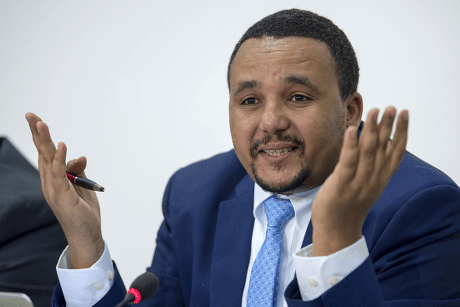
Jawar Mohammed’s “Progressive Patriotism” and the Oromo Question: A New Chapter in Ethiopia’s National Story
By Sultan Abda Neja, Ph.D.
—
For much of modern Ethiopian history, the question of who owns the nation has been answered in blood, in policy, and in silence. It is a question that has haunted the Oromo people—Ethiopia’s largest ethnolinguistic community—for generations. Their relationship with the modern Ethiopian state has been shaped by conquest, land dispossession, political exclusion, and cultural marginalization. Yet something is shifting. The old binary of Oromo resistance versus Ethiopian state nationalism is being challenged—not by a soldier, not by a separatist, but by a media-savvy activist-turned-thinker named Jawar Mohammed.
At the heart of this shift is a deceptively simple concept: Progressive Patriotism. It is Jawar’s attempt to articulate a political framework in which Oromo identity and Ethiopian national belonging are not mutually exclusive. It asks a new question: Can Oromo nationalism help redefine Ethiopian nationalism from within?
—
The Long Road from Resistance
To understand the weight of Jawar’s proposition, one must first understand the weight of history. Oromo nationalism did not emerge in a vacuum. It grew out of the expansion and consolidation of the modern Ethiopian state, the incorporation of Oromo territories, and subsequent struggles over land, language, religion, and political representation.
The Ethiopian state-building project, for much of its history, was associated with centralized authority, cultural homogenization, and the marginalization of groups whose languages and political identities differed from those of the ruling elite. The Oromo Liberation Front (OLF), founded in 1973, became the most prominent expression of Oromo resistance. But even then, Oromo nationalism was never monolithic. Some advocated independence; others supported multinational federalism, stronger regional autonomy, or a democratic Ethiopian state.
The 1995 Constitution, which formally recognized the rights of nations, nationalities, and peoples—including the right to self-determination up to secession—represented a significant shift. Yet constitutional recognition did not automatically produce democratic governance. The political crisis that culminated in the 2014–2018 protests exposed the limits of the existing order. Oromo protesters mobilized against political exclusion, human rights abuses, and the proposed expansion of Addis Ababa into surrounding Oromia.
Then came 2018. Abiy Ahmed, an Oromo politician, became prime minister. It was a moment of symbolic triumph—an Oromo had reached the highest office in the land. But symbolism, as Jawar would later argue, is not transformation.
—
Jawar’s Intervention: From Resistance to Governance
Jawar Mohammed’s political trajectory—from a fiery activist and media owner to a prominent voice in the debate over Ethiopia’s future—mirrors the broader evolution of Oromo political consciousness. His call for a transition from resistance politics to governance politics, and from ethnonationalism to broader nation-building, represents a significant shift.
In his writings and interviews, Jawar argues that Oromo politics must evolve beyond its traditional oppositional orientation. A movement that has historically defined itself through resistance must now demonstrate its capacity to govern, build institutions, deliver public services, and contribute to national stability. Political legitimacy cannot be sustained indefinitely through historical grievances alone.
This is not to suggest that Jawar asks Oromos to abandon their identity or their legitimate demands. Rather, he challenges the assumption that protecting Oromo interests and building a common Ethiopian political future are mutually exclusive. Given the Oromo people’s demographic significance, geographical position, cultural influence, and historical role in Ethiopia, their political participation is essential to any sustainable project of national reconstruction.
In a recent interview on Kallatti Media, Jawar explained that Ethiopian nationalism should not be understood as an identity or political project owned exclusively by historically dominant groups. Oromos, like other peoples of Ethiopia, have an equal right to define, shape, and participate in the national project. An Oromo can embrace Ethiopian citizenship, contribute to national unity, and take pride in a shared political identity without surrendering Oromo cultural identity or constitutional rights.
From this standpoint, Progressive Patriotism challenges the historical tendency to associate Ethiopian nationalism with cultural assimilation, political centralization, or the dominance of one group. It opens the possibility of an inclusive nationalism in which belonging to Ethiopia does not require becoming less Oromo.
—
The Goobana Question: Heroes, Traitors, and the Politics of Memory
Jawar’s concept of Progressive Patriotism extends beyond constitutional arrangements. It also engages with the politics of memory—specifically, the way political movements construct historical narratives that distinguish heroes from traitors.
In his text, Goobana: The Hero-Traitor Narrative in the Oromo Struggle, Jawar examines how the figure of Goobana Daacee—a historical Oromo figure remembered as a collaborator with Emperor Menelik II and, consequently, a traitor—has been used within the Oromo national movement. The narrative of betrayal, Jawar argues, can serve important political purposes: it mobilizes communities, establishes collective memory, and defines political loyalties.
But when a movement moves from resistance to governance, such narratives become liabilities. A movement operating in opposition can organize its political identity around a clear distinction between the oppressed and the oppressor, resistance and collaboration, liberation and betrayal. A political movement that enters government, however, must negotiate competing interests, govern citizens with different identities, and build institutions that extend beyond its original constituency.
Jawar suggests that political movements may need to move from a resistance narrative toward a governing narrative. Figures previously condemned may be reassessed; figures celebrated may be subjected to new scrutiny. The task, he argues, is not to replace every hero with a traitor, but to create a political culture in which historical disagreements can be examined without becoming grounds for denying citizenship, identity, or political legitimacy.
—
The Abiy Paradox: An Oromo Leader, but an Oromo-Empowering Government?
The question of Oromo ownership of Ethiopian nationalism cannot be separated from the political trajectory of Abiy Ahmed. His rise to power in 2018 symbolized the opportunity to translate Oromo political mobilization into democratic transformation at the national level.
His early reform agenda generated expectations of political liberalization, reconciliation, and greater openness. His government’s peace initiative with Eritrea further strengthened the image of a leader seeking to move beyond longstanding regional hostility. But the subsequent political project—associated with the formation of the Prosperity Party in 2019 and the language of Medemer—proved contentious.
Supporters interpreted Medemer as an attempt to overcome political fragmentation and the limitations of ethnic-based party organization. Critics, including Oromo nationalists, argued that it weakened the political and institutional protections established under multinational federalism. The war in Tigray, the subsequent armed conflicts in other regions, political polarization, and serious allegations of abuses by state and non-state actors exposed the limitations of a political transition that did not produce a broadly accepted democratic settlement.
The broader lesson is that an Oromo’s accession to the center of Ethiopian power does not automatically mean that Oromo nationalism has achieved its democratic objectives. An Oromo-led government is not necessarily an Oromo-empowering government, just as an Ethiopian national identity is not necessarily an exclusionary identity. The decisive issue is the character of the institutions and policies through which political power is exercised.
—
The Critics Speak: Progressive Patriotism Under the Microscope
Jawar’s Progressive Patriotism has not gone unchallenged. Critics from across the political spectrum have raised important questions about its conceptual clarity, its practical implications, and its relationship to the status quo.
Moges Zewdu Teshome argues that Jawar conflates multinational federalism, multicultural federalism, and a multicultural unitary state—distinct institutional arrangements that cannot be resolved simply by democratizing an allegedly flawed constitutional structure. He advocates revisiting the constitutional order, strengthening an inclusive civic identity, and building a political community in which citizenship is not subordinated to ethnic affiliation.
Professor Messay Kebede challenges Jawar’s claim that ethnonationalism has become effectively irreversible, reasoning that political identities and institutions are historically constructed and can therefore change. He proposes democratic or civic nationalism as a more coherent alternative, arguing that inclusive democratic institutions can protect cultural diversity without making ethnic political sovereignty the organizing principle of the state.
Benti Geleta Buli, through a sentiment analysis of Jawar’s proposal, notes that the term “progressive” remains inadequately defined and could become a rhetorical framework that preserves the status quo rather than resolving Ethiopia’s political divisions. He presents constitutional patriotism as a more constructive alternative grounded in shared constitutional values, democratic participation, and inclusive citizenship.
And in my own earlier critique, I argued that Jawar’s distinction between “centripetal” and “centrifugal” political forces unfairly portrays ethnonationalist movements while underemphasizing the historical injustices, assimilationist policies, and authoritarian practices that gave rise to them. Appealing to right-wing Ethiopian nationalists by equating their historical responsibilities with those of ethnonationalist movements risks undermining the legitimate struggles and sacrifices of nations and nationalities, including the Oromo people.
These critiques are not dismissive. They are, in fact, a sign of the seriousness with which Jawar’s intervention is being taken. They demand that Progressive Patriotism move beyond slogan and toward institutional specificity.
—
Toward a Constitutional Patriotism: The Roadmap
If Progressive Patriotism is to become more than a rhetorical compromise, it must be grounded in concrete institutional commitments. One possible way to clarify it is to connect it to constitutional patriotism—attachment to a political community based on shared constitutional principles, democratic institutions, equal citizenship, and fundamental rights rather than ethnic or cultural uniformity.
For Ethiopia, such a framework would require at least five commitments:
1. Meaningful regional self-government and the rights of nations, nationalities, and peoples must be constitutionally protected.
2. Federal and regional governments must be accountable through genuinely competitive political processes and an independent judiciary.
3. Minorities within regional states must enjoy equal citizenship, cultural rights, security, and political participation.
4. National institutions must be accessible to citizens regardless of language, ethnicity, religion, or political affiliation.
5. Disputes over federal authority, regional boundaries, resources, and political representation must be resolved through credible constitutional procedures rather than coercion.
Beyond these constitutional commitments, a pragmatic roadmap for Oromo ownership of Ethiopian nationalism requires several practical steps: protecting political pluralism within Oromo society, democratizing multinational federalism, establishing credible national dialogue, creating effective mechanisms for accountability, promoting an inclusive national historical narrative, and defining Progressive Patriotism institutionally.
It also requires a crucial conceptual separation: national unity must be separated from unconditional support for a government. Citizens should be able to oppose a prime minister, criticize the federal government, or demand constitutional change without being branded enemies of Ethiopia. Likewise, support for Oromo rights should not require unconditional loyalty to an Oromo political organization.
—
The Future of Ethiopian Nationalism: A Shared Project
The most important question, ultimately, is not whether Oromo nationalism should disappear into Ethiopian nationalism or remain permanently opposed to it. It is whether both can be transformed through democratic institutions so that neither requires the political subordination of the other.
Jawar Mohammed’s Progressive Patriotism is an attempt to articulate a framework in which ethnic identity and shared national belonging can coexist. Its credibility depends on democratic institutions, constitutional protections, political pluralism, and an explicit rejection of coercive assimilation. Abiy Ahmed’s experience illustrates the dangers of attempting to build national cohesion by weakening the political forces and constitutional guarantees through which historically marginalized communities sought recognition.
The future of Ethiopian nationalism will depend on whether the country can build a political community in which unity is freely sustained rather than coercively imposed, ethnic identities are protected rather than demonized, and national citizenship is shared rather than monopolized.
Oromo nationalism’s most consequential contribution to Ethiopia may ultimately be its capacity to help transform Ethiopian nationalism from an inherited claim of state authority into a genuinely shared project of democratic citizenship. That is the promise of Progressive Patriotism. Whether it becomes a reality depends not on the eloquence of its advocates, but on the institutions through which it is enacted—and on the willingness of all Ethiopians, Oromo and non-Oromo alike, to engage in the difficult, patient work of democratic negotiation.
The question is no longer whether the Oromo belong to Ethiopia. The question is what kind of Ethiopia can belong equally to Oromos and all other citizens. The answer, if it comes, will not be found in slogans or in the shadow of a single leader. It will be found in the constitution, in the ballot box, and in the everyday practice of citizenship.
—
Sultan Abda Neja, Ph.D., is a political analyst and author specializing in Ethiopian politics, federalism, and ethnonationalism. His work has appeared in Borkena and other outlets.
The full article can be accessed:

The Irony of Faisal Roble’s Attack on Oromo Nationalism: A History of Somali Expansionism
By Asfaw Beyene
I was taken aback by recent comments from two prominent political commentators of Somali ethnicity, Farah Maalim and Faisal Roble, both associated with Nairobi’s political circles. My focus here is on the remarks made by Faisal Roble.
In an interview with a media outlet unfamiliar to me, Faisal Roble expressed concern about what he described as the growing number of “ultra-nationalists” among the Oromo. He claimed that these nationalists had become so numerous, indeed, “huge” in number, that the phenomenon posed a danger to Ethiopia.
He then asked why Oromo nationalists had become so radicalized, suggesting that the movement’s supposed extremism might be explained by its being relatively new and youthful. As evidence of what he called the “pervasive” nature of Oromo nationalism, he alleged that Oromo nationalists were making territorial claims extending as far as Mogadishu, Djibouti, Yemen, Kenya, and Eritrea.
By the time I finished listening to the interview, I found myself wondering whether Faisal Roble had confused Somali ultra-nationalists with Oromo nationalists. Nearly every characteristic he attributed to Oromo nationalism seemed far more applicable to the historical record of Somali expansionist nationalism.
His argument deserves careful examination.
The Contradictions in Faisal Roble’s Argument
First, the history of radical nationalism in the Horn of Africa cannot be discussed without examining Somali expansionism. Somali nationalism has a long and complicated history. Its expansionist manifestations, particularly the ideology of Greater Somalia, contributed to regional wars, territorial disputes, and political instability. Somalia’s own experience with authoritarian rule, civil war, and state collapse demonstrates the destructive potential of nationalism when it becomes inseparable from territorial ambition and political exclusion.
It would be simplistic to attribute Somalia’s decades of instability entirely to nationalism. Nevertheless, the historical consequences of expansionist and pervasive Somali nationalism are too significant to ignore.
Second, Faisal Roble describes Oromo nationalism as a danger to Ethiopia. This assertion raises a fundamental question: a danger to which Ethiopia? If Oromo nationalism seeks equality, self-determination, political representation, and the protection of Oromo rights, it can be considered a danger only to a political order that refuses to recognize those rights.
A political movement demanding justice for a historically marginalized people should not automatically be characterized as extremist. The distinction between legitimate national aspirations and exclusionary ultra-nationalism is essential.
Third, Faisal portrays Oromo nationalism as a new and youthful phenomenon.
This reflects a troubling misunderstanding of Oromo history. The historical roots of Oromo collective identity, political institutions, resistance, and struggles over sovereignty extend back centuries. The Oromo played a major role in the political transformations of the Horn of Africa during the sixteenth century, long before the emergence of the modern Ethiopian state.
Modern Oromo nationalism took shape through subsequent historical experiences, particularly the incorporation of Oromo territories into the expanding Ethiopian Empire during the nineteenth century. To describe Oromo nationalism simply as a new movement is to overlook this long historical trajectory.
Fourth, Faisal alleges that Oromo nationalists claim territories extending to Mogadishu, Djibouti, Yemen, Kenya, and Eritrea. This is perhaps the most extraordinary part of his argument. I have yet to encounter a credible statement by a recognized Oromo political party, organization, or prominent nationalist leader asserting territorial claims over Mogadishu, Yemen, Eritrea, or Djibouti.
If Faisal possesses such evidence, he should present it. Which Oromo political organization has made these claims? When were they made? In what official document or public statement? Without such evidence, these allegations amount to a sweeping and potentially inflammatory misrepresentation of Oromo nationalism.
The irony is striking: the territorial ambitions he attributes to Oromo nationalists bear a much closer resemblance to the historically documented ideology of Greater Somalia. This leads to a more important question: Why has Faisal Roble chosen this moment to launch such an attack on Oromo nationalism? To explore that question, we must examine the emerging political connections between Nairobi, Mogadishu, and Jijjiga.
The Nairobi–Mogadishu–Jijjiga Nexus
Recent political developments in the Horn of Africa raise questions about the relationships among Somali nationalist networks, political actors in Somalia, and political movements operating within Ethiopia’s Somali Region. Nairobi has long served as an important center for Somali political, commercial, and diaspora activity. Its significance as a meeting place for politicians, businesspeople, and opposition figures is well established. However, the existence of these networks does not, by itself, establish that they operate under a coordinated political agenda.
What concerns me is the possibility that certain political actors are attempting to exploit regional tensions, territorial disputes, and opposition alliances to advance a renewed expansionist agenda. This concern becomes particularly important when viewed alongside recent political developments in Ethiopia and the changing alliances among armed and opposition movements.
The Minnesota Fraud Cases and the Nairobi Connection
Recent federal fraud prosecutions in Minnesota have also drawn attention to the movement of stolen public funds into overseas investments, including real estate in Kenya. Among the individuals named in connection with these cases, several of them have investments in Nairobi realestate. The diversion of funds intended to feed vulnerable children is deeply disturbing. Such misconduct betrays taxpayers’ trust, harms the communities these programs were designed to serve, and unfairly tarnishes the reputation of the many honest, hardworking Somali Americans who have contributed to their communities and American society. Criminal responsibility rests with the individuals involved and should never be generalized to an entire ethnic or immigrant community. Nevertheless, for Oromos and Kenyans, reports of property acquisitions by individuals indicted in the Minnesota fraud cases, in a city (Nairobi) where allegations of a nonexistent Oromo ultranationalist movement have suddenly surfaced, raise legitimate concerns. This does not imply any connection between those implicated in Minnesota and political figures in Nairobi. Rather, the broader question is whether illicit financial networks, political influence, and regional nationalist agendas intersect in ways that warrant further investigation.
The ONLF and the Changing Political Alliances in Ethiopia
In September 2026, the Ogaden National Liberation Front (ONLF) was reported to have joined a coalition known as the Ethiopian Peoples’ Forces Alliance for Survival, bringing together seven armed and opposition organizations opposed to Prime Minister Abiy Ahmed’s administration.
The ONLF has historically pursued Somali self-determination in Ethiopia’s Somali Region. Its political trajectory must also be understood in the context of the broader history of Somali nationalism and the territorial disputes that have shaped relations between Ethiopia and Somalia. The changing fortunes of opposition alliances, including those associated with the TPLF, may have created opportunities for other political movements to reposition themselves.
I am particularly concerned that some advocates of Somali expansionist nationalism may see these developments as an opportunity to revive older territorial ambitions. Faisal Roble’s political commentary and Farah Maalim’s reported statements about support for the ONLF deserve examination in this context, despite political sympathy for an organization should not be confused with proof of operational involvement in its activities. The critical issue is whether opposition to the Ethiopian government is being used to advance legitimate political demands or to reopen territorial conflicts between neighboring communities.
Moyale, Borana, and the Politics of Territorial Expansion
Recent tensions around Moyale and Borana territory have intensified these concerns. Moyale lies in a historically sensitive borderland where Oromo and Somali communities, including Borana and Garri populations, have longstanding relationships shaped by trade, migration, political competition, and periodic conflict.
Reports of violence, including the alleged killing of a 13-year-old girl and the reported refusal to return her body to her family, are deeply disturbing. These allegations demand an independent investigation, accountability, and justice for the victim’s family. No territorial or political dispute can justify the killing of a child. This is extreme nationalism in action.
Of particular concern are reports that a Somali national flag, rather than the flag of Ethiopia’s Somali Regional State, was raised in contested territory. If verified, such an act would carry political significance extending beyond an ordinary local dispute. It would raise questions about whether the conflict was being framed in terms of Somali national territorial ambitions rather than local administrative boundaries. This is why I do not believe the tensions should be dismissed simply as a dispute between the Garri and Borana communities both of whom are Oromos and both of whom speak Oromo language. There is a larger historical and political context that deserves examination.
The timing of Faisal Roble’s remarks, following heightened tensions and Oromo reactions to events in the area, is striking. His criticism of Oromo nationalism appears to reflect a broader political anxiety about Oromo resistance to territorial encroachment. Whether this interpretation is correct requires further evidence. Nevertheless, it provides a compelling reason to examine the historical record of Somali expansionist nationalism.
Greater Somalia: The Historical Irony
Perhaps the greatest irony in Faisal Roble’s accusations is that the territorial expansionism he attributes to Oromo nationalists closely resembles the ideology of Greater Somalia. The Greater Somalia project was not an imaginary accusation invented by political opponents. It was an explicit political objective promoted by extreme Somali nationalist movements and successive Somali governments. Its central ambition was to unite Somali-inhabited territories across the Horn of Africa under a single political entity. This included the Somali Republic, the Ogaden and other Somali-inhabited territories of Ethiopia, the Northern Frontier District of Kenya, and Djibouti. The five-pointed star on Somalia’s flag historically symbolized these five Somali territories.
Under Siad Barre, this ideology became closely associated with military expansionism and the attempt to alter established international borders by force. Thus, the history of Somali ultra-nationalism is not merely a history of territorial ambition. It is also a warning about the destructive consequences of authoritarianism, militarization, and exclusionary political identity.
Against this historical background, Faisal Roble’s portrayal of Oromo nationalism as uniquely expansionist becomes especially difficult to understand.
The Western Somali Liberation Front and the Ogaden War
The Western Somali Liberation Front (WSLF) provides one of the clearest historical examples of ultra nationalism and the territorial objectives associated with Greater Somalia. Supported by the Somali government, the WSLF operated in eastern Ethiopia and played a significant role in the conflict that culminated in the 1977 – 1978 Ogaden War. The name Western Somali Liberation Front itself reflected a territorial conception in which parts of internationally recognized Ethiopian territory were regarded as belonging to a broader Somali nation.
During the war, Somali forces advanced into substantial portions of eastern Ethiopia before being defeated by Ethiopian forces. The conflict had devastating consequences for the region and its civilian populations, the broader military campaign and associated political movements affected Oromo communities and territories. But the central point is undeniable: territorial revisionism was an explicit component of the Greater Somalia project, manifested as ultra nationalism. These fanatical adventures to alter boarders by force led to the disintegration of the Somali state apparatus and the mushrooming of warlords.
Where, then, is the equivalent documented Oromo nationalist program claiming Mogadishu, Yemen, or Eritrea? If Faisal Roble wishes to make that comparison, the burden of evidence rests with him.
From the WSLF to the ONLF
The decline of the WSLF and the emergence of the ONLF marked an important transformation in Somali nationalist politics in Ethiopia. The ONLF emerged in the 1980s and eventually became a major political and armed organization advocating self-determination for ethnic Somalis in Ethiopia. Although the ONLF and WSLF differed in their organizational structures, political circumstances, and stated objectives, their histories are connected to the broader question of Somali national identity and political sovereignty in the Horn of Africa.
The relationship between Somali nationalist movements and Oromo liberation organizations has also been complex. At different times, their interests have converged around opposition to Ethiopian central governments. At other times, territorial competition, political rivalry, and conflicting national aspirations have generated serious tensions. Historical attacks of Somali extremists on Oromo liberation figures, including the 10 massacred at Shinniga in 1980 have deeply saddened the Oromo people, leaving a historical scar. Faisal shall pour no more fuel to these historic wounds and respect the brotherly sentiment that existed between Oromos and Somalis for centuries.
The Somali Abo Liberation Front and the Struggle Over Oromo Territory
During the 1970s, the Somali government supported extremist Somali movements operating in southern Ethiopia, including areas historically associated with the provinces of Bale, Sidamo, and Arsi. These regions were primarily inhabited by Oromo populations. The SALF mobilized some communities in these areas to suit Somalia’s regional political and military objectives. Unlike the WSLF, which focused primarily on Somali national claims in eastern Ethiopia, the SALF’s activities extended into areas where Oromo identity and political aspirations were central. It was a clear expansionist and extremist move to annex some Oromo territories including the Garri.
Following Somalia’s defeat in the Ogaden War, the Oromo Abo Liberation Front (OALF) emerged reflecting changing political identities and alliances. The precise organizational relationship between the SALF and OALF, including claims about formal renaming and changes in political affiliation, remain beyond the scope of this paper. Nevertheless, the broader history illustrates an important point: Somali state-sponsored political and military movements were active in territories inhabited by Oromo communities, and the growing national aspirations of Somali extremism was already evident decades ago.
This is the historical context in which false accusations of Oromo territorial expansionism must be evaluated. It is important to note that out of such piles of political extremism was born Al-Shabaab, whose emergence was also shaped by a different mix of ideology, state collapse, and extremist politics. There simply are no parallels to such extremism in the Oromo body politics, reason why Faisal’s statement itself comes as extreme.
Who Is Really Promoting Expansionist Nationalism?
Faisal Roble’s comments raise questions that cannot be avoided. Why are political commentators such as Faisal Roble and Farah Maalim devoting so much attention to the alleged dangers of Oromo nationalism while appearing less concerned about the documented history of Somali territorial expansionism? Why portray Oromo demands for political rights and territorial security as extremist while failing to apply the same scrutiny to the ideology of Greater Somalia? And why should Oromo opposition to perceived territorial encroachment be interpreted as radicalization rather than as a legitimate concern about security, identity, and political rights?
These questions are especially important given the continuing challenges facing Somalia itself.
Somalia has struggled for decades with state fragmentation, armed insurgency, political instability, and the difficulty of establishing effective authority across its territory. Regional and international assistance, including sacrifices made by Ethiopian forces, has played a significant role in efforts to restore security. I have no doubt that many of these forces come from Oromia.
Rather than reopening old territorial disputes, political leaders and commentators should devote greater attention to peace, accountable governance, economic development, and cooperation among the peoples of the Horn of Africa.
This is not an argument against Somali nationalism as an expression of cultural identity or legitimate political aspiration. Nor is it a criticism of Somali people, whose communities have suffered enormously from war, displacement, and political instability. It is an argument against expansionist ultra-nationalism, regardless of who promotes it.
Conclusion: The Danger of Historical Amnesia
Faisal Roble’s criticism of Oromo nationalism suffers from a fundamental contradiction. He warns against an alleged Oromo expansionist movement without identifying credible evidence of the extraordinary territorial claims he attributes to it. Yet the historical record contains extensive documentation of Somali nationalist movements that openly pursued territorial revisionism across the Horn of Africa.
The Greater Somalia project, the WSLF, the Ogaden War, and the history of Somali-backed political movements in southern Ethiopia are not matters of speculation. They are part of the region’s political history.
None of this means that Oromo nationalism should be exempt from criticism. Any nationalist movement can become intolerant, exclusionary, or extremist. Oromo nationalism, like every other political movement, should be judged by its principles, conduct, and respect for the rights of others. But criticism must be grounded in evidence, not sweeping accusations or historical distortions.
If Faisal Roble believes that Oromo nationalists are claiming Mogadishu, Yemen, Djibouti, Eritrea, and Kenya, he should identify the organizations, leaders, statements, and documents that substantiate his allegations. Until then, his claims remain unsupported.
The peoples of the Horn of Africa have suffered enough from territorial wars, political manipulation, and competing nationalist ambitions. They deserve a future based on mutual recognition, historical honesty, and respect for one another’s rights. The real danger to Ethiopia and the wider Horn of Africa is not the legitimate expression of Oromo or Somali national identity. It is the revival of expansionist ideologies that treat the territories and rights of neighboring peoples as objects of political conquest. That is the danger Faisal Roble should be addressing rather than projecting onto Oromo nationalism the very expansionist tendencies that have already caused so much suffering in the region.

The Lion of Borana: Remembering Guyyoo Boruu Galmaa, the Abbaa Gadaa Who Defied Empires
By Dhabessa Wakjira
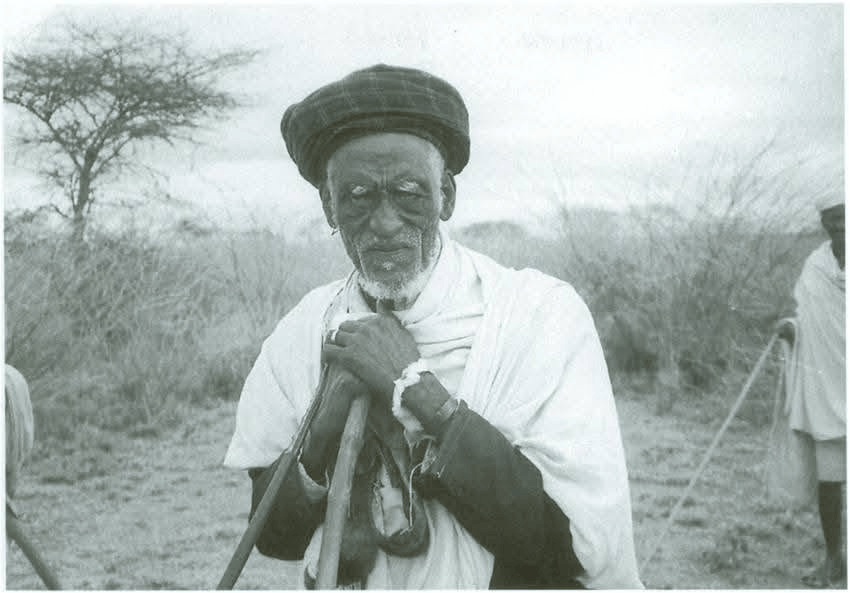
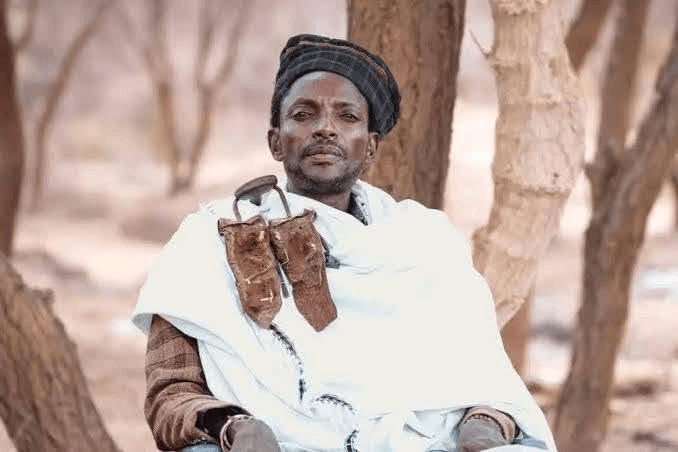
In the annals of Oromo history, there are leaders who govern, and then there are those who become the embodiment of a people’s resistance. Guyyoo Boruu Galmaa, who served as the Abbaa Gadaa of the Borana Oromo from 1944 to 1952, belongs unequivocally to the latter. He was not merely a custodian of the ancient Gadaa system; he was a shield against the encroaching empires of the 20th century—a man whose defiance of both Italian invaders and the Ethiopian imperial state preserved the soul of the Borana people.
His story, deeply intertwined with the fate of the sacred wells and the contested borders of Moyale, offers a masterclass in indigenous diplomacy and unyielding sovereignty.
A Legacy Born in the Shadow of Partition
The roots of Guyyoo Boruu’s leadership stretch back to a defining tragedy for the Borana nation. In 1907, the British and Ethiopian empires signed the Anglo-Ethiopian Boundary Agreement, a colonial decree that arbitrarily carved the Borana homeland in two, dividing the people of Moyale.
At that time, it was Boruu Galmaa Dooyyoo—the father of Guyyoo—who served as the Abbaa Gadaa. He was among the first to openly reject the treaty, recognizing it not as a legal boundary, but as an existential threat to the unity and sovereignty of the Borana. The son inherited the father’s fire.
In 1944, when Guyyoo Boruu Galmaa took the Baallii (the ritual transfer of power) and assumed the mantle of Abbaa Gadaa, he stepped into a region rife with external pressure. The Borana were not only facing the legacy of the 1907 partition but were also navigating the chaotic fallout of global wars and shifting imperial ambitions in the Horn of Africa.
Defying the Italian War Machine
Historical records reveal that Guyyoo Boruu’s leadership did not begin in 1944; his journey as a freedom fighter started much earlier. Between 1936 and 1945, he was actively leading the Borana Oromo in resistance against the Italian occupation.
When the Italians invaded, they brought not just armies, but a strategy of land seizure. As the historical account notes, the Italian forces attempted to annex vast tracts of Handaraa land, claiming everything except the sacred Arddaa and Tula (water wells). Guyyoo Boruu responded by building the Borana Gadaa structures and waging a relentless war against the Italians.
His struggle was not just about repelling a foreign army; it was about defending the sacred ecology of Borana life. The Tula wells were the lifeblood of the cattle and the people. Guyyoo Boruu understood that to lose the land was to lose the wells, and to lose the wells was to lose the Borana identity itself.
Standing Against the Imperial Crown
Following the defeat of the Italians, the Borana faced a new, more insidious threat: the expanding centralization of Emperor Haile Selassie’s government. Between 1947 and 1950, the imperial regime sought to impose its administrative and cultural dominance on the southern frontiers.
Guyyoo Boruu Galmaa became the primary obstacle to this encroachment. He did not merely resist the political pressures of the imperial state; he actively protected the Gadaa system, ensuring that traditional laws, democratic consensus, and indigenous governance continued to thrive despite the centralizing forces of Addis Ababa.
His defiance culminated in a moment of profound historical significance. In 1950, the Haile Selassie government, seeking to co-opt local leaders, offered Guyyoo Boruu the title of “Giraazmach”—a high-ranking imperial military and administrative honor.
He refused.
In rejecting the title, Guyyoo Boruu Galmaa made a definitive statement of Oromo autonomy. He rejected the legitimacy of an empire that had partitioned his people and threatened their customs. By turning his back on imperial honors, he affirmed that his authority came not from a distant emperor, but from the Gadaa, the Borana people, and the land itself.
The Enduring Wisdom of the Elders
The legacy of Guyyoo Boruu Galmaa is not confined to the history books; it is a living, breathing testament to the resilience of Oromo culture.
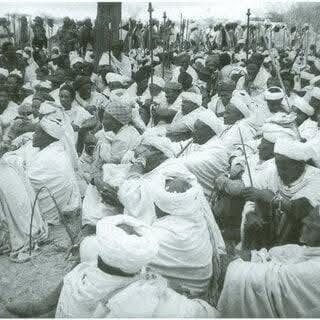
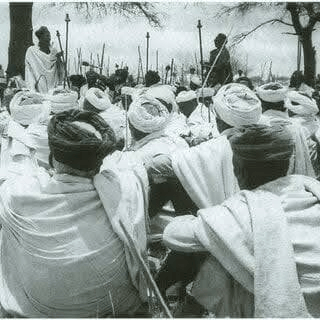
His life was meticulously documented by Western anthropologists who recognized the profound nature of the Borana political system. The renowned scholar Eike Haberland photographed him in 1952—the year he completed his term as Abbaa Gadaa. Decades later, in 1986, anthropologist Günther Schlee captured another historic moment: Guyyoo Boruu, then approximately 95 years old, was photographed at the Gumii Gaayyoo (the great assembly) as his son, Boruu Guyyoo Boruu, took the Baallii and assumed the leadership of the Gadaa.
That photograph, showing the aged father watching his son take the reins of power, is a powerful visual metaphor. It represents the unbroken chain of the Gadaa system—a system that Guyyoo Boruu fought to protect with weapons, diplomacy, and sheer moral courage.
A Beacon for the Present
As the Oromo people today face a renewed crisis of state violence, displacement, and the ongoing political capture of their sacred resources—including the Tuula Saglan Booranaa—the legacy of Guyyoo Boruu Galmaa serves as a vital beacon.
He stands as a reminder that Oromo sovereignty is ancient, sophisticated, and deeply rooted in a democratic culture that predates modern statehood. He proved that true leadership is not measured by the titles bestowed by empires, but by the courage to defend one’s people against them.
Nearly a century after he began his resistance, the spirit of Guyyoo Boruu Galmaa still echoes across the plains of Borana, flowing like the waters of the sacred wells he fought to protect: undivided, unbroken, and eternally free.
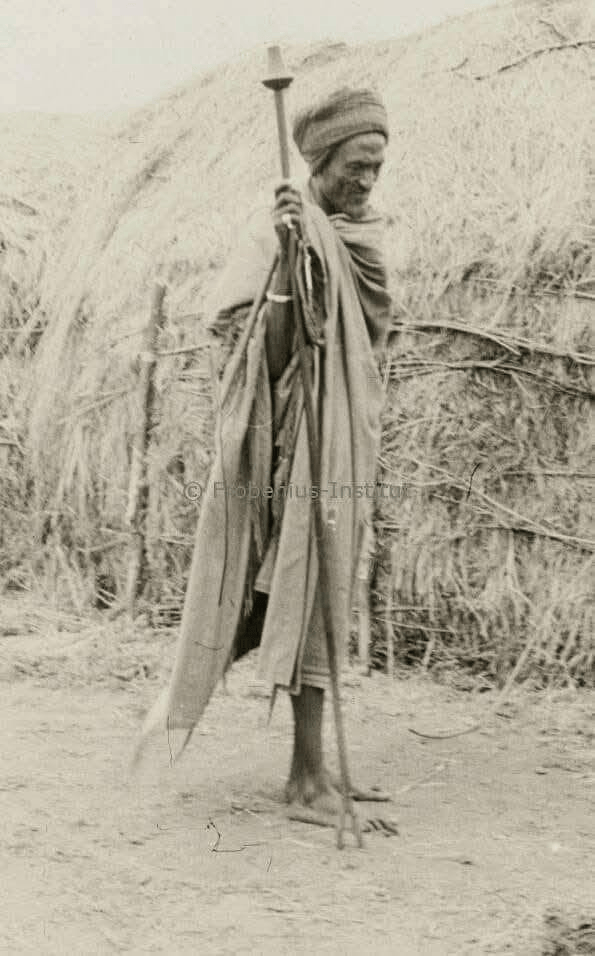
Photos: Guyyoo Boruu Galmaa, photographed by Eike Haberland (1952) and Günther Schlee (1986).

Celebrating Oromia Media: The Unyielding Voice of a People
By Dhabessa Wakjira
In a country where the state maintains a near-monopoly on the levers of national and international media, the existence of independent Oromia media is nothing short of an act of defiance. To celebrate Oromia media today is to celebrate the resilience of a people who, for over a century, have seen their history distorted, their language suppressed, and their struggles silenced.
While the government in Finfinnee projects a façade of progress to the international community, the reality on the ground—as documented by human rights organizations—is a landscape scarred by violence, displacement, and systemic marginalization. In this environment, Oromia media serves as the vital, beating heart of the Oromo nation’s quest for truth and self-determination.
The Battle Against Erasure
The importance of an independent Oromo press cannot be understood without acknowledging the historical context. As the Oromia Support Group (OSG) notes in its submissions to the UN Human Rights Council, the Oromo people were subjected to the neftenya-gabbar system of subjugation, and while formal slavery was abolished, the culture of supremacy continued. Even today, the OSG warns that the gains in autonomy and the adoption of the Oromo language within the 1995 constitution are in danger of being lost as power is centralized.
For decades, mainstream Ethiopian media has been complicit in this erasure. It has often served as a mouthpiece for the state, demonizing Oromo organizations, masking state-sponsored atrocities, and amplifying biased narratives. When international human rights organizations are sometimes duped into publishing poorly researched reports that wrongly attribute massacres to the Oromo Liberation Army (OLA), independent Oromia media becomes the essential corrective mechanism. It is the platform that documents the drone strikes in East Wallega, the mass displacements in West Showa, and the forced conscription of children.
Oromia media does not just report the news; it archives the truth. It ensures that the 7,862 civilian killings documented since 2018 are not reduced to mere statistics, but are remembered as the mothers, fathers, and children lost to a brutal conflict.
Amplifying the Culture of Gadaa
To view Oromia media solely through the lens of conflict is to miss its profound cultural significance. The Oromo people possess a rich, vibrant heritage rooted in the ancient Gadaa system—a democratic, egalitarian, and consensus-based governance model recognized by UNESCO as a World Heritage treasure.
Oromia media is the guardian of this heritage. Through music, poetry, literature, and broadcasting in Afaan Oromoo, it nourishes a language that was once forbidden in schools and public life. It carries the voices of the Borana elders reciting the blessings of the Tuula Saglan Booranaa (the Nine Sacred Water Wells) across the diaspora. It celebrates the resilience of the Qerroo youth, who have stood at the forefront of demanding justice.
In a world where the government and its allies abuse their influence in global media and institutions to demonize Oromo people, these independent platforms offer a counter-narrative of dignity. They remind the world that the Oromo are not merely victims of a geopolitical crisis, but a proud nation with a sophisticated history of compromise, power-sharing, and democracy.
The Courage of the Diaspora
Much of this vital work is shouldered by the Oromo diaspora. Fleeing the violence that has created a global refugee crisis—with Oromos facing xenophobia in South Africa, detention in Egypt, and extortion in Yemen—the diaspora has weaponized media as a tool for survival.
Organizations like the Oromia Support Group (OSG) and various independent Oromo media outlets operate under immense pressure. They face digital surveillance, smear campaigns, and the constant threat of being discredited by state-aligned actors. Yet, they persist. They bridge the gap between the isolated villages of Oromia and the halls of the United Nations in Geneva.
A Voice for the Future
As the Horn of Africa faces increasing instability, the role of Oromia media will only grow in importance. It is the vehicle through which the Oromo people can demand accountability for the crimes committed against them, and it is the medium through which they articulate their vision for the future—a future built on self-determination, human rights, and the revival of their indigenous democratic values.
The existence of a free Oromia media is a testament to the fact that no amount of state repression, drone strikes, or media manipulation can extinguish the spirit of a people. To celebrate Oromia media is to celebrate the journalists, the poets, the citizen reporters, and the diaspora activists who refuse to let the world look away.
It is the sound of a nation reclaiming its own story. And it is a sound that will not be silenced.
Dhabessa Wakjira is a commentator on Horn of Africa affairs and human rights.

A Nation Behind the Façade: Inside the Oromo Crisis Ahead of the UN Human Rights Council
By Dhabessa Wakjira
When the 63rd Session of the UN Human Rights Council convenes in Geneva from 7 September to 9 October 2026, diplomats will debate frameworks, resolutions, and language. But beneath the procedural veneer lies a brutal reality documented by the Oromia Support Group (OSG) in its submission to the Council: a nation where the state’s monopoly on violence has been turned against its own people, and where the international community’s attention remains dangerously fragmented.
The OSG’s submission, drawing on Reports 73 and 74, paints a portrait of Ethiopia that stands in stark contrast to the narrative of progress and development promoted by the government in Finfinnee. It is a portrait of a country where at least 7,862 civilians have been killed since September 2018—a figure the OSG acknowledges is only a fraction of the total. Since April 2026 alone, at least 245 civilians have been killed, 38 of them by Amhara Fano militants.
The Anatomy of a Massacre
The numbers, however staggering, cannot capture the human cost. In early March 2026, 32 villagers—including women and children—were slaughtered in a single attack by Fano in Abee Dongoroo district, Horo Guduru. On 30 June and 1 July, at least 12 were killed in Agamsa, Horo Guduru. On 24 July, 11 or more were killed in Hanger Gutin, East Wallega, where they had gathered for a football tournament.
These are not isolated incidents. They are part of a systematic campaign of violence that has engulfed Oromia, driven by a confluence of forces: government security forces, Amhara Fano militants, and government operatives masquerading as Fano or as the Oromo Liberation Army (OLA) to sow hatred between communities.
The OSG submission is explicit: “Government forces masquerading as Fano and OLA are deployed against Amhara, Oromo and Gumuz communities with the sole purpose of fomenting hatred between them.” This is not a byproduct of war; it is a strategy of division, a modern iteration of the zero-sum, supremacist culture that has haunted Ethiopia for over a century.
Displacement, Destruction, and the Vanity of Development
Beyond the killings, the OSG documents a systematic campaign of displacement and destruction. Since March 2026, artillery barrages and drone strikes have killed people and animals in East Wallega, North Showa, and East Showa. Homes have been burned and villagers displaced across North, West, and Southwest Showa, Wollo, Hararge, Bale, Arsi, Qellem, West Wallega, and Buno Bedele zones.
This violence is not merely a security operation; it is deeply intertwined with economic interests. The OSG notes that displacement continues for “corridor and vanity projects and clearing of land for foreign investors.” The government’s vision of modernization, it seems, is built on the ruins of Oromo homes and the graves of Oromo farmers.
The submission also highlights the lawlessness and extortion by government militias, the forced conscription of youngsters—often under 17 years of age—into national defense forces, and more recently, into the Sudanese Rapid Support Forces (RSF) based in Asosa zone. Older and infirm men are press-ganged into local militia. Refusal of conscription leads to detention, torture, and killing.
The Weaponization of Rape and the Corruption of Aid
The OSG submission reiterates previous findings: the rape and murder of young girls and women continue with impunity. But it also raises a troubling new dimension: the weaponization of these crimes in the international media.
“Even Amnesty International has been duped into biased and inflammatory propaganda against OLA,” the submission states, “singling it out as almost the sole perpetrator of sexual violence against women in West Wallega, despite this being the opposite of the conclusions drawn by the UN Independent Commission of Human Rights Experts in Ethiopia.”
This is a damning indictment of the international human rights community’s ability to be manipulated by state actors. Massacres committed by government forces masquerading as OLA have been attributed to OLA itself in poorly researched and biased reports. The result is a global narrative that legitimizes state violence while demonizing those who resist it.
Meanwhile, behind the façade of progress in Finfinnee and other major cities, the OSG paints a picture of a destitute and hungry population, heavily dependent on foreign aid—aid whose distribution is “once again rife with corruption and discrimination.” The government and its allies, the submission notes, abuse their connections in national and international media, NGOs, and institutions to demonize Oromo people and their organizations.
The Refugee Crisis: From Bad to Worse
The violence has created a refugee crisis of staggering proportions. Oromo civilians, displaced by government and Fano forces, constitute the bulk of Ethiopian refugees fleeing to neighboring countries and beyond—to Egypt, Yemen, South Africa, and further afield.
But the world is not welcoming them. The OSG documents a global shift away from treating refugees with dignity and compassion. In Egypt, hundreds of Oromo and Sudanese refugees have been detained, and many, including registered asylum-seekers, have been returned against their will. At least one Oromo died in detention in Cairo on 22 July 2026. In Cape Town, South Africa, at least two Oromo registered asylum-seekers were killed by xenophobic mobs in early July. Thousands are trapped in Sana’a, Yemen, unable to escape because of forced conscription by Houthi militia and violence and extortion by traffickers. UNHCR offices are closed and unable to help. Migrants who survive lethal violence by border guards are liable to summary justice and execution for minor offenses in Saudi Arabia.
The Historical Roots of the Crisis
The OSG submission does not shy away from history. It traces the roots of the current crisis to the 19th and early 20th centuries, when the Oromo—the majority people of Ethiopia—were overrun by Amhara and Tigrayan tyrants. Although slavery was abolished by Italian invaders in 1936, serfdom within the neftenya-gabbar system continued until 1974. Amhara racist and supremacist culture, the submission argues, continues to exert itself under the Prosperity Party government.
“Although nominal Oromo are part of that government, all the gains in autonomy and the adoption of the Oromo language within the 1995 federal constitution are in danger of being lost as the incumbent Prime Minister attempts to monopolise control within a presidential system,” the OSG warns.
This is the crux of the matter: the fear that the hard-won gains of federalism, however imperfect, are being rolled back in favor of a centralized, authoritarian state that serves the interests of a narrow elite.
The Gadaa Alternative
Against this bleak backdrop, the OSG offers a vision of hope rooted in indigenous knowledge. The Oromo culture of compromise, power-sharing, consensus decision-making, and checks and balances to avoid the monopoly of power by individuals and small groups is evidenced in the ancient Gadaa system, recognized by UNESCO as of World Heritage significance.
“By enabling the emancipation and self-determination of the Oromo, it would be possible to experience again the benefits of this culture,” the submission states. “This could be the only way to restore peace, stability, and respect for human rights in Ethiopia for all its peoples.”
A Call to the International Community
As the UN Human Rights Council convenes in Geneva, the OSG submission is a stark reminder that the international community cannot afford to look away. The crisis in Ethiopia is not a distant, intractable conflict; it is a manufactured catastrophe, sustained by a government that has weaponized ethnicity, manipulated international institutions, and deployed its security forces against its own citizens.
The submission’s conclusion is unambiguous: “Without self-determination for the Oromo and other oppressed peoples of Ethiopia, there will be no stability in Ethiopia. A peaceful and prosperous Ethiopia would allow stability and peace to develop in the Horn of Africa.”
The choice before the international community is clear. It can continue to reward a government that has turned its guns on its own people, or it can stand with those who seek a different path—one rooted in the ancient wisdom of the Gadaa system, where power is shared, dissent is tolerated, and every voice is heard.
For the people of Oromia, the stakes could not be higher. They have endured over a century of subjugation, and they are now facing a government that seems determined to erase their gains and silence their demands. The world must decide whether it will stand with them—or stand aside as the slaughter continues.
The Oromia Support Group’s full submission is available at oromiasupport.org.

The Thirst of Moyale: How Politics and Power Threaten the Sacred Wells of the Borana
By Daandii Ragabaa
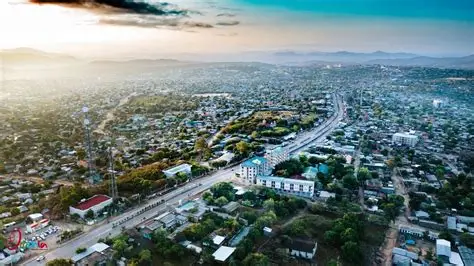
In the dry, unforgiving expanse of the Ethiopia-Kenya borderlands, water is not just a resource; it is the architecture of existence. For the Borana Oromo people, water is life, identity, and law. It is enshrined in the Tuula Saglan Booranaa—the Nine Sacred Water Wells—whose sanctity is still invoked in public blessings and whose historical significance was meticulously archived by British colonial anthropologists as “vital for the survival of the Borena tribes.”
Yet today, these ancient lifelines are at the center of a bitter, decades-long geopolitical struggle. Through the lens of a book written two years before the fall of the EPRDF regime by Obboo Alaka Simbiru, a former Governor of the Borena Zone, a troubling narrative emerges. It is a story of how the manipulation of borders, the politics of identity, and the heavy hand of the military eroded Borana autonomy and facilitated the capture of sacred resources by immigrant Somali groups.
A Border Drawn in Sand and Blood
The origins of the current crisis in Moyale can be traced back to the arbitrary drawing of colonial borders. As the book documents, the 1907 Anglo-Ethiopian treaties artificially divided the Borana people, splitting their traditional grazing lands and water sources between Ethiopia and Kenya. Moyale, located exactly 770 kilometers from Addis Ababa, became a divided town—a “twin city” straddling two nations.
For decades, this division was navigated through traditional governance. According to historical records and oral traditions cited in the text, the Borana managed their water sources through a deeply democratic system, rooted in the Gadaa system and governed by councils of elders. Under Emperor Haile Selassie and later the Derg regime, special administrative arrangements allowed the Borana to maintain relative control over their wells and grazing lands.
But the ascension of the TPLF-led EPRDF regime brought a seismic shift. The new government reorganized the country into ethnic federalism, redrawing internal boundaries and creating a volatile administrative reality on the ground.
The Anatomy of Dispossession
In 1991 and 1992, Moyale found itself at the center of a regional power struggle. The TPLF, consolidating its control over the south, established new administrative boundaries that placed the Borana and Somali communities in fierce competition for resources.
According to Simbiru’s account, the TPLF government did not merely redraw maps; it altered the demographic and political reality through force. The text highlights how the government systematically disarmed the local Borana population—leaving them defenseless—while allegedly arming and supporting immigrant Somali tribes, including groups crossing from neighboring countries.
The result was catastrophic for the Borana. As the book explicitly outlines, under the watch of TPLF military generals who controlled the region, two of the nine sacred Tuula Saglan Booranaa wells fell into the hands of these immigrant groups. This was not a natural migration, but a politically engineered displacement.
A Well is Cattle. A Well is Wife. A Well is Family.
To an outsider, the loss of two wells might seem like a minor logistical setback. But in Borana cosmology, the wells are sacred. They are the physical manifestation of a covenant between the people, their cattle, and Waaqa (God). “The well is cattle. The well is wife. The well is family,” the Borana say.
Access to these wells is governed by nagaa Boran—the peace and moral order of the Borana—which demands that no one is denied water. However, the political capture of the wells by rival groups, backed by military force, shattered this order.
The text details how the TPLF’s “divide and rule” tactics weaponized water and land. Borana politicians and elders who attempted to advocate for their people were systematically marginalized. The text notes that the Ethiopian government of the time pursued a deliberate strategy of “population settlement” and administrative gerrymandering to weaken the Borana demographic majority, thereby ensuring that the region’s resources were controlled by groups aligned with the central government.
The Echoes of LAPSSET and the Fight for the Future
Today, Moyale is no longer just a pastoral backwater; it is a strategic geopolitical node. The town is slated to be a major hub in the LAPSSET (Lamu Port-South Sudan-Ethiopia Transport) corridor. The promise of oil pipelines, highways, and international trade has made control of Moyale and its surrounding lands immensely valuable.
The historical grievances documented by Simbiru provide the necessary context for the intermittent violence that continues to plague the region. When communities feel that their sacred sites have been stolen and their traditional governance dismantled by state-backed forces, peace becomes elusive.
A River of Blessings, an essay collection published in honor of the late British anthropologist Dr. Paul Baxter, documented the resilience of Borana culture. But resilience has limits. Climate variability has forced pastoralists to dig deeper and modify use rules, abandoning less productive wells. Land use changes, settlement in dry-season grazing areas, and the expansion of cultivation have shrunk the grazing lands that sustain the well system. And now, the political capture of wells themselves—if Simbiru’s account is accurate—adds a dimension of dispossession that no amount of rainfall can remedy.
The Blessing That Endures
In the verses of Borana blessing ceremonies, the nine wells still live. They are recited in public gatherings, their names carried across generations like a covenant. The Tuula Saglan Booranaa are not merely infrastructure. They are kinship, cattle, family, and peace itself.
The Borana blessing verses still name the nine wells. They still recite their sanctity. But a blessing recited over water one no longer controls is a haunting thing. It is the sound of memory contending with loss.
For the Borana, the nine wells are not negotiable. They are the physical manifestation of a covenant between people, cattle, and the divine. To lose two is to lose a part of the whole. To recite the blessing while another holds the water is to live inside a contradiction that no peace agreement has yet resolved.
What Comes Next
Moyale’s future hinges on whether the deeper issues—who controls water, who belongs to the land, and whose history is written into the landscape—can be addressed before the next round of violence. The Gadaa system, with its customary laws for managing water and pasture, once worked efficiently across these borderlands. Elders from both sides have mediated conflicts before. But as one field monitor observed after the 2014 clashes, “I don’t think things will change in Moyale as long as the same community leaders who are warlords are also the peacemakers.”
The story of Moyale is a cautionary tale about what happens when state power ignores traditional sovereignty and tramples on sacred ecology. As the Borana elders continue to recite the blessings of the Nine Sacred Wells, two of those names are now spoken with a sense of mourning and dispossession. The water still flows, but for the Borana, the moral order of the land remains broken.
Until the grievances of the past—the arbitrary borders, the militarized disarmament, and the stolen wells—are addressed with historical honesty, Moyale will remain a powder keg on the edge of the Horn of Africa. The thirst of the Borana is not just for water; it is for justice.
The River of Blessings flows still—in verses, in memory, in the stubborn hope that what was sacred will be restored. But rivers can be diverted. And wells, once captured, are not easily returned.
Daandii Ragabaa is a journalist covering the Horn of Africa, with a focus on land, water, and conflict in borderland communities.

Feature News: Death of 13-Year-Old Oromo Girl in Moyale Exposes the Human Cost of a Frozen Border Conflict
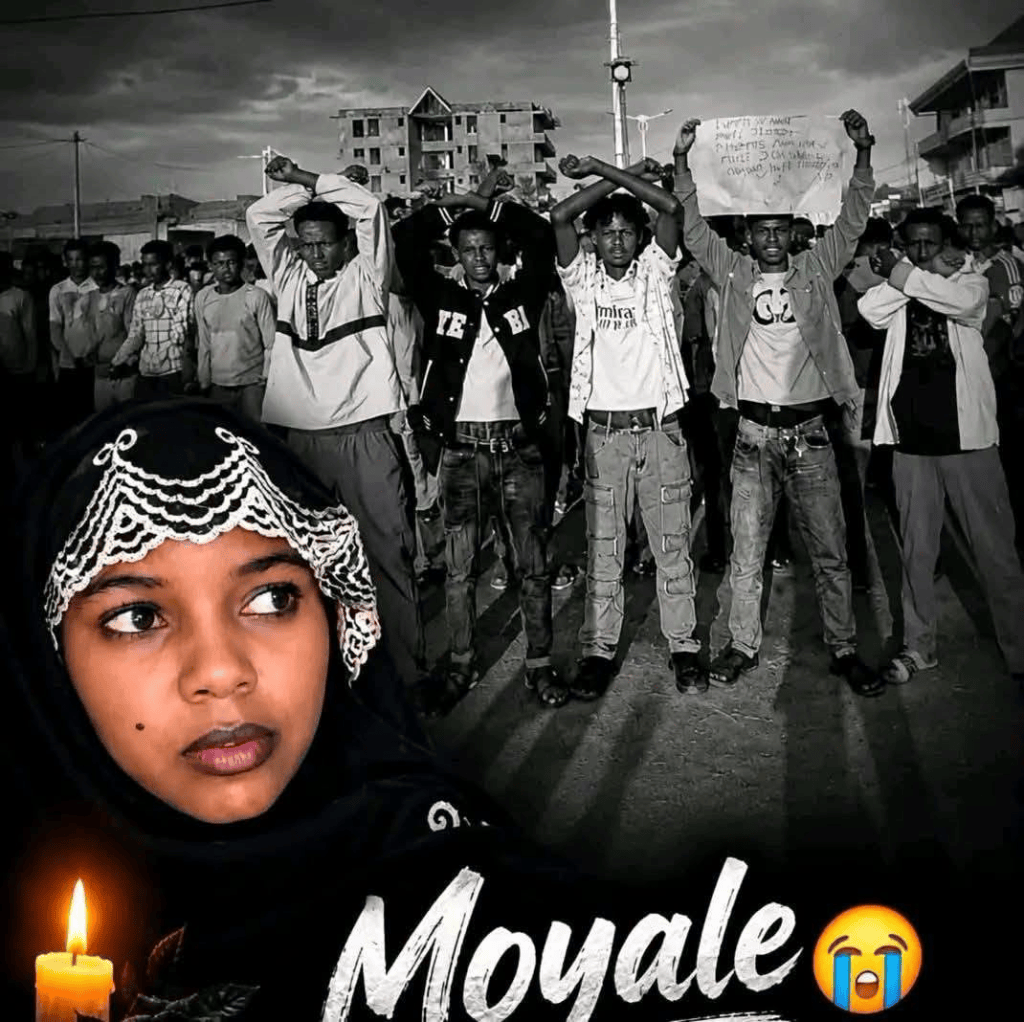
The killing of a teenage girl during a flag dispute in Moyale has reignited protests and grief in Borana, laying bare a decades-old territorial fracture between Oromia and Somali Region that neither federal intervention nor peace conferences have managed to heal.
By the time the gunfire stopped on 18 October, Diqqoo Jaataan Aagaa was dead. She was 13 years old.
According to residents who spoke to Addis Standard, the violence began when authorities from the Somali Region opened a new administration office in Moyale town, located in the Borana zone of Oromia regional state, and raised the Somali regional flag . Oromia local militia members and Somali Region police exchanged fire. The Ethiopian National Defense Force intervened to halt the shooting, but not before the girl was struck.
The accounts diverge sharply. Residents on the Oromo side accuse Somali Region police of shooting the child directly, with one resident describing the act as “cruelty and lawlessness” and claiming officers accused her of throwing stones . Residents from the Somali side insist she was caught in crossfire and that Somali forces did not target her. A security official who spoke to Addis Standard sided with the Oromo account, saying Somali Region security forces killed the girl in connection with the flag dispute .
Shuraa Waariyoo, the girl’s uncle, told Addis Standard that her body had not been buried as of Tuesday. He alleged that Somali Region forces had taken the body, and the family was still negotiating for its return .
The killing triggered immediate protests. Transport services were disrupted, businesses shuttered, and bus stations closed as security fears gripped the town . Elders and security officials reportedly agreed on Monday to remove the Somali Region flag, but that decision itself prompted counter-demonstrations from Somali residents, particularly in Kebele 02, deepening the standoff .
For the people of Moyale, the pattern is agonizingly familiar. Mallicha Diida, a resident of Kebele 02, told Addis Standard: “In Moyale, human blood has been spilled year after year” .
The roots of the recurrent violence lie in a border dispute that has never been fully resolved. Moyale sits at the frontier between the traditional territories of Somali and Oromo communities, both with vested interests in the area’s pastoral resources . A 2004 referendum was meant to settle the boundary between Oromia and Somali Region, but its implementation remains contested, and the underlying competition over land, pasture, and water continues to fuel clashes .
The scale of the suffering is staggering. Tensions intensified in July and August 2025 after the Somali Regional State approved an administrative restructuring plan creating new woredas and zonal administrations in contested territories. Subsequent clashes along the Oromia-Somali border displaced more than 288,000 people .
The death of a 13-year-old girl in a dispute over a flag is, in one sense, a singular tragedy. In another, it is the inevitable arithmetic of a conflict that has been allowed to fester for generations—where the symbols of administrative control carry life-and-death weight, and where the bodies of children become the price of unresolved boundaries.
The funeral arrangements for Diqqoo Jaataan Aagaa remain incomplete. Her family is still waiting for her body. In Moyale, the flags still fly, the militias still watch, and the question of whose land this is remains as unanswered as ever.

53 Years of Oromo Freedom Struggle, 53 Years of Impact
Half a century after a small band of nationalists took up the Oromo cause, the movement has transformed the political landscape of Ethiopia—even without achieving the independent state it once sought. Its deepest impact lies not in territorial control, but in the irreversible awakening of a people who can no longer be governed as before.
The Oromo Liberation Front was founded in 1973, emerging from the ferment of Oromo student activism and the memory of the banned Mecha-Tulama Self-Help Association . What began as a clandestine project among intellectuals would, over five decades, become the central axis of Ethiopian political contestation—not because it won, but because the questions it raised about identity, land, and power could never again be buried.
The early years were defined by armed insurgency and brutal repression. The OLF established itself as a guerrilla force operating across Wollega, Bale, and Hararghe, drawing recruits from peasants who had watched the imperial and then Derg regimes dispossess and marginalize them . The Derg’s response was predictable and catastrophic: mass arrests, executions, and a campaign of terror that killed thousands accused of harboring OLF sympathies. Yet repression produced what it so often does—martyrdom, recruitment, and an enduring sense of grievance that outlasted the gun.
The movement’s most significant impact, however, came not on the battlefield but in the realm of consciousness. The OLF’s founding vision articulated something that had been suppressed for generations: that the Oromo were a nation, not merely a labor force or a demographic majority to be managed. This idea, once planted, proved impossible to uproot. Even after the OLF was pushed out of the transitional government in 1992 and reduced to a marginal political actor, the seeds of Oromo nationalism continued to grow underground .
The eruption came in 2014, when the Qeerroo—Oromo youth—took to the streets over the Addis Ababa master plan, a policy they saw as another chapter in a long history of land dispossession. The protests spread, intensified, and by 2018 had forced the ruling coalition to install Abiy Ahmed, an Oromo, as prime minister . It was a remarkable inversion: a ruling party that had once sought to contain Oromo nationalism now depended on Oromo street power to survive.
The human cost of this struggle has never been abstract. In 2020, the assassination of Hachalu Hundessa, a musician whose lyrics had given voice to a generation’s anger and longing, triggered days of unrest that left at least 166 people dead, according to police figures . Hachalu’s music had become an instrument of the movement itself—his songs were sung at protests, his death a rallying cry. The violence that followed exposed how fragile the gains remained and how deeply the wounds of marginalization had festered.
Fifty-three years on, the struggle’s landscape is fractured. The OLF split in 2018, with its political wing entering legal politics and its armed wing—the Oromo Liberation Army—continuing an insurgency that the government has designated as terrorism . Peace talks between the government and the OLA have repeatedly collapsed, with Addis Ababa accusing the rebels of “unrealistic demands” and the OLA charging the government with seeking co-optation rather than addressing root causes . Meanwhile, the regional government in Oromia pursues a dual track: encouraging surrender through elders and Abba Gadas while waging military operations against those who refuse .
Yet the struggle’s most enduring legacy may lie elsewhere—in the cultural and intellectual infrastructure that no military campaign can dismantle. The Gada system, the indigenous Oromo governance structure that regulates political, social, and religious life through rotating eight-year cycles, was inscribed on UNESCO’s Representative List of the Intangible Cultural Heritage of Humanity in 2016 . What was once dismissed or ignored by the Ethiopian state is now recognized globally as a sophisticated democratic tradition. Oromummaa—the articulation of Oromo peoplehood and identity—has become a force in Ethiopian politics that no government can afford to ignore .
What, then, does 53 years of impact look like? It looks like a language once suppressed now spoken in parliament. It looks like a youth movement that toppled a prime minister and then grew disillusioned with his successor. It looks like a struggle that began as a separatist insurgency and became, instead, a permanent renegotiation of what Ethiopia means. The OLF’s founding dream of an independent Oromia has not been realized. But the conditions that made that dream thinkable—a people conscious of their history, their numbers, and their rights—have become irreversible.
The next chapter remains contested. The government insists the answer is peace and reintegration. The OLF’s political wing insists it is negotiation. The OLA insists it is continued resistance. The Qeerroo, who inherited a struggle they did not start, wait to see which vision will prevail. What is certain is that 53 years after a handful of nationalists took up the Oromo cause, the question they raised is no longer a question at all. It is a fact of Ethiopian life, and it will not be resolved by ignoring it.

Irreechaa Celebrated in Peace and Unity, Advocacy for Oromia Says, Pledging to Nurture the Festival’s Message of Reconciliation
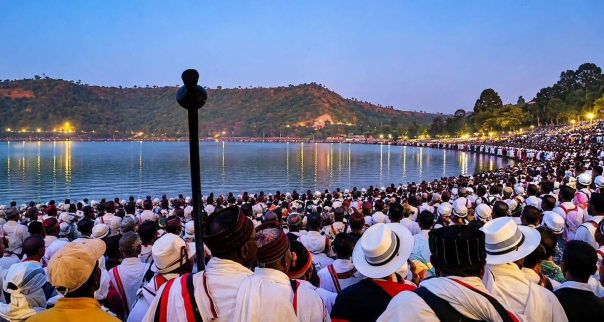
Advocacy group praises security forces, community members, and government structures for ensuring a peaceful celebration of the Oromo thanksgiving festival amid a national climate of conflict and hatred
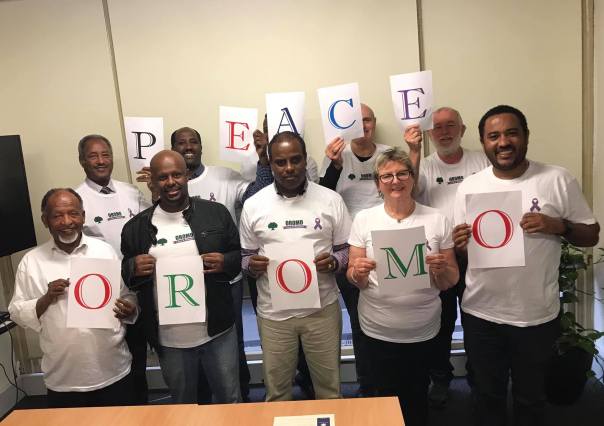
(October 4, 2026)-Advocacy for Oromia has expressed deep satisfaction with the peaceful and beautiful celebration of Irreechaa, the revered Oromo thanksgiving festival, praising all parties who contributed to its success and vowing to continue nurturing the ancient tradition as a source of peace, reconciliation, and prosperity.
In a statement released on October 4, 2026, the advocacy group said it was “greatly delighted that the Irreechaa festival has been celebrated in a beautiful and peaceful manner,” and extended its gratitude to all those who played a role in ensuring the festival unfolded peacefully.
Irreechaa, one of the most significant cultural and spiritual festivals of the Oromo people, is widely recognized as a celebration of thanksgiving, reconciliation, love, peace, and unity. The statement noted that millions of people gathered in unity in Finfinnee (Addis Ababa), Bishoftu, and across the world, reaffirming the festival’s enduring power to bring communities together.
Gratitude Amid a Challenging National Climate
The statement placed particular emphasis on the significance of the peaceful celebration given the current situation in the country. “Above all, at a time when the situation in our country is filled with conflict and hatred, we wish to express our heartfelt gratitude to the security organs and police who participated, and to our community who provided support and assistance, in ensuring that the Irreechaa festival, which began in peace, was also concluded in peace in Oromia,” the group stated.
Advocacy for Oromia also extended its appreciation to government structures, community organizations, and individual community members who played a major role in facilitating the celebration.
A Festival That Has Endured Through Hardship
The statement highlighted the resilience of Irreechaa, noting that the festival has continued over the years “despite oppression and pressure from systems.” The group expressed hope that Irreechaa will continue to proclaim and sustain reconciliation, peace, love, and unity into the future.
“Advocacy for Oromia wishes to declare that it will work in every possible way to nurture and expand this Irreechaa festival, which is a source of peace and reconciliation, and a means of well-being and prosperity,” the statement read.
The group concluded with a prayer for the nation: “May reconciliation, restitution, and peace be upon our country and our people!”
A Continuing Commitment
The statement underscores Advocacy for Oromia’s ongoing commitment to promoting the cultural heritage of the Oromo people and advocating for peace and reconciliation in the region. As Irreechaa continues to draw millions of celebrants each year, the group’s pledge to protect and expand the festival reflects its broader mission of fostering unity and well-being among Oromo communities at home and abroad.
— Advocacy for Oromia, October 4, 2026

The Sacred Rite of Irreechaa: Fresh Grass, Yellow Flowers and the Waters of Blessing
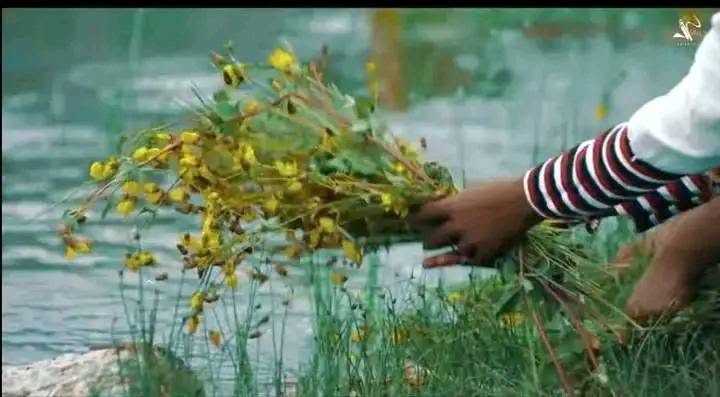
How Oromos carry keelloo and fresh grass to the riverbanks, dip them into the water, and renew their covenant with Waaqa
By Staff Writer
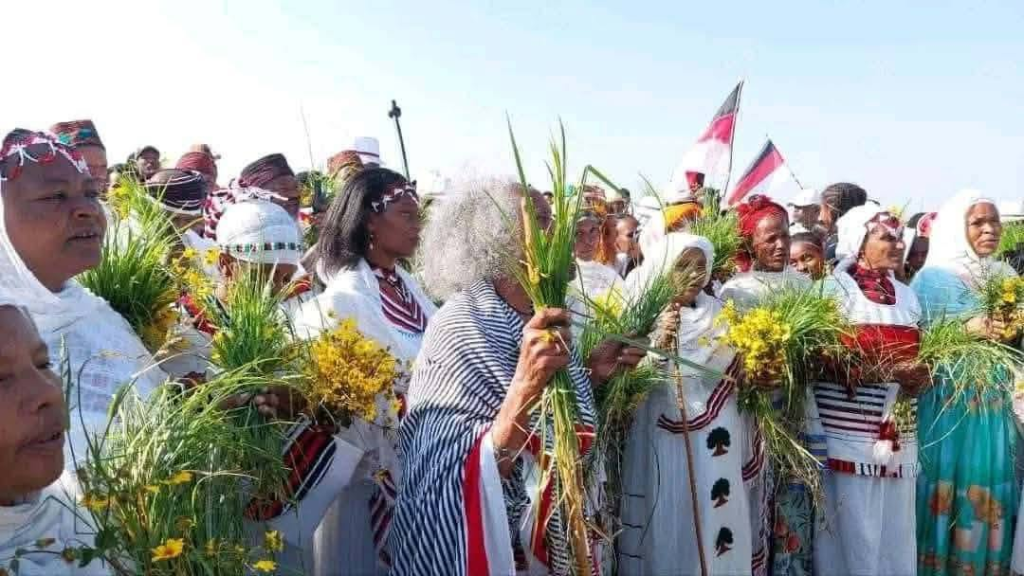
At the heart of the Irreechaa festival lies a ritual of profound simplicity and immense spiritual depth. Long before the songs reach their peak and the crowds swell along the riverbanks, Oromo elders, mothers and youth begin their journey toward the water. In their hands they carry daraaraa keelloo — yellow flowers — and marga jiidhaa — fresh, green grass.
These are not decorative items. They are sacred emblems of life, fertility, peace and gratitude. And when they are dipped into the flowing water as part of the irreeffannaa rite, they become instruments of blessing for the entire community.
Daraaraa Keelloo: The Yellow Flower of Blessing
The keelloo — a bright yellow flower that blooms in the Oromo landscape, particularly in the season surrounding Irreechaa — holds a special place in Oromo spiritual and cultural life. Its yellow color symbolizes light, hope, warmth and the radiance of the sun after the long, dark rainy season. It is the color of ayyaana — blessing and divine favor.
During Irreechaa, the keelloo is gathered with care. Young men and women often collect the flowers in the early morning, singing traditional songs as they go. The flowers are then carried to the riverside, where they will be used in the central act of the celebration. The keelloo is also used in other Oromo rituals and is associated with joy, celebration and the beauty of creation.
For Oromos, the keelloo is more than a flower. It is a visible sign of Waaqa’s goodness — a reminder that after hardship comes renewal, and that the earth itself rejoices with the people.
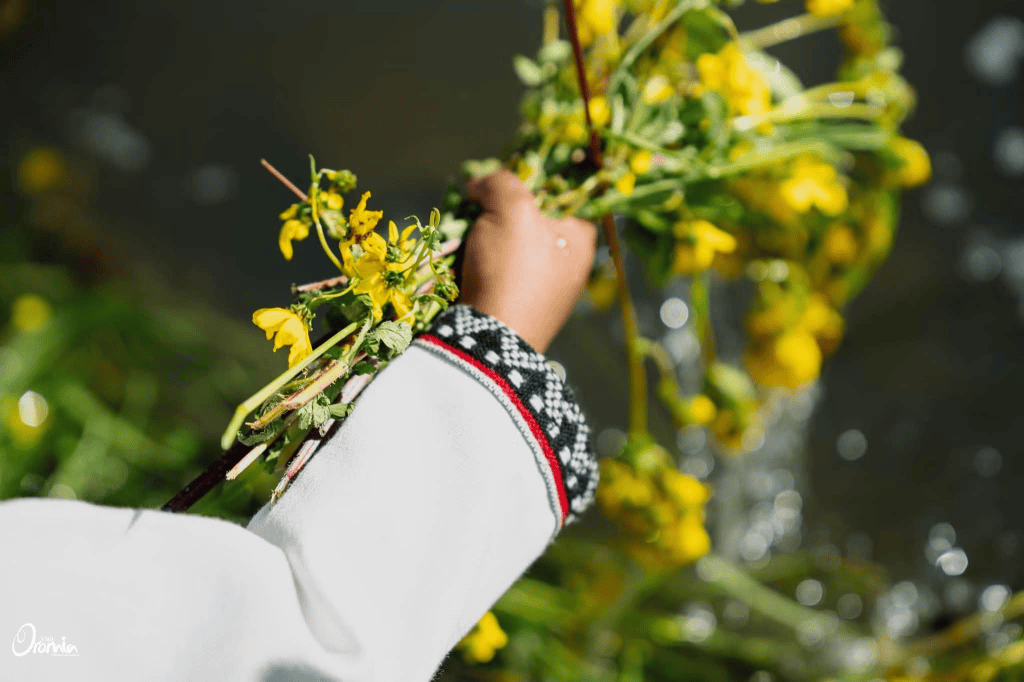
Marga Jiidhaa: Fresh Grass as the Symbol of Life
Marga jiidhaa — fresh, moist grass — is equally central to the Irreechaa ritual. In Oromo culture, green grass is the universal symbol of peace, life, fertility and well-being. It is used in ceremonies of reconciliation, in blessings, and in prayers for abundance. When elders wish to bless someone, they may sprinkle fresh grass or hold it as they speak words of peace.
At Irreechaa, the grass is gathered in bundles. It is often mixed with the keelloo flowers, creating a combined emblem of life and blessing. The grass must be fresh and green — a sign that the land has received rain and that the season of abundance has arrived.
The Journey to the Malkaa: Walking Together to the Water
When the time comes, the community moves toward the malkaa — the riverbank, lakeshore or sacred water body. This journey is itself a ritual. People walk together, often dressed in their finest traditional attire, singing songs of praise and gratitude. The movement toward the water is a movement toward purification, renewal and encounter with Waaqa.
The choice of water is significant. In Oromo cosmology, water is the source of life, a symbol of purity and a channel of blessing. Rivers and lakes are understood as sacred spaces where the spiritual and physical worlds meet. To stand by the water during Irreechaa is to stand at the threshold of the divine.
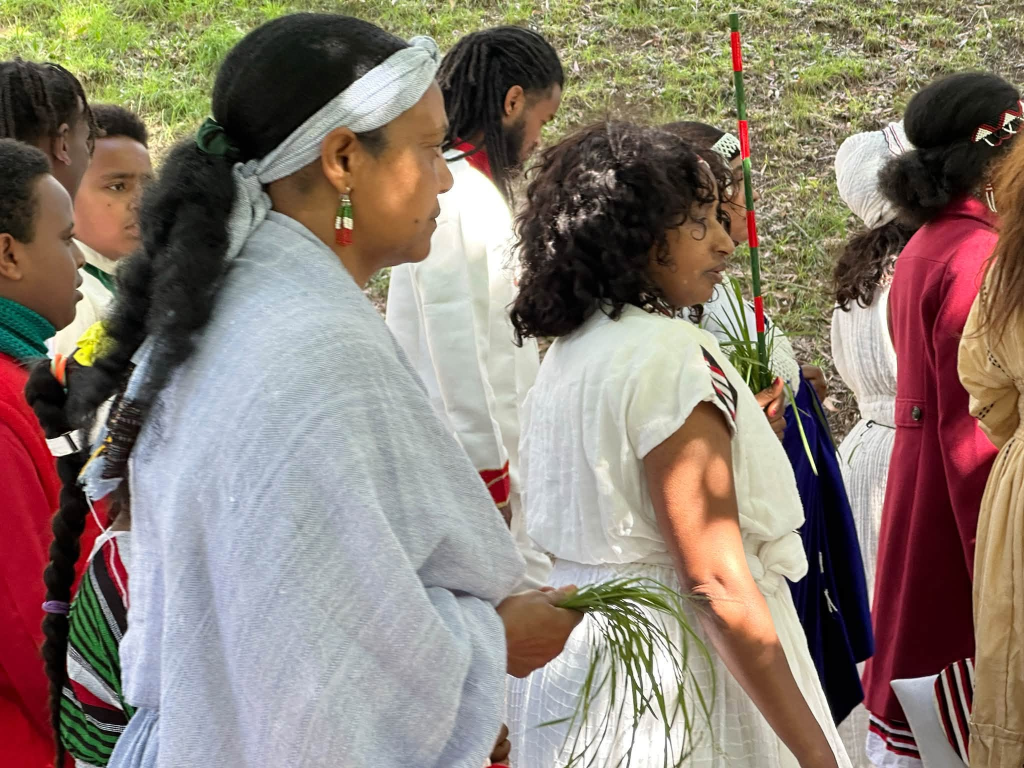
Cuuphaa: Dipping the Grass and Flowers into the Water
At the water’s edge, the central rite unfolds. The participants — often led by the Haadha Siinqee, Qaalluu figures, elders and the Abbaa Gadaa — approach the water with the keelloo and fresh grass in hand.
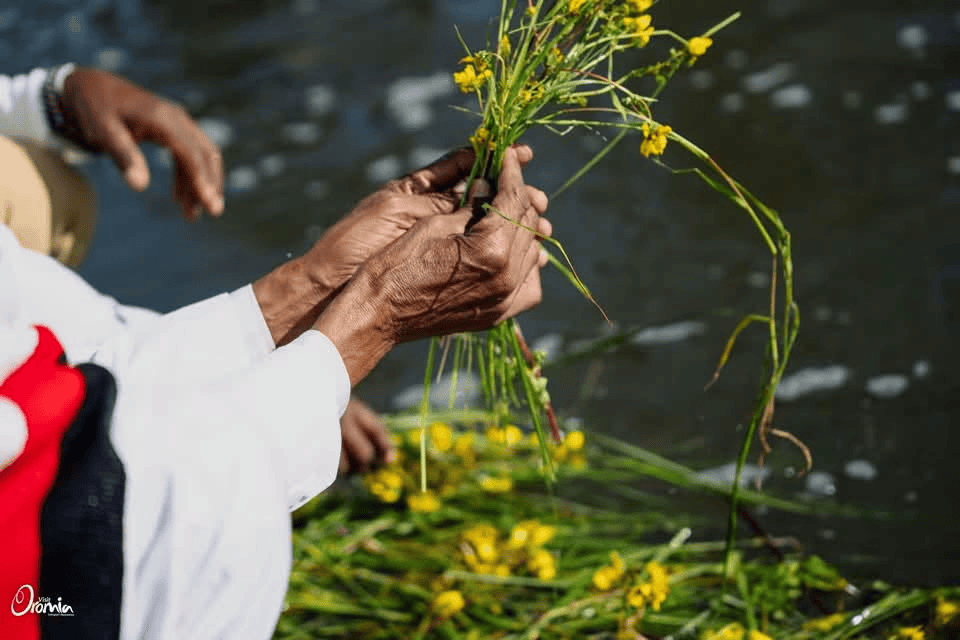
They then dip the grass and flowers into the water (cuuphaa). This act of immersion is rich with meaning:
- Thanksgiving: It is an offering of gratitude to Waaqa for the gift of rain, fertility and life. The water is the visible blessing, and the grass and flowers are the visible response of the people.
- Purification: The dipping represents a cleansing of the community — a washing away of the impurities, grievances and misfortunes of the past year.
- Renewal of Covenant: It symbolizes the renewal of the covenant between Waaqa, the people and the earth. The relationship is restored and made fresh for the coming season.
- Blessing and Sprinkling: After dipping, the participants often sprinkle the water from the grass and flowers upon themselves, upon others, and upon the ground. This sprinkling is a gesture of blessing, conveying peace and fertility to all present.
Some accounts describe the water being sprinkled on the participants’ heads and faces, a ritual act that marks them with divine favor. Others describe the grass being passed through the water and then carried back to the community as a sign of peace.
The Irreeffannaa Prayer: Words Said Over the Water
The dipping is accompanied by prayer and invocation. The irreeffannaa — the act of giving thanks and blessing — is spoken aloud by elders and ritual leaders. Words of gratitude are offered for the rains, for the harvest, for the health of families and livestock, for the peace of the land. Prayers are also lifted for the year ahead: for continued fertility, for protection from disaster, and for harmony among all peoples.
The community responds with “Irreechaa!” — a joyful affirmation and invocation of blessing. The sound of the word itself carries the meaning of “thank you” and “may it be blessed.”
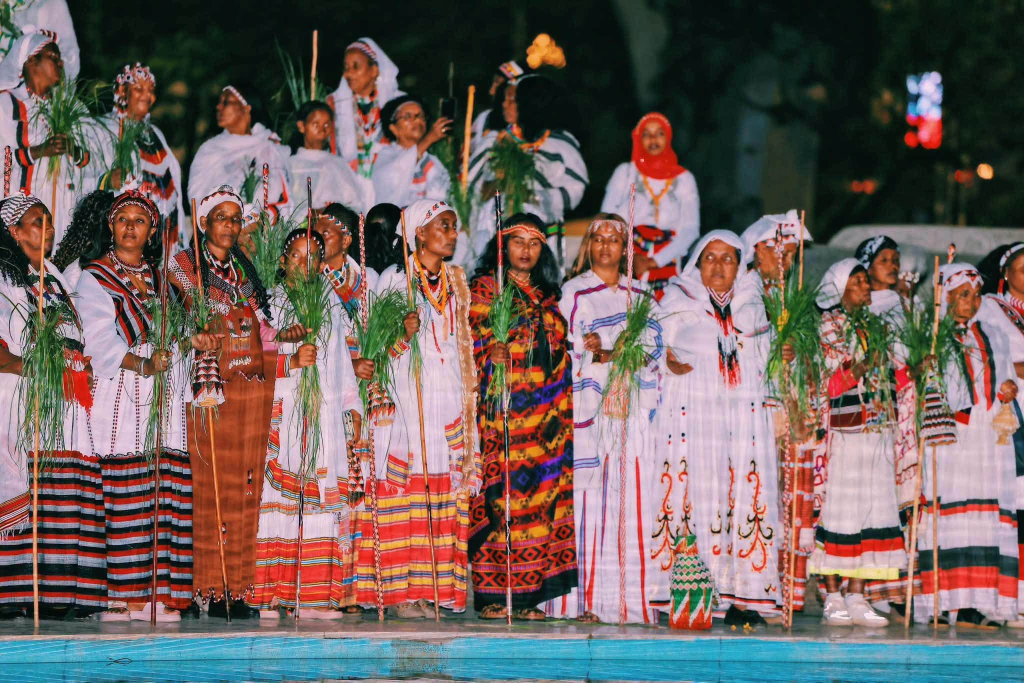
A Ritual That Connects All Creation
The Irreechaa water rite is a profound expression of Oromo cosmology — the understanding that human beings, the earth, the waters, the plants and the divine are all interconnected. By carrying the flowers and grass to the water, dipping them in, and offering them up, the Oromo people enact their belief that gratitude, peace and life itself flow from the sacred relationship between Waaqa and creation.
The daraaraa keelloo and the marga jiidhaa are therefore not merely objects. They are prayers made visible. The water is not merely water; it is the medium of blessing. And the act of dipping is not merely a gesture; it is a covenant renewed — a promise of peace, a plea for abundance, and a song of thanks to the source of all life.
At the riverbank, with flowers in hand and water flowing, the Oromo people stand as they have stood for generations: grateful, humble and connected to the sacred rhythm of the earth. And when they raise their voices and dip the green grass into the water, they declare to the world that life is a gift — and that gratitude is the way to honor it.